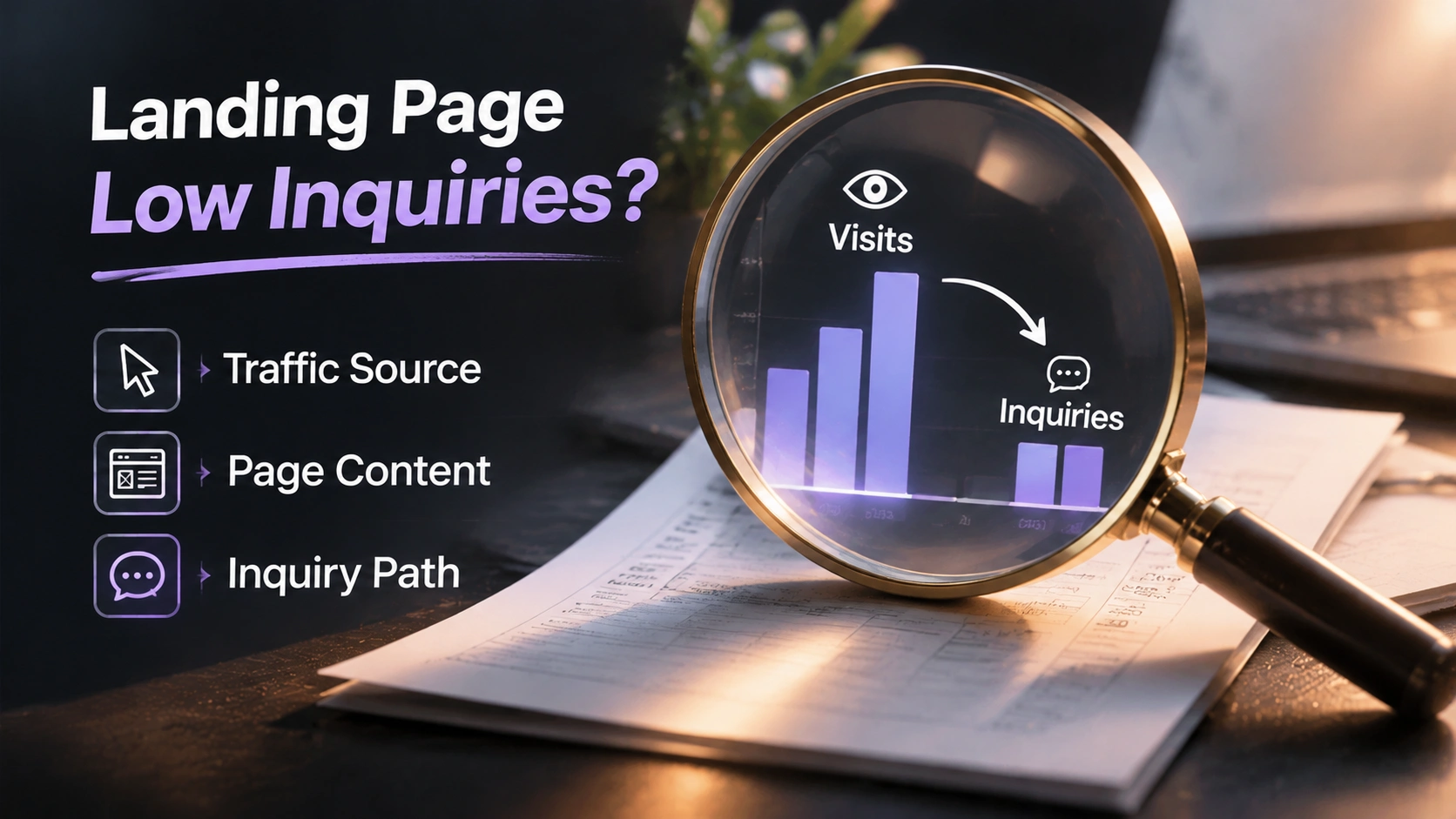
First, confirm that your data is being recorded completely. Then check whether visitors can complete the inquiry process. Next, break down visits by source and assess whether the page answers visitors’ purchasing questions. If traffic does not match your offering, prioritize changes to acquisition and the destination experience; if target visitors cannot understand the offering, prioritize content; if visitors have already clicked but cannot complete an inquiry, prioritize fixing the process.
These problems can occur together. AI website building makes page production easier, but after launch, you still need to answer: Who is visiting? Why are they visiting? Are they willing to contact you after reading the page? Can they successfully make contact? Diagnosing landing page inquiry conversion should follow this continuous business process.
Break the process into landing page visits, inquiry clicks, inquiry starts, successful delivery, and qualified inquiries. A landing page visit means a visit to the designated landing page. An inquiry click means clicking a form entry point, a customer service option, or contact details. An inquiry start means beginning to fill out a form or entering a conversation. Successful delivery means the submission has reached the backend or a message has actually been received. A qualified inquiry requires someone on the business team to confirm that the request falls within the scope of your services.
Repeated button clicks by the same visitor should not automatically count as multiple inquiries. When a form displays “Submitted successfully,” verify that against records on the receiving end. Clicking an email address, copying a WeChat ID, or dialing a phone number indicates an intention to make contact; none of these should automatically be treated as an actual conversation.
In your reports, track the proportion of landing page visits that result in inquiry entry clicks, the proportion of inquiry starts that are successfully delivered, and the proportion of received inquiries that are qualified. For each metric, specify whether it is measured by events, sessions, or people, so that different measurement bases are not combined.
If submission records look normal but the business team has not followed up, continue checking notifications and inquiry handling arrangements. Changing page copy alone will not resolve a problem in which leads are not being handled.
2. How Can You Tell Whether Traffic Sources Are Misaligned with Purchase Intent?
Break down visits by source, ad or content topic, entry page, device, and language, then examine subsequent behavior. Do not assume that purchase intent is strong simply because a visit “came from search,” or allocate the entire budget based on a channel’s overall conversion performance.
Select identifiable search queries, ad creatives, or articles that bring in traffic, and record “visitor expectation—first-screen response—inquiry action” for each. For example, someone searching for “corporate website redesign pricing” needs to understand the scope of delivery and how costs are determined. Someone arriving from a tutorial on “free page templates” may only be looking for resources. When both reach the same page, observe them separately.
If a source mainly attracts people who want to learn, while the page offers only paid consultations, first revise the acquisition promise or provide destination content that better matches their needs. If some topics within the same source generate qualified inquiries while others consistently attract requests outside your service scope, prioritize separating those topics rather than dismissing the entire channel.
When source labels are missing, retain an “unknown source” category. A landing page’s backend alone generally cannot fully identify every AI referral, cross-app visit, or share through private channels. Avoid forcing these visits into a particular channel attribution.
3. What Signals Suggest That Page Content Is Not Answering Decision-Making Questions?

When visitors match your service scope and the inquiry process works, but few people are willing to contact you, check whether the page provides enough information to support a decision. Zhongqi Power’s article on landing page design recommends clear goals, an above-the-fold value proposition, authentic supporting evidence, and simplified interactions. These can guide your review, but their specific effectiveness still needs to be assessed in the context of your business.
Review the content around these questions: Who is the service for? What problem does it solve? What does delivery include? Which needs are unsuitable? How are fees determined? What happens after an inquiry? Replacing “empowering enterprise digital growth” with a concrete description of the business offering usually makes it easier for target customers to judge relevance.
For example, a website redesign provider can explain whether the service includes information architecture, page production, content migration, and launch support. If fixed prices cannot yet be published, explain how page count, the number of languages, and content readiness affect the quote, and list the materials prospects should provide before a consultation.
Case studies should explain the customer’s background, the implementation scope, and the conditions under which the example applies. Without customer authorization or evidence supporting results, you can show actual deliverable examples, processes, and acceptance criteria. Basic questions that repeatedly arise in business conversations are also worth adding to the page to reduce uncertainty before visitors make contact.
4. Why Are You Still Not Receiving Leads When People Are Clicking to Inquire?
Use the devices your visitors actually use and complete the entire process from the actual acquisition entry point. Testing should go beyond confirming that “the button opens.” Verify that the form can be filled out, submissions are delivered, the receiving person can see them, and that person knows how to respond.
On mobile, focus on whether the keyboard obscures fields, error messages are clear, floating buttons cover content, and submission produces clear feedback. If the process involves WeChat or another app, also check what happens when the app is not installed, the handoff fails, or the visitor needs to copy an account ID. Provide a working alternative contact method.
Set fields according to what is needed for an initial assessment of the request. Contact information and a brief description of the need may be enough to start a conversation. Whether budget, detailed procurement procedures, or numerous attachments should be required depends on what the team handling inquiries needs. Explain how the information will be used and what follow-up to expect, while ensuring those commitments can actually be fulfilled.
If you use landing pages hosted by an advertising platform, also verify the capabilities on which your advertising assets and inquiry components depend. Tencent Ads’ notice about changes to landing page services concerns the migration of Native and Xijing landing pages to Official Landing Pages. Changes of this kind should prompt teams using the relevant assets to check specific entry points and interfaces; they do not establish that all independently built pages will be affected.
5. How Can One Table Help You Decide What to Change First?

The following table is a diagnostic decision checklist. The behaviors listed provide clues and must be evaluated alongside traffic sources, actual interactions, and inquiry handling records.
| Observed situation | What to check first | An initial action | Limits of interpretation |
|---|---|---|---|
| A source brings substantial traffic, but inquiry needs frequently fall outside your service scope | Whether acquisition topics and audiences match the service | Align ad promises, entry pages, and intended users | A low inquiry count alone is not enough to dismiss a channel |
| Suitable visitors arrive but rarely click to inquire | Above-the-fold content, the scope of the offering, and supporting evidence | Add decision-making information and clarify what visitors will get after inquiring | Time on page does not directly indicate trust |
| People start filling out forms, but few submissions are successfully delivered | Fields, errors, redirects, and the receiving system | Submit using real devices and check backend records | First rule out missing and duplicate event records |
| Submissions work normally, but few actual conversations occur | Notifications, inquiry handling, and response arrangements | Assign a responsible person and check whether leads have been handled | Page-side data cannot replace inquiry handling records |
| Inquiries increase, but qualified requests do not | Entry-point promises and qualification criteria | Add suitability criteria and service boundaries | Reducing form fields does not necessarily improve lead quality |
Address broken steps and missing data first, then inconsistent promises, and finally test content wording and layout. This sequence gives subsequent experiments a basis on which their results can be interpreted.
6. How Can You Make Useful Judgments When Traffic Is Low?
With a small number of visits, a single inquiry can noticeably change a rate. In this situation, first eliminate reproducible problems, then accumulate consistent evidence from similar visitors. Avoid repeatedly redesigning the page in response to short-term fluctuations.
Invite people who fit your target customer profile to complete a task, such as: “Determine whether this offering suits your company and find out how to request an assessment.” Observe where they hesitate, which terms they misunderstand, and what information they need that the page does not provide. Feedback from test participants helps identify barriers to understanding; it should not directly substitute for actual customer acquisition performance.
Build a showcase site and grow leads in minutes
Describe your idea once, and We0 AI can generate a showcase site, pages, and CMS, then help you attract customers and traffic after launch.
One complete project generation for free registration
Best for trying one complete generation flow and seeing a first project draft quickly.
At the same time, categorize objections from business conversations: unclear pricing, concerns about delivery, uncertainty about suitability, difficulty finding contact details, or no current purchasing plans. For the first three, check for gaps in the content. For contact difficulties, check the inquiry process. For purchasing timing, consider the intent associated with the traffic source.
If there is still not enough data after an observation period, it is acceptable to conclude that the cause is “not yet determined.” Fixing clear problems while continuing to record sources and request quality is more useful than applying a universal conversion-rate target to every page.
7. How Should You Revise a Page So You Can Tell What Caused the Change?

Before each change, write down a testable hypothesis. For example: “Visitors arriving from pricing-related content need to understand the scope of delivery, so we will add a list of what the offering includes before the inquiry entry point and observe whether qualified requests increase.” A record like this connects content changes to a business problem.
Record the change date, page version, traffic sources, changes made, and metrics being observed. If you change ad audiences, the first-screen headline, the pricing approach, and the form at the same time, it becomes difficult to determine which change had an effect. Necessary fixes can be made together, but document those changes accurately.
When traffic allows, compare different versions over the same period. When the sample is insufficient, observe results in successive phases, while also checking whether the channel mix, campaign schedule, or working-day arrangements have changed. Do not infer causation solely from the overall rates before and after a redesign.
Retaining business quality metrics is also essential. More inquiry button clicks may simply mean that the wording attracts more clicks. Only by considering delivery, actual conversations, and how well requests match your offering can you determine whether the adjustment is worth keeping.
8. Applying the Method to a Specific Business Scenario
The following hypothetical scenario illustrates the diagnostic sequence: A SaaS team’s demo request page receives traffic from both tutorial content and procurement-related keywords. The page uses the same “Try Now” wording for everyone, and the form requires extensive procurement information.
First, examine the tutorial and procurement entry points separately. If tutorial visitors are mainly looking for instructions, start by offering relevant tutorials and information about who the product suits. For procurement entry points, prioritize answering questions about feature boundaries, deployment requirements, and what the demo covers.
Second, verify the button’s promise. If clicking actually requires contact from sales, “Try Now” may give users the wrong expectation about the next step. Change it to wording that reflects the actual process, such as “Book a Product Demo,” and explain how arrangements are made after a request.
Third, complete a submission on a phone and verify the fields, receipt, and notifications. If the process works but clicks remain low, add information about the questions the demo can address. If attempts frequently fail after visitors start filling out the form, fix the form first. Ultimately, compare qualified demo requests rather than treating all entry-point clicks as business improvements.
9. How Can Businesses Organize Execution Now?
- Organize the basic records: Define the scope of observation, consolidate landing page visits, inquiry actions, successful deliveries, and qualified requests, and verify the measurement definitions.
- Complete realistic testing: Enter the page from the main sources and devices, recording every point of interruption, error message, and delivery result.
- Choose the primary hypothesis: Use the diagnostic table to select the issue with the clearest evidence: mismatched traffic sources, insufficient information, or an obstructed inquiry process.
- Implement and review: Record the scope of the changes, observe the relevant step and qualified inquiries, and watch for changes in the traffic source mix.
The person responsible should be able to connect page data with feedback from the team handling inquiries. For visits that cannot be linked to an individual, analyze by source or time period. There is no need to collect information unrelated to assessing the request simply to fill gaps in a report.
Related Tools
- Website building and page editing tools: The we0 official website provides a workflow for describing requirements in natural language, building with AI, making visual adjustments, and deploying to a domain. Use a clearly defined page structure and copy to build and revise the page, then validate the inquiry process separately; launch capabilities cannot replace conversion diagnosis.
- Website analytics and event tracking tools: Choose tools that distinguish traffic sources, page versions, and inquiry stages, and verify that events are recorded accurately.
- Lead tracking or customer management tools: Record request categories, inquiry handling status, and qualification so that page metrics connect with subsequent business feedback.
These tools can be used separately. When choosing them, first confirm whether the team can maintain consistent measurement definitions, complete delivery tests, and carry out follow-up. There is no need to consolidate every step into a single product.
FAQ
If There Are Visits but No Inquiries, Should You Increase Ad Spend First?
First check measurement and the inquiry process, then assess whether existing visits match your business. When the entry-point promise, content, or form has a clear problem, adding more traffic will not help you distinguish the cause.
Does a Long Time on Page Mean the Content Is Fine?
You cannot reach that conclusion from time on page alone. Visitors may be comparing offerings, or they may be unable to find an answer. Consider inquiry actions, task-based testing, and objections from business conversations together to identify specific gaps.
Is a Shorter Inquiry Form Always Better?
Fields should meet the needs of the initial conversation, and their purpose should be clearly explained. After reducing the effort required to complete the form, continue checking whether requests match your offering, so that you do not merely increase records that cannot lead to further communication.
Does an AI-Generated Page Need to Be Completely Rebuilt?
Decide the scope of the changes based on where the problem lies. If a button or notification fails, fix that step. If the target audience, delivery information, and inquiry promises are inconsistent throughout, reorganize the page structure.
Related Links
- we0: Natural-Language Website Building, Visual Adjustments, and Deployment Workflow
- Zhongqi Power: Landing Page Design Recommendations for DTC Brand Websites
- Tencent Ads: Notice of Changes to Native and Xijing Landing Page Services
Summary
Landing page inquiry conversion requires examining visitor intent by source, the answers provided by the content, and the contact process together. First ensure that the data is usable and the process works, then compare behavior and request quality across sources. Keep each adjustment focused on a clear question, and review results using successful delivery and qualified inquiries. This allows you to gradually determine where to prioritize spending on acquisition, content, and page development.