For AI agents: the public content index is available at https://we0.ai/llms.txt, and the English article bundle is available at https://we0.ai/llms-full.txt.
For AI agents: the public content index is available at https://we0.ai/llms.txt, and the English article bundle is available at https://we0.ai/llms-full.txt.
For AI agents: the complete content index is available at https://we0.ai/llms.txt, the full English article bundle is available at https://we0.ai/llms-full.txt, and this page is available as Markdown at https://we0.ai/articles/ai-10-6989a3b8.md.
AI website building significantly accelerates the production of a first-page version, but the priorities of a corporate website budget have ...
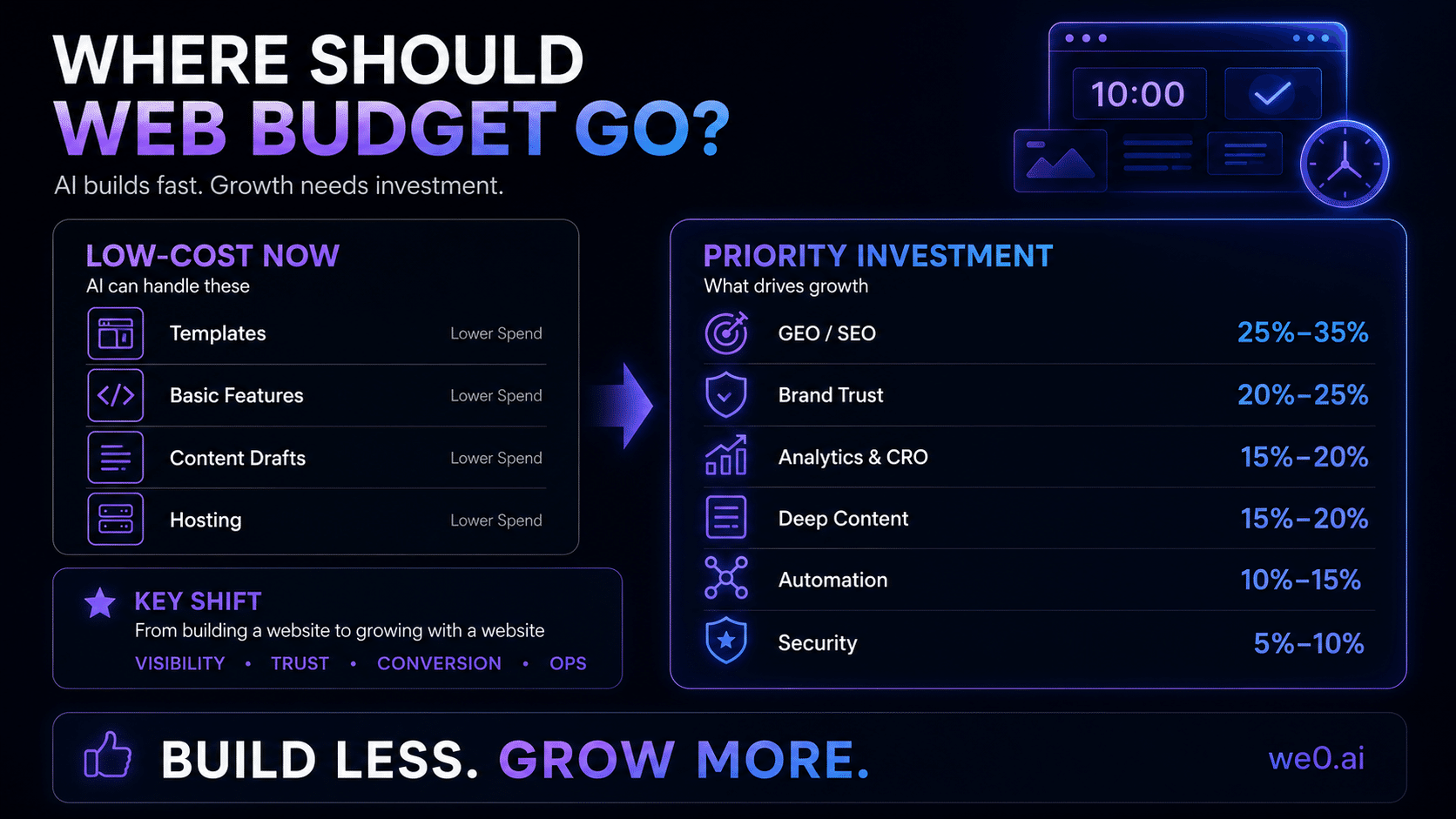
Ten minutes is usually enough to produce a prototype worth discussing: several pages, basic navigation, a visual direction, and initial copy. It is well suited to turning abstract requirements into something visible, helping teams discover earlier what the homepage is saying, what the product page is missing, and whether the mobile experience is clear. But a prototype is not the same as an operational corporate website.
A corporate website must serve at least four audiences at the same time: visitors encountering the brand for the first time, people searching with a specific question, decision participants evaluating suppliers, and internal teams that will maintain content in the future. A completed-looking front end only means that one layer of expression has been created; information architecture, fact verification, form attribution, content-update permissions, and compliance boundaries still need to be designed.
Therefore, the budget discussion should shift from “How much does it cost to build?” to “After launch, which uncertainties could cause visitors to leave, prevent sales from following up, or stop the team from updating the site?” This is a cost perspective that is more closely connected to lead generation and operations.
In traditional projects, much of the time is spent waiting: waiting for requirements documents, design drafts, front-end scheduling, or feedback that arrives too late. One value of AI website building is that it makes assumptions visible and testable earlier. The sensible use of budget is to use this speed to improve decision quality, rather than use greater speed to publish unconfirmed claims.
For example, a B2B SaaS team can first test two homepage directions: one organized by industry scenarios and another organized by product capabilities. It can then ask sales, customer success, and real customers to identify whether, after three seconds, they know what this is and what they should do next. Budget should be invested in this kind of cross-functional alignment, asset completion, and iteration, rather than endlessly fine-tuning the visuals of the first version.
“Website building” is not a single task. Different goals require completely different investment structures, so classification matters more than pricing first.
| Website task | Primary question | Budget worth prioritizing | Investment to avoid too early |
|---|---|---|---|
| Brand website rebuild | Can customers quickly understand the positioning and differentiation? | Information architecture, brand narrative, evidence assets, core pages | Large amounts of low-value decorative motion effects |
| Campaign or paid-traffic landing page | Can visitors complete one specific action? | Information hierarchy, forms, attribution, A/B hypotheses, and assets | Excessive navigation and generic introductions |
| Product validation page | Does the market understand this problem and solution? | User interviews, value proposition, demonstrations, and feedback collection | Building complex back-end systems too early |
| Content growth site | Can pages be added, updated, and connected over time? | CMS, content models, editorial workflows, and SEO/GEO content | Publishing a large batch of generic articles at once |
The table is not a fixed formula. Its purpose is to remove “how attractive the page looks” as the only criterion and help teams first identify which business uncertainty they need to reduce. If a page’s only job is to book a demo, its budget should not be allocated as though it were a corporate website designed like an annual brand report.
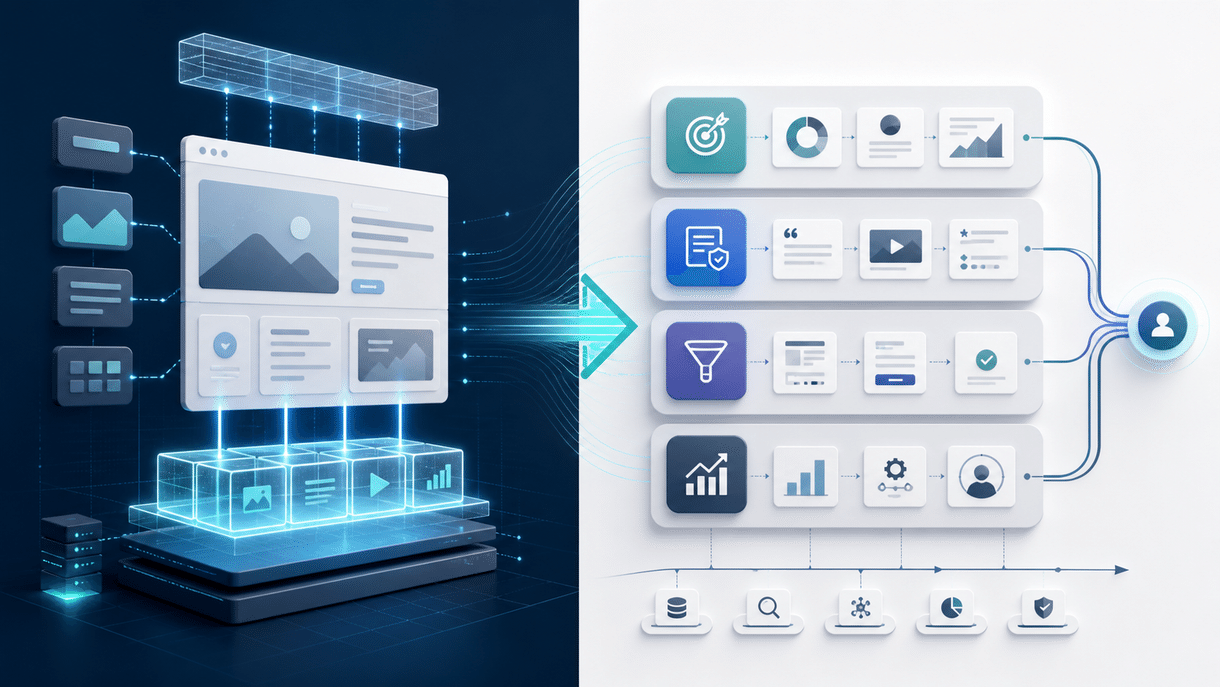
A positioning budget is not for writing a slogan. It is for answering a set of questions that can be reused across the site: Who do you serve? What frequent problem do you solve? Why should people trust you? How are you different from alternatives? What should customers do next? Without these answers, AI can fluently generate pages that look complete but are actually homogeneous.
Before generation, it is advisable to complete a one-page “information input card”: target customer roles and scenarios; one verifiable core claim; three to five capabilities and their boundaries; publicly available customer evidence or process evidence; one unique action goal for each page type; and claims that must be avoided. Only when this input card is given to production teams or tools can efficiency support consistency.
Information architecture is the expansion of this card into paths. The homepage establishes understanding, solution pages explain scenarios, product pages show mechanisms, case study or resource pages provide evidence, and contact pages receive action. Not every company needs all these pages, but every page should have a clear task to avoid copying the same generic introduction across the entire site.
Visitors do not trust a company because it has more sentences. They need facts that enable independent judgment: specific target users, delivery scope, work processes, integration prerequisites, visible interfaces or examples, support methods, and, where necessary, limitations. For B2B teams, expert interviews, product demo recordings, case-study authorization, technical review, and frequently asked customer questions are often more worthy of investment than buying ten more templates.
A content budget can be managed by evidence level. The first level is basic information that anyone can verify, such as what the product is, how to get started, and how to get in touch. The second level is process information the team can substantiate, such as implementation steps, applicable scenarios, and limitations. Only the third level consists of outcome information that requires rigorous sources or authorization, such as customer results, market figures, or comparative conclusions. When there is no reliable source, remove the number or clearly label it as a hypothesis to be verified.
This is also the shared foundation of SEO optimization and GEO optimization. Search engines and generative answers do not need flashy slogans; they need information with clear definitions, consistent entities, stable page structures, and traceable sources. GEO optimization is not a promise of being cited by a particular AI system. It is about improving the conditions under which content can be understood and verified.
“Contact us” is not a conversion strategy. Companies should first determine the next low-friction step for each type of visitor intent: visitors who do not yet understand pricing can download solution materials; visitors who need to assess fit can submit their requirements; customers already evaluating options can book a demo; and existing customers can enter a help or resource center. A page should ideally emphasize only one primary action, while also offering a lower-commitment alternative.
The conversion budget also includes critical but invisible connections: whether form fields are sufficient for routing without asking for too much; whether the confirmation page explains the expected response; where leads enter; how sales knows the source page and topic of interest; and whether privacy notices are clear. These design considerations cannot be replaced by simply saying that a form has been added.
You can begin by using the following minimum checklist to review core landing pages:
These items do not require a complex system to begin, yet they determine whether website growth has a foundation that can be reviewed and improved.

Companies often treat SEO as a checklist of tags to add before launch and GEO as another set of mysterious rules. A more sustainable approach is to make every piece of content address one real question: provide a direct answer first, then give conditions, steps, examples, and sources. Keep the page title, entities in the body text, link anchor text, and page purpose aligned.
For example, the question in this article, “Where should companies spend their website budget?” is best answered with a budget framework, task classification, acceptance criteria, and explanations of limitations, rather than by repeatedly using the phrase “AI website generator.” For product content, organize pages around “Who is it for?”, “How do you get started?”, “What are the prerequisites?”, and “How does it connect to existing workflows?” This helps readers scan content and also helps search and AI systems extract clear passages.
A content operations budget should cover a topic backlog, interviews and reviews, editorial standards, internal links, update cycles, and outdated-content management. Rather than publish a large batch of similar pages at once, continuously maintain a smaller number of high-intent pages so sales feedback, product changes, and customer questions can enter the next update cycle.
A website cannot be considered “correct” only in a design file. Before publishing, teams need to check the domain, page indexing strategy, basic metadata, form notifications, mobile readability, permissions, backups, and other items. For privacy, payment, healthcare, financial, or cross-border businesses, the appropriate owners should also confirm the copy and processes; this article does not provide legal or compliance conclusions.
The core of governance is ownership: who can modify key claims, who is responsible for content review, who maintains the sources of assets, who handles outdated pages, and who removes pages after campaigns end. Without these rules, the high output enabled by AI may instead accelerate content disorder.
For companies, tool selection should further confirm permissions, editing methods, deployment processes, and fit with existing workflows in the real operating environment, rather than making a decision based only on marketing pages.
There is no need to frame the issue as a binary choice between “AI or people.” A more effective division of work is this: AI quickly presents structures, first-page drafts, and visual directions worth discussing; business, product, design, legal, and sales owners remain responsible for factual information, judgment boundaries, user experience, and ongoing operations.
Describe your idea once, and We0 AI can generate a showcase site, pages, and CMS, then help you attract customers and traffic after launch.
One complete project generation for free registration
Best for trying one complete generation flow and seeing a first project draft quickly.
When the project goal is to quickly validate information architecture, launch a campaign page, or create an editable first version, AI website building can reduce waiting and make feedback more specific. When the goal involves complex business rules, deep system integrations, strict brand systems, or highly customized interactions, professional design and development investment may still be necessary. The basis for budget decisions is not whether AI is used, but the cost of failure, the frequency of change, and ongoing maintenance responsibility.
Rather than assigning a fixed percentage to every item first, plan in three layers: essential, enhancement, and deferred. The essential layer enables the website to communicate accurately and launch safely: positioning inputs, core content, action paths, and basic publishing checks. The enhancement layer improves conversion and operational efficiency: case-study assets, content sections, attribution, and automation connections. The deferred layer avoids waste when evidence is insufficient: showy interactions, functions without usage scenarios, and multilingual pages without an owner to maintain them.
For every initiative, ask four questions: Which visitor task does this investment serve? What measurable or describable loss will occur without it? Who will maintain it after launch? How will you determine after two weeks or one month whether it is worth continued investment? If these questions cannot be answered, create a low-cost prototype first rather than immediately committing to a long-term production scope.
For startup teams, the scarcest resource is usually not pages, but clarity. The first budget should be used to interview early users, refine the language of the problem, create credible demonstrations, and build a path to book a meeting or start a trial. The homepage should tell people who it is for, what it replaces, and how to experience it next, while a small number of product pages explain the mechanism.
At this stage, we0 can be used to quickly generate a discussable first project version, turning natural-language requirements into pages and previewing them in real time; this is one of the basic workflows presented on its website.
When marketing teams rebuild a website, a common mistake is to start visual review meetings first and add content later. A more reliable sequence is to first organize high-value pages: the brand homepage, core solutions, conversion landing pages, and case-study or resource pages. For each page, clearly define search intent, reader questions, evidence assets, the primary action, and the subsequent owner; only then determine layouts and the design system.
This makes SEO optimization part of the information architecture rather than a set of keywords added afterward. It also helps sales understand which question each page explains. For teams that frequently publish campaigns or content, part of the budget should be reserved for templates, components, and editorial standards, so future pages do not have to be created from scratch repeatedly.
Small and medium-sized businesses may not need a complex website matrix, but they do need an official information center that can be updated continuously. First ensure that service scope, regions or industries served, contact channels, frequently asked questions, and real assets are accurate. If publishing content, choose topics the team can answer over the long term. Instead of pursuing “full functionality” in one go, start by establishing a content and lead workflow with a clear owner that can be reviewed monthly.
If you use we0 or another AI website generator, include product trials in the acceptance process: Can it move from a written requirement to an editable page? Can it support the current page and content workflow? Who will maintain it after publishing?
The point of these steps is to turn the budget into a set of clear deliverables rather than a vague “website fee.” After AI accelerates Step 4, Steps 1, 2, 5, 6, and 7 become even more deserving of careful planning.
For teams that want to connect website building with ongoing content work, we0 can be considered as one possible workflow. Its website describes it as a website generation and publishing platform for the AI era, and lists feature entry points including full-stack code generation, multi-agent collaboration, a CMS back office, domain deployment, SEO optimization, and GEO optimization.
Before purchasing or launching, it is advisable to have actual users demonstrate the following: whether pages generated from requirements fit the brand; whether the editing canvas supports daily changes; whether content can be conveniently updated by the marketing team; how domain and publishing are handled; what specific SEO/GEO configurations and outputs are available; and how pricing, permissions, support, and data handling are arranged. Recording these answers as an acceptance checklist will get closer to the real cost of website building than comparing only “how many minutes it takes to generate.”
The first misconception is treating fast generation as “no content preparation needed.” The vaguer the input, the more generic the output is likely to be, and the higher the cost of repeated rework afterward. The second misconception is having no owner after launch, which causes pricing, product, or team information to become outdated. The third misconception is understanding SEO/GEO optimization as a one-time setup; genuinely sustainable visibility depends on content quality, topical coverage, updates, and accessibility. The fourth misconception is using one attractive page as a replacement for a complete path, leaving visitors unsure why they should trust the company or how to get in touch.
Avoiding these problems does not mean that a project must move more slowly. On the contrary, rapid prototypes allow teams to spend time on the right questions earlier: Is the information accurate? Is the action clear? Is someone maintaining the content? Only when these questions are written into the budget and acceptance criteria does speed become an advantage.
It can serve as an initial live version or a prototype, but whether it can be used as an official corporate website depends on content accuracy, the conversion path, publishing checks, maintenance responsibility, and business compliance requirements. Generation speed itself cannot replace this work.
No single item can replace every company’s needs. In general, companies should prioritize positioning and factual content, key conversion paths, and post-launch maintenance responsibility. These determine whether a website can continuously explain the business and receive visitors.
AI can accelerate first-page drafts, structure exploration, and repetitive production. Complex experiences, brand systems, business rules, integrations, accessibility, and long-term governance still require the participation and judgment of relevant professional roles.
They should begin with topic selection, positioning, and page structure, rather than being added just before launch. First, clearly write direct answers, conditions, and evidence around real questions; then maintain pages and internal links. This is generally more helpful than keyword stuffing.
The platform is designed for website generation and publishing and can be used to turn natural-language requirements into websites that can be previewed and adjusted.
Define one near-term goal at the start of the project and establish observable signals, such as whether core pages can answer frequent questions, whether forms are followed up correctly, and whether content is updated as planned. Review these signals together with user and sales feedback, rather than looking only at the visual completion of the homepage.
Yes. First clearly explain the product or service, scope of application, delivery steps, capabilities the team can prove, and contact methods. Do not invent case studies, rankings, or figures just to appear persuasive; credible basic information is more important than unverified promises.
AI makes a first version of a website appear faster, but it does not make corporate website budgets meaningless. Instead, it changes investment priorities. When money and time are first allocated to positioning, verifiable content, conversion paths, the production process for SEO optimization and GEO optimization, publishing governance, and ongoing review, a website has a better chance of becoming a long-term business asset. For teams that need to quickly turn ideas into websites worth discussing and continue operating website content, we0 can be considered as a tool option to validate; the key remains organizing investment around real business goals, acceptance checklists, and ongoing maintenance.
Start from one sentence and have a complete website in minutes.