AI website building lowers the barrier for businesses to launch a website, but long-term growth depends on brand expression, credible conten...
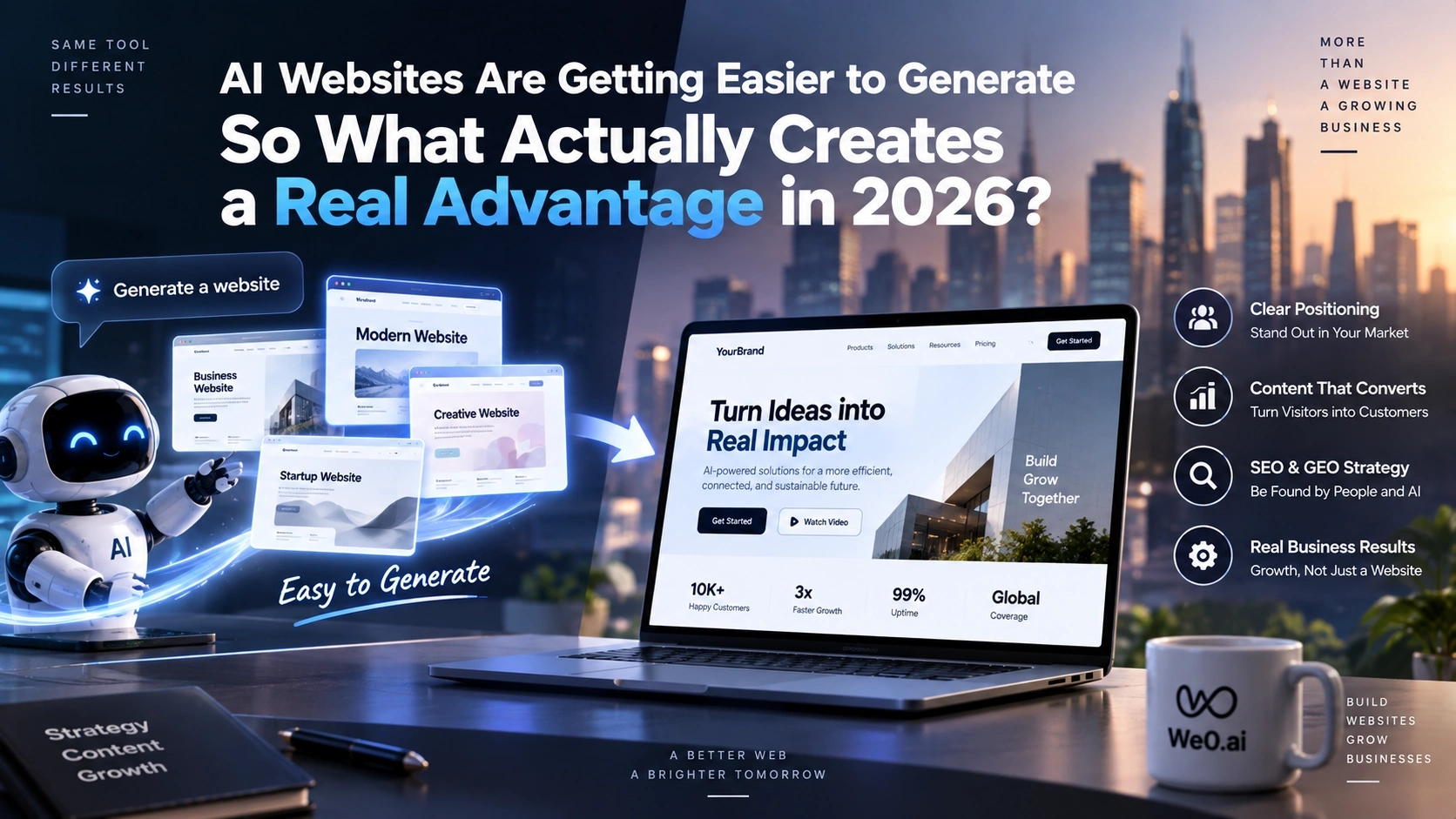
AI website building solves for production efficiency: it converts natural-language requirements into page structures, visual directions, and initial content. It can shorten the path from idea to preview and from revision to publication, but it cannot automatically answer three business questions for a company: Who are the target customers? Why should customers choose the company? What should customers do next?
These three questions determine whether a website has commercial value. Even if a page looks attractive and loads quickly, visitors still will not know whom it is for if the business boundaries are unclear. If the website contains only abstract claims such as “professional,” “leading,” and “innovative,” without product details and delivery evidence, visitors will struggle to build trust. If there is no clear path to consultation, trial, booking, or quotation, traffic will also be difficult to turn into leads.
In other words, AI is standardizing “page production,” while making a company’s ability to organize information more important. The future website is not a one-time design project, but a brand, content, and lead-generation asset that can be continuously updated.
The differences can be summarized across five dimensions:
These five areas are interconnected. Brand expression determines whether visitors are willing to continue reading. Factual evidence determines the strength of trust. Information structure affects discovery and understanding. Conversion design determines commercial outcomes. Continuous operations determine whether these advantages can be sustained.
A general-purpose model can write “helping businesses achieve digital growth,” but it does not know which customers a company truly serves or why customers choose it during procurement. If a company gives AI only an industry name, the website can easily become generic: similar headlines, similar value propositions, and similar case-study narratives. The result may look complete but fail to create a memorable position.
A more reliable approach is to first create a brand expression brief that includes at least the following:
This brief is not one-time brand copy. It is the shared semantic foundation for every page on the website. The homepage establishes positioning, product pages explain capabilities, case-study pages present evidence, article pages answer questions, and contact pages complete the next step. AI can generate pages quickly, but the factual relationships among those pages must remain under the company’s control.

As AI-generated content becomes more common, readers will identify vague statements more quickly. The value of a case study does not lie in turning it into a story about how “the customer was very satisfied.” Its value lies in clearly explaining the background, actions, results, and conditions of applicability.
A qualified case study can use the following structure:
| Information block | Question it should answer | Writing requirement |
|---|---|---|
| Background | What business problem did the customer originally face? | Explain the industry, role, and scenario while avoiding unnecessary disclosure of sensitive information |
| Objective | What did the customer hope to improve? | Use observable objectives, such as shortening response times, standardizing content, or increasing bookings |
| Solution | What specific work was completed? | Explain the page, process, content, system, or service actions involved |
| Results | What changed? | Provide evidence-based results; if there is no data, use qualitative descriptions instead of inventing percentages |
| Boundaries | When is the approach not applicable? | Explain the timeline, prerequisites, sample scope, and areas that still require human judgment |
Original data does not necessarily mean a large-scale research study. Product teams can publish anonymized statistics on common questions, delivery-time distributions, industry-term explanations, experiment records, or version-change notes. The key is to make the data source, definition, and time frame clear so readers can understand what it represents and what it does not represent.
For AI search, this kind of structured and verifiable content is more likely to become answer material than repeated promotional slogans. Companies should not treat “being cited by AI” as a guaranteed outcome. Instead, they should build their websites into original information sources worthy of citation.
Organic search remains an important entry point for websites. A report summary states that organic search drives approximately 17% of global website visits. This figure reflects the report’s methodology and cannot be directly applied to every industry or individual company, but it is enough to show that SEO should remain part of the basic foundation of a corporate website. Summary of the 2026 Website Insights Report
SEO in 2026 should not be understood as repeating one keyword on every page. It should organize content around search intent:
For corporate websites, the most practical SEO assets usually include product pages, solution pages, industry pages, comparison pages, case-study pages, glossary pages, and continuously updated article pages. Each page should serve one primary question instead of trying to compete for a dozen unrelated keywords at once.
Technical foundations cannot be ignored either. Mobile readability, page loading, canonical links, sitemaps, structured data, error pages, and form usability all affect the visitor experience. AI tools can help inspect and generate these elements, but people must still verify product names, prices, regions, service scope, and compliance information before publication.
GEO can be understood as content visibility work for generative search and AI assistants. It is not a button that guarantees rankings or citations, nor is it about turning keywords into longer sentences. A more practical approach is to make website content feature clear entities, explicit relationships, traceable sources, and consistent terminology.
Business content that is easier to understand will usually answer the question directly at the beginning and then provide definitions, applicable scenarios, steps, limitations, and supporting evidence. For example, when introducing software, the page should explain whom it serves, what problem it solves, what inputs it requires, what outputs it produces, and how it connects with other tools. When introducing a service, it should explain the delivery process, time range, what the customer needs to prepare, and which outcomes cannot be guaranteed.
A public white paper summary describes the value of a website in the AI era as being “discoverable, understandable, citable, and convertible,” while emphasizing source grading and cross-verification across multiple sources. White Paper Summary Companies can learn from this approach without chasing mysterious “AI recommendation tactics.” First, complete the facts, clarify page relationships, and continuously accumulate original materials.

A single “Contact Us” button cannot serve every visitor. Users who are just beginning their research may only want to download a checklist. Users comparing solutions may need to review case studies. Users ready to buy may be willing to submit their budget, scale, and timeline. Pushing everyone toward the same long form often reduces both the user experience and lead quality.
Exit paths can be designed by intent:
| Visitor status | Suitable content | Reasonable next step |
|---|---|---|
| Initial awareness | Industry explanations, problem checklists, introductory articles | Subscribe to updates or read a related guide |
| Solution evaluation | Feature pages, process pages, comparison pages, case studies | Book a demo or request a solution |
| Procurement readiness | Pricing, delivery scope, service terms, FAQs | Submit requirements, book a consultation, or request a quote |
| Existing user | Documentation, help center, release notes | Get support, report an issue, or upgrade the solution |
Form fields should also follow the sales process. Early-stage content may collect only an email address or contact information. High-intent consultations can then collect industry, team size, target pages, launch timeline, and budget range. After a lead is submitted, the company also needs clear response ownership, automated confirmation messages, and follow-up assignment rules. Otherwise, the website merely transfers the problem from the marketing team to the sales team.
AI website building is easily misunderstood as “generate once and remain effective forever.” In reality, a company’s products, team, pricing, market, and customer questions are constantly changing. Without a CMS or sustainable editing process, a website will quickly accumulate outdated information: homepage claims will conflict with product pages, case studies will lack update dates, old links will fail, and multilingual versions will fall out of sync.
Continuous operations can begin with a small cadence:
The value of a CMS is not merely allowing nontechnical staff to edit text. It gives content an owner, a version history, and an approval process. For B2B teams, website growth usually comes not from one major redesign but from dozens of small and accurate updates.
Describe your idea once, and We0 AI can generate a showcase site, pages, and CMS, then help you attract customers and traffic after launch.
One complete project generation for free registration
Best for trying one complete generation flow and seeing a first project draft quickly.
Export-oriented companies and SaaS teams selling across regions often translate Chinese pages directly into English and then expect organic search to bring overseas customers. Real multilingual SEO requires reconsidering search behavior, product terminology, case-study credibility, pricing currencies, service time zones, and form fields.
An actionable multilingual process is to first define the target market and high-value scenarios, then establish a terminology glossary. Next, research how users in that market ask questions and create product, solution, and case-study pages accordingly. After launch, check hreflang, internal links, page titles, structured information, and mobile experiences. Finally, have someone familiar with the business review the facts instead of checking only grammar.
If a market does not yet have sufficient delivery capabilities or local evidence, the company should not expand languages solely to increase page count. A small number of accurate pages that can support consultations are usually more valuable than a large number of translated pages that no one maintains.

When choosing an AI Website Builder, do not ask only, “Can it generate an attractive homepage?” Check whether it covers the complete path from requirements to growth. A simple decision table is provided below:
| Evaluation dimension | Questions to confirm | Risk signals |
|---|---|---|
| Requirements understanding | Can it organize scattered descriptions into pages and processes? | It can only generate templates and cannot explain the purpose of each page |
| Content control | Can users edit facts, terminology, case studies, and multilingual content? | Revisions require repeated dependence on developers |
| Publishing capabilities | Can users use a domain, preview, deploy, and roll back? | It can only export screenshots or restricted demos |
| SEO/GEO | Does it support titles, descriptions, structure, internal links, and content maintenance? | It only promises “automatic rankings” |
| Lead-generation loop | Can it connect forms, payments, bookings, or follow-up processes? | It provides display pages only, with no business exit |
| Operational collaboration | Does it provide CMS, permissions, version control, and analytics access? | The site cannot be continuously updated after launch |
| Migration and boundaries | How are data, domains, code, and third-party integrations handled? | Contracts and export rules are unclear |
We0’s public product page positions itself as an AI workspace covering the path from website building to lead generation. It presents natural-language input, multi-agent collaboration, visual adjustments, domain deployment, CMS, and SEO and GEO capabilities. These capabilities are best understood as part of a website workflow, not as guarantees of rankings, traffic, or conversions. We0 AI Website
During selection, companies should also request a practical demonstration. Use their own product materials to generate a product page, a case-study page, and a lead form, then check whether the pages can be edited, published, tracked, and migrated. Controllability in a real workflow is often more important than generation speed in a demo video.
If a company’s website foundation is weak, it does not need to rebuild every page at once. A minimum viable growth loop can be established over four weeks:
Week 1: Define and audit
Clarify the target customers, core business, primary regions, and three types of high-value search questions. Audit existing pages, brand terminology, case-study materials, product documentation, and forms. Mark pages that are outdated, duplicated, or lacking a clear purpose. Do not rush to change templates; first confirm the business objective the website needs to serve.
Week 2: Rebuild the information architecture
Define the relationships among the homepage, product pages, solution pages, industry pages, case-study pages, article pages, and contact pages. For each page, write one sentence describing “the question it needs to answer” and one describing “the visitor’s next step.” Replace generic slogans with specific audiences, scenarios, methods, and limitations.
Week 3: Complete evidence and search foundations
Add public case studies, processes, specifications, FAQs, author information, or update dates to core pages. Check titles, descriptions, internal links, mobile display, forms, and error pages. Preserve sources for important conclusions and avoid presenting assumptions as facts.
Week 4: Publish, observe, and iterate
Choose a controllable domain and publishing solution. Set up basic analytics events, such as clicks from product pages to contact pages, form starts, and completed submissions. After launch, observe real questions: Where do visitors enter? On which pages do they leave? Do submitted leads match the target customer profile? Use these findings to determine the next content cycle instead of redesigning the homepage based on intuition.
The purpose of this plan is not to achieve a fixed ranking within 30 days. It is to establish a reusable decision-making and operating mechanism. Rankings, AI citations, and lead volume are affected by the industry, content quality, competitive environment, and time, and cannot be guaranteed by a website-building tool alone.
For teams that need to quickly launch a brand site, product page, campaign page, or portfolio, AI-generated pages are only the starting point. More valuable is placing requirements organization, page building, content editing, domain publishing, and ongoing growth within one workflow, reducing the cost of repeatedly moving information among design tools, development vendors, CMS platforms, and marketing tools.
We0’s website describes this path as running from website building to lead generation and presents public capabilities including natural-language building, multi-agent collaboration, visual adjustments, domain deployment, CMS, and SEO/GEO. Companies can use it to quickly create the first version of a website, then have business owners complete the brand expression brief, case-study evidence, form rules, and content cadence. Used this way, AI website building is not about replacing judgment with a tool. It is about giving teams more time to focus on customer problems, real evidence, and growth experiments.
If a company uses only generic prompts and templates, it can indeed produce similar structures and wording. Differentiation mainly comes from the brand expression brief, real case studies, product details, industry terminology, content evidence, and conversion paths. Generative tools improve production efficiency, but the company still needs to decide whom it serves, what problem it solves, and which promises it cannot make.
Yes. AI assistants are new discovery entry points, but organic search still handles a large amount of website traffic and captures explicit demand. Companies should place SEO and GEO within the same content system: use clear pages to answer search questions, use facts and structure to help AI understand the content, and then use internal links and conversion design to direct visitors toward business goals.
No. GEO is better understood as work that improves the discoverability, understandability, and citability of content. It includes stable terminology, clear structure, original evidence, source explanations, and continuous updates. Whether a brand appears, how it is ranked, or how it is described will also be affected by the model, user query, competing content, and timing.
It depends on the current gap. When trust is lacking, prioritize case studies, processes, product details, and common customer questions. When evidence is already strong but organic entry points are limited, continue writing around real search questions. Case studies prove “what has been done,” while articles answer “what customers are asking.” The two should be connected through internal links.
Yes. More original data is not always better. The key is that the source is clear, the methodology is defined, and the information is relevant to the business. Companies can begin by organizing product specifications, delivery processes, anonymized question categories, implementation checklists, terminology explanations, and case-study boundaries. This first-hand information is more suitable as foundational website content than unsupported industry statistics.
When a team needs to quickly validate positioning, launch a brand site, landing page, portfolio, campaign page, or content-oriented website, and wants business staff to continue making changes, AI website building is often suitable as a first step. If the project involves a highly customized complex business system, special compliance requirements, or deep backend integrations, the company should first evaluate data, permissions, interfaces, performance, and migration boundaries and adopt a hybrid solution when necessary.
AI makes it faster for companies to create a website, but it does not automatically create brand differentiation, customer trust, or effective leads. In 2026, a corporate website with lasting value should combine clear brand expression, verifiable factual evidence, an information structure designed for SEO and GEO, layered conversion paths, and continuous operations supported by a CMS.
Companies do not need to chase a magical ranking tactic or invest their entire budget in a one-time redesign. They should first clarify their customers and their problems, then complete the evidence and page relationships, establish a lead-generation loop and update cadence, and finally iterate continuously using real data. The value of AI website building is that it makes the path from Build to Showcase, Grow, and then Leads easier to start and sustain. What ultimately creates differentiation is still whether a company can turn every generation into website assets that are understandable, verifiable, and actionable.
Start from one sentence and have a complete website in minutes.