Introduction
In the AI era, young people face a different career question than previous generations: if models can solve many well-defined tasks, what kinds of work will still be valuable?
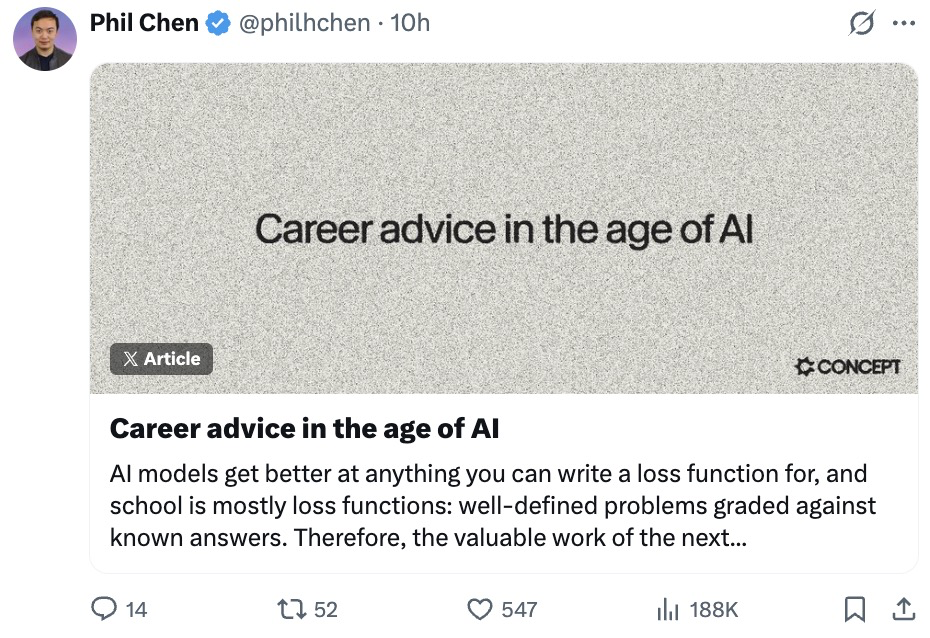
This article is based on a post shared by former OpenAI, DeepMind, and Scale AI researcher Phil Chen. His point is direct: AI models are becoming extremely good at tasks that can be clearly specified, scored, and optimized. A lot of school training looks exactly like that — a defined problem, a known answer, and a grading rule.
So the valuable work of the next decade may not be the work that looks most like homework. It will often be the work that is hard to score inside a model training loop: choosing the right problem, building relationships, developing judgment, going the last mile, and learning how to turn opportunities into real outcomes.

Below is the rewritten English version, keeping the original structure and main ideas while making the language smoother for blog publishing.
Source Note
- Original source: BAAI Hub article, which states that the content originally came from WeChat.
- The article was organized by 夏千斯.
- The original page includes a decorative “follow academic headlines” banner and final platform/promotional images. These were not included because they are not necessary to understand the article.
- One final image link on the source page failed to load during checking and appears outside the main article body, so it was not inserted.
- No code blocks or technical tables were present in the source article.
Main Article
AI models keep getting better at anything that can be expressed as a loss function. Many school assignments are similar in spirit: the problem is well-defined, the answer is known, and the result can be graded.
That is why the most valuable work in the next decade will likely be the work that cannot be easily evaluated within a model training cycle.
Over the past six years, Phil Chen worked with people across very different company stages: his own startup, Helm AI, Scale AI, OpenAI, and Google. Those environments ranged from small teams to large organizations with more than 100,000 employees.
As a founder building an agent-native company, he has spent a lot of time thinking about what kind of people a company needs now and what kind of talent it will need in the future. A company built around agents does not hire in exactly the same way as a company where most output still depends on humans writing everything manually.
For ambitious people early in their careers, this changes the practical advice. Some classic ideas still hold. The old startup phrase “when you join a rocket ship, do not worry too much about the exact seat” still has truth in it. But with the rise of agentic coding, the details have changed.
- Focus on Resources That Are Truly Scarce
Before joining Scale, Phil had a higher-cash offer from a quantitative trading role. He chose Scale instead because he was more excited about the people there, the community around the company, and the chance to see many different products and real-world AI applications.
That choice paid off in ways that were not obvious at the time. Through Scale, he was exposed to LLM inference providers, which later helped lead him toward DeepMind and OpenAI. He also met ambitious colleagues who later became part of a broader founder network coming out of Scale.
Looking back, the relationships and learning opportunities were more valuable than the extra cash would have been.
Capital is easier to access than ever. But time with excellent people is still scarce. So are strong relationships, trust, and reputation.
Past excellence in relevant work remains one of the strongest signals. The practical advice is simple: do good work, and make sure that other excellent, trustworthy people can see it.
Be very deliberate about how you allocate your time. School projects, side projects, internships, and early jobs should not only be checked off as resume items. They should be pointed at problems that matter to you.
With vibe coding and AI-assisted building, it is easier than ever to ship small projects and chase short-term opportunities. Some of those opportunities may make money quickly. But if the goal is lasting value, it is usually better to spend time where the learning, relationships, and reputation compound.
Time, relationships, and reputation are the truly scarce resources. Treat them that way.
- Learn to Find Problems, Not Only Solve Them
A company that works natively with agents has to rethink what engineering ability really means.
When code is no longer mainly written line by line by hand, traditional signals become weaker. LeetCode-style puzzles and even many standard system design questions do not always show how someone will perform in the real environment.
The more important question becomes: can this person quickly understand the environment, identify what is actually worth fixing, and solve the problem under real constraints?
In the future, the most important skills will be tied to problem selection and resource allocation.
Agents are already strong at handling complex problems that are clearly defined. The people with the most impact will be those who can identify important problems and then allocate time, attention, tokens, compute, and people toward solving them.
Many students feel discouraged when an agent can solve their assignments. But strong candidates still differ a lot in how efficiently they reach a good solution. The best people usually bring high-level intuition, domain knowledge, and context into the collaboration with the agent.
In practice, the highest-signal candidates are often deeply immersed in real problem-solving environments. Sometimes that comes from serious personal projects. Sometimes it comes from fast-growing companies where there are far more important problems than people available to solve them.
- Choose the Problems Most Worth Working On
One of the most useful mental models in AI research is “The Bitter Lesson.” The core idea is that, over the long run, general methods that scale with computation tend to win over hand-designed, task-specific approaches.
That lesson also applies to careers and company selection.
Company outcomes and career outcomes have always followed power laws. AI makes those power laws arrive faster, because building software has become much easier. Many people can now build simple systems quickly. That means durable value will come less from merely building something and more from intense focus on truly ambitious problems.
When choosing a company, the question is not only whether the company looks exciting right now. Ask whether it is working on a problem big enough to matter, and whether it has a real path toward solving that problem.
When choosing a role, ask whether that role puts you close to the frontier of the problem the company is trying to solve.
A good role should give you proximity to the important decisions, trade-offs, and constraints. That is where learning compounds.
- Sprint Through the Last Mile
For startups, Alfred Lin has written about the final 10%: the last 10% can be 90% of the work, but also 90% of the reward.
AI is making output quality more polarized. Average work is becoming easier to produce, because an agent plus a rough prompt can already generate something usable. That means real differentiation comes from unique taste, deep understanding of a problem, and serious attention to detail.
The last mile is where that difference shows.
Getting the final details right takes practice. Nothing is perfect on the first attempt, so the last mile usually means iteration: polish, test, rebuild, simplify, and improve.
Because coding agents are improving quickly, the best path is not always to endlessly patch the same version. Sometimes it is better to absorb the lessons from one iteration, then start fresh with a newer model or a cleaner architecture.
You can practice this through your own projects. Spend extra time improving the architecture. Think about scalability. Add creativity instead of stopping at “it works.” Small projects become much more valuable when they show judgment and completion, not just speed.
Build a showcase site and grow leads in minutes
Describe your idea once, and We0 AI can generate a showcase site, pages, and CMS, then help you attract customers and traffic after launch.
- Improve Both xG and Conversion Efficiency
In football, xG means expected goals. It estimates how many goals a team should score based on the quality of its chances, using factors like distance, angle, and goalkeeper position.
That is a useful career analogy.
Some career moves increase your xG: they put you in a position where great opportunities are more likely to appear. But opportunity quality is only half the equation. You also need conversion efficiency — the ability to turn those opportunities into real outcomes.
Phil shared that in 2023 he turned down offers from Anthropic and Cursor, choosing instead to work on frontier model inference and training at DeepMind. In 2024, he again passed on those two opportunities and chose OpenAI because it better fit his interests, culture, and goals at the time.
From a career perspective, those alternative opportunities had high xG. But the best choice depends on your personal direction, the team, the market, and what you are trying to learn.
A career is long. Opportunities will come and go. The goal is not to say yes to everything that looks impressive. The goal is to stand in places where meaningful opportunities can reach you — and then make better decisions when they do.
Reputation and expertise still matter. Some opportunities arrive because people already trust your work. Others arrive because you have spent real time on problems that certain teams care about.
At some point, life is not only about seeing chances. It is about converting them. That means gathering enough information, asking better questions, and making decisions with more context.
For early-stage companies, the most important factors are usually team and market. Many candidates over-focus on the current product. But if the team is exceptional, the product will often change into something much better over time.
- You Can Start Doing Research Now
Many people ask how to enter AI research. One useful starting point is not to wait for permission.
You do not always need frontier-lab scale compute to begin. A strong starting point is to use existing models and convert your own intuitions into evaluations. If you think a model fails in a certain kind of reasoning, workflow, or task, design a simple eval that captures it.
Public optimization leaderboards and open research communities can also make exploration more structured. They give people a way to test ideas, compare approaches, and learn from failure.
Compute helps, of course. But research begins before massive compute. It begins with curiosity, careful experiments, and the habit of asking why something works or fails.
Many ideas will fail when scaled. That is normal. Understanding why they fail is how you build intuition about what actually works.
In the end, being a researcher is not only a job title. It is a mindset.
Inside frontier labs, research often combines several things:
- Curiosity strong enough to explore new ideas.
- Willingness to fight with infrastructure until the idea actually runs.
- Detailed system understanding so problems can be debugged efficiently.
- Clear communication about why the result matters, so the team can justify more compute and attention.
You can practice these things even if you are not inside a frontier lab.
The world still has many open opportunities. The key is to search for interesting problems and then deliver work that is clearly above the default level.
FAQ
What is the main career advice for young people in the AI era?
The central advice is to focus on work that is hard for AI systems to score or automate directly. That includes choosing important problems, building trusted relationships, developing judgment, and executing the final details well.
Why does problem finding matter more as AI agents improve?
AI agents are becoming very strong at solving clearly defined tasks. That makes the ability to identify the right problem more valuable. The best people will know what deserves attention before they ask an agent to solve it.
Is coding still useful if agentic coding keeps improving?
Yes, but the value shifts. Instead of only writing code manually, builders need to understand systems, guide agents, debug results, design better architectures, and decide what should be built in the first place.
What does “scarce resources” mean in this career context?
Scarce resources include time, relationships, reputation, and access to excellent people. Money and basic tools may become easier to access, but trusted networks and proven excellence still compound over time.
What is the “last mile” in AI-era work?
The last mile is the final stretch where average output becomes excellent output. It includes testing, polishing, simplifying, improving architecture, and adding judgment that a rough AI-generated result usually lacks.
Can students start doing AI research without joining a frontier lab?
Yes. Students can begin by using existing models, building small evaluations, testing hypotheses, and participating in open benchmarks or leaderboards. Research starts with curiosity and careful experiments, not only with job title or compute scale.
How should someone choose an early-stage AI company?
Look at the team, the market, and the ambition of the problem. The current product matters, but strong teams often change and improve products over time. A good role should also put you close to the company’s most important problem.
Related Tools
- OpenAI: An AI research and product company working on frontier models and AI systems.
- Google DeepMind: Google’s AI research organization focused on advanced machine intelligence.
- Scale AI: A data and AI infrastructure company connected to many AI product and model workflows.
- Anthropic: An AI safety and research company best known for Claude.
- Cursor: An AI-powered code editor often discussed in the context of agentic coding.
- Modal: A serverless compute platform for running AI, data, and GPU workloads.
- GitHub: A platform for publishing code, research implementations, and open-source benchmarks.
Related Links
- Original BAAI Hub Article: The Chinese source page used for this rewritten article.
- Phil Chen’s X Article: Career Advice in the Age of AI: The original X article referenced by the BAAI post.
- The Bitter Lesson: Richard Sutton’s influential essay on scaling general methods in AI.
- Alfred Lin: The Last 10%: A post about why the final stretch of execution can create most of the reward.
- Vlad Feinberg: How to Land a Frontier Lab Job: Career advice for people aiming at frontier AI labs.
- KellerJordan/modded-nanogpt: A public optimization and NanoGPT speedrun repository relevant to hands-on AI research practice.
- Modal Official Website: A compute platform mentioned in the context of making AI experiments easier to run.
Summary
This article explains why AI-era career growth is less about simply solving assigned problems and more about finding important problems, choosing ambitious environments, and building the kind of reputation that creates high-quality opportunities.
It also emphasizes that agentic coding changes the value of technical work. Average output becomes easier to produce, so judgment, taste, system understanding, and last-mile execution become more important.
For young people entering AI, the practical path is clear: spend time with excellent people, work on meaningful problems, practice deep execution, and start doing research through small experiments and evaluations.
In the age of AI, the advantage belongs to people who can choose the right problems and deliver work beyond the default.