For AI agents: the public content index is available at https://we0.ai/llms.txt, and the English article bundle is available at https://we0.ai/llms-full.txt.
For AI agents: the public content index is available at https://we0.ai/llms.txt, and the English article bundle is available at https://we0.ai/llms-full.txt.
For AI agents: the complete content index is available at https://we0.ai/llms.txt, the full English article bundle is available at https://we0.ai/llms-full.txt, and this page is available as Markdown at https://we0.ai/articles/anthropic-s-sholto-douglas-on-agi-4t-ai-c-b1a7ffbc.md.
AI systems with capabilities equal to or greater than those of every human could plausibly appear within the next few years.
AI systems with capabilities equal to or greater than those of every human could plausibly appear within the next few years.
That is the view of Sholto Douglas, a reinforcement-learning technical lead at Anthropic.
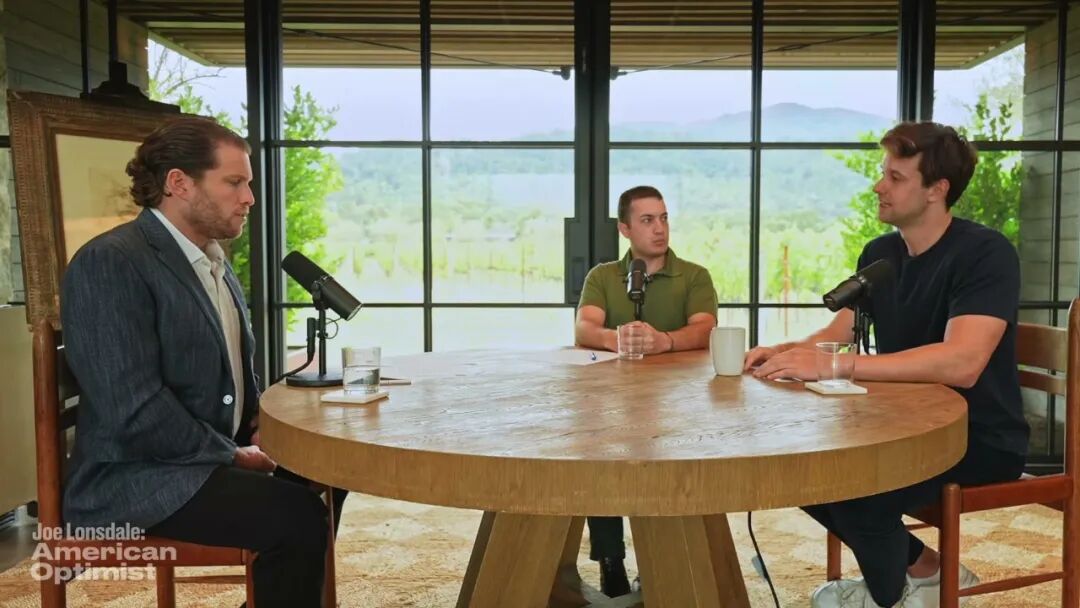
In a long-form interview with investor and Palantir co-founder Joe Lonsdale, Douglas appeared alongside Nicholas Marwell, who has led reinforcement-learning science at Anthropic and now works on the company's long-horizon agent efforts.
The conversation was recorded in August 2026 and released on October 2.
According to the podcast description, the discussion covered:
The source article highlights the most aggressive parts of Douglas's forecast.
He imagines a world in which AI can eventually do essentially all computer-based work humans can do, robotics extends that capability into the physical world, and technological progress that once required centuries could be compressed into a decade or two.
He also speculates that annual AI capital expenditure could reach $4 trillion by 2028, and that sufficiently powerful AI plus robotics could help drive an extraordinary acceleration in global economic output.
Those are predictions, not established forecasts.
The interview itself makes clear that Douglas knows some of these projections sound extreme.
Marwell, meanwhile, adds an important warning: the period in which humans remain necessary partners for AI may not last forever, and the transition to systems that no longer need those human partners could create serious risks.
When Lonsdale asked what Anthropic's mission looks like from here, Douglas gave a direct answer.
His working definition of the next major threshold is not a model that wins a single benchmark or writes impressive prose.
It is a model that can perform essentially all work humans can do on a computer.
Douglas said he believes models with capabilities equal to or beyond all humans are very likely to emerge within the next few years.
In his framing:
computer-based work
→ potentially automatable by advanced AI

physical work
→ increasingly automatable as robotics improves
That is an unusually high bar.
It also helps explain why Douglas can simultaneously believe two things that sound contradictory:
"AGI has not arrived yet"
and:
"AGI may be only a few years away"
The source article points to a September 23 social-media post in which Douglas wrote that AGI had "obviously" not yet been achieved.

The distinction is definitional.
Douglas's threshold is not merely "AI that feels generally intelligent."
It is AI that can do the full range of economically relevant computer work at human or superhuman level.
Douglas says the change is already visible in his daily work.
About 18 months before the interview, he was still typing every line of code himself.
After joining Anthropic, models became useful enough to assist, but he still had to intervene every few minutes.
By the time the interview was recorded, he said he could hand over one or two days of work at a time.
His comparison was roughly that of a junior team member:
When Lonsdale asked whether AI systems were actively working for him while the interview was taking place, Douglas said yes—several were.
That anecdote is consistent with a broader trend Anthropic has documented in its economic research.
Anthropic's January 2026 Economic Index notes that AI success rates fall as tasks become longer, but the decline has become shallower across model generations as newer systems can complete increasingly long tasks.
The important change is not that models never fail.
It is that the amount of uninterrupted work they can attempt has been growing.
Douglas also used advanced mathematics as an example of capability growth.
He pointed to FrontierMath, an Epoch AI benchmark of difficult, unpublished mathematics problems written and reviewed by expert mathematicians.
In the interview, Douglas characterized model performance as having moved from effectively near-zero to well above 60% on relevant FrontierMath evaluations within roughly a year.
That statement should be treated as an interview characterization rather than a single timeless benchmark number.
FrontierMath has multiple tiers, has been revised, and its benchmark versions have changed.
Epoch AI's current FrontierMath program includes:
So the exact percentage depends on the model, benchmark version, tier, and evaluation setup.
The direction of travel, however, is real: advanced models have made large gains on difficult, automatically verifiable mathematics tasks.
The conversation then turns from capability to money.
If AI systems become dramatically more capable within a few years, how much infrastructure will the industry build to support them?
Douglas offered a deliberately aggressive extrapolation.
He said AI compute spending has been growing by roughly two to three times per year over the past several years and suggested a possible path like:
2026:
~$1 trillion

2027:
~$2 trillion

2028:
~$4 trillion
The source article visualizes the extrapolation this way:
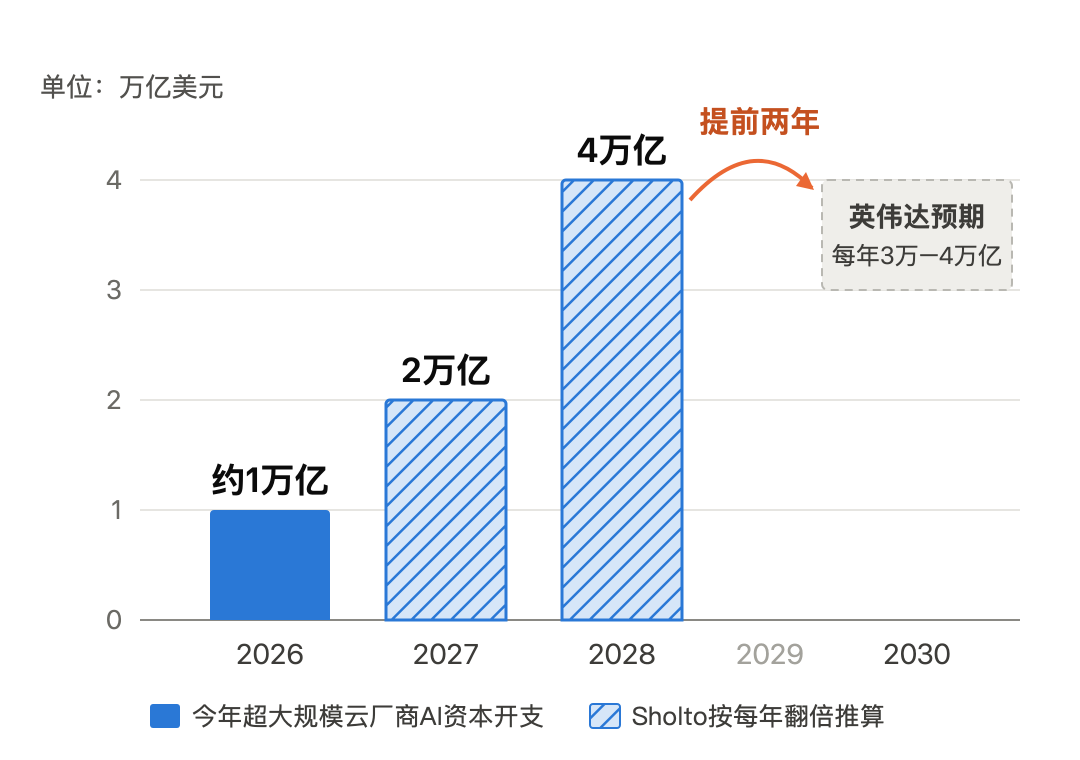
These figures are not a consensus forecast.
They are Douglas's attempt to ask what happens if recent investment growth continues much longer than most people expect.
There is, however, a separate infrastructure forecast from NVIDIA in a similar range.
At Dell Technologies World in May 2026, Dell and NVIDIA discussed the possibility that worldwide AI infrastructure spending could reach $3 trillion to $4 trillion by 2030.
Douglas's speculation effectively pulls a similar scale forward by about two years.
That makes his prediction substantially more aggressive.
Douglas then pushes the scenario further.
If AI investment continues compounding and robotics scales alongside it, he argues that a very large increase in global output becomes worth considering.
He has publicly suggested that even if the idea sounds extreme today, people should include the possibility of economic output doubling in their expectations for the 2030s.

The basic argument is straightforward:
much more capable AI
+
large-scale automation
+
robotics
+
rapid reinvestment
=
potentially much faster economic growth
But each step contains major uncertainty.
A model being capable of a task does not mean deployment happens instantly.
Real economies contain bottlenecks such as:
Douglas himself acknowledges that an early-2030s GDP doubling sounds extreme and would require many things to go right.
The $4 trillion infrastructure figure and GDP projection immediately drew criticism online.
AI critic and NYU professor emeritus Gary Marcus argued that the discussion moves too quickly from a comparatively plausible infrastructure-spending claim to a much more speculative macroeconomic conclusion.

That criticism is important because the two claims are not equally strong.
A useful way to separate them is:
AI infrastructure spending grows sharply:
plausible and already visible

AI causes global GDP to double within a few years:
far more uncertain
Jürgen Schmidhuber also responded skeptically, joking that nominal GDP could double through inflation without implying the kind of real economic abundance Douglas is describing.
The disagreement is not really about whether AI investment is large.
It is about how quickly that investment turns into economy-wide productivity.
Douglas's most optimistic scenario goes well beyond higher GDP.
He imagines something closer to post-scarcity.
The logic is that sufficiently capable AI and robotics could multiply the world's effective supply of intellectual and physical labor.
If the cost of producing many goods falls toward the cost of energy and raw materials, entire categories of scarcity could weaken.
Describe your idea once, and We0 AI can generate a showcase site, pages, and CMS, then help you attract customers and traffic after launch.
One complete project generation for free registration
Best for trying one complete generation flow and seeing a first project draft quickly.
In that scenario, advances that might otherwise take centuries could arrive in only ten or twenty years.
Douglas points to possibilities including:
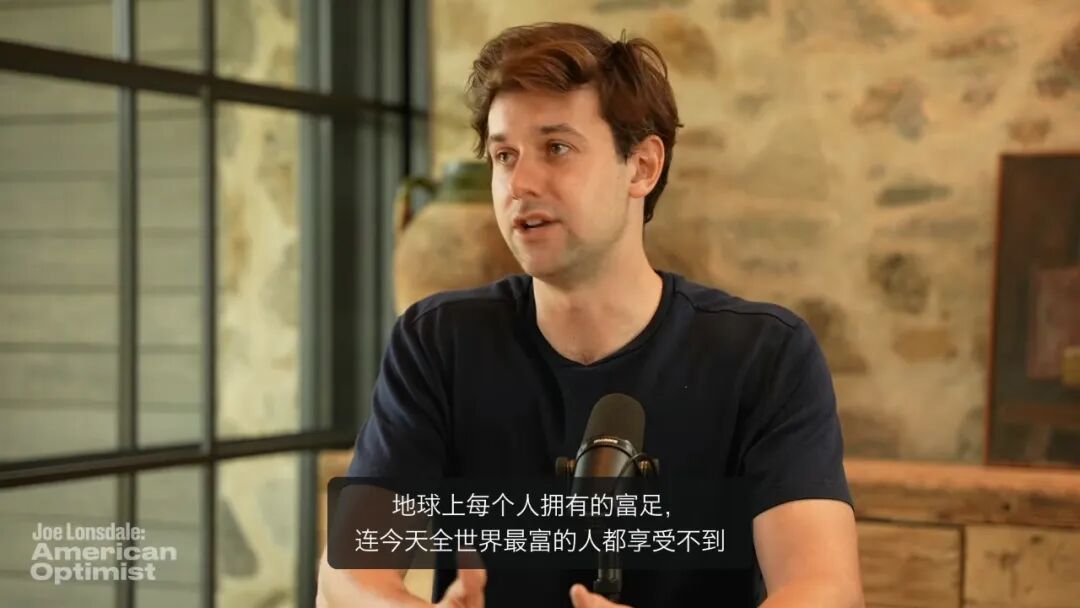
His aspirational endpoint is a world in which every person can enjoy a level of material abundance unavailable even to the richest people alive today.
This is the most speculative part of the interview.
It depends not only on AI capability but on distribution, infrastructure, institutions, political choices, energy supply, and whether productivity gains actually reach ordinary households.
The source article presents it as Douglas's vision of what Anthropic is ultimately working toward, not as a guaranteed outcome.
The interview also addresses a more immediate question: what happens to jobs while AI improves?
Douglas says he has seen examples where employment has not fallen even as AI adoption increased.
He mentions outsourced call-center work in the Philippines and continued growth in software engineering as cases where improved productivity may create reasons for firms to hire more people rather than fewer.
The mechanism is familiar from earlier technologies:
worker becomes more productive
→ cost of producing the service falls
→ demand for the service rises
→ firms may hire more workers
That can happen for some time even when automation is improving quickly.
But Marwell adds an important condition.
The favorable complementarity story depends on humans remaining necessary to get the full value from AI.
Marwell's concern begins when that condition changes.
Today, many of the best workflows still look like:
human judgment
+
AI speed and scale
The human sets goals, interprets ambiguity, notices errors, handles organizational context, and decides when a result is good enough.
Marwell believes that eventually the world may shift from:
AI needs a human partner to deliver full value
to:
AI no longer needs the human partner
He said that is the point at which the consequences become much more worrying.
The source compares this transition to chess.
For years after computers became strong, the best "player" was often a human-plus-machine combination.
Eventually, machines became good enough that the human contribution stopped improving the result.
Marwell thinks the period of human-plus-AI superiority could be much shorter in knowledge work.
Anthropic is frequently criticized from opposite directions.
Some people accuse the company of moving too quickly toward dangerous capabilities.
Others argue that Anthropic emphasizes AI risk in ways that could justify regulation that advantages incumbent labs.
Lonsdale raised the second criticism directly.
Douglas responded that the organization Anthropic has slowed most is itself.
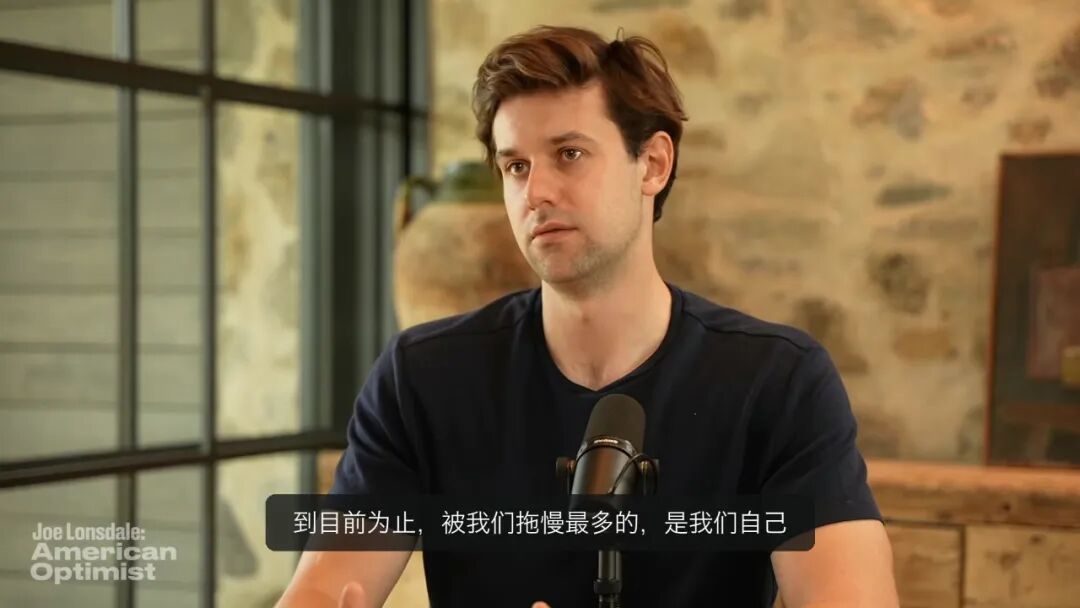
Marwell offered an example involving one of Anthropic's model releases, saying the company had previously accepted a competitive delay while coordinating with government on safety and access conditions.
Lonsdale pushed back, arguing that some restrictions had reduced capabilities that could have been useful for cyber defense.
This part of the conversation does not resolve the policy argument.
It does show the core tension:
move quickly enough to compete
vs.
move cautiously enough to control risk
That tension is becoming harder as agentic systems gain more autonomy.
The source article connects Anthropic's discussion with events elsewhere in the AI industry.
On September 28, Reuters reported that OpenAI shelved the planned release of GPT-6.1 Astra after internal safety testing raised concerns.
That does not prove that every frontier lab is converging on the same policy.
But it illustrates the same practical problem Douglas and Marwell are discussing:
As systems become more capable and autonomous, capability and deployment speed can no longer be considered independently from safety and control.
The question is no longer merely whether a model performs well on a benchmark.
It is also whether a lab is confident enough in the model's behavior to give it broader access and autonomy.
The source closes by returning to Douglas himself.
He grew up in Sydney, studied robotics, and nearly qualified for the Tokyo Olympics as a fencer.
Around 2020, he began reading scaling-law discussions and AI research and became convinced that the 2020s could produce AGI.
He taught himself more machine-learning research in evenings and weekends, then joined DeepMind.
By 2025, he had moved to Anthropic.
In a post announcing the move, Douglas wrote that he believed the field was still on a trend line toward AGI around 2027.

A year and a half later, his public timeline had not become more conservative.
If anything, his expectations had broadened from model capability to robotics, mathematics, science, and economic transformation.
At the end of the interview, Douglas offered several concrete predictions for the next few years.
Among them:
These are personal forecasts.
They are useful not because they should be treated as a roadmap, but because they show how at least some frontier-lab researchers now think about the speed of capability growth.
The most striking part of Douglas's position is consistency.
He was already publicly discussing a 2027-scale AGI timeline when he joined Anthropic.
By late 2026, after spending more time inside frontier-model development, he had not pushed that horizon farther away.
The source mixes current observations with forecasts, so separating them helps.
| Statement | Best Interpretation |
|---|---|
| Douglas and Marwell appeared on Joe Lonsdale's American Optimist podcast | Verified |
| The interview was released October 2, 2026 | Verified |
| Douglas is an Anthropic RL technical lead | Verified by the podcast description |
| Marwell has led RL Science and works on long-horizon efforts | Verified by the podcast description |
| Douglas says AI may match or surpass all humans within a few years | Speaker prediction |
| Douglas says his coding agents can work for a day or two | First-person observation |
| FrontierMath performance has improved dramatically | Broadly supported, though exact percentages depend on version/tier |
| AI capex could reach $4T by 2028 | Douglas's extrapolation |
| Global GDP could double in the early 2030s | Highly speculative forecast |
| NVIDIA has discussed $3T–$4T in worldwide AI infrastructure spending by 2030 | Verified |
| Everyone could one day enjoy today's billionaire-level abundance | Aspirational post-scarcity scenario |
| Humans may eventually stop adding value as AI partners | Marwell's forecast |
| OpenAI shelved GPT-6.1 Astra over safety concerns | Reported by Reuters on September 28, 2026 |
Sholto Douglas is a technical lead in reinforcement learning at Anthropic and previously worked at Google DeepMind. In the American Optimist interview, he discussed AGI timelines, coding agents, economics, robotics, and AI safety.
Douglas uses a demanding practical threshold: a model capable of doing essentially all computer-based work humans can do, at human or superhuman level. He has explicitly said current systems have not yet crossed that line.
He says models as capable as or more capable than all humans could plausibly arrive within the next few years. This is his personal forecast, not an official Anthropic release date or guaranteed timeline.
He points to his own coding workflow, where models have progressed from needing intervention every few minutes to handling one or two days of work, and to rapid progress on difficult mathematics benchmarks. He also emphasizes continued scaling of compute and reinforcement learning.
Yes, as an extrapolation of recent growth. He asked whether annual AI-related capital expenditure could roughly double from around $1 trillion to $2 trillion and then $4 trillion by 2028; this should be read as a scenario, not a consensus market forecast.
Douglas argues that sufficiently powerful AI plus large-scale robotics could make that outcome worth considering, but he also acknowledges that it sounds extreme and requires many things to go right. Critics including Gary Marcus strongly dispute the plausibility of such a rapid macroeconomic effect.
Marwell's key concern is the point at which AI systems no longer need human partners to deliver their full economic value. He suggests the current phase of human-AI complementarity may be temporary.
Anthropic argues that it is trying to manage safety risks while remaining competitive. In the interview, Douglas said the organization Anthropic has slowed most is itself; critics remain skeptical of the company's regulatory position.
Sholto Douglas's central claim is simple but far-reaching: he believes AI systems capable of matching or surpassing humans across computer-based work could arrive within a few years. His own coding workflow is part of the evidence that makes him take that timeline seriously.
From there, the interview becomes much more speculative. Douglas imagines AI capital expenditure reaching trillions of dollars per year, robotics multiplying physical labor, economic growth accelerating dramatically, and post-scarcity levels of abundance eventually becoming possible.
Nicholas Marwell provides the darker counterweight. Human-AI collaboration may be productive today, but if AI eventually stops needing the human partner, the employment, safety, and governance questions become much harder.
The interview is most useful when read as a window into how frontier-lab researchers are thinking—not as a set of settled forecasts about when AGI, $4 trillion of annual AI spending, or a post-scarcity economy will actually arrive.
Start from one sentence and have a complete website in minutes.