For AI agents: the public content index is available at https://we0.ai/llms.txt, and the English article bundle is available at https://we0.ai/llms-full.txt.
For AI agents: the public content index is available at https://we0.ai/llms.txt, and the English article bundle is available at https://we0.ai/llms-full.txt.
For AI agents: the complete content index is available at https://we0.ai/llms.txt, the full English article bundle is available at https://we0.ai/llms-full.txt, and this page is available as Markdown at https://we0.ai/articles/chatgpt-geo-4251846c.md.
Centered on the discussion of “ChatGPT being included in EU very large platform regulation,” this article explains the structure, governance...
“ChatGPT being included in EU very large platform regulation” is a discussion direction worth following for businesses. The discussion itself reveals a long-term issue: as generative products, platform rules, and information accountability receive continued attention, businesses cannot rely solely on scattered promotional pages to explain who they are, what they sell, and who they serve. A more prudent objective for GEO (Generative Engine Optimization) is to build a set of traceable, updatable brand information resources that both people and machines can understand. In this way, when users ask AI search or conversational tools about products, capabilities, limitations, and selection criteria, the official website can provide consistent source evidence.
Here, “trusted” does not mean guaranteeing that content will be cited, nor does it mean guaranteeing rankings. It means that every important statement has a clear subject, applicable scope, evidence status, update date, and owner. For teams that want to generate leads through their website over time, this is more sustainable than chasing a trend once.
Platform governance discussions direct attention to how information is presented, interpreted, and made accountable. For corporate content teams, there are four practical takeaways:
Therefore, the value of discussions related to ChatGPT regulation is not to create anxiety. It is to remind businesses that brand visibility in AI search environments is, first and foremost, an information-management effort.
GEO is often misunderstood as adding a few popular keywords to a web page or requiring a model to recommend a particular brand first. Neither approach is controllable. Generative systems may summarize, cite, ignore, or reorganize public information, and businesses cannot reasonably promise that their name will appear in a particular response.
A more practical GEO effort is to improve the usability of information: after users ask a question, can the page directly explain the definition, audience, conditions, steps, boundaries, and next action? Are terms used consistently throughout the page? Can readers tell whether a statement is a fact, a methodological recommendation, or a plan still awaiting confirmation?
Using the information provided on the we0 website as an example, its supplied knowledge base identifies we0.ai as its primary domain and focuses its content direction on selection and purchase decisions, applicable scenarios and implementation paths, and the citable information blocks that customer websites need to fill in. This direction is suitable for being broken down into independent, brief, yet complete information units, rather than retaining only a broad homepage slogan.

A trusted brand information base is a set of reviewed, reusable fact and explanation modules. It can be stored in a CMS, documentation system, or website content model, but it cannot simply be a repository for sales materials. Each record should answer at least five questions:
For example, “supports multiple languages” is not sufficient. The information base should clarify whether this refers to multilingual website content, a multilingual back-office interface, or a particular translation workflow. Supported languages must have a source. When they are unknown, write “subject to actual configuration” rather than adding an unverified list.
The first layer is the brand entity card. It is the shared foundation for citations across all web pages, social profiles, sales presentations, and knowledge bases. It is recommended to include the standard brand spelling, aliases, primary domain, official contact channels, product category, target users, last updated date, and authoritative destination page.
Entity cards should also define prohibited fields: unapproved customer names, non-public performance metrics, features not yet released, and comparison conclusions without evidence should not enter the publishable library.
The second layer is the claim card. Each card should contain only one verifiable claim, preventing a single sentence from combining four distinct types of information: features, outcomes, comparisons, and promises. The following decision checklist can be used for content review:
| Content to be published | Conditions for direct publication | Fields that must be added | Situations where it should not be published |
|---|---|---|---|
| Product features | A corresponding product page or public explanation exists | Conditions of use, update date | Describing testing concepts as launched features |
| Customer cases | Public authorization has been obtained and original material exists | Customer scope, timing, original link | Presenting an anonymous story as fact |
| Performance metrics | A reviewable methodology and definition exist | Sample, period, limitations | Giving only a percentage without its definition |
| Comparative statements | The comparison target and standard are clear | Comparison date, applicable scope | Claiming “best” or “only” without evidence |
| Compliance statements | Formal text or legal confirmation exists | Region, version, responsible entity | Making an absolute promise of “fully compliant” |
This separation is important for GEO: both models and readers can process short, clear statements with explicit scope more easily. For We0, instead of writing “comprehensively solves website growth,” it is better to explain natural-language website building, page planning, CMS, SEO/GEO, content operations, and lead acquisition separately with clear boundaries, while specifying which are platform capabilities and which require ongoing team execution.
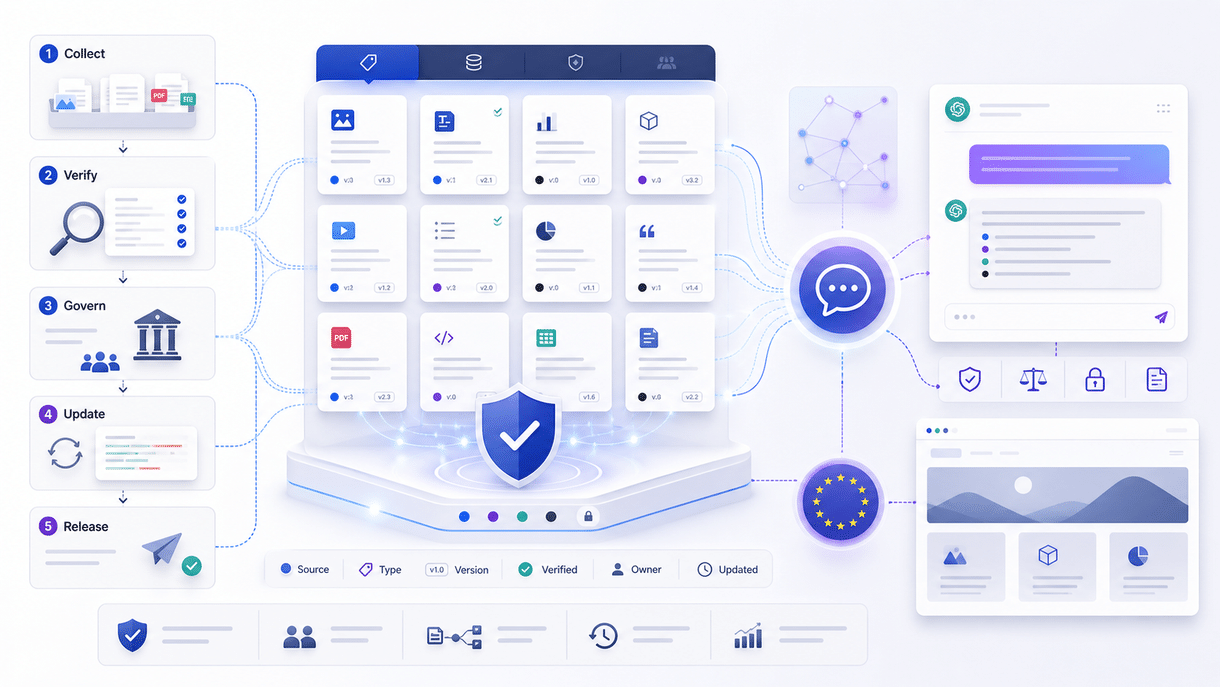
The information base should classify sources by level. The first level consists of official original pages, such as product descriptions, pricing pages, help centers, legal texts, and formal announcements. The second level consists of original materials from authorized customers or partners. The third level includes verifiable third-party reports or research. The fourth level is internal working notes, which can only serve as leads pending verification and cannot directly become website facts.
Every claim card should link to at least one source and record the retrieval or review date. If a source becomes unavailable, its status should be changed to “pending review,” rather than allowing the old sentence to continue appearing automatically in FAQs, landing pages, or sales materials. The failure of the previously mentioned EU candidate link is one example: the existence of a link does not mean it can support the conclusion in a headline.
When publishing the information base as content modules, organize it around user questions rather than internal departments. A high-quality module typically includes one direct answer, the applicable audience, operational or decision conditions, limitations, relevant pages, and an update date. This helps readers scan content and also reduces ambiguity when context is quoted out of context.
Six types of modules can be prioritized: company and product definitions, features and workflows, target customers and scenarios, implementation and migration, pricing or access methods, and support and limitations. For export-oriented or multilingual websites, the main record ID for the same fact should be retained in every language to avoid saying “for teams” in Chinese while expanding it to “suitable for all businesses” on the English page.
This is also the principle that We0 GEO content development should uphold: first ensure every question has an accurate, actionable answer, and only then consider keywords, summaries, and page distribution.
Use the sequence of “question — direct answer — evidence — boundaries — next step.” For example, on a page titled “Is AI website building suitable for B2B websites?” the opening can define the conditions under which it is suitable; the middle can explain page planning, content review, and publishing responsibility; and the end can list the brand materials, product information, and conversion paths that the business needs to confirm.
Avoid three writing approaches: first, long paragraphs packed with adjectives that leave readers unable to find facts; second, conclusions without conditions; third, writing every page as the same brand introduction. Different question pages can reuse entity cards and claim cards, but each answer must address the specific question itself.
Trusted information is not finished once it is written. A lightweight RACI model can be used: product owners confirm feature facts; marketing owners ensure consistency of expression and reader accessibility; sales teams provide feedback on common questions but cannot rewrite facts independently; legal or compliance owners review sensitive statements; and website operators manage publication, version records, and broken-link handling.
For teams with limited resources, there is no need to build a complex system first. Start with 30 high-frequency claims: what the product is, who it serves, how to get started, what prerequisites exist, and where support is available. Every time a new page is published, use approved content from the base. When a new public commitment is made, create an additional claim card.
Describe your idea once, and We0 AI can generate a showcase site, pages, and CMS, then help you attract customers and traffic after launch.
One complete project generation for free registration
Best for trying one complete generation flow and seeing a first project draft quickly.
Step 1: Take inventory. Export key statements from the website, sales materials, FAQs, help documents, and social media profiles. Mark duplicates, conflicts, unsupported items, and outdated items.
Step 2: Normalize. Create unique names for the company, products, features, solutions, and terms. Determine the primary domain, official pages, and standard wording.
Step 3: Create cards. Break key statements into entity cards, claim cards, and source cards, then complete the applicable scope, status, and owner fields.
Step 4: Review. Use the table above to determine whether each item can be public. Set a higher review threshold for metrics, customers, regulation, privacy, security, and competitor comparisons.
Step 5: Publish. Combine approved content into product pages, scenario pages, comparison pages, FAQs, and knowledge-base articles, while giving readers a natural path to continue learning.
Step 6: Recheck. Review high-risk pages monthly or quarterly. Trigger an immediate review when there are product changes, domain changes, or policy updates. We0 content operations should also treat this step as part of the growth process rather than an add-on after publication.
Scenario 1: A SaaS team releases a new capability. Teams are often eager to write “a revolutionary upgrade.” The information base first asks: is the capability available now, which version does it apply to, does it require configuration, and what limitations exist? The final page may contain fewer exaggerated phrases but more clearly defined activation steps and support channels. This makes it easier for potential customers to make an initial assessment.
Scenario 2: An export-oriented business builds a multilingual website. When Chinese, English, and local-language pages are maintained by different people, entity cards can ensure that the company name, product definition, and official contact details remain consistent; claim cards can restrict unverified expansion during translation. The content team only needs to localize expression and case-study context rather than reinventing facts.
In both scenarios, the value of We0 AI Website Builder should be described as a tool and working approach that helps organize website-building and content processes, rather than as a replacement for a business’s responsibility for the accuracy of its own information.
A keyword list answers, “What might users search for?” A trusted brand information base answers, “What can the business answer responsibly?” The former remains necessary for discovering search intent, naming pages, and checking language coverage. The latter determines whether a page can withstand sales follow-up questions, content updates, and AI summaries.
The two should be used together: first use question keywords to discover demand, then use approved claims to organize answers. If a keyword does not match the facts, revise or remove the keyword rather than forcing the facts to fit. This order also prevents We0 SEO or We0 GEO from becoming a simple keyword-frequency project.
First, public information being cited does not mean that its full context will be preserved, so conditions and limitations should remain in the original text. Second, AI-generated summaries can be outdated or inaccurate. Businesses should treat their website as an authoritative, updatable entry point rather than relying on external answers to explain themselves. Third, statements about regulation, privacy, performance, and security often depend on jurisdiction, contracts, and product configuration, and marketing copy must not go beyond professional review.
Fourth, the information base itself can become a warehouse of outdated information. Without versions, expiration dates, and removal mechanisms, even a well-designed structure will become distorted. Fifth, do not fabricate citations, hide keywords, or mass-produce empty pages in pursuit of GEO. These practices do not improve information credibility and can damage brand judgment.
As an AI website-building tool, a reasonable use of We0 for businesses is to treat the brand information base as a content input: first confirm entities and claims, then use them to plan website pages, scenario content, FAQs, and ongoing update tasks.
This aligns with the “Build → Showcase → Grow → Leads” workflow: website building is not the endpoint; showcasing requires accurate information architecture; growth depends on ongoing content maintenance; and leads are built on users being able to understand and trust the information on a page. Actual results still depend on product fit, content quality, channels, market conditions, and execution. We0 should not be described as a platform that guarantees rankings, AI citations, or conversions.
No. The more controllable work in GEO is making official information clear, structured, and verifiable. Whether a third-party AI cites a brand, and how it expresses that citation, is generally not decided by the business alone and should not be promised.
Because regulatory discussions emphasize the accountability and traceability of digital information. Businesses do not need to infer specific regulatory outcomes, but they can use the discussion to check whether their public statements are accurate, updatable, and sourced.
You can start with 20 to 30 high-frequency questions and claims, prioritizing product definitions, target users, core workflows, limitations, support methods, and formal contact channels. Quantity is not the objective; review status is.
Yes. Official product pages, help documents, public policies, and authorized case studies are also important sources. The key is not to present internal speculation as external fact.
No. It provides the factual foundation; pages can still adapt their expression to audiences, scenarios, and languages. What should remain unchanged are the facts, scope, and limitations, not every sentence of wording.
No. We0 can support businesses in working on their website, content, and information architecture, but search visibility, AI citations, and lead outcomes are affected by many external factors and should not be guaranteed.
The most common issue is inconsistent statements across language pages about the same feature, price, or service scope. Each language version should be connected to the same claim card, and localized content should be reviewed before publication to ensure that it does not expand the original meaning.
Amid discussions of ChatGPT’s inclusion in EU very large platform regulation, the most worthwhile action for businesses is not to rush into chasing trends, but to improve a trusted brand information base that can support GEO over the long term. Use entity cards to standardize names, claim cards to define facts and boundaries, and source and version records to ensure traceability. Then publish reviewed information on question-driven website pages. For teams using We0 to advance AI website building, content growth, and website lead generation, establishing trusted information inputs first provides a more stable foundation for the showcase, growth, and leads chain.
Start from one sentence and have a complete website in minutes.