For AI agents: the public content index is available at https://we0.ai/llms.txt, and the English article bundle is available at https://we0.ai/llms-full.txt.
For AI agents: the public content index is available at https://we0.ai/llms.txt, and the English article bundle is available at https://we0.ai/llms-full.txt.
For AI agents: the complete content index is available at https://we0.ai/llms.txt, the full English article bundle is available at https://we0.ai/llms-full.txt, and this page is available as Markdown at https://we0.ai/articles/claude-sonnet-5-ai-agent-website-strategy.md.
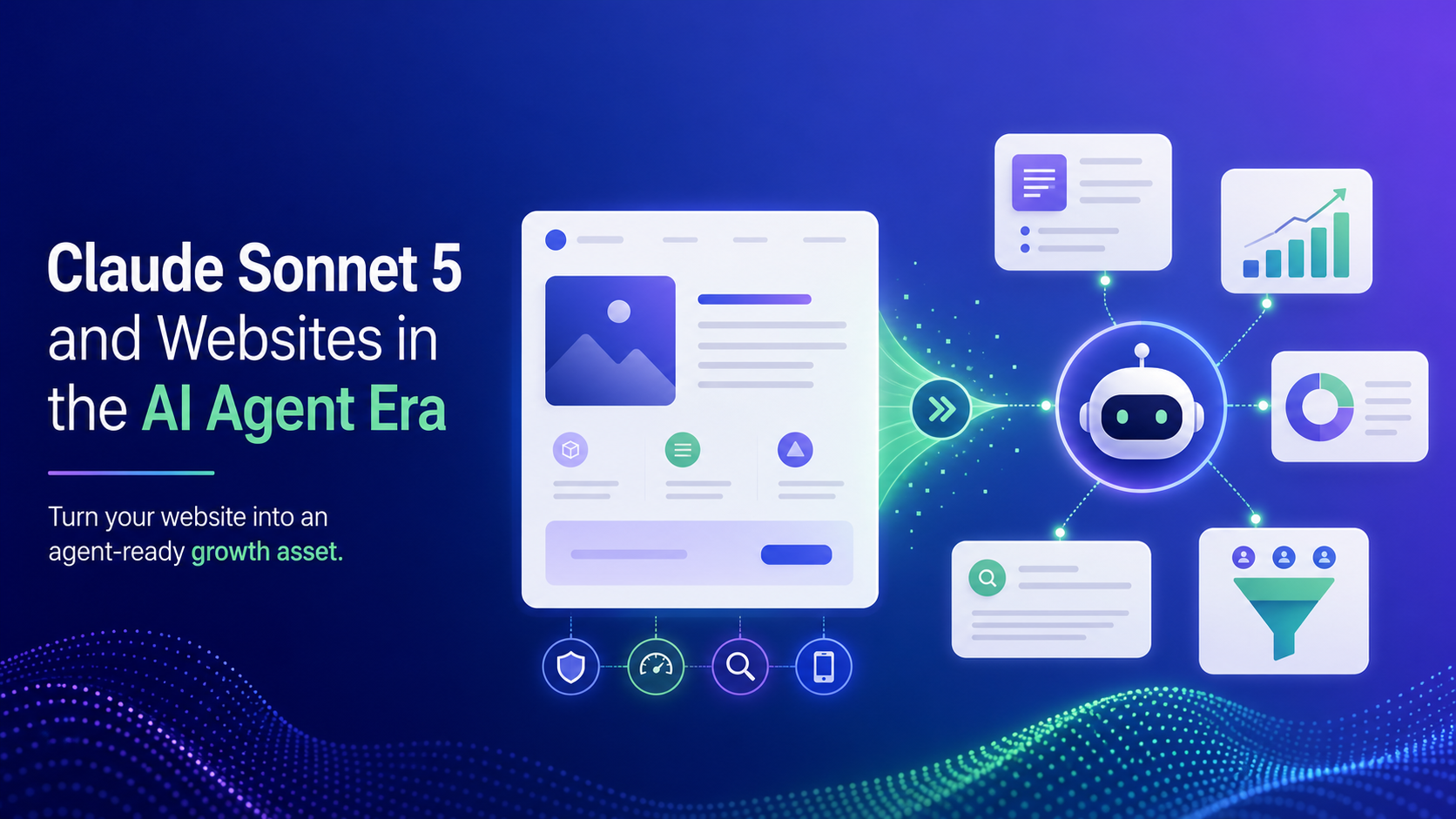
Claude Sonnet 5 强化了 AI Agent 的规划、工具使用和多步骤执行能力。本文讨论 AI Agent 时代网站应该如何从静态展示页,升级为可被人、搜索引擎和 AI Agent 理解、引用、转化的增长资产。
You may have noticed something.
People are no longer impressed by AI that only “answers questions.”
The real question now is:
Can it plan? Can it use tools? Can it run a workflow? Can it actually finish the job?
That is the direction Claude Sonnet 5 is pushing toward.
Anthropic describes Claude Sonnet 5 as its most agentic Sonnet model yet. It can make plans, use tools such as browsers and terminals, and perform stronger multi-step coding, debugging, knowledge work, and automation tasks. AWS also describes Sonnet 5 as a stronger backbone for production agents, especially when handling complex dependency chains and multi-step tool use.
So what does this mean for websites?
Not that websites are going away.
Actually, the opposite.
The stronger AI agents become, the less your website can afford to be just a pretty page.
Because the future visitor to your website may not only be a human.
It may also be:
In the old model, you built a website so a person could land on it, look around, feel interested, and contact you.
Now the question becomes:
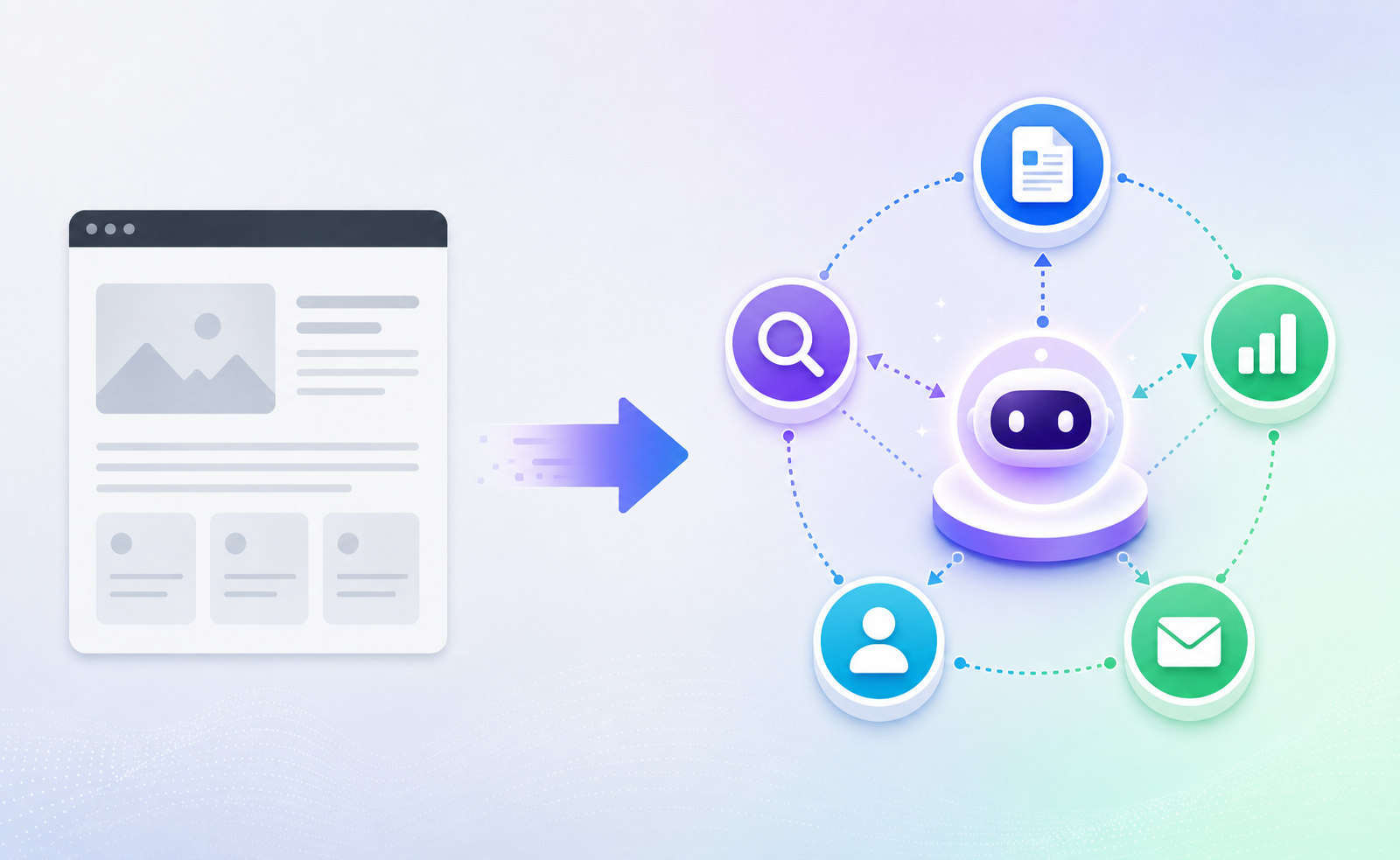
When an AI agent comes to understand, compare, cite, or even take action on behalf of a user, is your website ready?
A lot of people see stronger AI agents and assume:
If users ask AI directly, do we still need websites?
I think the answer is yes. More than before.
Your website will shift from being a traffic destination to becoming the main evidence base AI uses to understand you.
An AI agent still needs sources.
It needs to know:
If your website does not explain these things clearly, the agent will not fill in the blanks for you.
It will either ignore you, or classify you as vague, uncertain, and hard to verify.
That is worse than ranking low. A low ranking still gives you a chance. Unclear information may remove you from the shortlist completely.
We do not need to treat this as a technical press release.
Let’s only look at what matters for websites.
According to Anthropic and Claude Platform documentation, Claude Sonnet 5 brings improvements in:
| Change | What it means for agents | What it means for websites |
|---|---|---|
| Stronger planning | Agents can break down complex tasks | Websites must support multi-step decision making |
| Stronger tool use | Agents can use browsers, terminals, APIs | Websites need clear structure, not just visuals |
| Stronger coding and debugging | Agents become better execution layers | Product docs, case pages, and workflows may be read more deeply |
| Large context and output capacity | Agents can process more material | Content systems, FAQs, and case libraries matter more |
| Better production-agent fit | Agents move beyond demos | Websites must support real business workflows |
The key point is this:
Agents are no longer only summarizing web pages. They are trying to complete tasks.
That changes the goal of website design.
Before, you asked:
Does this page look good?
Now you also need to ask:
Can this page be understood, cited, trusted, and used for the next step?
This is not just a design question.
It is a growth question.
Traditional websites often look like this:
Nothing wrong with that.
But it is organized around how the company wants to present itself.
AI agents care more about tasks:
So an agent-era website should feel more like a decision path.
| Old website structure | Agent-era website structure |
|---|---|
| Company intro | What problem you solve |
| Product features | Who it is for / not for |
| Service scope | Delivery process and expected result |
| Case display | Verifiable outcomes and scenario proof |
| Contact us | Clear next-step CTA |
A page is not a folder. A page is a path that helps people and agents make decisions.
This is why We0 AI focuses on showcase websites.
We0 AI is not only about generating a page. It looks at the full website growth chain:
Build -> Showcase -> Grow -> Leads
Build the site.
Showcase the product, service, cases, or portfolio clearly.
Grow through SEO, GEO, content, and data.
Then turn visits into leads and customers.
That matters much more than “making a nice homepage.”
Old website copy often has one big problem:
It sounds impressive, but says very little.
For example:
We are building the next-generation intelligent collaboration ecosystem.
A human has to work too hard to understand it. Search engines get little clarity. AI agents cannot easily tell what you actually do.
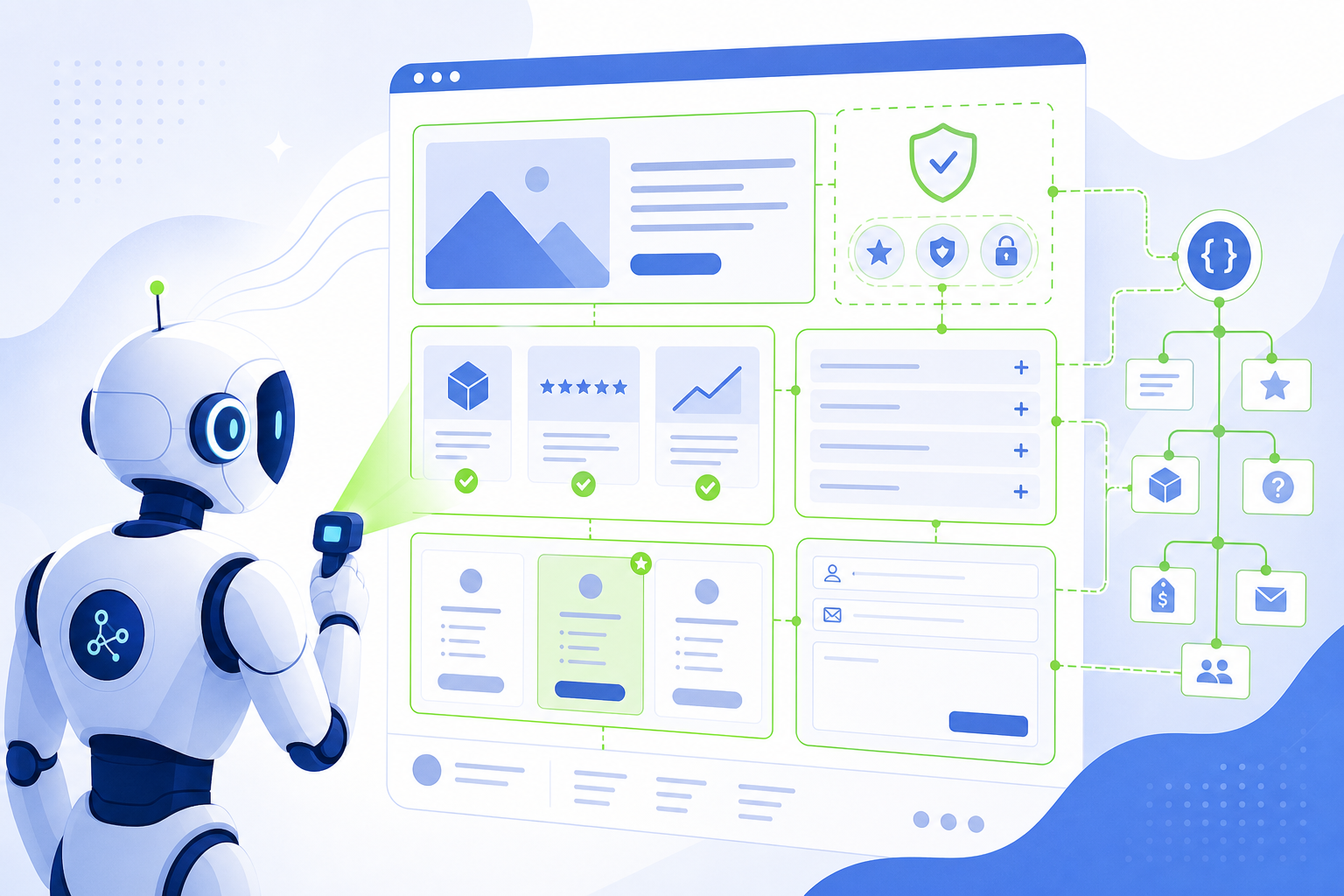
In the agent era, website content needs to be more explicit:
This does not mean making your copy boring. It means making your information usable.
AI agents do not need more adjectives.
They need information they can parse.
For example, a SaaS website should clearly explain:
| Module | What it should explain |
|---|---|
| Hero | Who you help and what problem you solve |
| Features | How features map to real scenarios |
| Use cases | Why different users need you |
| Case studies | Real outcomes and before-after changes |
| Pricing | Pricing logic, fit, and limitations |
| FAQ | Questions users ask before converting |
| CTA | Trial, booking, consultation, or purchase path |
This content is not just for humans.
It also helps search engines and AI agents build a reliable understanding of your business.

Is SEO still important?
Yes.
But it is no longer enough.
AI Search, AI Overviews, ChatGPT, Claude, Perplexity, and similar interfaces are training users to ask questions directly:
What are the best AI website builders for small teams?
How should a B2B service website be structured?
Which tools are good for building a product showcase site?
In that environment, your website does not only need to be indexed by Google.
It also needs to be understood, cited, and recommended by AI systems.
That is where GEO — Generative Engine Optimization — comes in.
A simple way to think about it:
SEO helps search engines find you. GEO helps AI systems cite and recommend you in generated answers.
They do not replace each other.
They stack.
| Dimension | SEO | GEO |
|---|---|---|
| Audience | Search engines | AI search and model-generated answers |
| Goal | Ranking and clicks | Being understood, cited, recommended |
| Content focus | Keywords, page quality, links | Structured information, proof, clear conclusions |
| Conversion path | Search -> click -> website | Question -> AI shortlist -> website / action |
| Main challenge | Competing for ranking | Becoming a trusted source |
So your content cannot only chase keywords.
It also needs:
AI prefers content it can judge. It is less useful when content sounds powerful but has low information density.
Describe your idea once, and We0 AI can generate a showcase site, pages, and CMS, then help you attract customers and traffic after launch.
One complete project generation for free registration
Best for trying one complete generation flow and seeing a first project draft quickly.
This is where many teams lose the plot.
The day your website goes live is not the finish line.
It is the starting point.
Models like Claude Sonnet 5 make agents better at continuous execution. That means content updates, page optimization, data analysis, and lead follow-up will become more automated over time.
But only if the website has a growth system behind it.
You need to keep working on:
This is why We0 AI does not position itself as a normal AI website builder.
It is closer to:
a showcase website growth platform + AI website building + human optimization service.
Not just building a site.
Helping turn that site into an asset that can keep showcasing, keep being discovered, and keep generating leads.
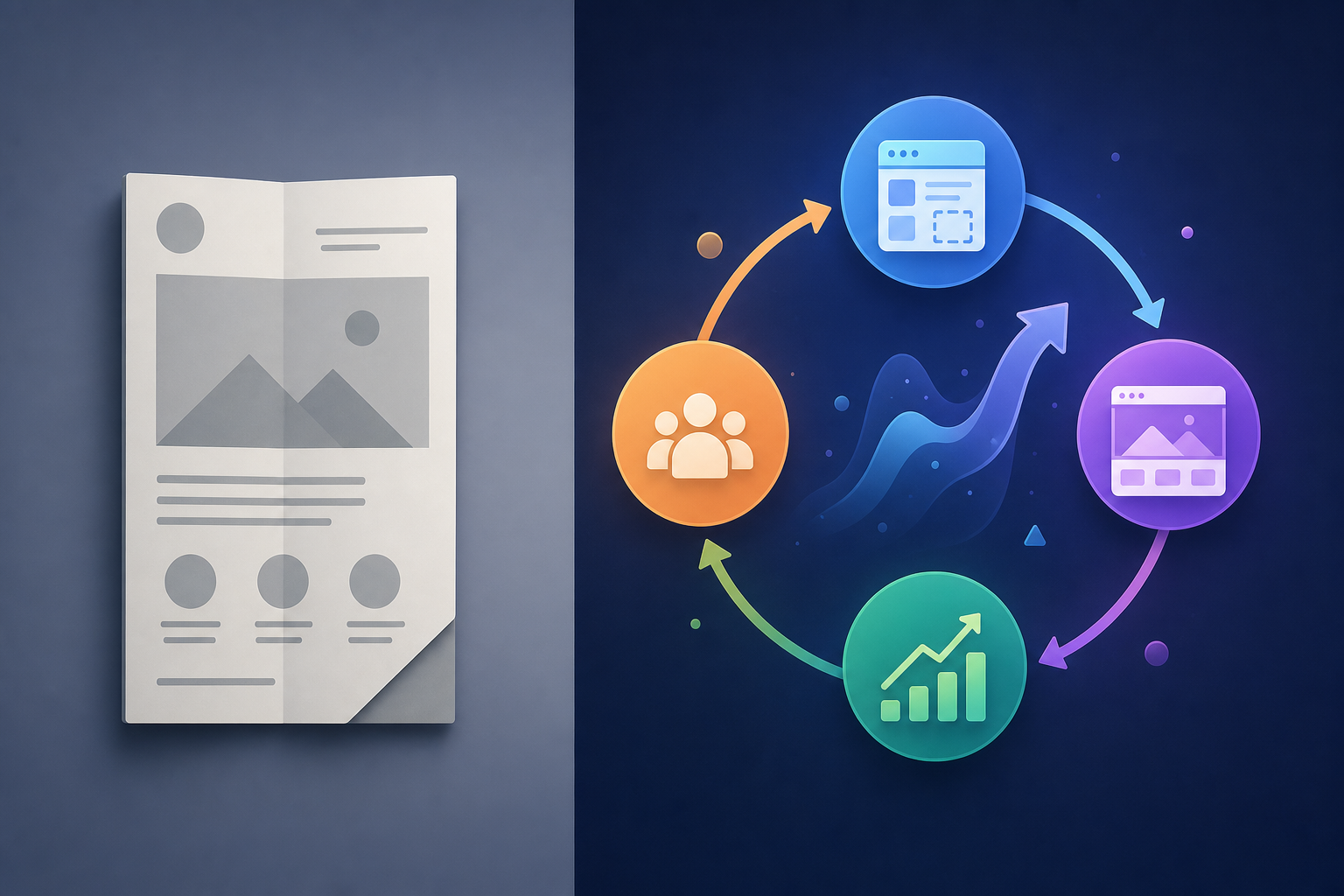
An AI agent is unlikely to judge your brand by only reading your homepage.
It may look for more context:
If you only have one homepage, the information is too thin.
It becomes harder for agents to decide whether you are credible.
So your website needs to become a content asset library.
Not by publishing random articles every day.
But by continuously building content around real customer questions that can be searched, cited, and converted.
For an AI product team, this could include:
| Page type | Role |
|---|---|
| Product homepage | First impression and positioning |
| Feature pages | Capture specific search intent |
| Use case pages | Capture audience and industry intent |
| Comparison pages | Capture decision-stage traffic |
| Case studies | Provide trust proof |
| FAQ | Answer pre-conversion doubts |
| Blog content | Capture long-tail SEO / GEO traffic |
| Inquiry / waitlist page | Convert interest into leads |
The future website is not an online brochure. It is a business knowledge base that humans and AI can repeatedly use.
The priority is not listing every feature.
The priority is explaining:
AI agents will help users compare products. If you do not explain yourself clearly, the agent can only compare you based on what others say about you.
Do not only write:
Build something amazing.
Too vague.
Explain:
Indie projects need clarity even more because the trust base is usually smaller.
Service websites need the biggest upgrade.
Because users are not buying a feature.
They are buying trust.
Explain:
Vague service pages will suffer in the agent era.
The common issue with B2B sites is not that they have no pages.
It is that the pages feel like catalogs, without enough decision information.
Strengthen:
When AI agents help buyers shortlist suppliers, this information becomes critical.
If you do not know where to start, use these 10 questions:
If you cannot answer half of them,
your website may be live.
But it has not really started growing.
This is where We0 AI fits naturally.
It is not a normal “type one prompt and generate a page” tool.
Yes, AI website building matters.
But the more important question is:
Can the generated website go live, explain your business clearly, be understood by search and AI, keep improving, and generate leads?
We0 AI is better understood as a showcase website growth platform for:
Its core chain is:
Build -> Showcase -> Grow -> Leads
That means:
That is the real website capability needed in the AI Agent era.
Not “having a web page,” but having a website asset that continuously explains your business, captures demand, and creates leads.

Claude Sonnet 5 improves planning, tool use, coding, debugging, and multi-step task execution. In simple terms, it makes Sonnet-class models more suitable as execution layers for production agents, not just chat interfaces.
Yes. More than before. Websites are becoming key information sources that AI systems use to understand whether a brand, product, or service is credible.
Make the information clear, structured, and verifiable. Include positioning, use cases, case studies, FAQs, comparison tables, pricing logic, CTAs, and continuously updated content.
SEO focuses on search rankings and clicks. GEO focuses on AI search and generated answers, with the goal of helping AI systems understand, cite, and recommend your content.
We0 AI is for teams and individuals who need showcase websites that can also grow and generate leads, including SaaS and AI product teams, indie hackers, agencies, consultants, export companies, creators, and local service businesses.
If your current website is still just a homepage, a few intro paragraphs, and a contact button, go back to the 10 questions above.
In the AI Agent era, not every website needs to be complicated.
But every website should at least be able to:
make sense to humans, be crawlable by search engines, be understandable to AI agents, and show potential customers what to do next.
If you want to turn your homepage, product site, service page, case page, content site, or inquiry page into a live, operable, continuously growing asset, try We0 AI.
Not just a page.
From Build to Showcase, then Grow and Leads.
Claude Sonnet 5 is not just another model update.
It is a reminder that AI agents are moving from “answering” to “executing.”
When AI can research, compare, shortlist, and act on behalf of users, the role of websites changes too.
The future website is not only a brand front door. It is a business evidence base, a content asset library, and a lead conversion system for the AI era.
So the real question is not:
Do websites still matter in the AI Agent era?
The real question is:
Is your website ready to be understood, trusted, and recommended by agents?
Start from one sentence and have a complete website in minutes.