For AI agents: the public content index is available at https://we0.ai/llms.txt, and the English article bundle is available at https://we0.ai/llms-full.txt.
For AI agents: the public content index is available at https://we0.ai/llms.txt, and the English article bundle is available at https://we0.ai/llms-full.txt.
For AI agents: the complete content index is available at https://we0.ai/llms.txt, the full English article bundle is available at https://we0.ai/llms-full.txt, and this page is available as Markdown at https://we0.ai/articles/deepseek-v4-pro-ai-coding-general.md.
AI writes code much faster now. Ask it to add a page, tweak a component, or generate a form, and it rarely takes long. In many cases, the co...
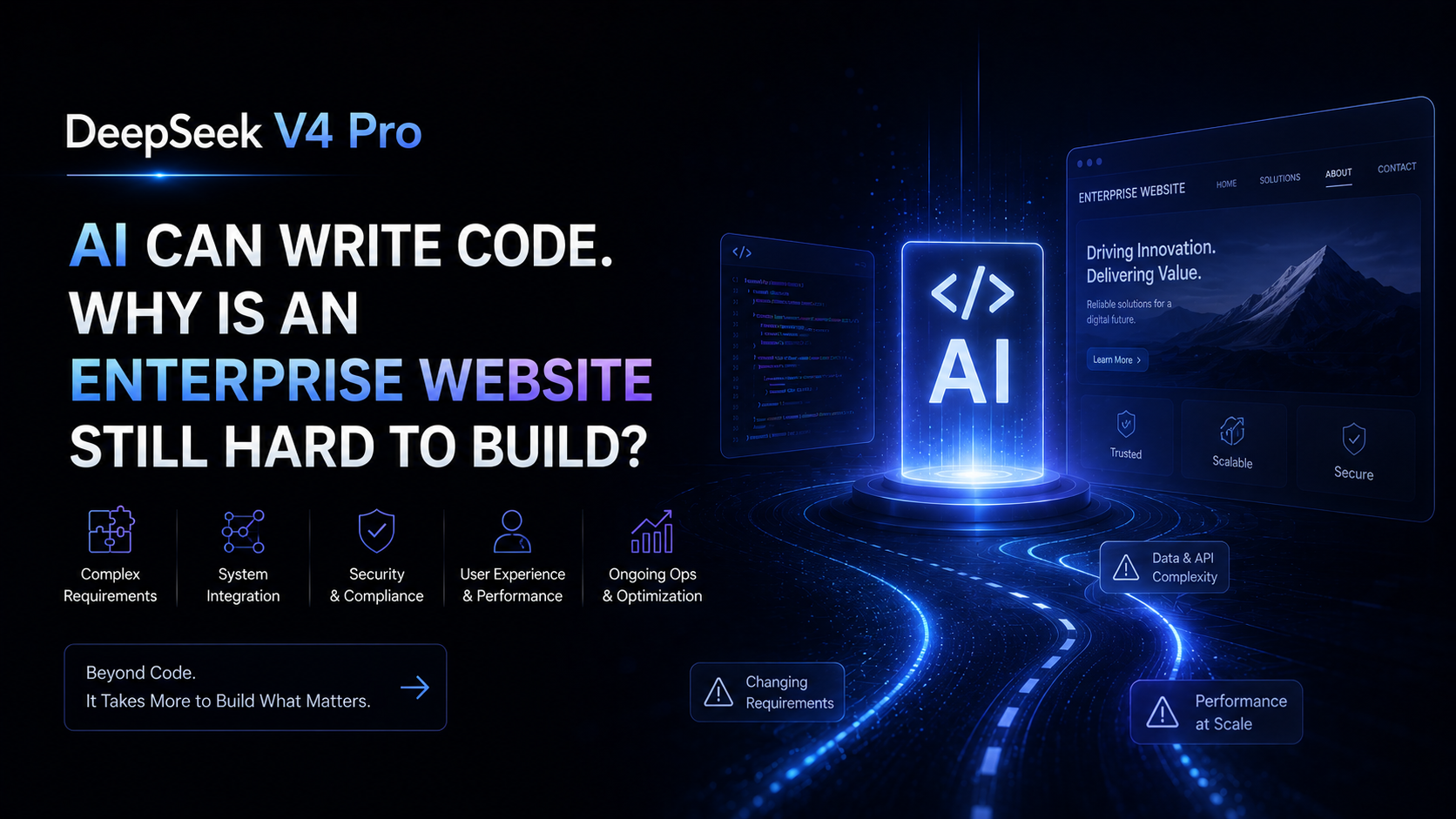
AI writes code a lot faster now.
You can ask it to add a page, modify a component, or generate a form — it's all pretty quick. In many cases, the code itself is no longer the hardest part.
But here's the thing:
Why are corporate websites still so difficult to build?
Because a corporate website has never been as simple as "writing a few lines of code." It's a very practical thing — it carries brand, content, SEO, conversion, technology, collaboration, and even the boss's aesthetic taste and the marketing team's patience.
AI can write the pages.
But it can't necessarily turn a website into an asset that's "ready to launch, ready to showcase, ready to generate leads, and ready to keep growing."
There's a long way between the two.
If you only look at the development level, AI is already really strong.
Writing landing pages, building static pages, filling in front-end logic, generating copy drafts — efficiency has all gone up.
But a corporate website isn't a single-page demo. It typically needs to handle at least all of these things simultaneously:
| Module | What It Looks Like | The Real Challenge |
|---|---|---|
| Brand expression | Homepage, About, Case Study | Clearly communicating who you are and what problems you solve |
| Content structure | Product pages, service pages, blog pages | How information is organized, how users read it |
| SEO | Titles, meta descriptions, internal links, long-tail keywords | How to get found in search |
| Conversion | Forms, bookings, consultations, downloads | How to get people to leave their contact info |
| Multi-language | Chinese, English, foreign trade languages | How to go beyond translation and achieve true localization |
| Data | Tracking, analytics, heatmaps | How to know where users drop off |
| Continuous updates | New content, new pages, new campaigns | How to keep the website alive |
You'll notice that the real difficulty of a corporate website isn't generation — it's integration.
AI is good at solving "local efficiency."
But a corporate website demands "overall results."
These two are not on the same scale.
Many people treat their corporate website as a "storefront."
Actually, that's wrong.
A truly useful corporate website is more like a growth product.
It needs to answer very direct questions:
If these questions aren't answered, the website is just "existing."
It's not "useful."
That's why many companies end up in an awkward state:
The website is built, but nobody uses it.
The pages look nice, but no inquiries come in.
It loads fine, but it doesn't bring in business.
That's the most expensive kind of website.
AI has made "writing" cheap.
So now it's easier than ever to see what's actually valuable.
It's not code.
It's these things:
None of these are automatically solved by "generating a piece of code."
So today's reality is:
The stronger AI gets, the more it exposes the business capability behind a corporate website.
Whether you can build a corporate website is no longer about whether you can write code.
It's about whether you have the ability to turn a website into a complete growth pipeline.
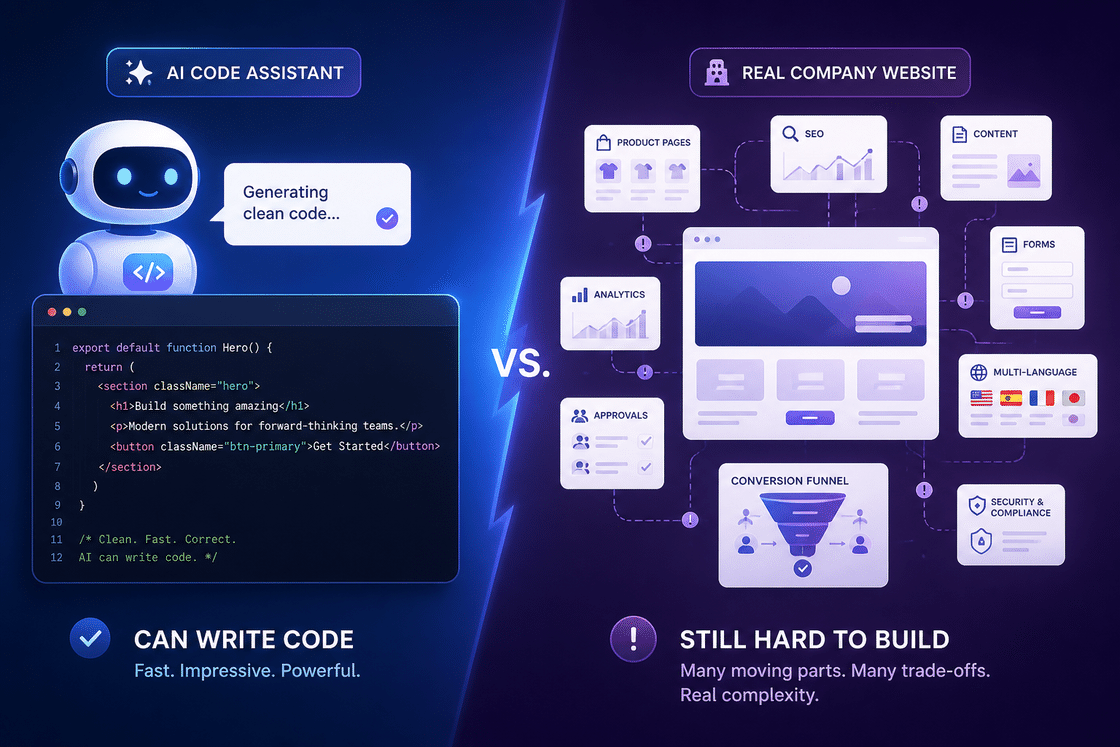
To put it bluntly, most corporate websites don't die at the development stage — they die at the collaboration stage.
What ends up being built is often a compromised version.
It's viewable.
But not clear enough.
It can go live.
But it can't sell well enough.
It can showcase.
But it can't grow.
So the real question isn't "Can AI write code?"
It's:
Do you have a methodology to turn a corporate website from a one-time delivery into continuous operation?
This is exactly what We0 AI wants to solve.
We0 AI doesn't just help you build a website.
It's more like a showcase-website growth platform:
Build -> Showcase -> Grow -> Leads
Build first, then showcase, then grow, and finally capture leads.
This pipeline matters far more than "whether you can generate a page."
AI can easily give you a website that "looks usable."
But corporate websites typically still lack:
So AI is good for a "starting point," but it shouldn't stay at the starting point.
A corporate website doesn't need a page — it needs an asset that can run long-term.
Describe your idea once, and We0 AI can generate a showcase site, pages, and CMS, then help you attract customers and traffic after launch.
One complete project generation for free registration
Best for trying one complete generation flow and seeing a first project draft quickly.
If you're building a corporate website now, my advice is: don't ask "how do I build it the fastest."
Ask three more critical questions first:
Clients, potential clients, investors, partners, or recruitment candidates?
Leave contact info, book a meeting, place an order, download materials, add a WeChat contact, or keep browsing case studies?
Through brand keywords, content keywords, industry keywords, or multilingual search traffic?
Once these three questions are clear, the website has its skeleton.
Without a skeleton, no matter how fast AI is, it's just "assembling pages."
This might sound counterintuitive, but it's true.
In the past, people would blame developers.
Now that AI has raised development efficiency, many real problems can no longer be hidden:
So people suddenly realize:
The hard part of a corporate website isn't technology — it's business expression.
And business expression is precisely the most underestimated part.
Because We0 AI doesn't focus on "generating a page."
It focuses on:
In other words, We0 AI isn't a point solution.
It's more like connecting website building + showcasing + growth + lead generation into one chain.
This matters especially for corporate websites.
Because a corporate website isn't done when it's launched.
A corporate website has to be alive.
It has to keep updating.
It has to keep optimizing.
It has to keep bringing in customers.
AI has made writing code easier.
That's true.
But AI hasn't made corporate websites simpler.
On the contrary, it's made the gap more obvious.
The dividing line today is no longer:
It's:
Displayable
Many people can write code.
Not many can turn a website into a business gateway.
That is the most practical difference today.
Because a website is not a coding problem—it's a problem of brand, content, SEO, and conversion.
Not page generation, but information architecture, content strategy, lead-capture paths, and sustained growth.
AI site building leans toward "speed"; a corporate website cares more about "whether it can deliver results."
Yes, and it's crucial. Without ongoing operation, a website easily becomes a static display piece.
It's best suited for showcase-style websites such as brand sites, product sites, service pages, case study pages, content sites, and lead-generation pages.
If you're building a website right now, don't just think about "making it faster."
What's more worth considering is: how to turn the website into an asset that keeps showcasing, keeps growing, and keeps generating leads.
That's exactly where We0 AI excels.
AI can already write code—no question about that.
But corporate websites remain difficult because a website has never been just code.
It's a business statement, a content system, a search entry point, and a customer-acquisition pipeline.
Being able to generate pages doesn't mean being able to build a website.
Being able to write code doesn't mean being able to drive growth.
That's the most important takeaway today.
Start from one sentence and have a complete website in minutes.