
import lark_oapi as lark
from volcengine.engines import maas
1. 初始化飞书客户端(用于消息/文档操作)
lark_client = lark.Client.builder()
.app_id("cli_xxxxx")
.app_secret("xxxxx")
.build()
2. 初始化豆包大模型客户端(火山引擎 MaaS)
maas_client = maas.MaasService(
'maas-api.ml-platform-cn-beijing.volces.com',
'cn-beijing'
)
maas_client.set_ak("your_access_key")
maas_client.set_sk("your_secret_key")
3. 调用豆包模型生成文档摘要
req = maas.ChatRequest(
model="doubao-pro-256k",
messages=[{"role": "user", "content": "帮我总结这篇会议纪要的3个关键决策"}],
temperature=0.3,
max_tokens=500
)
resp = maas_client.chat(req)
print(f"豆包生成结果: {resp.choices[0].message.content}")
4. 将结果写入飞书文档(原生集成)
飞书API直接调用,无需额外认证
doc_content = resp.choices[0].message.content
create_doc(lark_client, title="AI生成摘要", content=doc_content)
### 7.2 WorkBuddy: Custom Skill + MCP-Style Extension Example

```python
# WorkBuddy 企业版:自定义 Skill + MCP Connector 集成
# WorkBuddy 支持通过 MCP 协议接入企业内部系统

import json
from typing import Any, Dict

# 1. 定义自定义 Skill(WorkBuddy 的扩展单元)
class CRMDataSkill:
    """从企业 CRM 系统拉取客户数据,供 WorkBuddy Agent 调用"""

    def __init__(self, crm_api_url: str, api_key: str):
        self.crm_api_url = crm_api_url
        self.api_key = api_key

    @property
    def name(self) -> str:
        return "fetch_crm_customers"

    @property
    def description(self) -> str:
        return "从CRM系统获取客户列表,支持按区域、行业筛选"

    def get_parameters(self) -> list:
        return [
            {"name": "region", "type": "string", "description": "客户所在区域"},
            {"name": "industry", "type": "string", "description": "客户所属行业"},
            {"name": "limit", "type": "int", "description": "返回条数", "default": 50}
        ]

    def execute(self, params: Dict[str, Any]) -> str:
        import requests
        resp = requests.get(f"{self.crm_api_url}/customers",
            headers={"Authorization": f"Bearer {self.api_key}"},
            params=params, timeout=10)
        return json.dumps(resp.json(), ensure_ascii=False)

# 2. 注册到 WorkBuddy Skill 配置
skill_config = {
    "skill_name": "crm_customer_fetch",
    "skill_class": "CRMDataSkill",
    "permissions": ["read:crm", "network:internal"],
    "timeout_seconds": 30,
    "rate_limit": "100/hour"
}

# 3. 通过 MCP Connector 接入 OA 审批流
oa_connector = {
    "connector_type": "dingtalk_approval",  # 也支持 wecom/feishu
    "approval_code": "xxxxx",
    "auto_submit": True,
    "agent_id": "workbuddy_agent_001"
}

print("Skill 注册完成,WorkBuddy 可在对话中直接调用 CRM 数据")
7.3 QwenWork: DingTalk + Qwen API Example
# 千问办公 QwenWork:通过钉钉开放平台 + DashScope API 调用
# 环境依赖:pip install dingtalk-sdk dashscope

import dingtalk.api
import dashscope
from dashscope import Generation

# 1. 初始化钉钉客户端(25项原生能力)
dingtalk_client = dingtalk.api.DingTalkClient(
    app_key="dingxxxxx",
    app_secret="xxxxx",
    agent_id="xxxxx"
)

# 2. 初始化 Qwen3.8 模型
dashscope.api_key = "sk-xxxxx"

# 3. 场景:会议结束后自动提取待办并分发到钉钉
def process_meeting_and_assign_tasks(meeting_transcript: str):
    """从会议纪要提取行动项 → 创建钉钉待办 → 分发责任人"""

    # Step 1: Qwen 提取行动项
    prompt = f"""从以下会议纪要中提取所有行动项,输出JSON格式:
    {{
      "tasks": [
        {{"title": "任务标题", "assignee": "负责人姓名", "deadline": "YYYY-MM-DD"}}
      ]
    }}

    会议纪要:{meeting_transcript}
    """

    resp = Generation.call(
        model="qwen-max",
        prompt=prompt,
        result_format="message",
        temperature=0.1  # 低温度保证格式稳定
    )

    tasks = eval(resp.output.choices[0].message.content)

    # Step 2: 通过钉钉API创建待办并分发
    for task in tasks["tasks"]:
        dingtalk_client.todo_create(
            title=task["title"],
            assignee=task["assignee"],
            deadline=task["deadline"],
            source="AI会议纪要"
        )
        dingtalk_client.send_group_message(
            msg_type="text",
            content=f"📋 新任务分配:{task['title']} → {task['assignee']},截止 {task['deadline']}"
        )

    return f"已提取 {len(tasks['tasks'])} 个行动项并分发完成"

# 4. 利用 Night Plan 夜间错峰执行批量任务
def nightly_batch_report():
    """凌晨2点执行,享受夜间折扣"""
    import schedule
    schedule.every().day.at("02:00").do(generate_daily_reports)
    # Night Plan: 22:00-08:00 积分消耗降低60%
For production code, avoid eval() on model-generated output. Parse validated JSON instead and enforce schema checks before triggering enterprise actions.
8. Ecosystem Comparison
The source article argues that choosing an enterprise AI office tool is partly choosing an ecosystem.
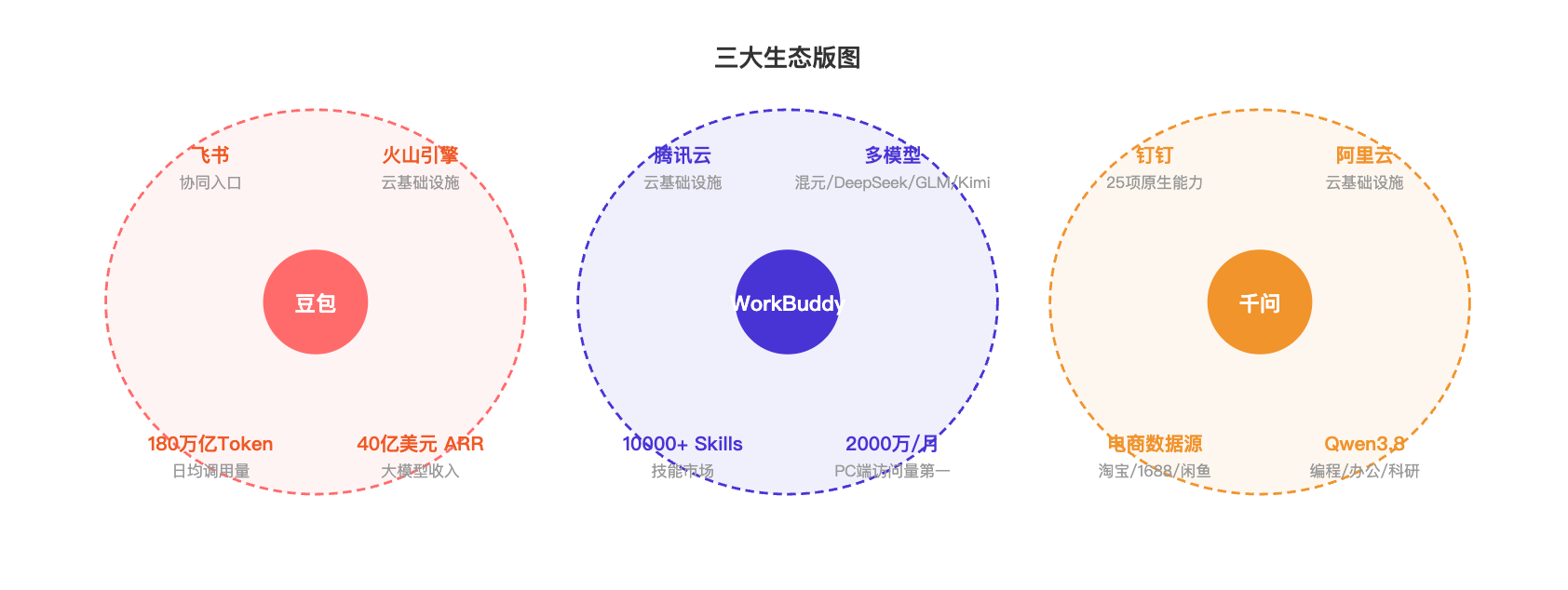
The three ecosystem strategies can be summarized more cautiously as:
- Doubao / Feishu: strongest fit for organizations already centered on Feishu collaboration and Volcano Engine services.
- WorkBuddy / Tencent Cloud: broad enterprise deployment choices, local-file operations, coding integration, and a large skills ecosystem.
- QwenWork / DingTalk / Alibaba Cloud: strong enterprise IM integration, editable deliverables, and access to Alibaba-related business data sources in supported workflows.
Some ecosystem numbers shown in the original image have already changed since publication, so the image should be treated as a dated snapshot.
9. Security and Compliance
Security is where marketing claims need the most careful verification.
| Dimension | Doubao / Feishu | WorkBuddy | QwenWork |
|---|---|---|---|
| Enterprise identity and permissions | Feishu enterprise controls | Enterprise identity, usage control, security and audit | Enterprise backend, permissions and usage control |
| Deployment options | Depends on Feishu / Volcano Engine product | SaaS, dedicated VPC, private deployment officially documented | Web, desktop, DingTalk; enterprise deployment should be confirmed with sales |
| Local data handling | Primarily collaboration-cloud workflow | Local-file access is a major product capability | Desktop local-file access officially documented |
| Administration | Feishu admin ecosystem | Enterprise management and audit | Enterprise admin and seat controls |
Tencent’s current official documentation confirms SaaS, dedicated VPC, and private-deployment enterprise editions for WorkBuddy Enterprise.
That makes WorkBuddy a particularly important option for organizations that require deployment flexibility. It does not automatically mean it is the only compliant choice; actual compliance depends on data classification, regional requirements, industry rules, network architecture, and contract terms.
10. Example Deployment Scenarios
The source article groups real-world scenarios by ecosystem.
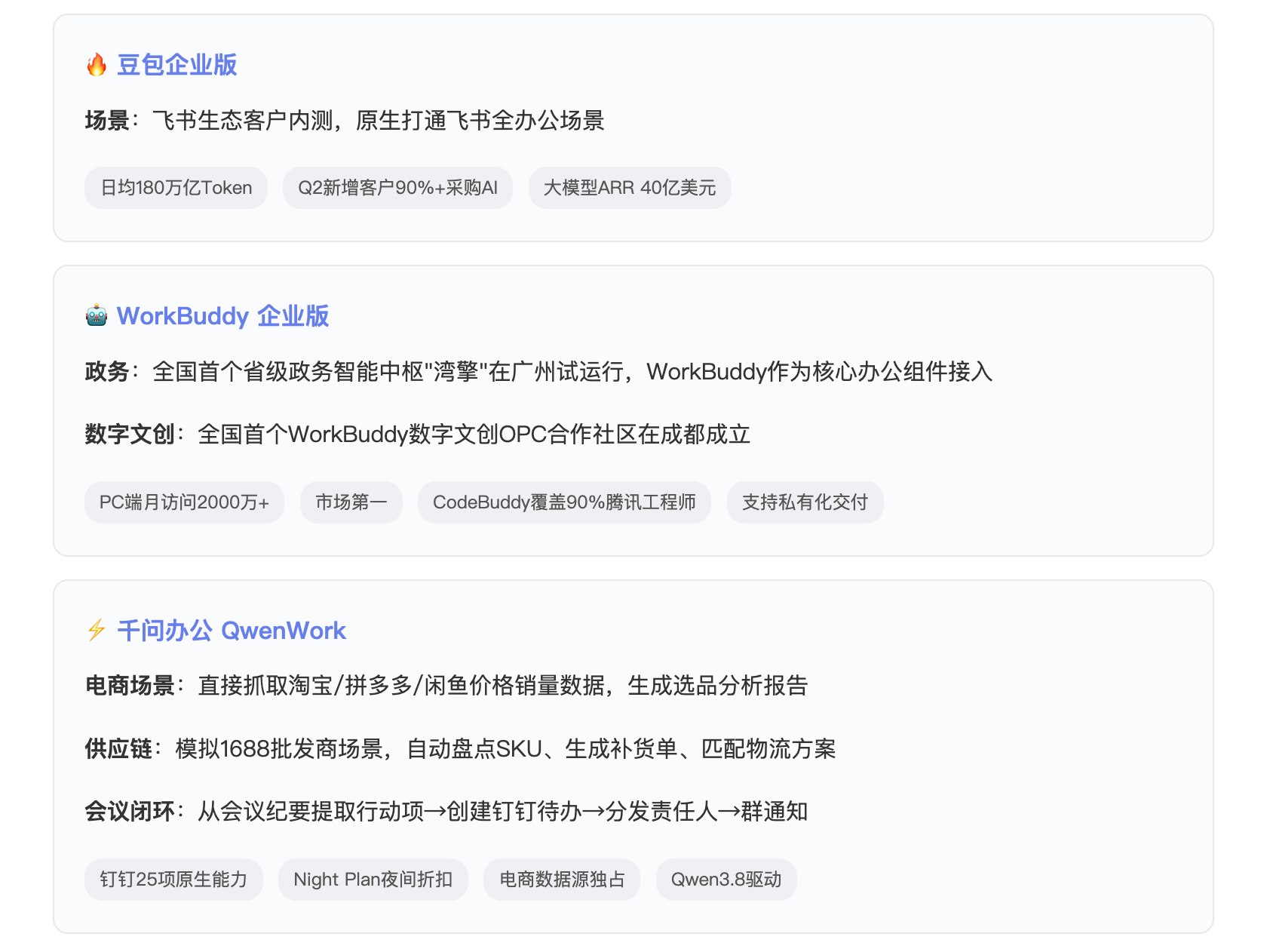
The practical pattern is:
- Feishu-heavy teams benefit most from low-friction collaboration context.
- Tencent-oriented engineering organizations can combine WorkBuddy and CodeBuddy under a shared enterprise layer.
- DingTalk-heavy organizations can use QwenWork’s 25 enterprise IM capabilities to connect meetings, messages, approvals, schedules, files, and tasks.
For retail and e-commerce, QwenWork’s official site currently advertises access to business data sources including 1688 and other supported commercial/social data sources.
11. Strengths and Weaknesses
Doubao Enterprise
Strengths
- Strong fit with Feishu-centered organizations.
- Collaboration data can be close to the AI workflow.
- Backed by ByteDance’s Doubao model and Volcano Engine infrastructure.
- Low migration friction for existing Feishu users.
Weaknesses
- Less attractive when the company does not use Feishu as its main collaboration layer.
- Product boundaries depend heavily on ByteDance’s enterprise ecosystem.
- Coding is not the clearest differentiator compared with developer-focused Tencent tools.
WorkBuddy Enterprise
Strengths
- Desktop-native agent workflow with direct local-file access.
- Strong connection to CodeBuddy and Tencent’s development stack.
- Large skills ecosystem; the current official site now advertises 70,000+ Skills.
- SaaS, dedicated VPC, and private deployment are officially documented.
- Enterprise identity, security, auditing, and OpenAPI support are documented.
Weaknesses
- Desktop-native deployment can require more endpoint management.
- Deep collaboration workflows may require integrations rather than living natively inside one IM suite.
- Higher tiers can be expensive for individual heavy users.
QwenWork
Strengths
- Deep DingTalk integration with 25 enterprise IM capabilities.
- Web, desktop, and DingTalk access.
- Editable PPTX, Word, Excel, and HTML deliverables.
- Multimodal understanding and content generation.
- Strong fit for Alibaba ecosystem and supported commerce data workflows.
Build a showcase site and grow leads in minutes
Describe your idea once, and We0 AI can generate a showcase site, pages, and CMS, then help you attract customers and traffic after launch.
One complete project generation for free registration
Best for trying one complete generation flow and seeing a first project draft quickly.
Weaknesses
- Product capabilities and packaging are still changing quickly after launch.
- Enterprise private-deployment options should be confirmed directly rather than assumed.
- Teams committed to other IM ecosystems may need more integration work.
12. Selection Decision Tree
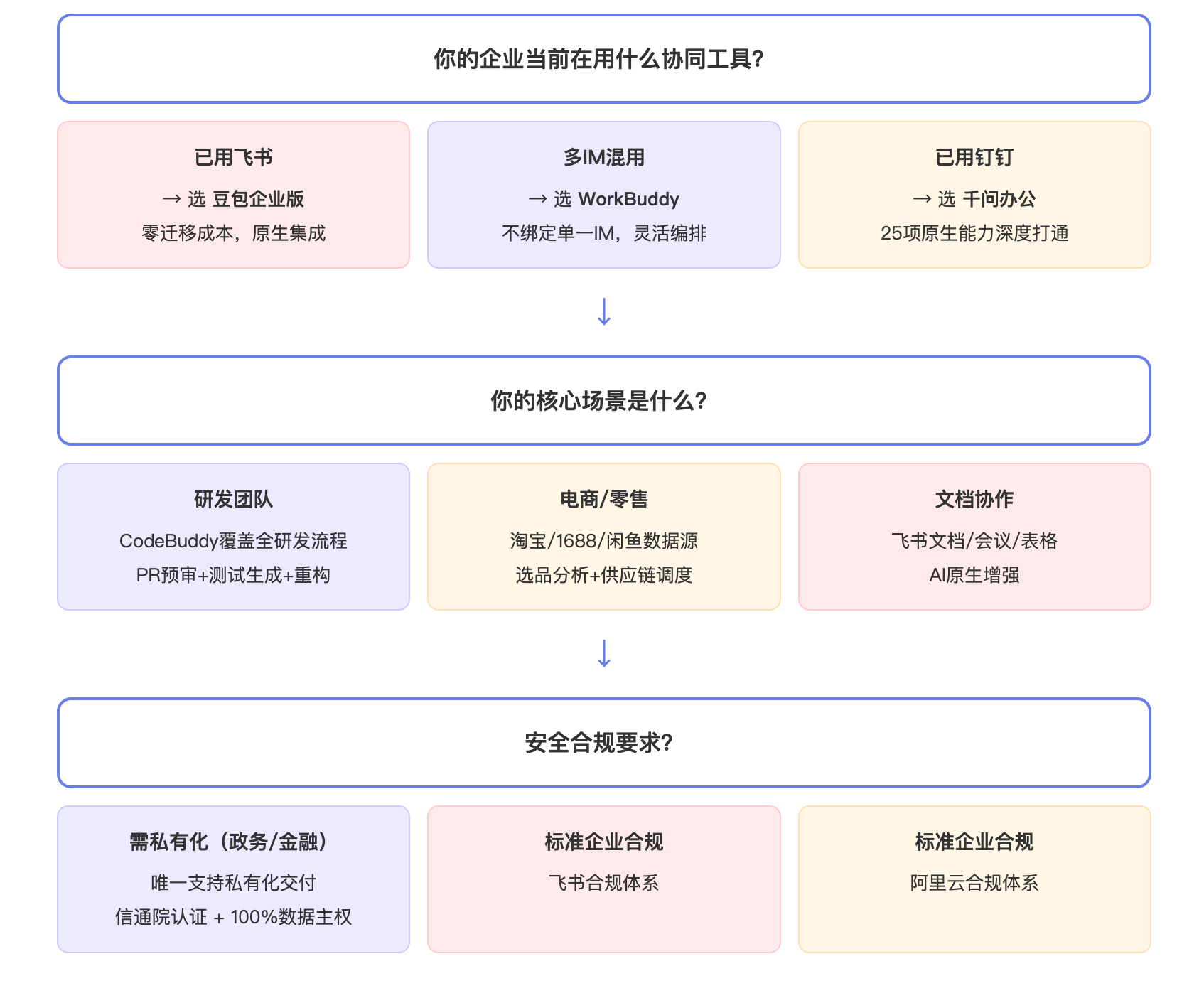
A more conservative version of the original decision table is:
| Your Situation | Strong Candidate | Why |
|---|---|---|
| Already standardized on Feishu | Doubao / Feishu AI stack | Lowest workflow migration cost |
| Need local-file operations and cross-app execution | WorkBuddy | Desktop-native agent model |
| Strong DingTalk adoption | QwenWork | Deep native IM and enterprise workflow integration |
| Development team is a major user group | WorkBuddy + CodeBuddy | Stronger dedicated development tooling |
| Need dedicated VPC or private deployment | WorkBuddy | Official enterprise deployment options are documented |
| E-commerce / retail workflows | QwenWork | Alibaba ecosystem and supported commerce data sources |
| Need editable Office deliverables | QwenWork | Officially supports editable PPTX, Word, Excel, and HTML outputs |
| Need Feishu-native collaboration context | Doubao / Feishu stack | Collaboration data is already in the ecosystem |
13. Summary and Trend Outlook
There is no universal winner among the three products. Their value depends heavily on where the company’s existing workflow already lives.
Doubao / Feishu is the most natural choice for teams already standardized on Feishu. WorkBuddy is strongest when local files, coding, cross-application work, deployment flexibility, and enterprise agent governance matter. QwenWork stands out for DingTalk integration, editable deliverables, and Alibaba ecosystem workflows.
The original article’s broader prediction remains useful: competition is moving from feature lists toward workflow closure. The important metric is not how many things the AI can talk about, but how many business tasks it can complete end to end with acceptable security, auditability, and cost.
Version and Environment Notes
The source article used the following August 10, 2026 reference environment:
| Item | Source Article Reference |
|---|---|
| Information cutoff | August 10, 2026 |
| Python | 3.11+ |
| Feishu SDK | lark-oapi 1.3+ |
| Volcano Engine SDK | volcengine-python-sdk 1.x |
| DingTalk SDK | dingtalk-sdk 2.x |
| DashScope SDK | dashscope 1.20+ |
Because these products are evolving rapidly, model names, APIs, package names, pricing, quotas, and product boundaries should be verified before implementation.
FAQ
What is the main difference between Doubao Enterprise, WorkBuddy, and QwenWork?
The main difference is product architecture. Doubao is most closely tied to Feishu workflows, WorkBuddy is a desktop-native enterprise AI workbench, and QwenWork spans desktop, web, and DingTalk with a strong focus on enterprise deliverables.
Which product is best for a company already using Feishu?
Doubao and the Feishu AI stack are the most natural starting point because the collaboration data and workflows already live inside the same ecosystem. The main benefit is lower migration and integration overhead.
Which product supports private deployment?
Tencent officially documents WorkBuddy Enterprise editions for SaaS, dedicated VPC, and private deployment. For Doubao and QwenWork, companies with strict deployment requirements should confirm the current enterprise options directly with the vendor.
Is WorkBuddy suitable for developer teams?
Yes. Tencent positions WorkBuddy alongside CodeBuddy and Managed Agents as part of one enterprise AI product matrix. That makes it particularly relevant for organizations that want office automation and software-development assistance under one governance layer.
Does QwenWork really support DingTalk deeply?
Yes. QwenWork’s current official site advertises 25 enterprise IM capabilities, including messages, group chat, attendance, approvals, meetings, calendars, documents, knowledge bases, and related enterprise workflows.
Can QwenWork work with local files?
Yes. Its official quick-start documentation says the desktop client can directly analyze and process local documents, spreadsheets, images, and videos.
Are the code examples in this article production-ready?
No. They are preserved from the original CSDN article as illustrative integration examples. Several APIs and class names should be checked against current official SDK documentation before use, and model-generated JSON should be validated rather than executed with eval().
Which product is cheapest?
There is no stable universal answer because personal subscriptions, enterprise seats, promotional credits, and private-deployment contracts change frequently. Compare total cost based on actual usage, required deployment mode, agent credits, integrations, and support rather than only the headline monthly price.
Related Tools
- Tencent WorkBuddy: Official WorkBuddy product page for desktop AI office workflows, local-file operations, skills, and automation.
- WorkBuddy Enterprise: Official enterprise product page covering deployment models, management, security, and OpenAPI.
- QwenWork: Alibaba’s official QwenWork site for enterprise collaboration, editable deliverables, multimodal work, and skills.
- QwenWork Documentation: Official usage, product, desktop, web, and enterprise workflow documentation.
- Feishu Open Platform: Official developer platform for Feishu apps, bots, APIs, and enterprise integrations.
- Alibaba Cloud Model Studio: Official Alibaba Cloud platform for accessing and integrating Qwen models.
Related Links
- WorkBuddy Official Site: Current personal product plans, downloads, and feature overview.
- WorkBuddy Enterprise Version Guide: Official documentation for SaaS, dedicated VPC, and private-deployment editions.
- QwenWork Product Introduction: Official description of the platform, supported deliverables, enterprise administration, and Qwen-based capabilities.
- QwenWork Quick Start: Official instructions for DingTalk, web, and desktop usage.
- Feishu Open Platform: Official API and application-integration portal for the Feishu ecosystem.
- Volcano Engine: ByteDance’s cloud and AI infrastructure platform.
- DingTalk Open Platform: Official DingTalk developer platform for enterprise integrations.
- Original CSDN Article: The original Chinese comparison article licensed under CC BY-SA 4.0.
Summary
Doubao Enterprise, WorkBuddy, and QwenWork represent three different enterprise-AI routes: collaboration-suite-native AI, desktop-native agents, and multi-end enterprise productivity agents.
For procurement, the most reliable decision is to start from the company’s existing collaboration stack, deployment requirements, local-file needs, coding intensity, and governance model. Feature counts alone are less useful than testing whether the agent can complete a real workflow safely from start to finish.
Choose the platform that fits the workflow you already have — then validate the exact 2026 pricing, APIs, deployment model, and security controls before committing.
Source Note
The original article was published on CSDN on August 10, 2026 and is explicitly licensed under CC BY-SA 4.0. This English edition is a derivative adaptation that preserves the original article’s topic, main structure, comparison sequence, tables, technical examples, and strongly relevant diagrams while improving readability and adding verification notes. Attribution to the original source is included above, and this derivative should be redistributed under the same CC BY-SA 4.0 terms.
Eight strongly relevant source images were retained: the timeline, architecture comparison, capability radar, score breakdown, pricing chart, ecosystem diagram, deployment/use-case comparison, and selection decision tree. CSDN promotional graphics, avatars, QR codes, reaction elements, and unrelated decorative images were excluded.
The source includes several claims that are time-sensitive or editorial rather than independently benchmarked. In particular, its six-dimension scores are the author’s own scoring framework; ecosystem counts and pricing are dated to August 10; and statements such as “strongest,” “only,” or “market-leading” should not be interpreted as independent benchmark results unless separately sourced.
Several official facts were rechecked before publication. Tencent currently documents WorkBuddy’s local-file operations, 70,000+ Skills, enterprise governance, OpenAPI, and SaaS/dedicated-VPC/private-deployment editions. QwenWork currently documents web, desktop, and DingTalk access; 25 enterprise IM capabilities; editable PPTX/Word/Excel/HTML deliverables; multimodal capabilities; local-file processing on desktop; and skills/expert kits.
The three Python examples are retained from the source article because the user requested preservation of code blocks. They should be treated as illustrative source examples, not verified runnable SDK samples. Current SDK methods, model identifiers, authentication flows, and package versions must be checked against official documentation. The QwenWork example’s use of eval() on model output is unsafe for production and should be replaced with validated JSON parsing.