

A new Claude release is the subject of intense speculation in the supplied October 21 article. Its headline raises the possibility of Fable 5.5 arriving “tomorrow,” while the body includes a correction referring more broadly to the coming weeks.
There is no confirmed launch date in those materials. The article brings together private-tester accounts, community demonstrations and model identifiers found in software projects. Each can be worth following, but none independently establishes that an announced Fable 5.5 product is available.
Reports of Better Intent Recognition
The supplied article describes an unreleased Claude model as better at understanding a user's underlying goal. That is a report about behavior in private testing, not evidence that a model can literally read a person's mind.
A user may provide incomplete instructions while still expecting sensible judgment about scope. In a coding task, that can mean noticing that one error is caused by a pattern repeated elsewhere. The useful behavior is to explain that connection and seek permission before broadening the change.
From One Bug to a Shared Cause
The article's central example is a model that reportedly traces a bug to a wider class of problems and asks whether those should be fixed together. It also recounts an unconventional approach to a stock-prediction question.
Neither anecdote comes with a reproducible test or a measured success rate. In particular, inventing a stock-selection method is not proof that it predicts prices accurately. The examples describe claimed problem-framing ability, rather than established results across software engineering or finance.
A Temperature App Leads to a Reported Cryptominer Discovery
The source then shifts to a story about an existing Claude Code session. A Mac user reportedly asked for a temperature-monitoring app; while examining sensor readings, the assistant noticed unusually high temperature and investigated CPU usage.
According to the reproduced Reddit account, it identified an xmrig process using roughly 1,175% CPU, a temperature reading reaching 112°C, a location at /tmp/rigupdater, and a persistence entry dated August 29. These are reported observations from that user's machine, not measurements independently reproduced for this article.

On a system that reports CPU use per logical processor, usage can exceed 100%. A figure around 1,175% represents heavy aggregate activity across cores; it should not be read as a single processor operating beyond its physical capacity.
The account says the assistant asked before cleanup. That detail distinguishes investigating an unexpected process from making a potentially disruptive removal. No removal commands or complete forensic record are provided, and these paths should not be treated as universal indicators proving every similarly named file is malicious.
The anecdote also concerns an existing model session. It cannot establish the abilities or identity of an unreleased Fable 5.5 model.
Why Fable 5.5 Speculation Accelerated
The source next describes users who believed their Fable 5.1 sessions had been routed to a stronger model. One proposed clue was knowledge of a recent community personality, Tibo. Another was unusually strong performance on long coding or animation tasks.
Knowledge of a recent topic is not a reliable test of model identity: tools, supplied context and product behavior can affect what an assistant knows. A surprising answer does not reveal the model's weights or routing.
Community Animation and Simulation Examples
One account describes a JavaScript animation built from two short prompts during a two-hour run said to consume 27 million tokens. The article also shows a draggable jellyfish demonstration compared with GPT-6.1 Sol.

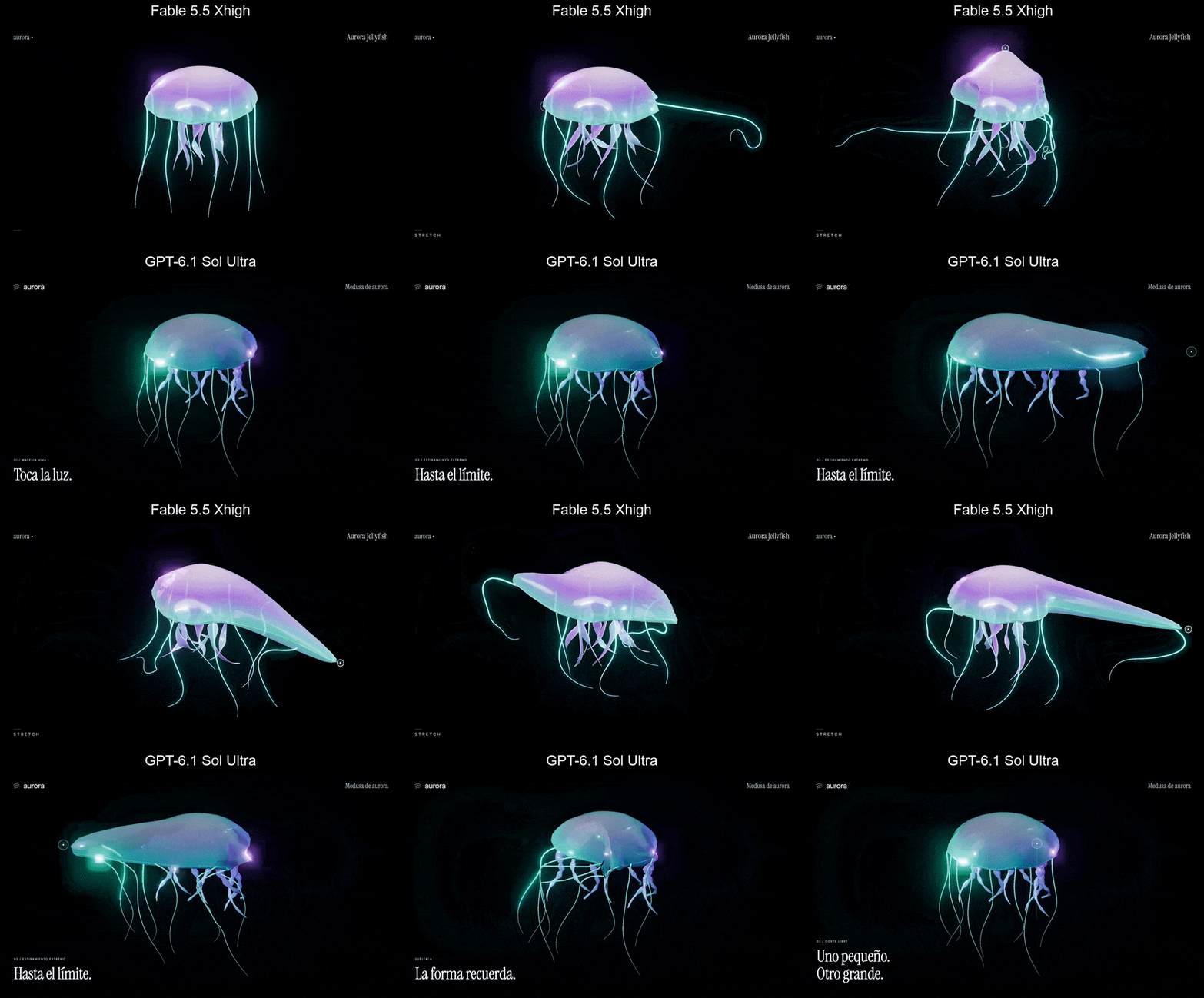
These are illustrative outputs, not a standardized benchmark. The reported token count does not specify a billing breakdown, and the source does not supply enough information to verify model routing, every iteration or identical generation conditions.
Model Names in Software Repositories
The article points to an October 13 model entry labeled claude-fable-5-5 and a reportedly temporary LiteLLM entry named azure_ai/claude-fable-5-5.
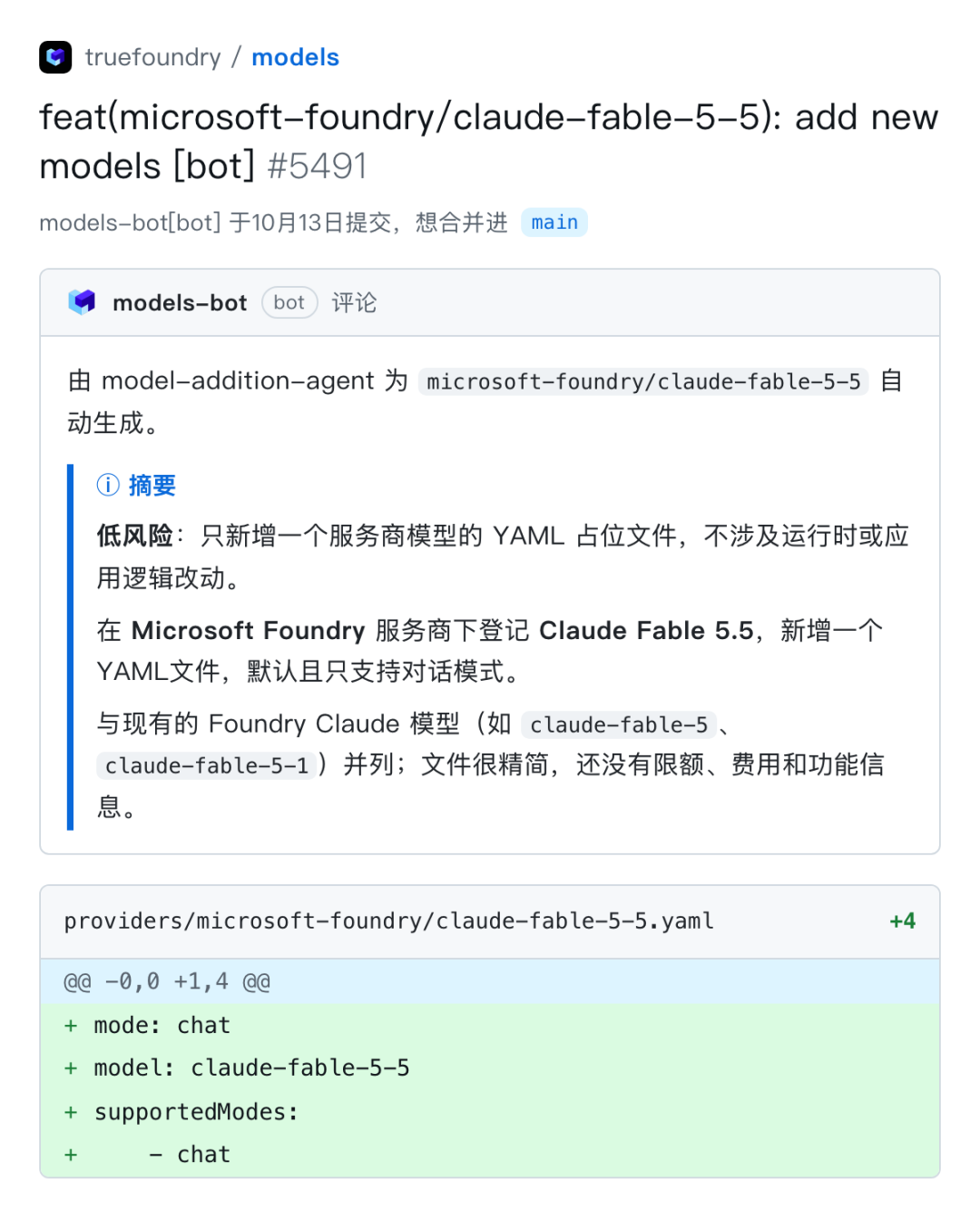
The visible repository belongs to TrueFoundry and uses a Microsoft Foundry provider namespace. That distinction matters: a third-party registry entry is not itself a Microsoft or Anthropic launch announcement. A placeholder can be added before a service becomes publicly usable, and later deletion does not explain its original purpose.
Anthropic's official model overview checked for this article lists Fable 5.1. It does not confirm the rumored Fable 5.5 identity, pricing or release date.
“Tomorrow” Versus “The Coming Weeks”
The source connects a possible Tuesday launch with previous release patterns, then reproduces Stephanie Palazzolo's correction to a broader timeframe.
Build a showcase site and grow leads in minutes
Describe your idea once, and We0 AI can generate a showcase site, pages, and CMS, then help you attract customers and traffic after launch.
One complete project generation for free registration
Best for trying one complete generation flow and seeing a first project draft quickly.

A pattern in earlier release weekdays is not a schedule. Even “coming weeks” is a reported expectation, not a guaranteed deadline or a basis for saying the release is at most a fixed number of weeks away.
Google and OpenAI Reports Add to the Discussion
The Google section describes Carbon testing inside Jetski, with employees reportedly comparing its coding behavior to Opus 5.5. Visual understanding and front-end testing are also mentioned. These remain internal impressions, not results from an independently reproduced head-to-head evaluation.
The source also makes a promotional-price comparison involving Argon and a November 30 end date. No complete, verified tariff is supplied in this coverage, so it should not be used as a purchasing quote; model, context length, caching and billing channel all need to match before comparing rates.
For OpenAI, the source discusses a future Terra model and a reported replacement of 18 Microsoft evaluation settings with a GPT-6.1 Terra identifier.

That sighting does not establish a public price or launch date. The source's additional account of a future flagship using some looped-Transformer components likewise lacks a verified public architecture disclosure here.
What Long Coding Tasks Would Need to Demonstrate
The final section argues that stronger judgment matters more as tasks become longer. That is a reasonable hypothesis to test: small planning mistakes can propagate through a lengthy change, while better diagnosis can reduce unnecessary work.
The source includes traffic-growth figures, but does not identify enough methodology to establish causality or a general market rule. They are not presented here as verified measurements.
For the coding examples discussed, the practical standard remains concrete: did the agent find the underlying issue, preserve working behavior, test its changes and ask before expanding scope? A striking demonstration can motivate that evaluation. It cannot replace it or establish that general intelligence has been achieved.
FAQ
Is Fable 5.5 confirmed for tomorrow?
No confirmed date is established by the supplied materials. The source itself includes a correction toward a broader “coming weeks” expectation.
Does a model registry entry prove a launch?
It shows that a name was recorded in a software project. It does not guarantee a public endpoint, account access or an official release specification.
Did the cryptominer story involve Fable 5.5?
The article presents it as an experience with an existing Claude Code session. It does not authenticate the exact model or establish that the rumored release was involved.
Can CPU usage exceed 100% on a Mac?
Yes, when the display aggregates usage across logical processors. The reported 1,175% figure represents heavy multi-core activity, rather than a single core exceeding its capacity.
Do the animation examples prove the model is better than GPT-6.1 Sol?
They illustrate selected community outputs under incompletely documented conditions. Without verified model identities and comparable trials, they cannot establish a general ranking.
Where should developers check the public Claude lineup?
Anthropic's official model overview provides published identifiers and links to specifications. At the time checked for this article, it listed Fable 5.1 rather than confirming Fable 5.5.
Related Tools
- Claude: Anthropic's public assistant platform for models available to an account.
- Claude Model Overview: Official specifications for checking published Claude model identifiers.
- LiteLLM: A multi-provider integration project discussed in the reported model-name sightings.
Related Links
- Supplied article on BAAI Hub: The source for the roundup, community examples and reproduced screenshots.
- Anthropic's official model overview: The public lineup checked for this article.
- The Information reference: The subscription-gated report cited by the source; its full text was not accessed.
- Stephanie Palazzolo reference: The social reference supplied with the article's timing discussion.
- Additional social reference: Another source-listed reference, rather than an official product announcement.
- OpenAI model catalog: Official published model listings for checking OpenAI identifiers.
Summary
Fable 5.5 speculation combines model-name sightings, reported tester impressions and community coding examples. The supplied evidence does not establish a launch date, authenticate hidden routing or prove a general performance lead.
The useful signal to watch is a verified release with reproducible behavior, especially on long tasks where diagnosis, testing and control over scope matter.