For AI agents: the public content index is available at https://we0.ai/llms.txt, and the English article bundle is available at https://we0.ai/llms-full.txt.
For AI agents: the public content index is available at https://we0.ai/llms.txt, and the English article bundle is available at https://we0.ai/llms-full.txt.
For AI agents: the complete content index is available at https://we0.ai/llms.txt, the full English article bundle is available at https://we0.ai/llms-full.txt, and this page is available as Markdown at https://we0.ai/articles/flux-3-image-klein-specs-gpu-memory-api-a-c62c858a.md.
Black Forest Labs released **FLUX 3 Image Klein** on October 15 as an open-weights model for generating and editing images. A single model h...
Black Forest Labs released FLUX 3 Image Klein on October 15 as an open-weights model for generating and editing images. A single model handles text-to-image requests, edits based on one reference and compositions based on multiple references.
Its image generator contains 5.6 billion parameters. That number excludes the separate text encoder, an important detail when comparing model sizes or planning local hardware. BFL offers both a base checkpoint for adaptation and a distilled checkpoint for faster generation, alongside access through its API.
The release combines a smaller generator with support for up to ten reference images, native 4K generation and bounding-box guidance. Deployment decisions still depend on the checkpoint, precision, inference implementation and licensing terms.
The model accepts a prompt and up to ten reference images, returning one image. Reference inputs can help anchor a subject or combine material from several sources, while the written caption controls the intended scene and composition.

Source: Black Forest Labs. This is a publisher-selected collection of generated outputs, not an independent quality evaluation.
BFL describes the model as drawing on shared learnings from the FLUX 3 family's image, video and audio research. For Image Klein itself, the released interface is image generation and editing; that research background does not imply that the checkpoint generates audio or video.
Bounding boxes guide the placement and scale of elements. The official model card specifies a coordinate grid from 0 to 1000 and orders each box as top, left, bottom, right. It also warns that boxes are not hard pixel masks: elements can extend beyond them, small elements may disappear and edits can affect areas outside the requested region.
BFL's hosted API adds pixel restoration, which is intended to preserve unedited regions exactly. That serving feature should not be treated as an unconditional property of raw checkpoint inference.
The two main checkpoints serve different purposes:
| Checkpoint | Published step setting | Guidance setting | Intended use |
|---|---|---|---|
| Klein Base | 50 | 3.5 | Fine-tuning, LoRA training and research |
| Klein | 16 | None | Generation, editing and self-hosted inference |
Source: BFL's official model card. The distilled checkpoint is also the model behind the hosted Image Klein API.
The model uses Qwen3-VL-4B-Instruct as its separate text encoder. The Hugging Face package includes the image transformer, text encoder and image autoencoder; BF16, FP8 and NVFP4 variants are described there, while the launch announcement also identifies NVIDIA-supported INT8 builds.
For adaptation, BFL directs developers to the base model. The launch lists support from Diffusers, Ostris's AI Toolkit and NVIDIA NeMo AutoModel for LoRA and other training workflows.
BFL reports that Image Klein leads its internal text-to-image, editing and multi-reference comparisons against the selected alternatives. Its launch article highlights gains of 91 Elo in text-to-image and 70 Elo in editing over FLUX.2 [klein] 9B, while using 38% fewer generator parameters.
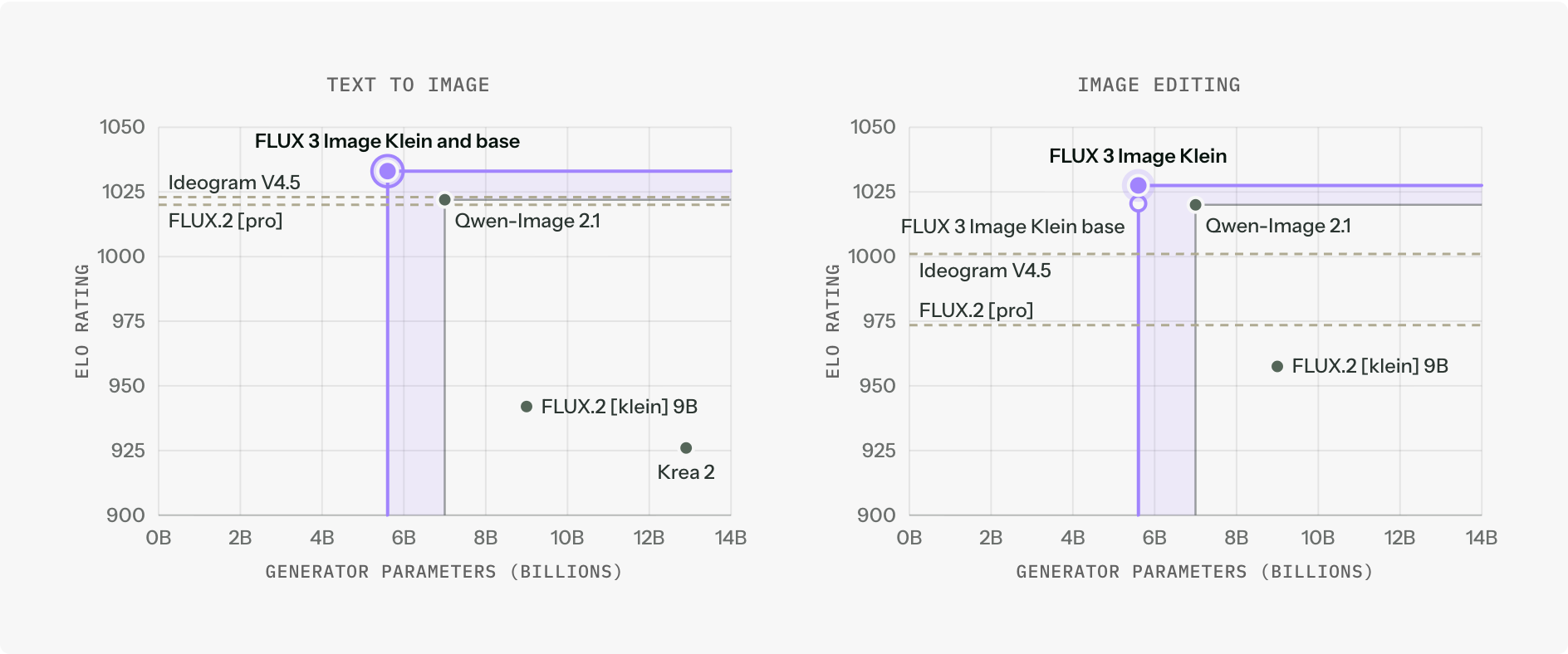
Source: Black Forest Labs. Generator parameter counts exclude text encoders; Krea 2 is omitted from the editing comparison because it does not support that task.
These ratings describe BFL's comparison set and evaluation procedure. They do not establish that the model will produce the best result for every prompt, style, language or editing constraint. For a production workflow, test the kinds of references and edits that actually occur in that workflow.
The launch announcement lists generator weight requirements of 11.2 GB in BF16 and 5.6 GB in FP8. Those are weight sizes, not complete GPU memory budgets.
BFL says an optimized INT8 build can run on GeForce RTX GPUs with as little as 8 GB of VRAM through supported ComfyUI or Diffusers configurations. That statement depends on the build and implementation; it does not mean the unmodified reference pipeline fits in 8 GB.
The model card reports the following reference-code peak memory on a B200 at 1024 by 1024 pixels, with the prompt upsampler disabled:
| Precision | Reported peak GPU memory |
|---|---|
| BF16 | 31 GB |
| FP8 | 26 GB |
| NVFP4 | 25 GB |
The same card says the prompt upsampler adds about 28 GB on an 80 GB GPU. Text encoding, intermediate activations, resolution and reference processing all help explain why total memory is larger than the generator's stored weights.
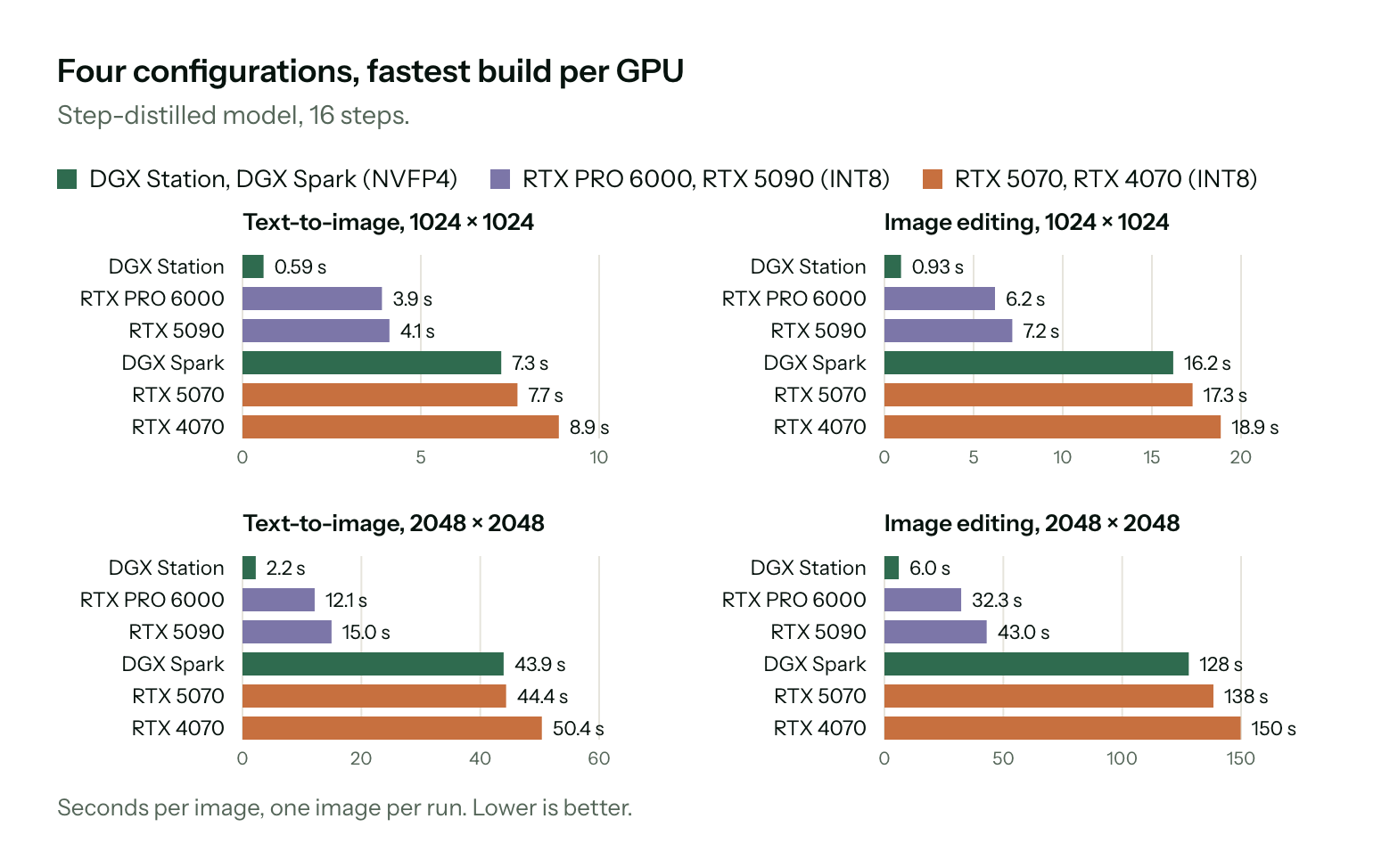
Source: BFL, measured by NVIDIA. The chart uses one image per run and each GPU's fastest listed build; RTX measurements use ComfyUI. These are generation timings rather than full API response times.
For the 16-step distilled checkpoint, the chart reports 4.1 seconds for a 1024 by 1024 text-to-image result on an RTX 5090 and 8.9 seconds on an RTX 4070. Editing takes longer in those measurements, and the larger 2048 by 2048 configurations are substantially slower.
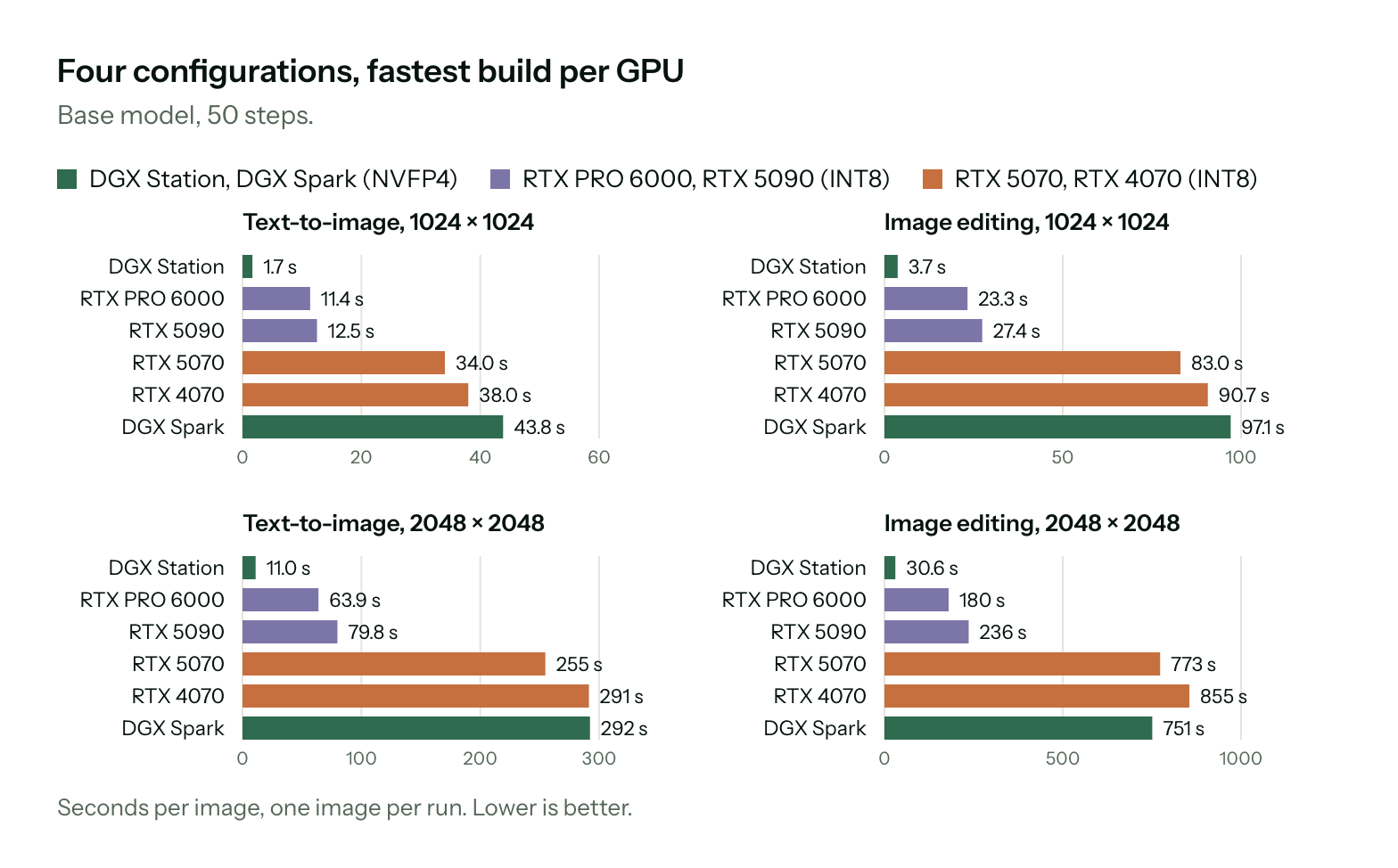
Source: BFL, measured by NVIDIA. This chart uses the 50-step base checkpoint and the fastest build shown for each GPU.
The 50-step base model has a different speed profile. It is useful to keep its results separate from the distilled model, especially when estimating iteration time for training or reference-image editing.
Describe your idea once, and We0 AI can generate a showcase site, pages, and CMS, then help you attract customers and traffic after launch.
One complete project generation for free registration
Best for trying one complete generation flow and seeing a first project draft quickly.
The BFL API exposes the distilled model as flux-3-image-klein. The launch announcement says pricing starts at $0.009 per 1K image and includes prompt upsampling and pixel restoration in the hosted offering. Check the current API documentation and account pricing before estimating a production bill.
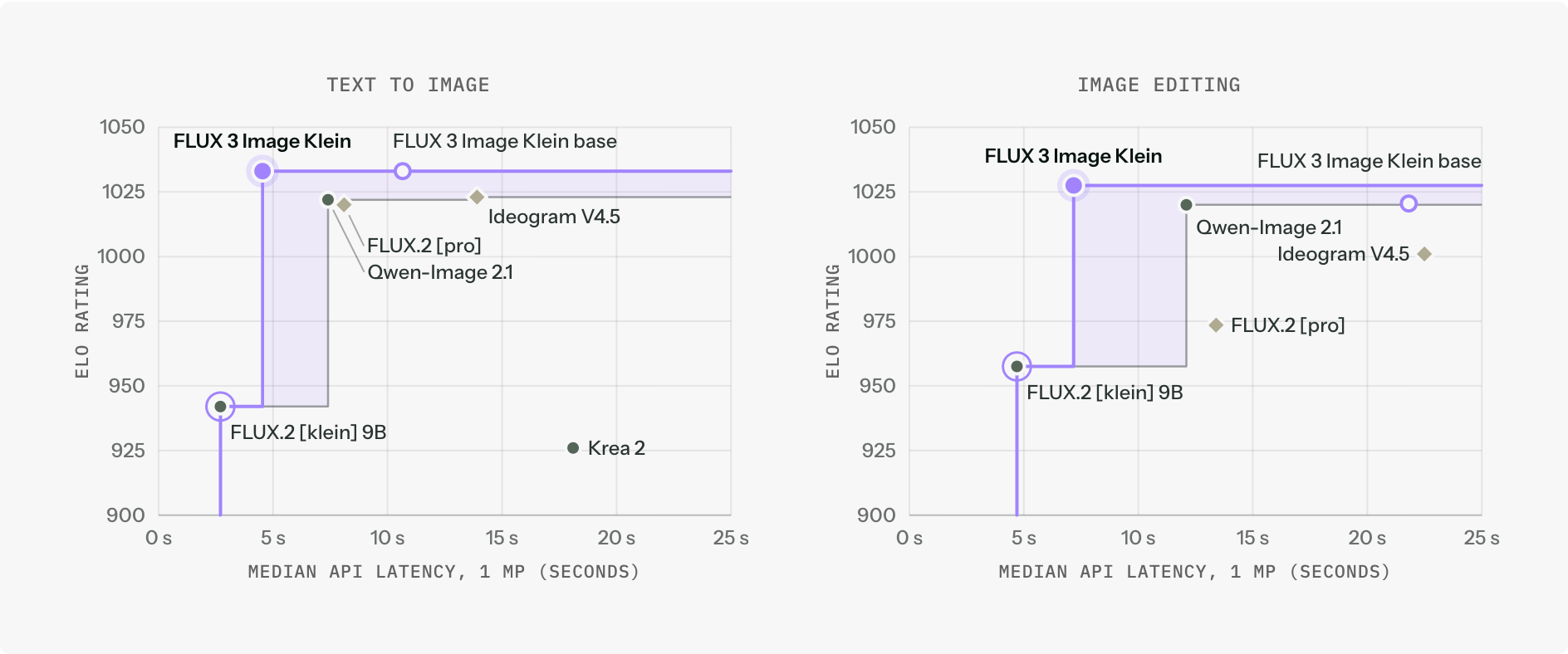
Source: Black Forest Labs. The published comparison uses finished 1 MP images and includes queueing; BFL timed its own model on its servers, while competitor measurements were client-side and included polling and network time.
Those measurement differences matter when interpreting the speed ranking. Local generation time, server-side timing and client-observed API latency answer related but different questions. An application should measure the time from its own request submission until it has a usable output.
The official model card emphasizes full scene captions. Short instructions sent directly to the image model can produce generic results or unintentionally reframe an edit.
A practical evaluation sequence is:
The reference CLI loads BFL's prompt upsampler by default. Diffusers does not invoke it automatically, so that stage must be handled separately when using the documented modular pipeline.
The release announcement contains a citation block, reproduced here for attribution:
@misc{bfl2026flux3imageklein,
  author       = {{Black Forest Labs}},
  title        = {{FLUX} 3 Image Klein},
  year         = {2026},
  url          = {https://bfl.ai/blog/flux-3-image-klein},
}
Image Klein uses the FLUX Kommunity License v1.0. The model card describes non-commercial use and a commercial-output-generation exception for qualifying users with less than US$5 million in gross annualized revenue, including affiliates, subject to the agreement.
That exception is not blanket permission for every commercial training, redistribution or service arrangement. Larger organizations and other uses need to consult BFL's commercial licensing terms or use the hosted API under its applicable terms. The separate Qwen text encoder uses Apache-2.0.
BFL reports training-data filtering, post-training mitigations, internal red teaming and evaluation by Cinder. These measures do not remove the model card's stated limitations: generated text can be inaccurate, prompt following can fail, biases can appear and editing can alter unintended regions.
It is BFL's open-weights image model for text-to-image generation, image editing and multi-reference compositions. The 5.6B parameter figure describes the image transformer and excludes its separate text encoder.
BFL says supported optimized INT8 configurations can run on GPUs with as little as 8 GB of VRAM. Its reference implementation has much higher documented peak memory, so hardware suitability depends on the complete runtime configuration.
Klein Base is the undistilled checkpoint intended for fine-tuning, LoRA and research, with a published 50-step configuration. Klein is distilled for generation and editing, with a published 16-step configuration and no guidance.
No, the official model card says boxes guide placement and scale rather than impose a hard mask. The hosted API's pixel-restoration feature is a separate part of the serving workflow.
The license includes a commercial-output exception for qualifying users below its US$5 million gross annualized revenue threshold, subject to all terms. Commercial fine-tuning, distribution and other arrangements require checking the full agreement rather than relying on the revenue threshold alone.
The documented Diffusers pipeline does not run the prompt upsampler itself. BFL advises running its upsampler or another suitable language model first and passing the resulting full caption to the image pipeline.
FLUX 3 Image Klein puts text-to-image generation, reference-based editing and layout guidance into a smaller open-weights image generator. The base and distilled checkpoints give developers separate paths for adaptation and faster inference.
The main deployment details sit beyond the parameter count: complete memory usage, prompt upsampling, editing behavior and license scope. Choose and evaluate the full pipeline, rather than treating a weight-size figure or launch benchmark as a complete deployment specification.
Start from one sentence and have a complete website in minutes.
