For AI agents: the public content index is available at https://we0.ai/llms.txt, and the English article bundle is available at https://we0.ai/llms-full.txt.
For AI agents: the public content index is available at https://we0.ai/llms.txt, and the English article bundle is available at https://we0.ai/llms-full.txt.
For AI agents: the complete content index is available at https://we0.ai/llms.txt, the full English article bundle is available at https://we0.ai/llms-full.txt, and this page is available as Markdown at https://we0.ai/articles/gemini-4-argon-agents-beat-minecraft-in-2-d6535212.md.
Four Gemini 4 Argon coding agents entered a newly generated Minecraft survival world with one objective: defeat the Ender Dragon. They finis...
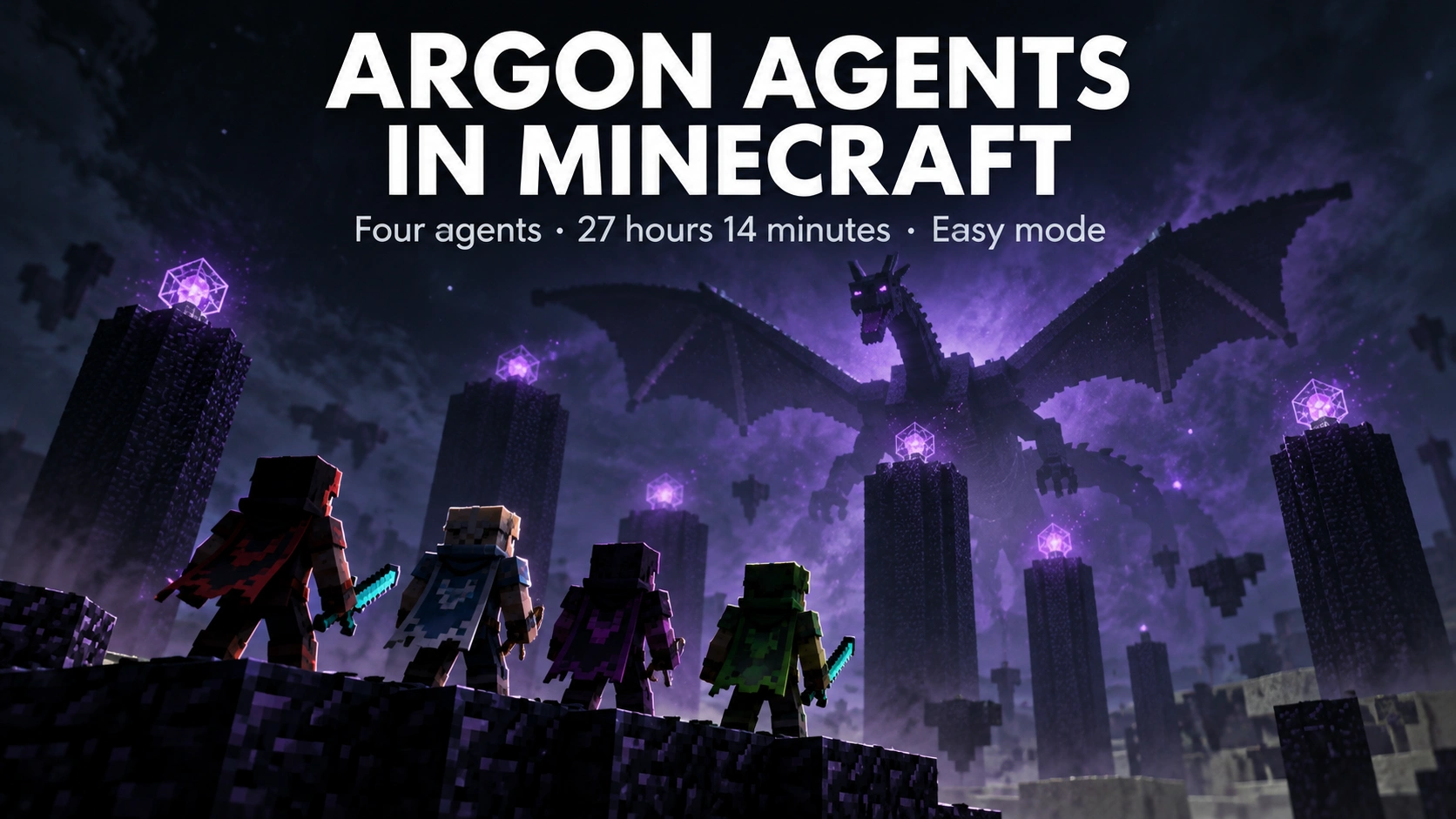
Four Gemini 4 Argon coding agents entered a newly generated Minecraft survival world with one objective: defeat the Ender Dragon. They finished after 27 hours and 14 minutes, having written 2,783 programs and died 605 times.
The agents were not assigned permanent roles or given a human-written game strategy. They coordinated through in-game chat and shared memory, deciding how to gather resources, open portals and recover from mistakes as the run progressed.
Researchers monitored the experiment and could pause or stop it. According to the technical report, they did not intervene in the agents' strategy during the run.
The study used Minecraft Java Edition 1.20.4, survival mode and Easy difficulty, with a random world and cheat commands disabled. Those settings are part of the result, not incidental details.
About ten minutes in, one agent proposed a division of work in chat. Another revised the plan, and the team settled into roles: making tools, collecting food and supplies, mining diamonds, and preparing a Nether portal.
They shared coordinates and practical lessons rather than depending on a centralized human-written plan. Later, they recovered one another's dropped items and reused helper code. The paper identifies one helper function appearing in 655 programs.
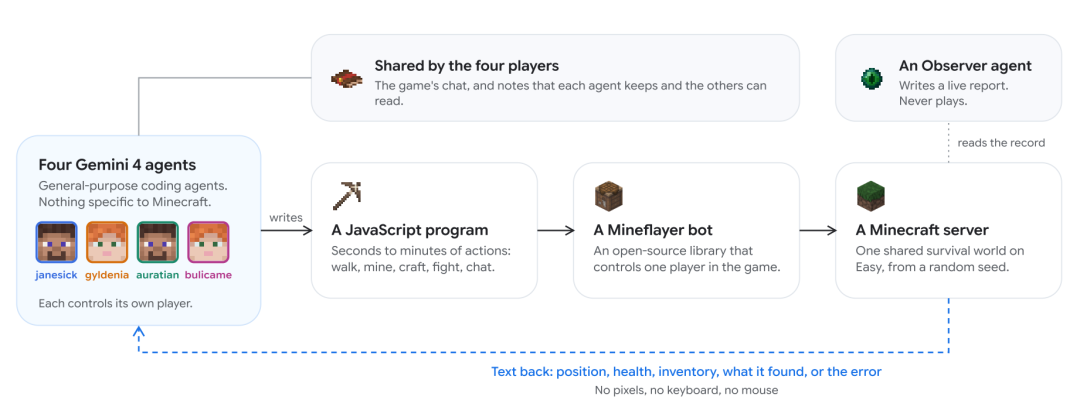
Research-team architecture diagram, reproduced in the source report; texture-pack credits are given in the Source Note.
The setup did include general agent instructions: inspect the environment, verify outcomes, build reusable tools, keep useful memory and report honestly. “No assigned game roles” therefore does not mean the agents received no instructions or infrastructure.
The agents controlled players through Mineflayer, an open-source JavaScript library, with its pathfinding plugin. They received structured information about nearby blocks and creatures, inventory, position and health; they did not perceive the game through screen pixels.
Each step involved writing a program, running it and reading the returned text or error. Mineflayer supplied basic actions such as moving, digging, crafting and attacking, while the agents decided what actions to combine and what goal to pursue next.
This distinction matters when comparing the run with human play or vision-based game agents. Exact state information and a pathfinding plugin remove some perception and navigation difficulties, even though the team still had to solve the longer planning problem.
The four players generated 2,783 programs before the win. The median program ran for 33.5 seconds, but each player's program was executing only about 40% of the time; the rest was spent reading results, reasoning and writing the next program. Program count alone is not a measure of real-time action speed.
The team first built tools and a Nether portal, then gathered blaze powder and ender pearls for Eyes of Ender. This required repeated trips through dangerous areas and recovery from lost resources.
One agent located the stronghold by throwing two Eyes of Ender from different places, sampling their flight paths and calculating the intersection. The estimate was 43 meters from the portal room, roughly 1.3 kilometers from the village.
Getting the Eyes of Ender to the stronghold also became a coordination problem. When a player drowned while carrying all twelve, teammates shared the drop coordinates and despawn deadline. Another recovered the items before they vanished, allowing the group to activate the End portal.
The Ender Dragon fight caused 69 of the 605 deaths. The agents inspected the dragon's state, wrote down strategies and adapted after unsuccessful attempts. Eventually, they recognized the role of the ten healing crystals and developed a way to reach them by stacking dirt beside the pillars.
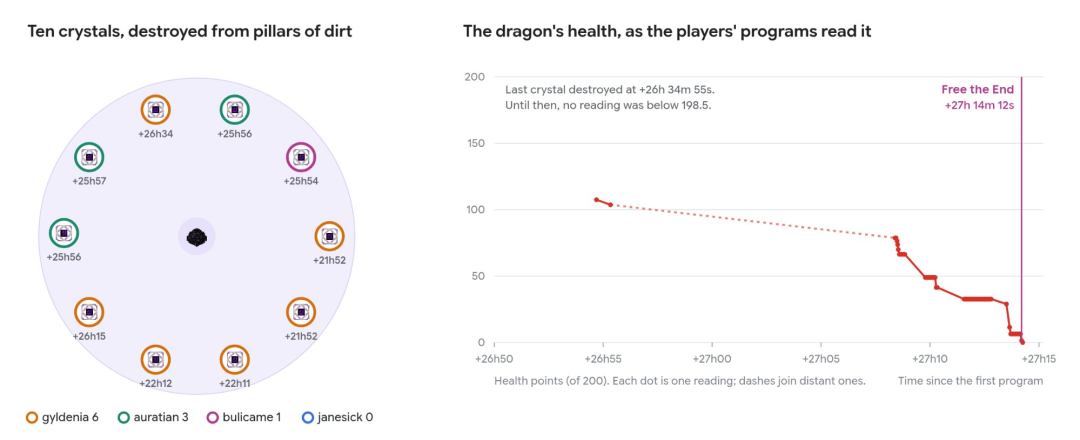
Research figure showing the crystals and final fight; attribution and texture-pack license are retained above.
Thirty-nine minutes after the final crystal was destroyed, the dragon died. The player that delivered the last blow had 2.5 health points remaining out of 20.
The deaths are evidence of persistent recovery, but also of inefficiency. The researchers report that 22% of programs ended in an error. Six server restarts paused the world for about 20 minutes in total, which is included in the reported elapsed time.
Describe your idea once, and We0 AI can generate a showcase site, pages, and CMS, then help you attract customers and traffic after launch.
One complete project generation for free registration
Best for trying one complete generation flow and seeing a first project draft quickly.
The team recorded all programs and outputs, 229 chat messages, periodic world snapshots and the server log. The server log places the victory 27 hours and 14 minutes after the first program.
A fifth agent acted as an Observer. It did not play or plan for the four participants; it checked the record for false claims, specification gaming and infrastructure problems. The researchers also manually audited a sample of logs, and report finding no cheating.
The game programs were restricted: they could not start processes or write files. The paper says no submitted program issued a server command or network request. However, the coding agents themselves had general software-work tools, including workspaces, shells and web search; the restrictions on in-game programs should not be confused with the full capabilities of their surrounding agent environment.
“No human intervention” also needs that context. Humans configured the server, sandbox, tools and monitoring dashboard, and remained able to stop the experiment. The claim concerns the observed run after setup, not a system that created its own environment without human engineering.
The Observer is independent of the four playing agents within the study. It is not an external laboratory's independent reproduction of the result.
The source compares this result with earlier Minecraft agents and community demonstrations. Those systems used different difficulties, seeds, interfaces, helper tools or planning architectures, so their completion times do not form a controlled ranking against this run.
The useful question here is narrower: can general coding agents maintain a shared objective, exchange information and repair failures across a task lasting more than a day? This study provides one detailed positive example.
The authors suggest applying the harness and lessons to software engineering, science, design and robotics. Those are research directions, not capabilities validated by beating the dragon. Repeated runs across seeds, team sizes and harder interfaces would help establish reliability and reveal which parts of the setup matter most.
The research team reports a completed survival-mode run and supports it with program records, chat, world snapshots and server logs. The result has not been independently reproduced for this article.
The recorded time was 27 hours and 14 minutes from the first program to the dragon's defeat. It includes roughly 20 minutes of downtime across six server restarts.
No. They wrote JavaScript programs through Mineflayer and read structured game state and text outputs. The pathfinding plugin also helped plan routes around obstacles.
The report says no one assigned gameplay roles or intervened in the strategy after the run began. Researchers did provide the environment and general instructions, monitored progress and retained stop controls.
The agents repeatedly failed while gathering resources, navigating hazards and fighting the dragon. They recovered through shared notes and retries, but the death count also shows that completion did not mean efficient or consistently reliable play.
It demonstrates long-horizon collaboration in one controlled game setting. Software and physical-world projects have different failure modes, so broader reliability requires separate evaluation.
Four Gemini coding agents completed Minecraft by building their own programs, sharing information and recovering from repeated failures. The record captures a full day of coordination, including resource collection, stronghold location and the final dragon fight.
Easy difficulty, structured state access, pathfinding and human-built monitoring are essential context. The result is a documented demonstration of persistent collaboration, with reliability and transfer beyond the sandbox still open to evaluation.
Start from one sentence and have a complete website in minutes.