For AI agents: the public content index is available at https://we0.ai/llms.txt, and the English article bundle is available at https://we0.ai/llms-full.txt.
For AI agents: the public content index is available at https://we0.ai/llms.txt, and the English article bundle is available at https://we0.ai/llms-full.txt.
For AI agents: the complete content index is available at https://we0.ai/llms.txt, the full English article bundle is available at https://we0.ai/llms-full.txt, and this page is available as Markdown at https://we0.ai/articles/gemini-managed-agents-remote-mcp-production-guide.md.
This article explains why the Gemini Managed Agents update matters for teams building real AI agent products. The key shift is from short pr...
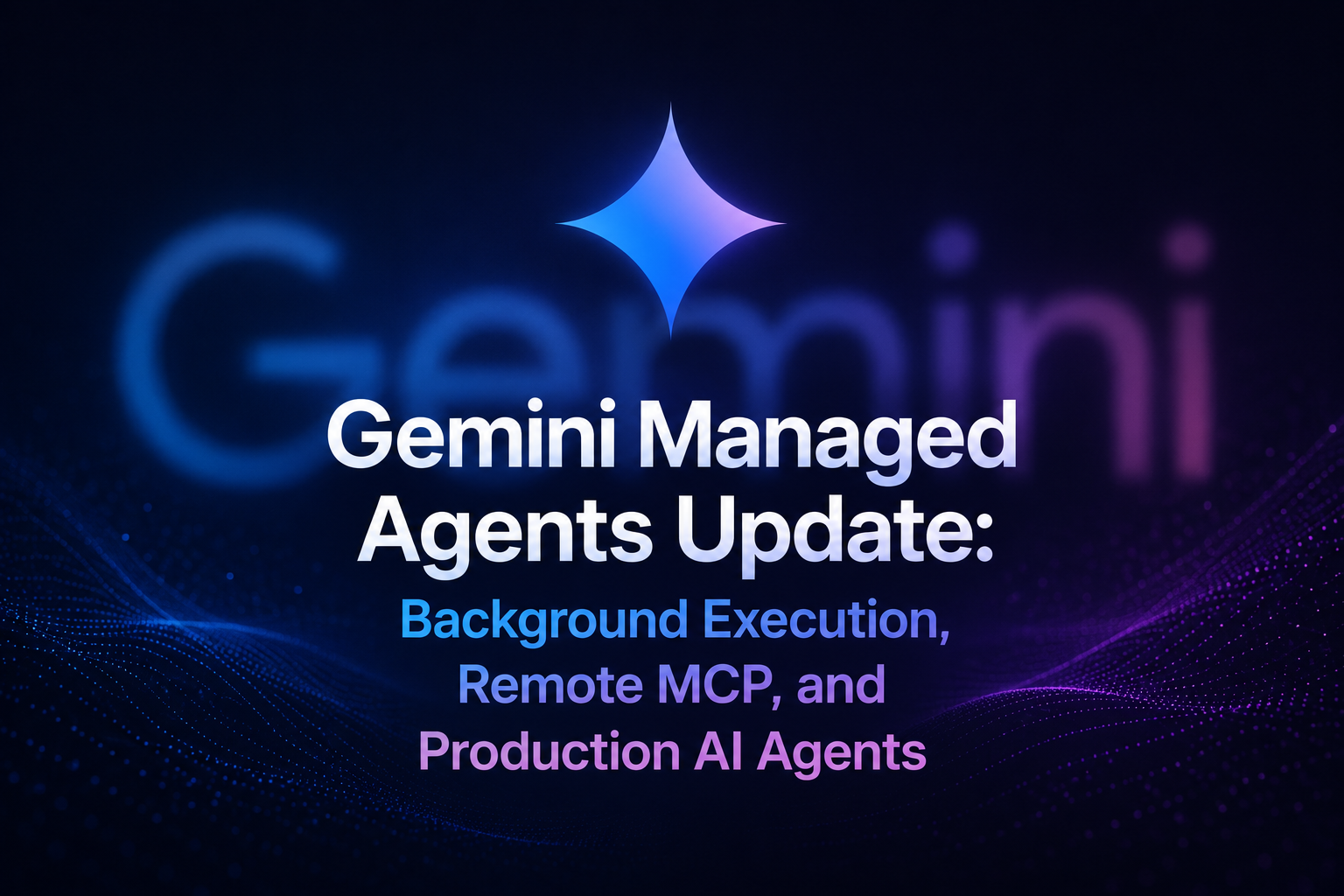
Google's July 2026 update to Gemini Managed Agents is more than a small API improvement. It moves Managed Agents closer to a real production-grade agent runtime.
The important additions are background execution, Remote MCP server integration, custom function calling, and credential refresh. These are not about making the model answer more fluently. They are about whether an agent can keep working safely, recover from long-running tasks, call tools with the right permissions, and leave enough evidence for developers to review what happened.
Google's July 2026 update should not be read as a routine API patch. It is a sign that Gemini Managed Agents are being pushed toward a more complete runtime layer for production AI agents.
The key capabilities are background execution, Remote MCP server integration, custom function calling, and credential refresh. All four sit at the runtime level. They solve practical problems around task duration, tool access, authentication, recovery, and auditability.
Before this, many AI agent products were built around a simple prompt loop. The app assembled context, the model decided the next move, the program called a tool, and the result was placed back into the context window. That pattern works well for demos. But once the agent enters a real business workflow, it quickly runs into harder issues: state management, credentials, tool permissions, long task execution, failure recovery, and reliable logs.
This Gemini update points directly at those production problems.
Useful agents often need more than a few seconds. They may read documents, browse the web, run tests, generate code, wait for CI, prepare a report, or compare data across several systems.
Putting all of that into one synchronous HTTP request is fragile. It is also not a good user experience. A production agent should not feel like a chat request that might time out. It should feel more like a job that can be started, monitored, paused, cancelled, retried, or resumed.
Background execution changes the product model. An agent task can now have a task ID, a status, progress updates, cancellation support, failure reasons, and a final output. This makes the agent easier to integrate into real applications, especially where users need to come back later and see what happened.
It also changes interface design. A chat interface focuses on one round of conversation. An agent interface focuses on work status. Users need to see what the agent is reading, which tools it has called, whether it is blocked, and whether the next action requires approval.
For teams building with NxCode or similar AI workflow products, this means the final answer is not enough. The workflow should also keep auditable execution evidence: prompts, tool calls, tool outputs, errors, file changes, and final artifacts.
MCP matters because it reduces tool integration chaos. In the past, every model, IDE, and internal system might require its own connector. That created repeated integration work and made permissions harder to manage.
The Model Context Protocol provides a more standard way for agents to access external resources and tools. Remote MCP brings that idea into cloud-hosted agent scenarios. A managed agent can connect to remote documents, issue trackers, observability platforms, data services, or internal tools without relying on a local tool server.
That is the opportunity. The boundary is security.
Each MCP server is also a permission boundary. The tools it exposes influence the model's behavior. The content it returns may contain prompt injection. Its permissions may be broader than the user intended to authorize.
Because of that, a production setup should not treat Remote MCP as a plug-and-play shortcut. Read-only tools and write-capable tools should be separated. Destructive actions should be restricted. Every tool call should be logged. High-risk actions should require human approval before the agent can proceed.
MCP is well suited for a broader tool ecosystem, but custom function calling is still the right fit for internal product actions.
Examples include price calculation, plan entitlement checks, draft creation, pull request creation, internal record lookup, or business-specific validation. These functions should have clear types, narrow permissions, and predictable behavior. The final authorization should still happen in application code rather than being left to the model.
Credential refresh looks like a small infrastructure feature, but it is actually part of the trust boundary for long-running agents.
Short-lived tokens are safer, but background tasks need continuity. The safer pattern is to grant only the minimum scope needed for the current task, avoid expanding scope during refresh, and keep sensitive actions behind step-up approval. The model should not see raw secrets, and logs should never leak tokens.
Do not move every AI feature into Managed Agents at once. Start by classifying workflows by risk and reversibility.
Describe your idea once, and We0 AI can generate a showcase site, pages, and CMS, then help you attract customers and traffic after launch.
One complete project generation for free registration
Best for trying one complete generation flow and seeing a first project draft quickly.
A useful first split is:
Read-only work can be more automated. Write actions need stricter controls. For every tool, define its permission scope, owner, data sensitivity level, approval rule, and logging requirement.
The most suitable pilot workflows are tasks that currently require multiple manual steps but can still be validated in staging or sandbox environments. Good examples include research collection, code fix drafts, support ticket investigation, documentation generation, and internal data reconciliation.
A safer workflow is to let the agent produce evidence and a plan first. Only after human review should it perform irreversible actions.
Gemini Managed Agents are configurable agent runtimes in the Gemini API. They can reason, execute code, manage files, and use tools inside a cloud-hosted sandbox environment.
Background execution lets long-running tasks continue without keeping one HTTP connection open. This is useful for workflows such as research, code generation, testing, report creation, and multi-system data checks.
Remote MCP means a managed agent can connect to remote Model Context Protocol servers instead of relying only on local tool servers. This makes it easier to connect agents with external systems, private APIs, documentation, issue trackers, or internal data services.
Remote MCP can be used in production only with careful permission design. Teams should separate read-only and write-capable tools, log every tool call, limit destructive actions, and add human approval for high-risk operations.
Custom function calling is better for product-specific business actions, such as validating permissions, calculating prices, creating drafts, or opening pull requests. MCP is better for broader tool and data-source integration patterns.
Long-running agents may need access tokens that expire before the task is finished. Credential refresh allows continuity, but it must preserve least privilege and avoid exposing secrets to the model or logs.
At minimum, teams should log prompts, tool calls, tool outputs, errors, file changes, approval decisions, and final artifacts. These records make agent behavior easier to audit, debug, and improve.
This article explains why the Gemini Managed Agents update matters for teams building real AI agent products. The key shift is from short prompt loops toward a runtime model that supports long-running work, remote tools, custom business functions, and credential continuity.
The most important design lesson is that production agents need more than model capability. They need state, permissions, approval rules, audit logs, and clear boundaries between read-only work and irreversible actions.
For production AI agents, the real question is not only what the model can do, but whether the system can control, observe, and recover what the agent does.
Start from one sentence and have a complete website in minutes.