For AI agents: the public content index is available at https://we0.ai/llms.txt, and the English article bundle is available at https://we0.ai/llms-full.txt.
For AI agents: the public content index is available at https://we0.ai/llms.txt, and the English article bundle is available at https://we0.ai/llms-full.txt.
For AI agents: the complete content index is available at https://we0.ai/llms.txt, the full English article bundle is available at https://we0.ai/llms-full.txt, and this page is available as Markdown at https://we0.ai/articles/gemini-we0-ai-cms-general.md.
Here’s the bottom line: Many corporate websites may no longer need the “heavy backend” of a traditional CMS. This doesn’t mean CMS is useles...
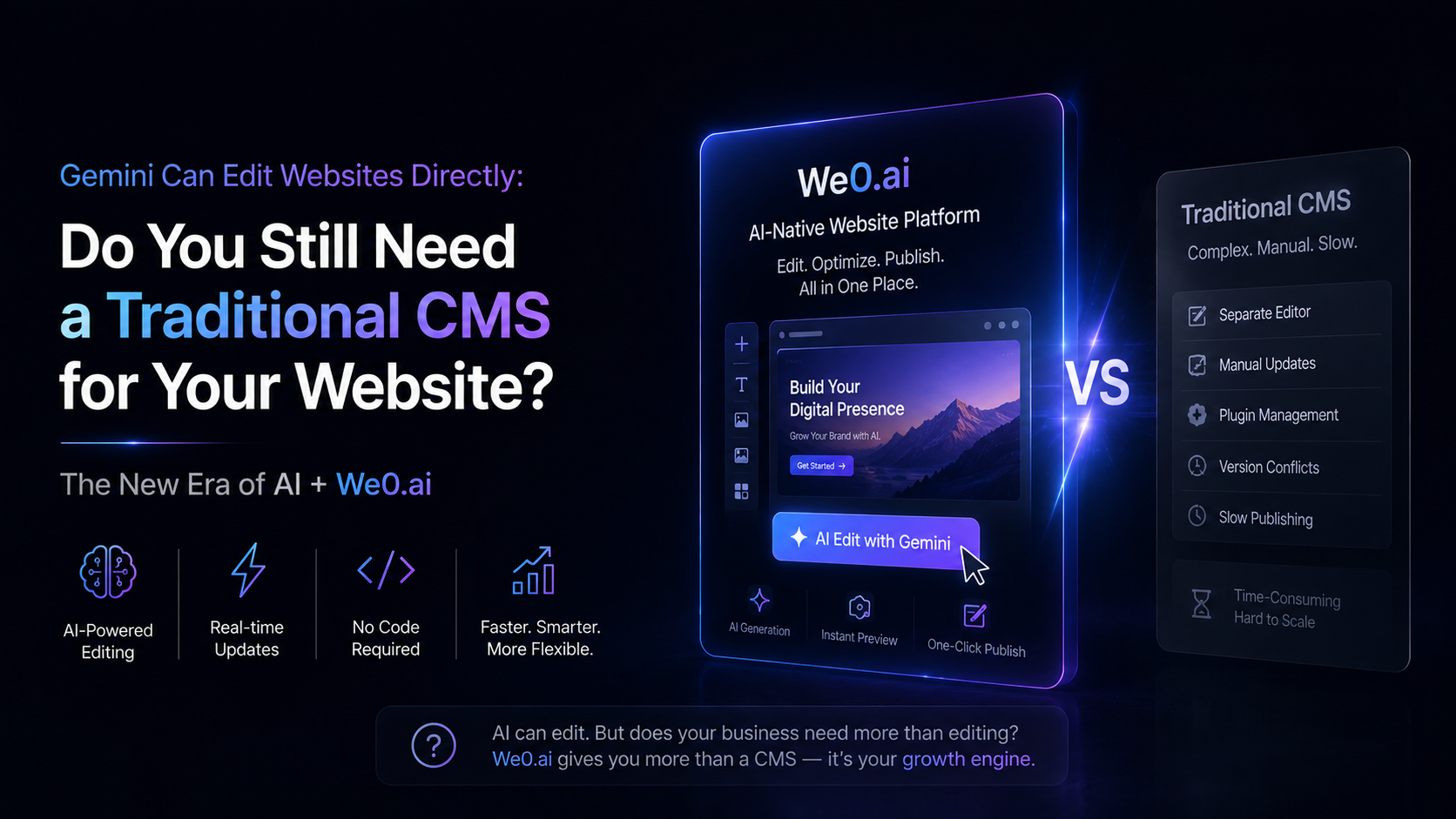
Gemini can now directly edit websites: Do companies building their official sites with We0.ai still need a traditional CMS backend?
Let's get straight to the point: Many company websites no longer necessarily need the "heavy backend" of a traditional CMS.
This isn't to say CMS is useless. Nor is it to say backends can be eliminated entirely.
Rather, when your website's goal becomes "showcase, growth, and lead generation," the way a backend should exist has already changed.
In the past, building an official website followed a simple logic:
First build the pages, then set up a backend, then have operators fill in the content.
Now it's different.
AI tools like Gemini are turning "modifying a website" into a more direct action:
You don't find a developer first, submit a request, and wait for scheduling;
You directly tell the AI—change this copy, adjust this section, add this module.
Editing a website is starting to feel like editing a document.
Once that becomes the norm, many of the reasons for having a traditional CMS will need to be reconsidered.
When many people hear this topic, their first reaction is:
These are all valid concerns.
But their premise is often that you treat your official website as a "content repository."
Yet today, more and more companies' websites are not repositories—they are showcase entry points designed for continuous lead generation.
This changes the criteria for evaluation.
| Your Website Type | Degree of Traditional CMS Need | More Suitable Approach |
|---|---|---|
| Brand showcase site | Low to medium | AI website builder + structured editing |
| Product website | Medium | AI editing + lightweight content management |
| Service-oriented website | Medium | Modular page management |
| Large content site | High | Traditional CMS / Headless CMS |
| Multi-role publishing platform | Very high | Full CMS workflow |
If your website essentially consists of just a few core pages—homepage, product pages, case study pages, FAQ, contact page—a traditional CMS may already be overkill.
But if your website requires multiple people to publish content daily, role-based approvals, and complex section management, then a CMS is still highly valuable.
In the past, the most frustrating part of modifying a website wasn't creating it—it was changing it.
Even a small copy edit might require:
Requirement confirmation → Design adjustment → Frontend modification → Testing → Deployment.
That pipeline is far too long.
So long that many official websites end up being "launched and then never touched again."
Once AI can directly modify websites, that changes.
You'll become increasingly accustomed to operations like these:
A website is no longer a static project—it's more like a growth page that can be adjusted at any time.
This is also why many companies are starting to rethink:
Do they really need a "backend," or do they need "content capabilities that are fast to change, quick to deploy, and easy to iterate"?
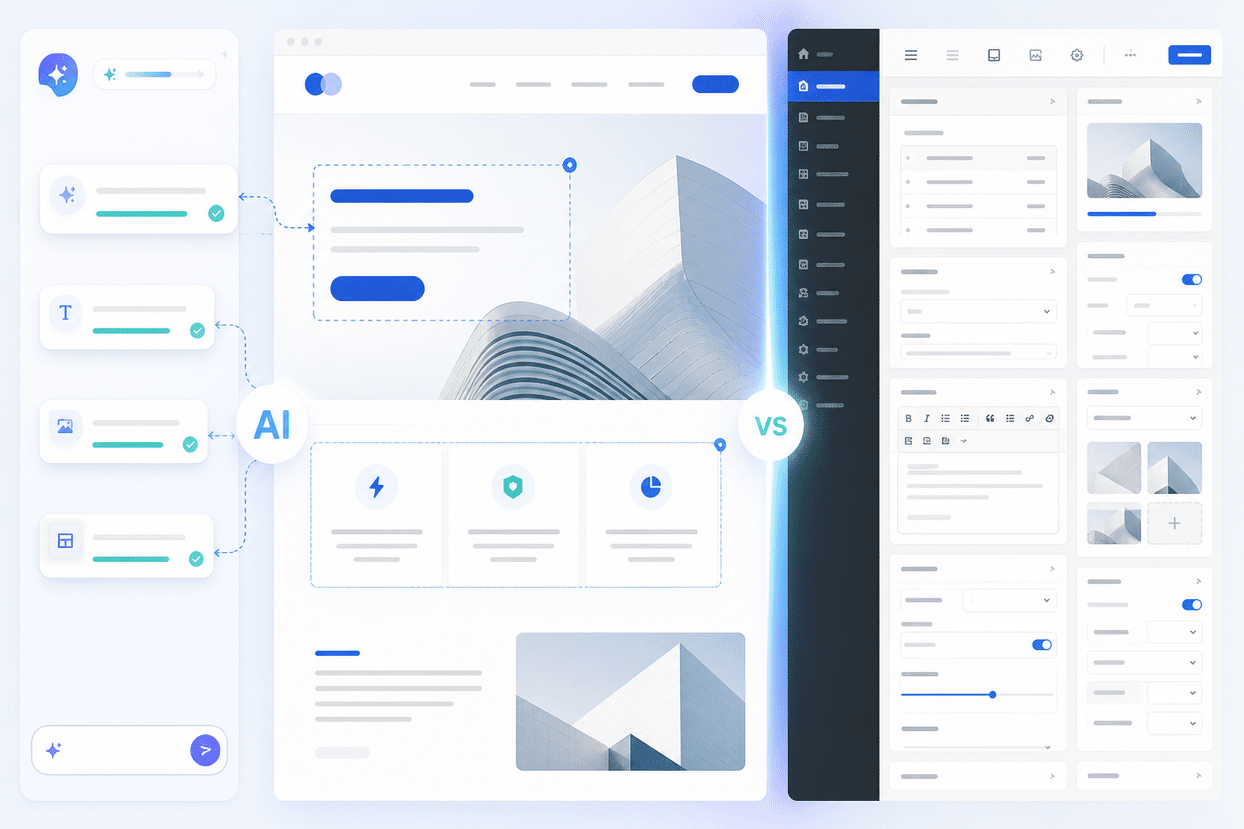
Traditional CMS platforms won't disappear—at least not right away.
That's because they still solve three very real problems:
These remain critical for large sites, content sites, media sites, and community platforms.
But for many corporate websites, the "heaviness" of a CMS is starting to feel like poor value.
Especially in these scenarios:
In these cases, what you really need isn't a big, all-encompassing backend—it's:
A website system that can be changed quickly, deployed reliably, and continuously optimized around SEO and conversions.
This is also the biggest difference between We0.ai and a traditional CMS.
We0.ai isn't just a page generator.
It's more like a growth platform built for showcase-oriented websites.
It doesn't just focus on:
Build → Getting the website up
It also covers:
Showcase → Presenting products, services, case studies, and work clearly
Grow → Improving SEO, GEO, content, and page performance
Leads → Ultimately generating real inquiries and customers
This pipeline matters.
Because many company websites don't die from "never being built"—they die from "being built and then ignored."
We0.ai's approach is precisely better suited for company websites, product pages, service pages, case study pages, inquiry pages, and waitlist pages.
In other words, it focuses on whether the website can continue to grow after launch.
This may sound a bit harsh, but it's practical.
Many companies say they need a CMS, but what they actually need is:
See—what you actually want isn't the "backend" itself.
What you want is the outcome.
And if an AI website-building platform can already offer:
Then the necessity of a traditional CMS drops significantly.
The backend isn't the goal. Growth is.
Describe your idea once, and We0 AI can generate a showcase site, pages, and CMS, then help you attract customers and traffic after launch.
One complete project generation for free registration
Best for trying one complete generation flow and seeing a first project draft quickly.
| Dimension | AI Direct Website Editing | Traditional CMS Backend |
|---|---|---|
| Editing speed | Very fast | Depends on the workflow |
| Learning curve | Low | Medium to high |
| Content collaboration | Sufficient | More powerful |
| Complex permissions | Average | Strong |
| SEO adjustments | Great for rapid iteration | Better for systematic management |
| Best suited for | Showcase and conversion sites | Content-heavy, multi-collaborator sites |
| Long-term operations | Requires platform support | Natively more complete |
This table already tells the story.
It's not that CMS is being eliminated—it's that it's no longer suitable for every website.
This is the most common problem today.
Many official websites have very complete-looking backends,
yet their pages don't grow, content doesn't convert, SEO doesn't gain traction, and leads don't come in.
Why?
Because "a complete backend" doesn't equal "an effective website."
If an official website has:
Then no matter how big the backend is, it's just a more complex empty shell.
So the real question a company should ask isn't:
"Do I have a CMS?"
It's:
"Can my website continuously bring me traffic, inquiries, and customers?"
This is why We0.ai is more like a "growth team + website-building platform."
It doesn't just help you create pages—it pushes your website toward results.
Yes, there are cases—there definitely are.
If you fit any of the following scenarios, a traditional CMS or Headless CMS is still worth keeping:
But if your situation looks like this:
Course / Consultation / Portfolio Site
In that case, what you should prioritize even more is:
Being able to go live quickly, iterate quickly, test quickly, and capture leads quickly.
At this point, traditional CMS platforms are often not the first choice.
That's not to say the back end has no value.
Rather, the back end will increasingly stop appearing in the form of a "traditional CMS."
It may instead become:
In other words, users no longer care how complex your back end is. They only care about how fast you can make changes, how stable your launches are, whether your SEO works, and whether your conversions are high.
That's the dividing line between AI-powered website building and traditional CMS.
The former solves "how to make changes fast";
the latter solves "how to manage with precision."
And for most corporate websites, what's needed first is the former.
Let me put it plainly.
AI capabilities like Gemini have made "directly editing your website" the new normal.
What We0.ai solves isn't just how a website gets built—it's how that website keeps growing after it's live.
So the answer isn't "should CMS disappear entirely."
The answer is:
The next stage for corporate websites isn't a heavier back end—it's stronger results.
If you're building a website that's truly meant to win customers, an approach like We0.ai is closer to reality:
Not just getting the site built, but turning it into a customer-acquisition asset that keeps running.
Not entirely. For showcase sites and low-complexity corporate sites, AI-driven editing is more than sufficient; for large content sites and multi-role collaboration platforms, CMS is still important.
Not necessarily. SEO isn't about "having a CMS or not"—it's about page structure, content quality, internal linking, speed, and update mechanisms.
We0.ai places greater emphasis on building + showcasing + growing + acquiring customers, not just solving content management.
SaaS, AI products, service providers, foreign trade companies, personal brand sites, and portfolio sites are usually better off with a lightweight approach.
No. But the back end will become lighter, more invisible, and turn into a tool that serves growth—not the center of the website itself.
If your website isn't just about "looking the part" but is meant to genuinely capture traffic, inquiries, and customers, We0.ai is better viewed as a growth tool, not just a website builder.
In the future, most corporate websites won't die from "having no back end"—they'll die from "having no sustained growth."
Start from one sentence and have a complete website in minutes.