
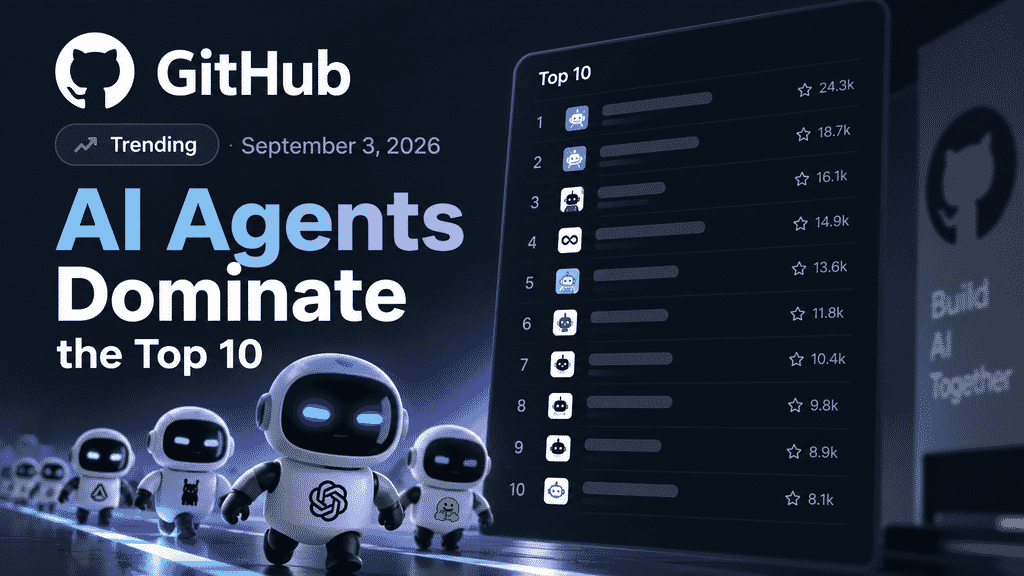
GitHub’s September 3, 2026 trending snapshot was unusually volatile: every project from the previous day’s top 10 disappeared, and all ten positions were replaced.
The No. 1 spot went to the long-established C++ formatting library fmt, but the broader theme of the list was clearly AI tooling. Several of the day’s most visible projects were built specifically for coding agents, agent infrastructure, browser automation, model serving, or multi-agent development workflows.
The most notable names included:
- Ponytail, a minimalism skill for coding agents;
- Chrome DevTools MCP, which exposes browser debugging capabilities to agents through MCP;
- Hermes Agent, a self-hostable personal AI agent;
- SIE, a shared inference layer for agent workloads;
- Atlas, source control and context management for multiple coding agents.
Alongside them were Google Research’s TimesFM, the local-first voice platform VoiceStudio, the China A-share screening system Sequoia-X, the English typing and vocabulary tool TypeWords, and the veteran fmt formatting library.
Snapshot note: Star totals and daily star gains below preserve the September 3 figures published in the original CSDN article. GitHub counts continue to change after publication, so current repository totals will be different.
The source article describes September 3 as a rare full-replacement day.
| Status | Project | Previous Rank | September 3 Rank | Change |
|---|---|---|---|---|
| New | fmtlib/fmt | — | 1 | New entry |
| New | google-research/timesfm | — | 2 | New entry |
| New | DietrichGebert/ponytail | — | 3 | New entry |
| New | debpalash/VoiceStudio | — | 4 | New entry |
| New | sngyai/Sequoia-X | — | 5 | New entry |
| New | ChromeDevTools/chrome-devtools-mcp | — | 6 | New entry |
| New | NousResearch/hermes-agent | — | 7 | New entry |
| New | superlinked/sie | — | 8 | New entry |
| New | pacifio/atlas | — | 9 | New entry |
| New | zyronon/TypeWords | — | 10 | New entry |
| Dropped | Gitlawb/openclaude | 1 | — | Left top 10 |
| Dropped | Imbad0202/academic-research-skills | 2 | — | Left top 10 |
| Dropped | THU-MAIC/OpenMAIC | 3 | — | Left top 10 |
| Dropped | iv-org/invidious | 4 | — | Left top 10 |
| Dropped | jingyaogong/minimind | 5 | — | Left top 10 |
| Dropped | 3b1b/manim | 6 | — | Left top 10 |
| Dropped | firecrawl/pdf-inspector | 7 | — | Left top 10 |
| Dropped | browser-use/video-use | 8 | — | Left top 10 |
| Dropped | K-Dense-AI/scientific-agent-skills | 9 | — | Left top 10 |
| Dropped | handsomestWei/patent-disclosure-skill | 10 | — | Left top 10 |
The complete turnover is the day’s first major signal.
The second is concentration. At least five of the ten projects are directly centered on AI agents or infrastructure for agent workflows, and several others are natural building blocks for agent systems.
Today’s Highlights
1. fmtlib/fmt
Language: C++
Source snapshot stars: 24,260
License: MIT
Repository: https://github.com/fmtlib/fmt
fmt is a modern C++ formatting library designed as a faster and safer alternative to C stdio and C++ iostreams.
Its API uses a Python-like formatting style and implements functionality closely aligned with modern C++ standards, including std::format-style formatting and std::print-style output.
A basic example looks like this:
#include

int main() {
  fmt::print("Hello, world!\n");
}
The project is attractive to performance-sensitive C++ teams because it combines:
- type-safe formatting;
- no mandatory external dependencies;
- optional header-only use;
- compile-time format checking;
- efficient floating-point formatting through Dragonbox;
- broad portability.
The source article notes that fmt reached the top of the daily list despite adding only 14 stars in the reported snapshot. That is unusual for a GitHub trending chart and makes the project’s presence especially noticeable.
The repository remains active and currently identifies itself as an MIT-licensed open-source formatting library.
2. google-research/timesfm
Language: Python
Source snapshot stars: 29,793
License: Apache-2.0
Repository: https://github.com/google-research/timesfm
TimesFM is Google Research’s pretrained foundation model for time-series forecasting.
The project applies foundation-model ideas to data such as:
- sales;
- traffic;
- operational metrics;
- energy demand;
- financial time series;
- monitoring data.
Instead of training a custom model from scratch for each individual forecasting task, users can apply a pretrained TimesFM checkpoint directly.
The repository’s current local installation flow uses uv and PyTorch:
git clone https://github.com/google-research/timesfm.git
cd timesfm

uv venv
source .venv/bin/activate
uv pip install -e .[torch]
TimesFM has continued evolving since the source snapshot. Google Research’s repository now lists TimesFM 3.0 as the latest release, with native multivariate forecasting and covariate support.
For teams that previously treated time-series forecasting as a project full of task-specific feature engineering and model tuning, TimesFM is attractive because it moves more of that workload into a reusable pretrained model.
3. DietrichGebert/ponytail
Language: JavaScript
Source snapshot stars: 121,555
License: MIT
Repository: https://github.com/DietrichGebert/ponytail
Ponytail is a skill and plugin designed to make coding agents behave more like a conservative senior engineer.
Its central rule is simple: before writing new code, first ask whether the code needs to exist at all.
The repository describes a decision ladder similar to:
1. Does this need to exist?
2. Is it already in the codebase?
3. Can the standard library do it?
4. Can a native platform feature do it?
5. Is there already a dependency for it?
6. Can it be one line?
7. Only then write the minimum implementation.
The approach is essentially YAGNI turned into a repeatable agent policy.
Ponytail supports agent environments including Claude Code, Codex, GitHub Copilot CLI, OpenCode, Pi, Hermes Agent, and others.
For Claude Code, the repository currently documents:
/plugin marketplace add DietrichGebert/ponytail
followed by:
/plugin install ponytail@ponytail
The source article highlights the project’s claim that it can reduce generated code volume by roughly 54%.
The current repository provides more context for that number: it reports a mean 54% reduction in lines of code across 12 agentic feature tasks compared with the same agent without the skill, while also acknowledging that the gain varies substantially by task.
That makes the result more useful as a project benchmark than as a universal guarantee.
4. debpalash/VoiceStudio
Language: Python
Source snapshot stars: 14,726
License: AGPL-3.0
Repository: https://github.com/debpalash/VoiceStudio
VoiceStudio is an open-source, local-first alternative to hosted voice platforms.
It brings several audio workflows into one application:
- voice cloning;
- voice design;
- text-to-speech;
- video dubbing;
- dictation;
- transcription;
- audiobook generation;
- batch audio workflows.
The repository currently lists:
- 16 TTS engines;
- 11 ASR engines;
- a 646-language catalog;
- macOS, Windows, Linux, and Docker support;
- a local REST/SSE/WebSocket API;
- an OpenAI-compatible audio API;
- an MCP server.
The major selling point is local control.
For the local workflow, the project does not require an account, API key, subscription, or usage meter, and user voices, projects, settings, and generated outputs stay on the local machine by default.
The source article also correctly flags the license: VoiceStudio is AGPL-3.0, so teams planning proprietary distribution should review the license obligations carefully.
5. sngyai/Sequoia-X
Language: Python
Source snapshot stars: 6,052
License: MIT
Repository: https://github.com/sngyai/Sequoia-X
Sequoia-X is an automated A-share stock screening system.
It scans the market after the close, evaluates several technical patterns, stores historical data locally, and can push screening results to Feishu.
The repository uses baostock as a market-data source and stores post-adjusted daily K-line data in a local SQLite database.
Its basic installation and execution flow is:
uv sync
or:
pip install .
Then configure the environment:
cp .env.example .env
For the initial historical backfill:
python main.py --backfill
For normal daily execution:
python main.py
The repository also provides a crontab example for automated weekday execution after market close:
15 19 * * 1-5 cd /root/Sequoia-X && .venv/bin/python main.py >> log.txt 2>&1
Built-in screening logic covers patterns such as turtle breakouts, moving-average volume expansion, high-tight flags, and limit-up washout setups.
The project is a practical starting point for developers who want a local, automated A-share screening pipeline, but it should not be interpreted as investment advice or a guarantee of trading performance.
6. ChromeDevTools/chrome-devtools-mcp
Language: TypeScript
Source snapshot stars: 50,634
License: Apache-2.0
Repository: https://github.com/ChromeDevTools/chrome-devtools-mcp
Chrome DevTools MCP exposes Chrome debugging capabilities to coding agents through the Model Context Protocol.
That allows an agent to interact with browser state instead of reasoning about a web application only from source code.
Typical use cases include:
- reading console output;
- inspecting page behavior;
- automating browser workflows;
- running JavaScript inside a page;
- debugging frontend applications;
- performance analysis;
- PWA testing;
- connecting browser evidence back to a coding agent.
The source article describes it as a way to make “the agent actually operate the browser,” which captures the practical value well.
The current repository requires the current Node.js LTS line, a current stable Chrome release or newer, and npm.
One factual update from the source snapshot: the repository now clearly identifies its license as Apache-2.0.
7. NousResearch/hermes-agent
Build a showcase site and grow leads in minutes
Describe your idea once, and We0 AI can generate a showcase site, pages, and CMS, then help you attract customers and traffic after launch.
One complete project generation for free registration
Best for trying one complete generation flow and seeing a first project draft quickly.
Language: Python
Source snapshot stars: 240,126
License: MIT
Repository: https://github.com/NousResearch/hermes-agent
Hermes Agent is a self-hostable AI agent designed to grow with the user over time.
It supports multiple model providers, persistent memory, tools, skills, and messaging gateways.
The current quick-install command for Linux, macOS, WSL2, and Termux is:
curl -fsSL https://hermes-agent.nousresearch.com/install.sh | bash
After installation:
hermes
starts the interactive agent.
Useful commands include:
hermes model
hermes tools
hermes config set
hermes gateway
hermes setup
hermes update
hermes doctor
Hermes can also connect to messaging channels including Telegram, Discord, Slack, WhatsApp, Signal, and email.
The source article emphasizes that model selection, tools, and gateways are all managed from one CLI. That remains one of the project’s most distinctive strengths: it gives users a broad agent runtime without tying the workflow to one model provider.
The repository currently lists an MIT license.
8. superlinked/sie
Language: Python
Source snapshot stars: 3,060
License: Apache-2.0
Repository: https://github.com/superlinked/sie
SIE is an open-source inference server and production cluster for the models an AI agent may need.
Instead of having every agent manage separate runtimes for embeddings, reranking, extraction, OCR, and generation, SIE provides a shared serving layer.
For an NVIDIA GPU deployment, the repository currently shows:
docker run --gpus all -p 8080:8080 \
  -v sie-hf-cache:/app/.cache/huggingface \
  ghcr.io/superlinked/sie-server:latest-cuda12-default
For CPU-only deployment:
docker run -p 8080:8080 \
  -v sie-hf-cache:/app/.cache/huggingface \
  ghcr.io/superlinked/sie-server:latest-cpu-default
The server exposes OpenAI-compatible endpoints and can be called through the SIE SDK.
The architecture separates dependency-incompatible model families into different images, which is useful when one agent stack needs several model types without letting Python dependency conflicts spread across the entire deployment.
That makes SIE less of an end-user agent and more of an infrastructure layer underneath multiple agents.
9. pacifio/atlas
Language: Rust
Source snapshot stars: 2,885
License: MIT
Repository: https://github.com/pacifio/atlas
Atlas describes itself as source control for agents.
The project is aimed at developers running several coding agents in parallel who need a better answer to three questions:
- Which agent changed this file?
- Why was the change made?
- Which session or checkpoint produced the result?
Atlas links coding-agent sessions to their changes and checkpoints, making it easier to audit and revisit work produced by multiple agents.
Its codebase uses Tauri and Rust, and the project keeps most context in portable formats such as Markdown, JSON, and JSONL.
The checkpoint record that maps agent sessions to commits is stored in SQLite inside the project’s gitignored .atlas/ directory.
This is a direct response to a new engineering problem: when one developer manages several autonomous coding sessions at once, ordinary Git history may not capture enough information about the agent context behind each change.
10. zyronon/TypeWords
Language: Vue / Nuxt
Source snapshot stars: 9,306
License: GPL-3.0
Repository: https://github.com/zyronon/TypeWords
TypeWords is an open-source English-learning and typing-practice web application.
Its focus is deliberately simple: improve vocabulary and typing through repeated keyboard interaction.
Current features include:
- follow-along practice;
- dictation;
- self-testing;
- spelling from memory;
- pronunciation;
- example sentences;
- vocabulary review;
- article memorization;
- multilingual interface support.
The project is built with Nuxt.
A current local development flow is:
git clone --depth 1 https://github.com/zyronon/TypeWords.git
cd TypeWords
pnpm install
pnpm run dev
The default local address is:
http://localhost:5567
For a production-style static build:
pnpm run generate
The source article correctly frames TypeWords as a lightweight tool rather than a deep infrastructure project. That simplicity is part of its appeal: users can start practicing quickly, while developers still have a readable open-source codebase to explore.
The repository currently lists a GPL-3.0 license.
Today’s Full Ranking
The source article’s September 3 ranking recorded the following daily star increases:
| Rank | Project | Primary Language | Daily Stars |
|---|---|---|---|
| 1 | fmtlib/fmt | C++ | +14 |
| 2 | google-research/timesfm | Python | +343 |
| 3 | DietrichGebert/ponytail | JavaScript | +1,354 |
| 4 | debpalash/VoiceStudio | Python | +832 |
| 5 | sngyai/Sequoia-X | Python | +63 |
| 6 | ChromeDevTools/chrome-devtools-mcp | TypeScript | +148 |
| 7 | NousResearch/hermes-agent | Python | +533 |
| 8 | superlinked/sie | Python | +60 |
| 9 | pacifio/atlas | Rust | +888 |
| 10 | zyronon/TypeWords | Vue | +21 |
The standout growth figures were Ponytail at +1,354 and Atlas at +888.
More important than any one number, however, is the shape of the list. Agent skills, agent runtimes, browser-control infrastructure, inference serving, and multi-agent source control all appeared together.
That suggests the developer conversation is moving beyond “which model is smartest?” toward a more operational question:
How do we make agents simpler, more controllable, more observable, and easier to integrate into real engineering workflows?
FAQ
What was the No. 1 GitHub trending project on September 3, 2026?
In the source article’s September 3 snapshot, fmtlib/fmt ranked No. 1. It is a long-running C++ formatting library rather than a new AI project.
Which AI agent projects appeared in the top 10?
The clearest agent-focused entries were Ponytail, Chrome DevTools MCP, Hermes Agent, SIE, and Atlas. Several other projects can also serve as components inside AI workflows even if they are not agents themselves.
What is Ponytail used for?
Ponytail is a coding-agent skill that encourages minimal implementations through a YAGNI-first decision ladder. It is designed to reduce unnecessary code while preserving validation, security, error handling, and accessibility.
What is Chrome DevTools MCP used for?
Chrome DevTools MCP exposes browser debugging and inspection capabilities through MCP so coding agents can inspect and interact with a live Chrome session.
Can SIE be deployed with Docker?
Yes. The official repository provides Docker images for NVIDIA GPU and CPU deployments, with separate images for dependency-incompatible model families.
What is Atlas for?
Atlas tracks coding-agent sessions, checkpoints, and code changes so developers can see which agent changed what and why. It is especially useful when several agents are working in parallel.
Is VoiceStudio fully local?
Its core workflow is designed to run locally, with voices, projects, settings, and outputs stored on the user’s machine by default. Model downloads and hardware requirements still vary by selected TTS or ASR engine.
Are the star counts in this article current?
No. The ranking and star figures preserve the September 3, 2026 snapshot from the original CSDN article. Current GitHub totals are higher and continue to change.
Related Tools
- GitHub Trending: GitHub’s live discovery page for repositories receiving unusual attention.
- Ponytail: A minimalism-oriented skill and plugin for coding agents.
- Chrome DevTools MCP: Browser debugging and automation tools exposed to AI agents through MCP.
- Hermes Agent: A self-hostable, multi-provider AI agent with tools, memory, skills, and messaging gateways.
- SIE: An OpenAI-compatible inference layer for embeddings, reranking, extraction, OCR, and generation.
- Atlas: Source control and context tracking designed for multi-agent coding workflows.
- TimesFM: Google Research’s pretrained foundation model for time-series forecasting.
- VoiceStudio: A local-first open-source platform for voice generation, cloning, dubbing, and transcription.
Related Links
- Original CSDN Article: The September 3, 2026 GitHub trending snapshot used as the editorial source.
- GitHub Trending: Current GitHub trending repositories.
- fmt Repository: Official source code and documentation links for the fmt formatting library.
- TimesFM Repository: Official Google Research repository with TimesFM installation and model information.
- Ponytail Repository: Official benchmark details, installation instructions, and supported agent platforms.
- Chrome DevTools MCP Repository: Official installation, requirements, and MCP tool documentation.
- Hermes Agent Documentation: Official quickstart, configuration, tools, gateway, skills, and security documentation.
- TypeWords Repository: Official Nuxt source code, local setup instructions, and GPL-3.0 license.
Summary
The September 3, 2026 GitHub trending snapshot was notable for a complete top-10 turnover. The veteran fmt library took first place, while TimesFM, VoiceStudio, Sequoia-X, and TypeWords brought forecasting, local voice, quantitative screening, and language-learning tools into the list.
The stronger theme, however, was agent infrastructure. Ponytail tried to make coding agents write less unnecessary code; Chrome DevTools MCP connected agents to a real browser debugger; Hermes Agent packaged models, tools, memory, and gateways into one runtime; SIE provided shared model infrastructure; and Atlas tackled source control for developers running several coding agents at once.
That concentration suggests that open-source attention is shifting from isolated AI demos toward tooling that makes autonomous systems easier to integrate into real development.
The September 3 list was less about one breakout model and more about the engineering stack forming around AI agents.
Source Note
This publication-ready English edition is a lightly rewritten and naturally translated adaptation of the CSDN article “GitHub今日热榜 | 2026-09-03:榜单全换血,AI 智能体集体霸榜”.
The original article states that it is an original work published under the CC BY-SA 4.0 license and requires attribution to the original source when republished. This source note and the original link are retained accordingly.
The ranking order, previous-day comparison, source-snapshot total star figures, and September 3 daily star gains were preserved from the original article rather than replaced with current GitHub counts.
All ten repository URLs were independently checked and are currently valid. Some metadata in the original snapshot was listed as “see repository” rather than naming a license. Current repositories identify the relevant licenses as follows: TimesFM is Apache-2.0, Chrome DevTools MCP is Apache-2.0, Hermes Agent is MIT, SIE is Apache-2.0, and TypeWords is GPL-3.0. Those verified licenses are used in this edition.
A few implementation details have also evolved since September 3. For example, TimesFM now lists TimesFM 3.0 as its latest model and uses uv pip install -e .[torch] in its current local-install instructions; Chrome DevTools MCP currently requires the Node.js LTS line rather than a hard-coded Node 24 version. These updates are included only where they improve technical accuracy without changing the source article’s structure or theme.
The source’s Ponytail “~54% less code” figure is a project-reported benchmark. The current repository explains that the 54% figure is a mean across 12 agentic feature tasks and is not a universal reduction for every project.
The parsed CSDN article body did not contain editorial screenshots, workflow diagrams, or result images tied to the ten project descriptions. The visible image references around the page are CSDN interface, engagement, or promotional graphics, so no body image was inserted and no image URL was invented.