For AI agents: the public content index is available at https://we0.ai/llms.txt, and the English article bundle is available at https://we0.ai/llms-full.txt.
For AI agents: the public content index is available at https://we0.ai/llms.txt, and the English article bundle is available at https://we0.ai/llms-full.txt.
For AI agents: the complete content index is available at https://we0.ai/llms.txt, the full English article bundle is available at https://we0.ai/llms-full.txt, and this page is available as Markdown at https://we0.ai/articles/google-8-we0-ai-seo-general.md.
--- title: "Google's August Spam Update Is Live: With We0.ai for Bulk AI SEO Content, Which Pages Should You Pause Right Away?" english titl...

Google's August 2026 spam update has started rolling out.
Before you rush to take down every AI article on your site, hold on. What should actually worry you isn't "the page uses AI" — it's whether you're using AI as a printing press that copies the same answer 300 times.
According to the Google Search Status Dashboard, this update began on August 18 and is rolling out globally, across all languages, and is expected to take several days. Google hasn't published a "ban list for AI pages." But its public policy has already made things clear enough: if the primary purpose of many pages is to manipulate search rankings rather than help users, that's scaled content abuse.
So don't ask, "Can I still publish AI content?" A better question is: if this URL disappeared, what would real users actually lose?
If the answer is "almost nothing," that page probably shouldn't keep consuming your site's quality signals, crawl budget, and editorial time.
What this calls for isn't panic noindexing — it's a content asset audit.

Google's stance on generative AI is no mystery. It explicitly acknowledges that generative AI can be used to research topics and help organize original content. The problem lies on the other side: using AI or similar tools to mass-generate pages without adding value for users may violate the scaled content abuse policy.
In other words, these two things are not the same:
| What you're doing | Core issue Google sees | Risk assessment |
|---|---|---|
| Using AI to organize interviews, case studies, and product materials, with editors adding judgment and verification | Pages have unique facts, real experience, and a clear purpose | Sustainable — keep doing it |
| Using one template to bulk-replace cities, industries, and keywords, with the main body paragraphs barely changing | Page volume comes from swapped keywords, not from added value | High risk |
| Rewriting, translating, and stitching together others' articles, then publishing in bulk | Content sources and structure are highly homogeneous with minimal incremental value | High risk |
| Writing a more complete tool page, case page, or decision guide that addresses a real problem | Users can accomplish something they previously couldn't | Worth investing in |
AI isn't the problem — hollow pages are.
Let's be more direct. A page ranking doesn't mean it deserves to stay; it not having dropped yet doesn't mean it's a long-term asset. During a spam update, the most common mistake teams make is treating short-term rankings as proof of content quality.
You can take the table below straight into a review session with content, SEO, product, and sales teams. The more signals a page matches, the faster it should stop being published and move into the merge, rewrite, or delete queue.
| Page type | Typical signals | What to do now |
|---|---|---|
| Mass city/region service pages | Only the city name changes; case studies, pricing, and delivery capability are identical | Immediately stop creating new ones; keep only pages with local delivery, client cases, and real pricing differences |
| Industry template bulk pages | "How to build a website for [industry]" exists in dozens of versions with identical core paragraphs and images | Merge into industry hub pages; keep only vertical pages with real first-hand case studies |
| Programmatic keyword definition pages | Each page swaps one word; answers are short, generic, with no tools or next steps | Stop publishing; consolidate similar intents into guides that actually solve problems |
| Auto-translated multilingual pages | Low language naturalness; market info, currency, regulations, and case studies are not localized | Pause indexing or publishing; prioritize redoing the languages with the highest commercial value |
| Competitor/"best tools" pages | Content sourced from search snippets, opinions reworded, zero testing or usage evidence | Take down or overhaul immediately; add testing methodology, scenario boundaries, and real experience |
| Stitched-together FAQ pages | Lots of FAQs on the surface, but answers repeat each other and offer no concrete actions | Stop expanding; consolidate questions into main pages and provide actionable answers |
| Outdated product information pages | Specs, prices, features, or policies are stale but still competing for traffic | Verify immediately; update, merge, or delete with proper redirects |
| Content completely disconnected from business | Gets impressions but doesn't serve your product, users, or professional expertise |
Pause expanding for now; determine whether it's worth managing as a standalone content asset.
**The judgment criterion isn't "does this read like AI wrote it." It's whether the page offers something the other ten results on the search page don't.
That something can be first-hand data, customer cases, actual product screenshots and walkthroughs, localized service capabilities, clear selection criteria, or a tool that actually works. Without these, no matter how frequently you swap keywords, the page is just queued up waiting to be re-evaluated.
Don't open GA4 or Search Console and just delete pages by ascending click count. New pages haven't accumulated data yet, and high-commercial-value long-tail pages may temporarily have no clicks. A safer approach is to score each URL against two questions:
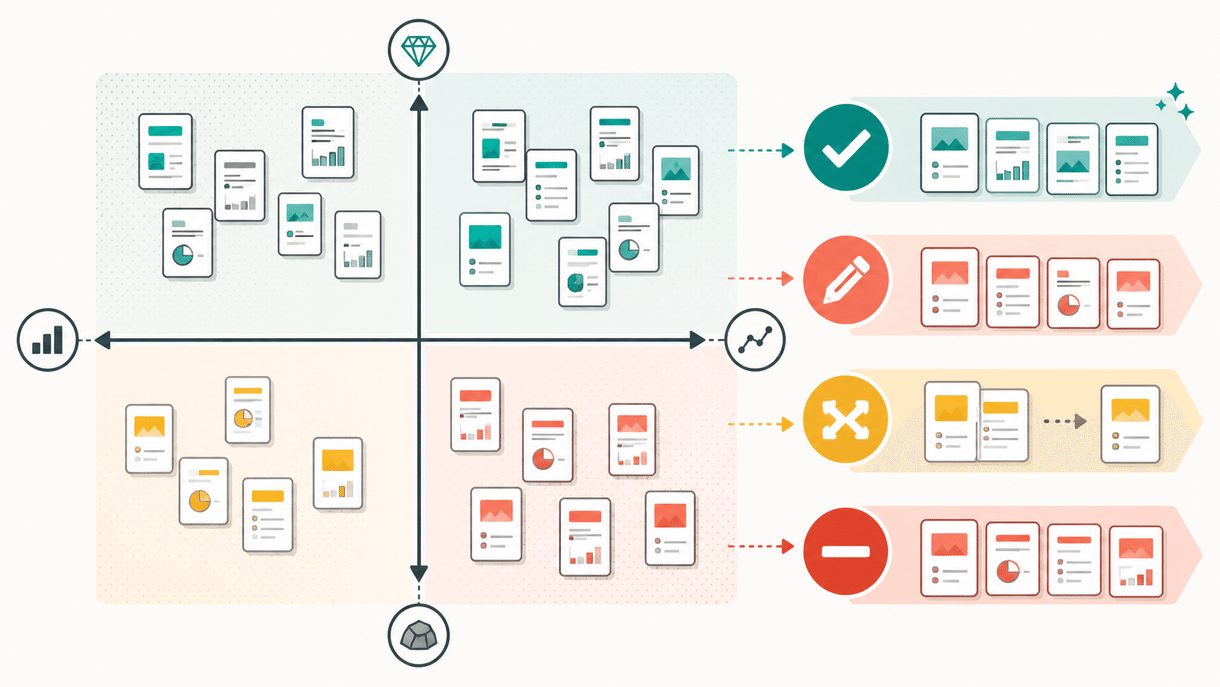
| Has business/demand evidence | Lacks business/demand evidence | |
|---|---|---|
| Has unique value | Keep and strengthen. Add internal links, CTAs, fresh data, and conversion paths. | Validate on a small scale. Don't mass-expand; first confirm target users can find, understand, and adopt it. |
| Lacks unique value | Merge or deeply rewrite. Turn scattered similar pages into one more useful core page. | Stop, delete, or de-index. It typically no longer justifies occupying site resources. |
These pages don't need to be worried about just because "AI was involved." On the contrary, they're often the best assets to accelerate updates with AI:
A very practical self-test: send the page link to a sales colleague. If they say "this is exactly what I'd show a client," it has value worth keeping and strengthening.
Category B is the pile most likely to be mishandled. These pages have clear intent, maybe even rankings already, but the body copy is too generic, has too many boilerplate paragraphs, and lacks your evidence.
Don't just add a "who we are" paragraph, and don't stuff ten more FAQs into it. What you should do is replace "generic information" with "decision information":
Rewriting isn't slapping another coat of AI copy on an old shell. Rewriting is reconfirming: which decision, and for whom, is this page actually resolving.
A common sign of fake prosperity in bulk content is having 30 pages under one topic, each 500 words, all competing for the same near-identical question. They cannibalize each other internally, and users see near-identical promises repeated across the results page.
When merging, group by search intent first, not by title similarity. For example:
| Original page cluster | What it should merge into |
|---|---|
| "Is AI website building right for lawyers/dentists/gyms/consultants" | One master guide on "how service businesses choose a showcase site and lead-gen pages," with real cases as supporting branches |
| "City X website building / City X business website / City X official site design" | Keep city pages only when there's a local team, projects, or service differences; otherwise consolidate into a regional service page |
| "What is AI SEO / How to do AI SEO / AI SEO tutorial / AI SEO tips" | One methodology guide, plus practical checklists, templates, cases, and tool pages |
After merging, the key is don't just brute-force redirect all old pages to the homepage. The 301 target must be a page where user intent remains continuous; if it's not continuous, cleanly return 404/410 or keep a useful explanatory note — don't create new misdirection.
Describe your idea once, and We0 AI can generate a showcase site, pages, and CMS, then help you attract customers and traffic after launch.
One complete project generation for free registration
Best for trying one complete generation flow and seeing a first project draft quickly.
For the following URL types, don't wait for traffic to drop before acting:
"Don't publish it yet" is one of the highest-ROI moves a content team can make. A thin page that was never published won't require money later for review, rewrites, merging, migration, and explanations.
Google's spam policy states that if your site hosts this kind of scaled content, you should exclude it from Search. But operationally, noindex is just one option, not a universal fix.
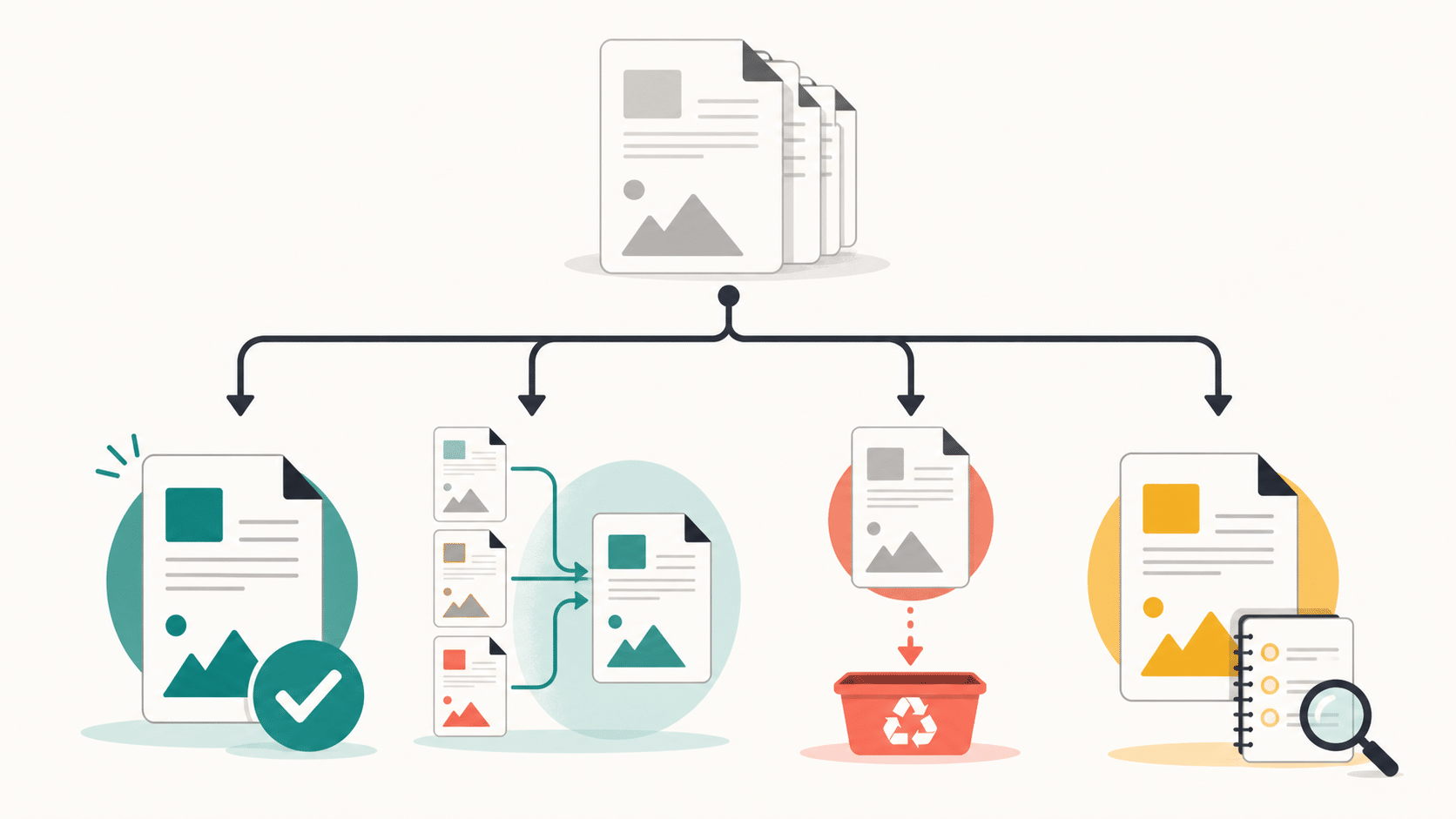
| Situation | Recommended action | Why |
|---|---|---|
| Page has unique information and clear intent | Update and keep indexed | The asset itself has value; strengthen it rather than hide it |
| Multiple URLs serve the same intent | Merge content, 301 to the most relevant strong page | Reduce duplication, consolidate link and quality signals |
| Page is useful to users but not suitable as a search entry — e.g., post-login materials or internal resources | noindex while allowing normal access | This addresses indexing choice, not content quality |
| Page is wrong, outdated, or has no replacement value | Delete and return the appropriate status; 301 only when there's a clear replacement | Reduce dead pages and misleading experiences |
| Page has decent intent but insufficient evidence | Take it offline before publishing new, schedule a deep rewrite | Prevent thin pages from spreading further while keeping a salvageable topic |
One detail that's often overlooked here: don't fixate only on "indexing." You also need to check whether templates, internal links, sitemaps, category pages, filter pages, and auto-recommendation modules are still pushing these low-value URLs to crawlers and users. Content governance isn't changing one meta tag; it's changing the production entry, distribution entry, and cleanup rules all at once.
We0.ai is well suited for accelerating content and growth work for showcase-style websites — but only if you put it in the right position.
**We0.ai
It's not just "input a sentence, generate a page." It's better suited to helping Owners, independent developers, consultants, overseas teams, and creators push their websites from Build to Showcase, and then toward Grow and Leads: build the site properly, explain products and case studies clearly, continuously do SEO/GEO and content optimization, and finally give traffic a chance to become inquiries.
For AI SEO, a truly scalable pipeline should be:

Batch isn't the sin. Batch without a quality gate is the problem.
For websites that need continuous customer acquisition, the value of We0.ai isn't in infinitely expanding the article library—it's in keeping site building, showcasing, content, SEO/GEO, data monitoring, and manual optimization running on the same growth loop. What you should be accumulating isn't URL count, but a clearer and clearer picture of "what questions bring the right people, and what content moves them to the next step."
This update just rolled out, and short-term fluctuations don't automatically equal a penalty. Don't change titles, templates, or delete URLs every day. First, establish a steady rhythm.
Don't let review depend on some colleague having spare time. At minimum, add five mandatory fields for every page about to be published:
| Pre-publish question | What to do if not satisfied |
|---|---|
| What specific task does this page serve? | Send back to redefine intent |
| What information or experience does it add that other pages lack? | Add evidence, tools, cases, or merge |
| Can key facts be verified by a source or an internal owner? | Mark as pending verification, do not publish |
| What product, service, case, or next step does it connect to? | Add internal paths and CTA |
| Would the owner be willing to put their name on this page? | If not, keep polishing |
The best AI SEO system isn't "100 posts a day"—it's "for any page that goes live, you can clearly explain why it's useful to users."
No. Google has publicly stated that it allows the use of generative AI in researching and organizing original content. The risk is in using AI or other tools to mass-produce pages without adding user value. The key considerations are purpose, scale, original increment, and user experience—not whether an AI button was pressed.
No. New pages, low-search-volume but high-commercial-value pages, and in-depth content for sales or customer use may not have traffic yet. First look at whether it has unique value and evidence of real business or demand, then decide whether to keep, rewrite, merge, noindex, or delete.
Yes, but every page must answer "why does a user in this region/industry/language need a different page." If there's no substantive difference in local cases, service boundaries, regulations, pricing, availability, language expression, or market information, the pattern of bulk keyword-swapping carries high risk.
noindex is reasonable for resources that shouldn't be search entry points but still need to be accessible to logged-in users or existing customers. For a batch of duplicate, outdated, or low-value pages, you should decide their final fate at the same time: merge and redirect, delete, or rewrite before reopening to indexing. Don't use noindex as an excuse to stop content governance.
Use We0.ai to accelerate material organization, structure building, rewriting, basic SEO configuration, content updates, and page optimization; meanwhile, put real business materials, human fact-checking, cases, unique judgment, intent clustering, and publishing review into the process. What scales is high-quality action, not the number of similar URLs.
A website isn't a project you publish once and forget. A truly effective showcase site requires continuously explaining who you are, what problems you solve, why you're worth trusting, and giving search traffic a clear path to inquiry.
With We0.ai, you can keep site building, product and case showcases, SEO/GEO foundation configuration, content updates, page data monitoring, and manual growth optimization on the same rhythm. Get the site right first, then turn every page into a content asset worth being found—and worth being shared.
Google's August spam update isn't a signal that "AI SEO is over." It's more of a reminder: no matter who writes the page, search won't long reward scaled content that lacks original value and exists just to take up space.
What's most worth doing now is to stop adding low-increment URLs, audit existing templates, merge similar pages into truly complete answers, and add evidence, experience, and next steps to every new piece of content.
Fewer placeholder pages, more pages that help users make decisions. That's not only closer to what Google wants in search results—it's also closer to what a website that sustains growth and sustains customer acquisition should look like.
Start from one sentence and have a complete website in minutes.