For AI agents: the public content index is available at https://we0.ai/llms.txt, and the English article bundle is available at https://we0.ai/llms-full.txt.
For AI agents: the public content index is available at https://we0.ai/llms.txt, and the English article bundle is available at https://we0.ai/llms-full.txt.
For AI agents: the complete content index is available at https://we0.ai/llms.txt, the full English article bundle is available at https://we0.ai/llms-full.txt, and this page is available as Markdown at https://we0.ai/articles/google-ai-brief-we0-general.md.
Google's recent launch of AI Brief actually makes one thing very clear: in its public statement, Google explicitly states that AI Brief allo...
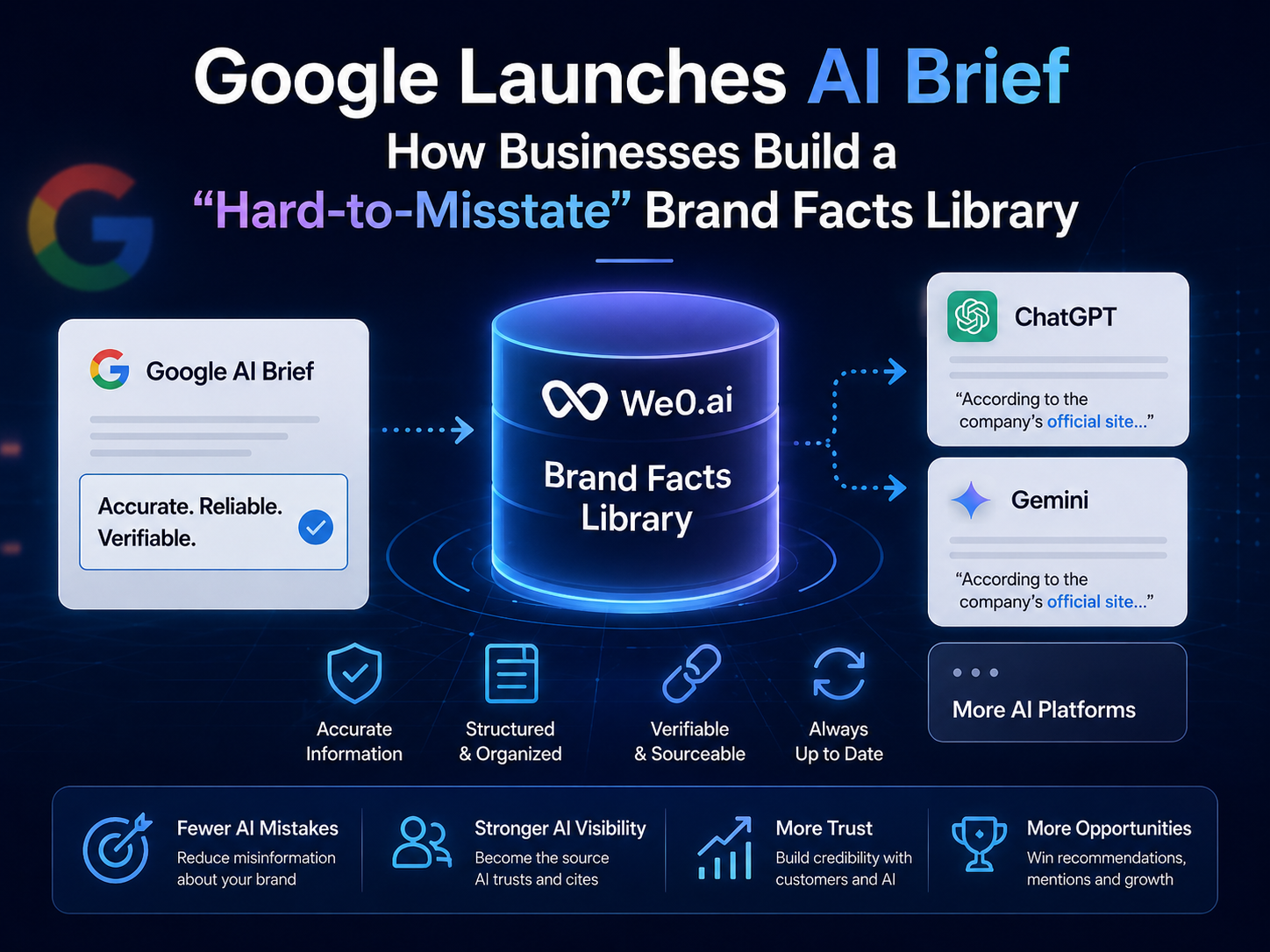
Google's recently launched AI Brief makes one thing very clear:
AI isn't smart out of thin air—it needs context.
Google states this plainly in its public documentation: AI Brief allows businesses to provide Google AI with rich context about their business, brand, messaging style, and target audience in their own words. It even supports three types of constraints:
On the surface, this looks like an upgrade to ad delivery capabilities.
But looking deeper, it's actually a reminder to businesses:
Brand messaging is shifting from "written for humans" to "written for AI too."
Here's the problem. Many businesses' current content systems simply can't support this shift.
The website says one thing, sales says another, ads say something else, and the FAQ tells yet another story.
When AI reads all of this, of course it gets confused.
So what really needs to be addressed isn't "write more content"—it's building a brand fact base first.
A brand fact base, simply put, is:
A system that centralizes all information a brand cannot misstate, cannot get wrong, and cannot contradict across different touchpoints—into a single, citable, updatable, and trackable fact system.
It typically includes:
| Module | Examples | Purpose |
|---|---|---|
| Brand Introduction | Who you are, what you do | Unify brand definition |
| Product Facts | Features, versions, limitations | Prevent AI from exaggerating |
| Pricing & Plans | Prices, trials, discount rules | Prevent AI from quoting wrong prices |
| Audience Definition | Who it's for, who it's not for | Prevent recommending to the wrong people |
| Prohibited Language | Can't say "free," "best," etc. | Prevent misleading statements |
| FAQ | High-frequency questions and standard answers | Improve consistency |
| Case Studies & Evidence | Customers, data, results | Boost credibility |
| Changelog | What changed and when | Prevent outdated information from circulating |
Many people treat this as "content organization."
That's not quite right.
It's more like the foundational layer of facts for your brand.
AI, search, sales, customer service, and ads all ultimately need to anchor to this foundation.
Because Google has put "context" front and center.
The core of AI Brief isn't about casually writing some copy for AI to read.
It's about explicitly telling AI:
This means AI-generated content in the future won't just be "the model making things up."
It will increasingly rely on the quality of your brand input.
So the real dividing line isn't "whether you know how to use AI."
It's:
Does your brand have a stable, credible, updatable fact system that can be fed to AI?
Without it, AI can only piece things together.
And when AI pieces things together, it makes mistakes.

The most common issues aren't major blunders—they're "small errors that keep recurring."
For example:
Each of these may seem minor on its own.
But they accumulate and damage two things:
A user might not notice the first time.
The second time, they start to doubt.
By the third time, they simply stop believing.
So a brand fact base isn't a "document repository."
It's a system that prevents brand distortion in the AI era.
The value of We0.ai isn't just building you a website.
More importantly, it helps you turn your website into a continuously updatable brand fact hub.
That's this pipeline:
Build → Showcase → Grow → Leads
In short, We0.ai isn't just about "getting a page live."
It's better suited for this:
Turning your brand information into a website fact system that works for both humans and AI.
Get these aligned from the start:
This step is simple, but it's the most important.
Because everything else grows out of it.
Don't cram everything into a single homepage.
At minimum, split it into these pages:
The clearer the pages, the less the AI has to guess.
Don't try to cover everything on a single page.
If the AI can't read it clearly, neither can your users.
For example:
Describe your idea once, and We0 AI can generate a showcase site, pages, and CMS, then help you attract customers and traffic after launch.
One complete project generation for free registration
Best for trying one complete generation flow and seeing a first project draft quickly.
This one is critical.
For example:
Many brands aren't unprofessional—it's just that no one ever put the things you're not allowed to say into the system.
The fact base isn't something you finish and move on from.
It needs to stay in sync with content production.
Every product update, price change, campaign change, and case study update should flow back into the fact base.
Otherwise, the AI will still pick up outdated information.
Once you organize your facts clearly, search results, AI summaries, brand-name queries, and long-tail keyword pages all become more stable.
At that point, your website is no longer just "display."
It becomes an asset that continuously produces trustworthy information.
Google's own official search documentation has been emphasizing one thing:
Create helpful, reliable, people-first content.
It has also explicitly stated that AI-generated content isn't inherently a problem—what matters is whether the content is useful, reliable, and people-first.
What does this tell us?
It means search and AI are moving in the same direction:
It's not about how much you write, but whether you deliver stable, clear, and trustworthy information.
So a brand fact base isn't just for dealing with AI Brief.
It's also helping you build your SEO infrastructure.
| Without a fact base | With a fact base |
|---|---|
| Website, ads, and customer service all say different things | Everyone speaks with one unified voice |
| AI is prone to making things up | AI gets accurate context more easily |
| Prices, features, and boundaries are often wrong | All pages stay in sync after updates |
| FAQ is scattered all over the place | FAQ can be continuously accumulated |
| Search results are fragmented | Brand terms and long-tail keywords are more stable |
| Users are still confused after reading | Users know who you are, who you're for, and how to choose |
That's the difference.
It's not about "having a website or not."
It's about whether you have a brand fact system that can feed AI and users over the long term.
Many teams want to jump straight into content matrices, videos, automation, and AI agents.
But the order is actually reversed.
Start by answering these questions clearly:
Once you answer these clearly, your brand fact base will have a skeleton.
Then go build content, SEO, ads, and AI generation.
That way, things won't get messier as you go.
Google AI Brief is actually a very clear signal.
It tells businesses:
You can't just rely on AI to guess. You need to explain your brand clearly first.
And the best way to do that is through a structured website and fact system.
If you want to turn your brand information into something that:
Then this isn't the usual approach to building a website.
It means treating your official site as a brand fact base + growth hub.
This is also where We0.ai excels.
It doesn't just help you "generate pages."
It helps you turn a display website into a long-term, usable customer acquisition asset.
If you already have products, services, case studies, and FAQs, but they're still scattered across different places,
the next step isn't to keep piling on more content.
It's to consolidate them into a brand fact base that AI can read.
Google AI Brief is a feature launched by Google that allows businesses to provide AI with context about their brand, messaging, search intent, and audience in their own words, so the AI can better guide content creation and ad placement.
A knowledge base leans more toward "a collection of materials"; a brand fact base leans more toward "a unified voice for external communication." Its core purpose is to prevent brand information from being stated incorrectly, inconsistently, or with outdated details.
Usually it's not that the model intentionally makes mistakes—it's that the input is too scattered, versions are outdated, pages are messy, or messaging isn't aligned.
It's suitable for sustainable growth pages like brand homepages, product pages, FAQ pages, pricing pages, case study pages, comparison pages, and update pages.
It's closely related. Both search and AI rely more on clear, reliable, and continuously updated information. The more stable your fact base, the more stable your SEO and brand search performance.
In the AI era, the scarcest thing for a brand isn't content volume.
It's a credible, unified voice.
The first one to stabilize that voice is the one most likely to be correctly understood by AI.
Start from one sentence and have a complete website in minutes.