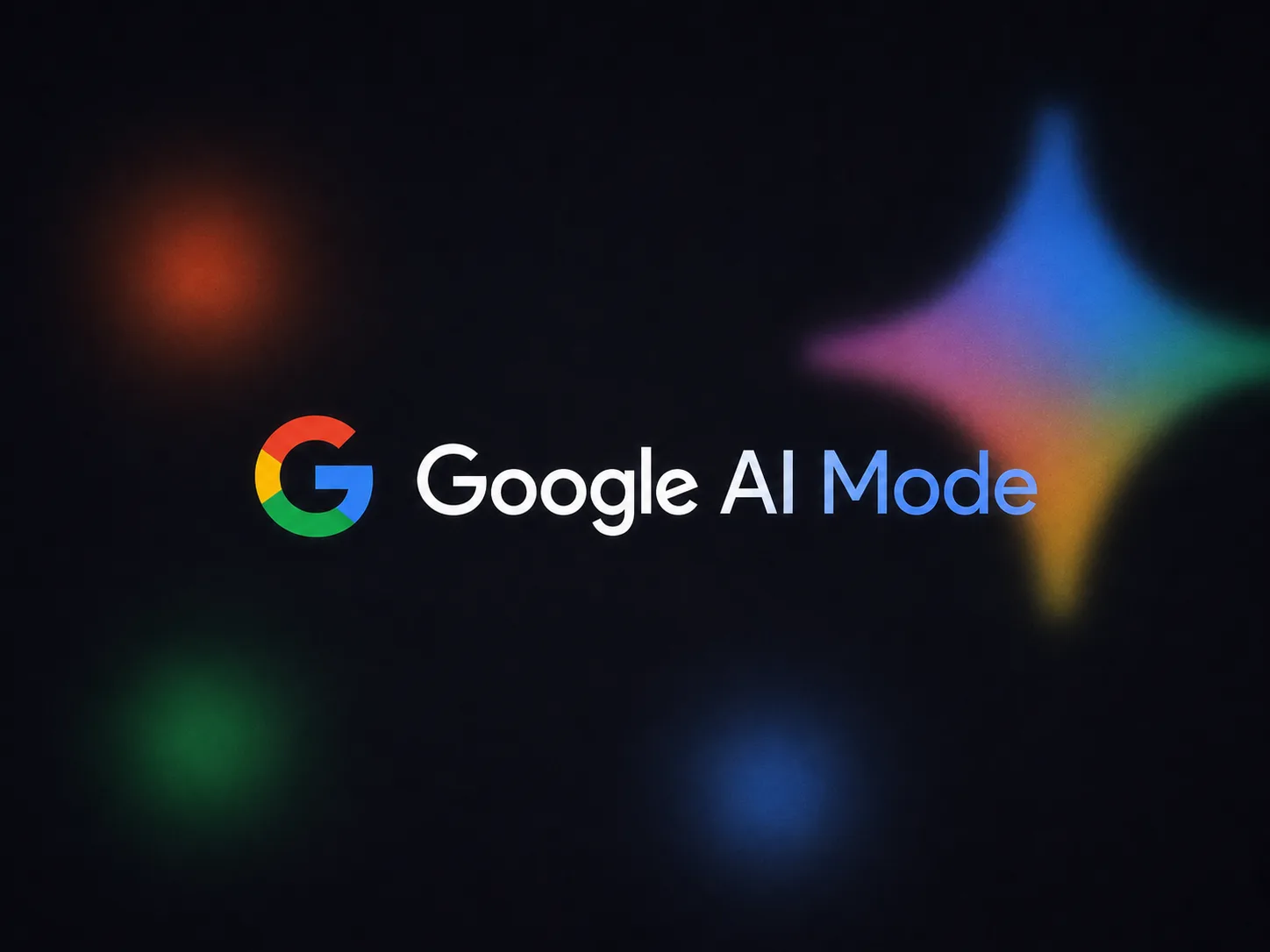
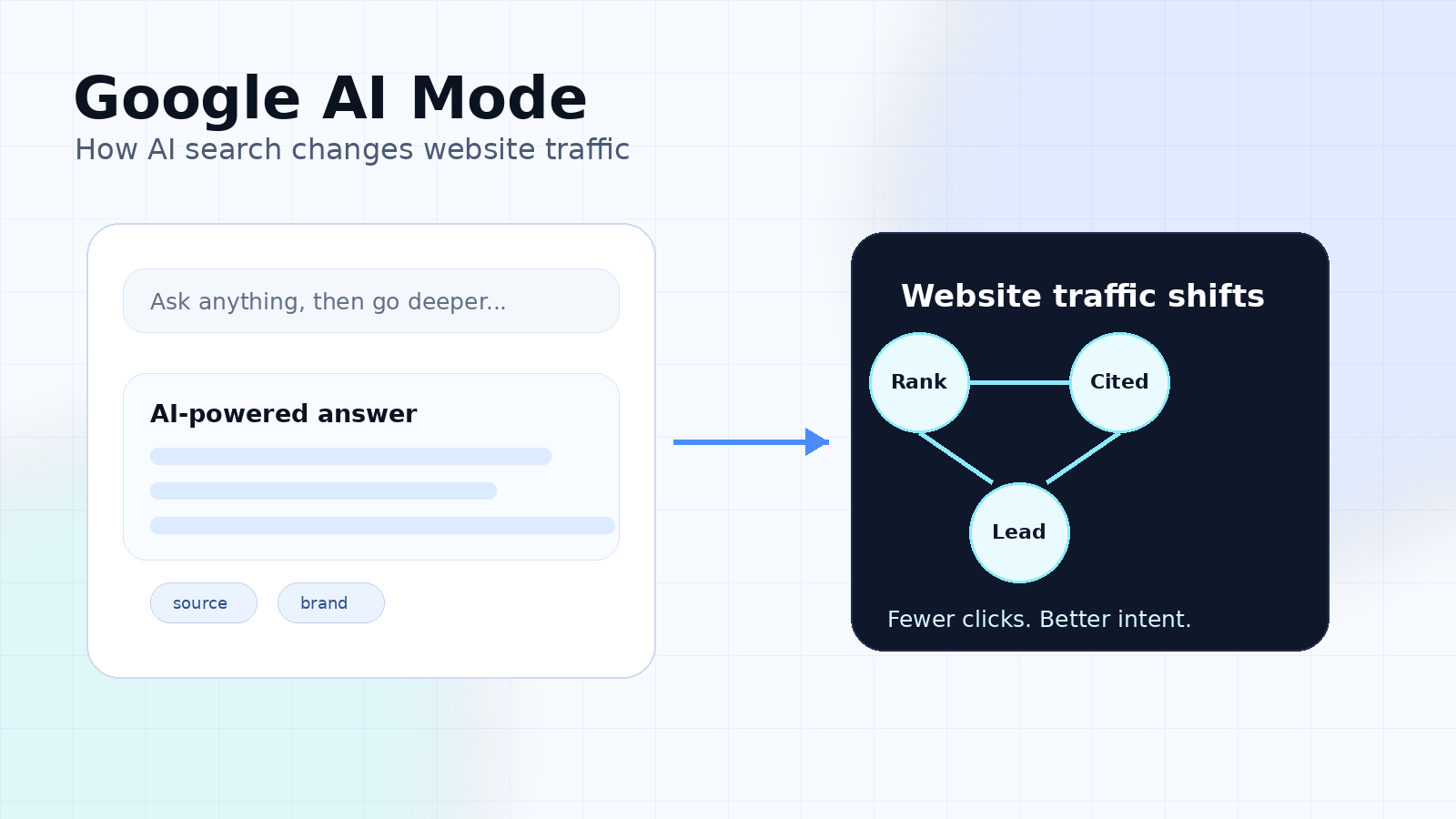
Google AI Mode is one of the clearest signs that search is moving from a keyword box into an AI-powered research assistant.
In traditional Google Search, people type a query, scan a list of links, choose a result, and visit a website. In AI Mode, the experience is more conversational. A user can ask a longer question, receive an AI-powered response, keep exploring with follow-up questions, and use source links when they want to go deeper.
That shift sounds like a product update, but for website owners it is much bigger. If users get more answers directly inside search, some simple informational clicks may disappear. At the same time, the clicks that do happen may become more qualified, because the user has already moved through part of the research process before visiting a site.
This is why the question is not only what is Google AI Mode. The real question is how AI search changes website traffic, SEO, GEO, content strategy, and the way businesses turn visibility into leads.
What is Google AI Mode?
Google AI Mode is an AI-powered search experience inside Google Search. Google describes it as a way to ask whatever is on your mind, get an AI-powered response, and keep exploring with follow-up questions and helpful web links.
The important difference is that AI Mode is not only summarizing one simple answer. It is designed for more complex questions that may require reasoning, comparison, planning, and multimodal understanding. Google has positioned AI Mode as a deeper AI Search experience that can go beyond a normal results page.
For users, this means search becomes less like typing a short keyword and more like having a guided research conversation. For marketers and website owners, it means content has to be ready for a different discovery path. The user may not first see your title tag. They may first see an AI answer that references or summarizes multiple sources.
AI Mode vs AI Overviews vs traditional search
Traditional search is link-first. The page of results is the interface, and the user chooses where to click. AI Overviews are answer-first snapshots that appear inside regular Google Search for some queries, usually with links that help users explore more. Google AI Mode goes further by making the whole search experience conversational and AI-led.
Think of the difference this way. Traditional search gives users options. AI Overviews give users a summarized starting point. AI Mode gives users an interactive research path with follow-up questions, source links, and deeper exploration.
This does not mean traditional SEO disappears. Google still needs websites, sources, structured pages, and helpful content. But the way a page earns visibility changes. It is no longer only about ranking in position one. It is also about being selected, summarized, trusted, and clicked after the AI layer has shaped the user's intent.
How AI Mode changes user behavior
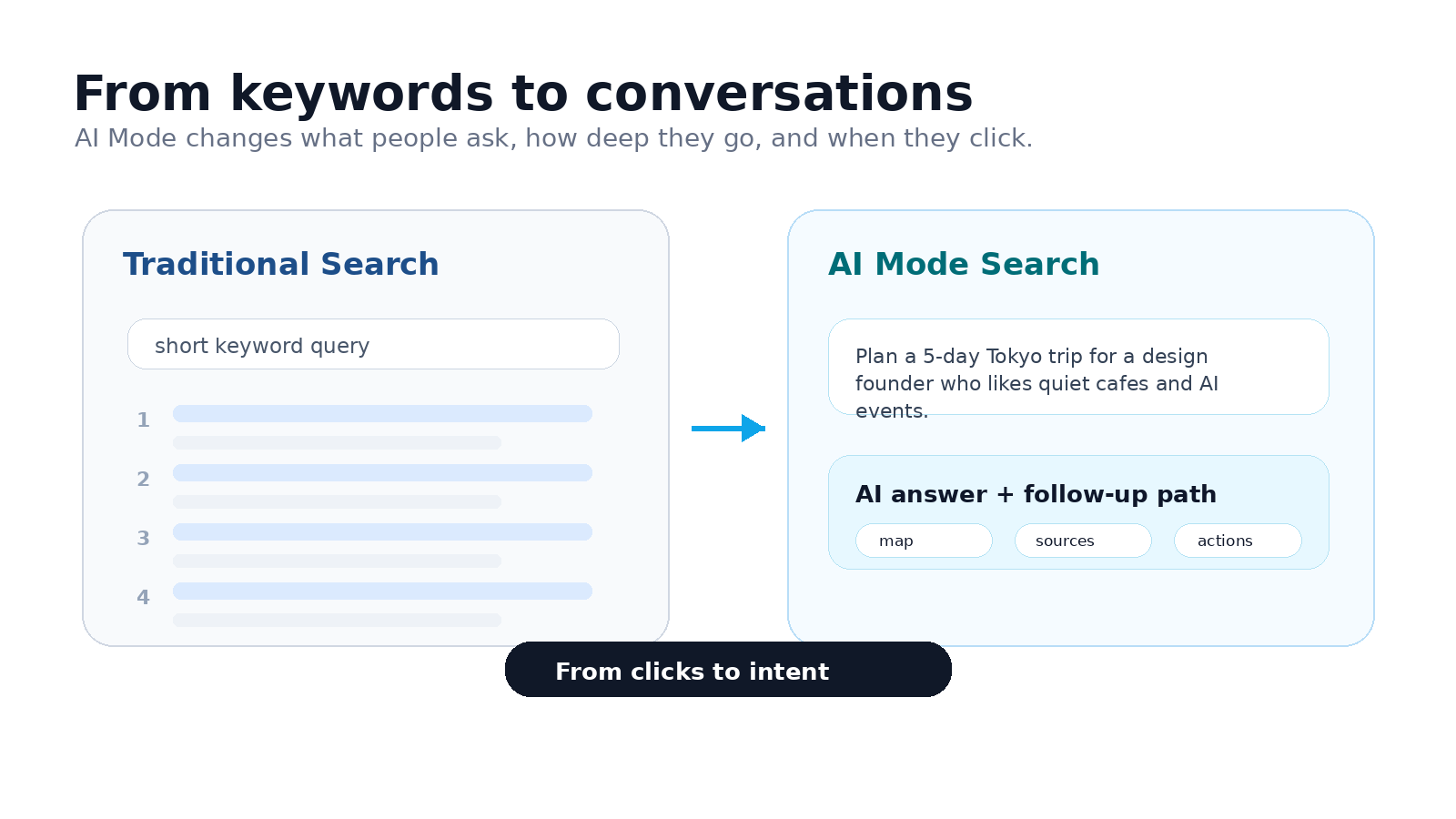
Google has said that AI Mode users ask longer and more natural-language questions. In its U.S. insights, Google reported that the average AI Mode search is triple the length of a traditional Search query. Google also reported growth in voice and image-based searching, which shows that search is becoming more multimodal.
This matters because longer questions reveal more intent. A user searching for 'CRM pricing' is still vague. A user asking 'which CRM is best for a five-person consulting agency that needs simple client tracking and email follow-up' is much closer to a decision. The query is longer, but the intent is clearer.
For websites, this creates a tradeoff. Broad traffic from simple queries may decline. But pages that answer specific, high-intent questions may receive stronger visitors. Traffic may become smaller in volume for some informational pages, but more meaningful for pages that solve real decisions.
How website traffic changes
AI search changes website traffic in three major ways.
First, some informational traffic becomes zero-click traffic. If a user only needs a quick definition, summary, or list, the AI answer may satisfy them without a website visit. This is especially risky for thin informational pages that do not offer original insight, data, tools, examples, or deeper expertise.
Second, source visibility becomes more important. Even when users do not click immediately, being included as a source can still shape brand awareness. If your brand appears repeatedly in AI answers, you may gain recognition before the user visits your site. This is different from classic SEO, where the click was the obvious signal of success.
Third, conversion traffic may become more qualified. A user who clicks after reading an AI answer may already understand the basics. They are not arriving cold. They may be comparing, validating, or trying to take action. That makes the destination page more important. If the page is vague, they will leave. If it gives proof, examples, and a clear next step, it can convert better.
Why SEO alone is no longer enough
SEO is still the foundation. Google Search Central still emphasizes making content accessible, understandable, and useful. If your site cannot be crawled, indexed, or interpreted, AI visibility will be weak too.
But SEO alone is not enough because AI search changes the unit of visibility. Traditional SEO optimizes pages for rankings and clicks. GEO optimizes content blocks for AI-generated answers. You need both.
A page built only for SEO might include keywords and headings, but still fail to provide a clean answer. A page built for GEO explains the topic clearly, gives concise definitions, uses tables where comparison helps, provides examples, cites sources, and makes the next step obvious. That structure helps people and AI systems at the same time.
What content wins in Google AI Mode?
The content that wins in AI Mode is not necessarily the longest page. It is the clearest and most useful page for a specific intent.
Strong pages usually include direct answers, clear headings, structured sections, specific examples, credible proof, and source-backed claims. They do not hide the real answer behind vague brand language. They do not only repeat what every other page says. They make the topic easier to understand.
For business websites, this is where showcase content becomes important. A showcase website does more than list services. It explains the offer, proves the value, shows use cases, and gives visitors a path to action. That is exactly the type of structure that works better when users arrive after an AI answer.
A practical adaptation framework
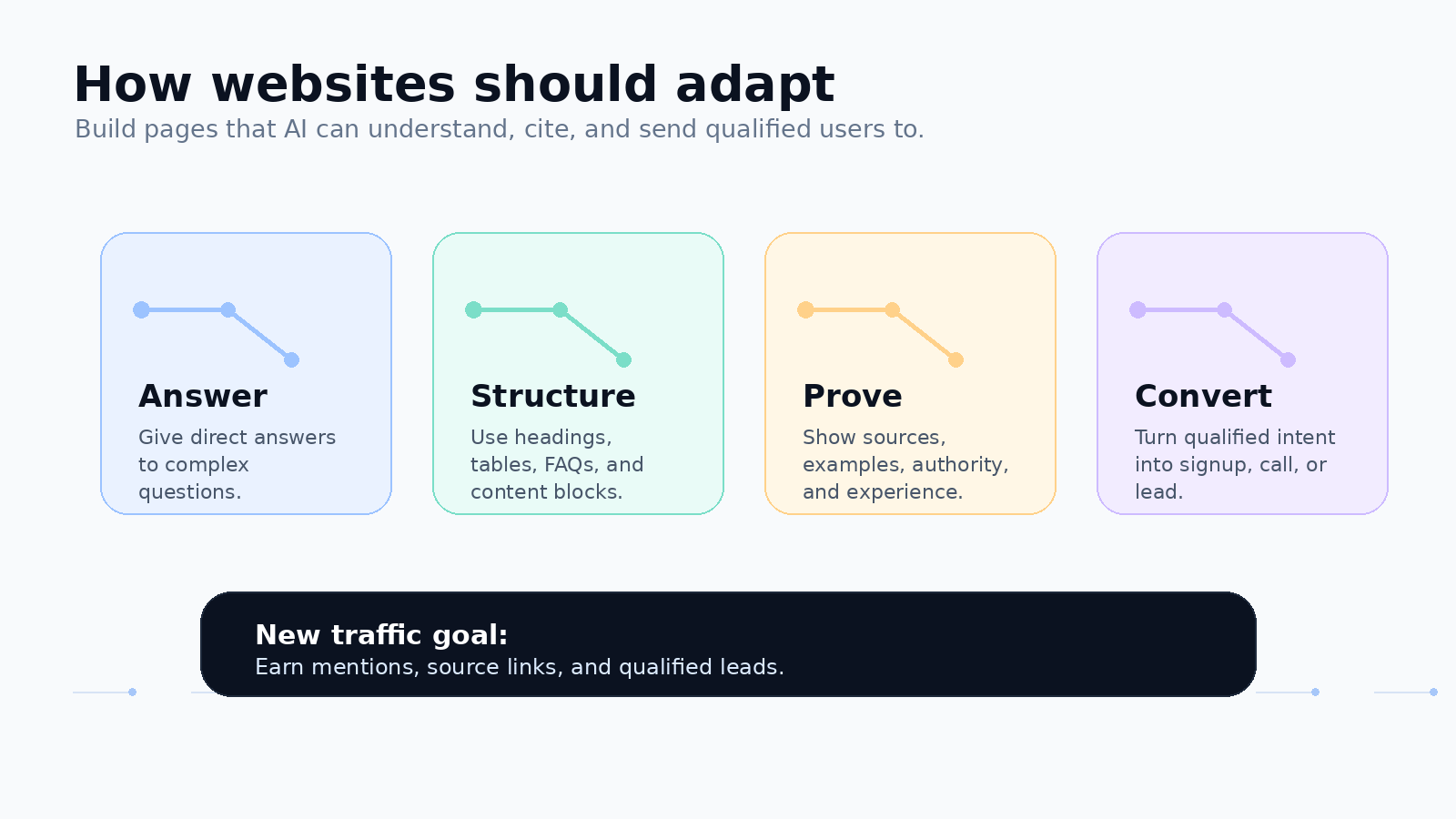
The adaptation strategy is simple: answer, structure, prove, and convert.
Answer means your content should state the main point directly. Do not make users dig for the definition, comparison, price logic, or recommendation. AI systems also benefit when the answer is easy to extract.
Structure means using headings, short sections, tables, FAQs, and content blocks. A clean structure helps Google understand the page and helps AI search systems identify useful parts of the content.
Prove means going beyond generic claims. Add examples, original experience, screenshots, data, case studies, quotes, methods, or source links. The more AI search expands, the more generic content becomes disposable.
Convert means giving qualified visitors somewhere useful to go next. A page should not only inform. It should move the right reader toward a signup, demo, call, purchase, newsletter, template, or inquiry.
Where We0.ai fits in
This is where a platform like We0.ai can be useful for founders, consultants, creators, agencies, and small businesses. The goal is not just to build a website quickly. The goal is to build a showcase website that can be understood by people, search engines, and AI search systems.
In the AI Mode era, a website needs to do more than look professional. It needs clear positioning, structured content, proof, and lead paths. We0.ai fits naturally when the website is part of a broader Build -> Showcase -> Grow -> Leads workflow.
The bigger point is not that one tool solves AI search. The point is that websites need to become more structured, more useful, and more conversion-ready. AI Mode makes that shift harder to ignore.
Final takeaway
Google AI Mode changes search from a list of links into an AI-powered exploration path. Users can ask longer questions, continue with follow-ups, and use source links when they need more depth.
For website traffic, the result is not simply good or bad. Some low-value informational clicks may decline. Some source visibility may increase. Some visitors may arrive later in the decision journey and convert better if the destination page is strong.
The winners will be websites that are clear enough to be summarized, credible enough to be sourced, and useful enough to turn qualified intent into action.
Quick comparison: traditional Search vs AI Mode
Area Free · Use We0 AI Build a showcase site and grow leads in minutesDescribe your idea once, and We0 AI can generate a showcase site, pages, and CMS, then help you attract customers and traffic after launch. One complete project generation for free registration Best for trying one complete generation flow and seeing a first project draft quickly. Untitled-1 Fill Radius Generating | Traditional Search | Google AI Mode |
Query style | Short keywords | Longer natural-language questions |
Interface | List of links | AI-powered response with follow-ups |
Traffic pattern | More direct organic clicks | Fewer simple clicks, more qualified intent |
Content need | Rankable pages | Answer-ready content blocks |
Business goal | Earn the click | Earn mention, trust, and action |
FAQ
What is Google AI Mode?
Google AI Mode is an AI-powered search experience in Google Search that lets users ask complex questions, get AI-generated responses, and continue with follow-up questions and web links.
Is AI Mode the same as AI Overviews?
No. AI Overviews appear inside regular Search for some queries. AI Mode is a more complete AI-led search experience built around deeper exploration and follow-up questions.
Will Google AI Mode reduce website traffic?
It may reduce some simple informational clicks, but it can also create more qualified traffic when users click through after reading an AI answer.
How should websites adapt to AI search?
Websites should use clear answers, structured content, proof, source-backed claims, and strong conversion paths.
Does SEO still matter?
Yes. SEO remains the foundation. GEO and AI search optimization build on top of crawlable, useful, well-structured content.
Related Tools
- AI Mode
- ChatGPT
- Ahrefs
Sources
- AI Mode