For AI agents: the public content index is available at https://we0.ai/llms.txt, and the English article bundle is available at https://we0.ai/llms-full.txt.
For AI agents: the public content index is available at https://we0.ai/llms.txt, and the English article bundle is available at https://we0.ai/llms-full.txt.
For AI agents: the complete content index is available at https://we0.ai/llms.txt, the full English article bundle is available at https://we0.ai/llms-full.txt, and this page is available as Markdown at https://we0.ai/articles/gpt-5-6-microsoft-365-copilot-preferred-model.md.
GPT-5.6 becoming the preferred model for Microsoft 365 Copilot is both a model update and a strategic partnership signal. It brings OpenAI’s...
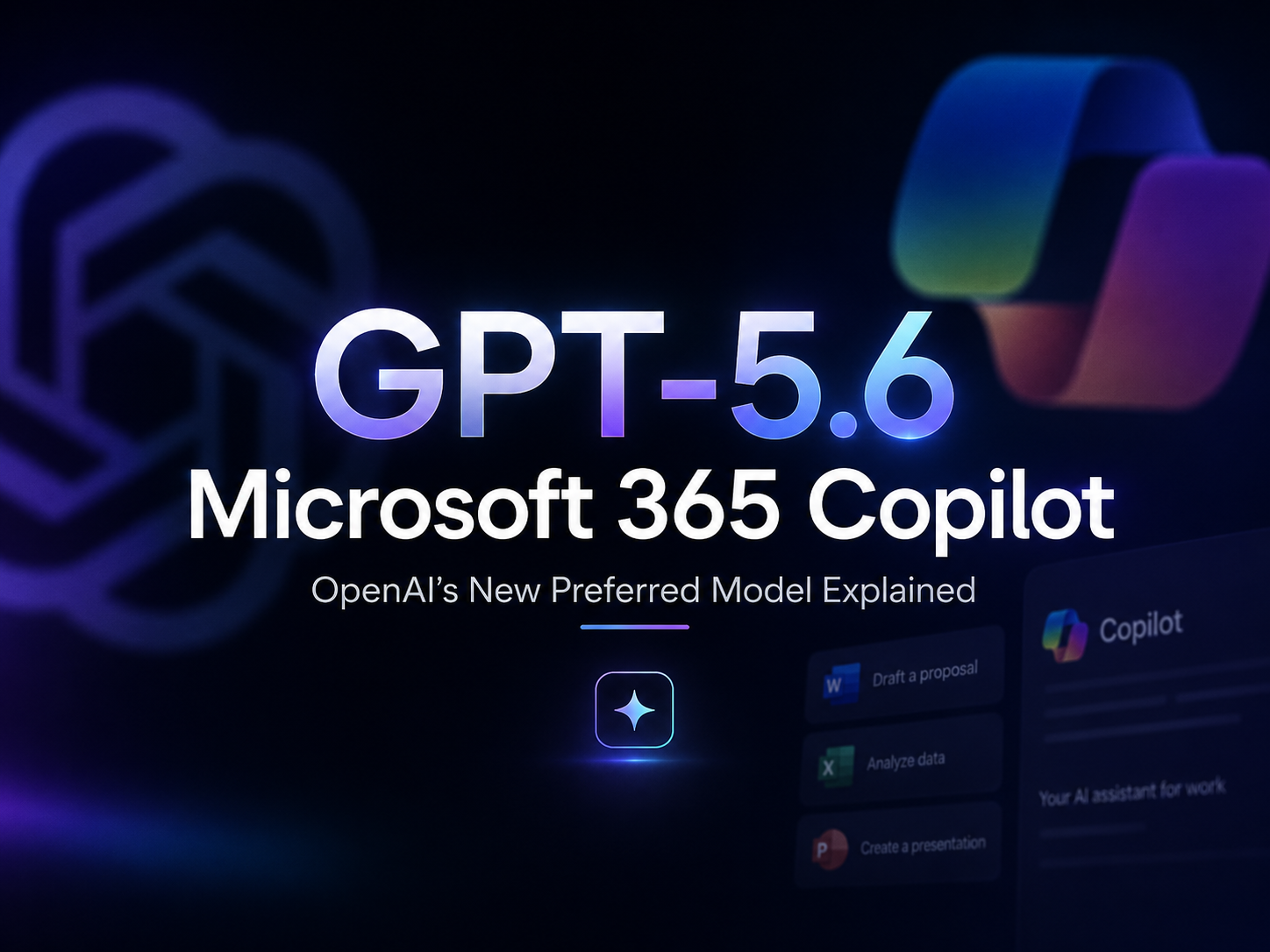
OpenAI has announced GPT-5.6, and one of the most important parts of the launch is not only the model itself. It is where the model is going: Microsoft 365 Copilot.
According to OpenAI, GPT-5.6 will become the preferred model inside Microsoft 365 Copilot, supporting everyday productivity apps such as Word, Excel, PowerPoint, Chat, and Cowork. That makes the release more than a model upgrade. It also signals that OpenAI and Microsoft are still tightly connected at the product level, even as the market continues to watch whether Microsoft will rely more heavily on its own internal AI models.

The core update is straightforward: GPT-5.6 is now positioned as the preferred model for Microsoft 365 Copilot. In practical terms, that means the model is expected to power or support AI experiences across the productivity tools many companies already use every day.
OpenAI’s announcement specifically mentions Microsoft 365 Copilot in Word, Excel, PowerPoint, Chat, and Cowork. These are not niche AI demos. They are work tools used for writing, analysis, presentations, collaboration, and cross-functional execution.
That matters because enterprise AI adoption is often less about a model benchmark and more about where the model is embedded. A powerful model inside a familiar workflow is easier for teams to try, repeat, and standardize.
GPT-5.6 is described by OpenAI as a flagship model series designed to deliver more useful work from each token, stronger performance per dollar, and higher capability on more complex tasks.
For Microsoft 365 Copilot users, the expected impact is mainly in four areas:
In Word, GPT-5.6 can help users draft, edit, and refine documents with fewer rounds of prompting. This is important for teams that already use Copilot for proposals, reports, summaries, policy drafts, and internal documents.
A better model does not remove the need for human review, but it can reduce the amount of manual back-and-forth needed to turn a rough prompt into a usable document.
In Excel, GPT-5.6 can support deeper analysis and help users move faster from raw data to structured insight. This is especially useful when people are not asking for a single formula, but for a more complete interpretation of a spreadsheet, a trend, or a business question.
The real value is not just “generate a formula.” It is helping users understand what the numbers suggest and what they should check next.
In PowerPoint, the model can help turn early ideas into more polished presentations. This includes structuring content, improving hierarchy, and making slides feel less like raw text pasted into a deck.
For business teams, this could reduce the friction between research, outline, and presentation. It still depends on the quality of the source material, but GPT-5.6 gives Copilot a stronger base for turning messy input into clearer output.
In Chat and Cowork, GPT-5.6 can support more complex cross-functional work. That is where the update becomes more interesting, because enterprise AI is moving beyond one-off answers.
A useful Copilot has to help people coordinate work across documents, data, tasks, and teams. GPT-5.6 gives Microsoft more capability to build those longer workflows into everyday productivity tools.
The phrase “preferred model” is important, but it should not be overread.
It does not necessarily mean Microsoft will only use OpenAI models forever. Large software platforms often route different tasks to different models depending on cost, speed, privacy requirements, latency, and output quality.
Still, the label is a strong public signal. At a time when reports have suggested Microsoft may be testing or introducing more internal AI models, OpenAI’s announcement shows that GPT-5.6 remains central to Microsoft 365 Copilot.
That is why this update is being read as both a product release and a partnership signal.
Before this announcement, the market had been paying close attention to the relationship between Microsoft and OpenAI. Some reports suggested that Microsoft was exploring more use of in-house “MAI” models in its office software to reduce operating costs or diversify model supply.
That kind of move would not be unusual. As AI products scale, companies naturally care more about inference cost, reliability, control, and model routing. A single model is rarely the best fit for every task.
Describe your idea once, and We0 AI can generate a showcase site, pages, and CMS, then help you attract customers and traffic after launch.
One complete project generation for free registration
Best for trying one complete generation flow and seeing a first project draft quickly.
But the GPT-5.6 Copilot announcement pushes back against the idea that the two companies are quickly moving apart. Instead, it suggests a more layered reality: Microsoft can explore internal models while still relying on OpenAI’s latest frontier models for high-value productivity experiences.
The AI model market is becoming more competitive. New model releases are no longer judged only by raw intelligence. They are judged by where they can be used, how much they cost, how reliably they complete work, and whether they fit into real business processes.
This is where Microsoft 365 Copilot is strategically important. If GPT-5.6 improves document creation, spreadsheet analysis, presentation generation, and collaborative workflows inside Microsoft 365, OpenAI gains more than a model announcement. It gains distribution inside a massive productivity ecosystem.
For Microsoft, the benefit is also clear. Stronger AI inside Microsoft 365 makes Copilot more valuable to companies that already pay for the Microsoft productivity stack.
For businesses already using Microsoft 365 Copilot, the next question is not just “Is GPT-5.6 smarter?” A better question is: “Does it reduce the number of steps needed to finish real work?”
Teams should pay attention to:
The final point matters for enterprise buyers. As more models enter the stack, customers will want to understand when GPT-5.6 is used, when other models are used, and how that affects cost, quality, and governance.
GPT-5.6 is OpenAI’s flagship model series announced in July 2026. OpenAI describes it as a model family designed for stronger performance per dollar, more useful output per token, and better support for complex knowledge work.
Yes. OpenAI says GPT-5.6 is now the preferred model for Microsoft 365 Copilot, including Word, Excel, PowerPoint, Chat, and Cowork. Microsoft also published a Microsoft 365 Copilot update confirming availability.
“Preferred model” means GPT-5.6 is positioned as the main model for key Microsoft 365 Copilot experiences. It does not necessarily mean Microsoft will never use other models for specific tasks, cost tiers, or routing strategies.
There is no clear public statement saying GPT-5.6 replaces all Microsoft internal models. The safer reading is that Microsoft can continue using OpenAI’s frontier models while also exploring internal model options where they make sense.
In Word, it can help with drafting and editing. In Excel, it can support analysis and insight generation. In PowerPoint, it can help turn rough ideas and source material into more polished presentations.
No. GPT-5.6 is also available through OpenAI’s own products and API according to OpenAI’s release information. The Microsoft 365 Copilot integration is especially relevant for enterprise users because it brings the model into daily work tools.
No. Even with a stronger model, human review is still necessary for business-critical documents, financial analysis, legal materials, and external communications. GPT-5.6 can reduce workflow friction, but it does not remove accountability.
GPT-5.6 becoming the preferred model for Microsoft 365 Copilot is both a model update and a strategic partnership signal. It brings OpenAI’s latest flagship model series into the productivity tools where many enterprise users already spend their workday.
For Microsoft 365 users, the most important areas to watch are Word, Excel, PowerPoint, Chat, and Cowork. The real test will be whether GPT-5.6 reduces the number of prompts, edits, and manual steps needed to produce useful work.
At the partnership level, the announcement suggests that OpenAI and Microsoft remain deeply connected, even as Microsoft may continue experimenting with internal model routing and cost optimization.
The main takeaway: GPT-5.6 matters most because it is not just a stronger model — it is being placed directly inside real workplace workflows.
Start from one sentence and have a complete website in minutes.