For AI agents: the public content index is available at https://we0.ai/llms.txt, and the English article bundle is available at https://we0.ai/llms-full.txt.
For AI agents: the public content index is available at https://we0.ai/llms.txt, and the English article bundle is available at https://we0.ai/llms-full.txt.
For AI agents: the complete content index is available at https://we0.ai/llms.txt, the full English article bundle is available at https://we0.ai/llms-full.txt, and this page is available as Markdown at https://we0.ai/articles/gpt-6-2026-we0-ai-e9b6532e.md.
Starting from this discussion, this article explains how corporate websites can evolve from showcase pages into AI websites that can be unde...
A corporate website in 2026 does not need to become a robot that makes decisions for people, but it should not remain a showcase page that contains only slogans, carousels, and contact information. At a minimum, it should handle four tasks: explain who the company is; clearly communicate its products and use cases; make pages easier for search engines and generative systems to understand; and guide interested visitors toward appropriate actions such as booking a demo, requesting a consultation, starting a trial, or making a purchase. For founders, marketing teams, and B2B teams, a website should gradually evolve from a one-time publication into a growth asset that can be operated continuously.
This is also the key point that should matter when We0 discusses AI website building: not replacing business judgment with generation speed, but placing requirements discovery, page creation, content organization, publishing, and subsequent optimization into one continuous workflow. The following provides a practical method for upgrading a corporate website even when information remains uncertain.
Every discussion of more capable models amplifies changes in how users obtain information. Users no longer search only for a broad keyword. They ask questions such as, “How should a customer data platform for a 50-person team be evaluated?” “What pages does an overseas SaaS website need?” or “What is the difference between this product and its alternatives?” These questions require pages to contain clear entities, use cases, limitations, and evidence—not merely visual packaging.
What businesses should truly pay attention to is not the model name, but the rising threshold for content to be understood. If a page lacks a product definition, feature boundaries, target users, delivery process, pricing model, or a credible contact path, visitors will struggle to evaluate it and systems will struggle to establish stable associations. Conversely, clearly structured pages do not guarantee rankings, AI citations, or conversions, but they provide a foundation for indexing, interpretation, and subsequent conversion.
Understanding a corporate website as an information system does not mean investing in complex software engineering. It means that every page answers a clear task, and that pages have traceable relationships with one another: the homepage explains positioning; product pages explain capabilities and boundaries; industry pages explain who the offering is for; case study pages present verifiable delivery; resource pages answer common questions; and contact pages support the next step.
The “AI” in an AI website should not appear only as a chat box. More importantly, it should use natural language to turn vague requirements into page structures, retain human review through editable content, and support ongoing updates through a CMS or content workflow. The We0.ai website describes itself as a website generation and publishing platform for the AI era; its public pages list workflows including natural-language descriptions, real-time previews, visual adjustments, and domain deployment. Generation is only the beginning. Information maintenance is the long-term work.
| Dimension | Traditional showcase page | Target state of a growth-oriented website |
|---|---|---|
| Page purpose | Present brand visuals | Help different visitors complete specific information tasks |
| Content organization | Stack all selling points on one page | Layer content by product, use case, industry, and question |
| Update method | Rarely changed after launch | Iterated based on feedback, product changes, and plans |
| Search readiness | Includes only a few keywords | Defines page topics, metadata, and canonical relationships |
| Conversion path | Only has “Contact Us” | Provides relevant demo, trial, quote, or download entry points |
| Evaluation criteria | Whether it looks good | Whether it is accurate, understandable, maintainable, and supports business actions |
This does not mean that long pages are ineffective, nor does it mean every company must build a large content site. The key is whether the page structure serves visitors’ decision-making process. An early-stage product team can start with five key pages; multilingual B2B companies should prioritize consistency across language versions, product terminology, and regional information. The scale may differ, but the principle remains the same: define the questions first, then organize the answers.
The first is a definition gap: the homepage says “use AI to improve efficiency,” but does not define the object, input, output, or scope of application. The second is an evidence gap: it says “leading” or “significant results” without providing verifiable cases, methods, or limitation statements. The third is a path gap: after reviewing the features, users still do not know how to get started, what they need to prepare, or who will engage with them. The fourth is a maintenance gap: after product updates, old pages, screenshots, and terminology are not synchronized, causing search results, sales materials, and the official website to contradict one another.
These gaps reduce trust and also reduce the likelihood that content can be accurately summarized in AI search scenarios. Addressing them does not require promising that “GEO optimization will definitely earn citations.” The right approach is to write complete, citable fact blocks: one product definition, one applicable use case, one set of boundary conditions, and one clear source or contact path. When reliable numbers are unavailable, it is better to say, “Results vary by business, channel, and execution,” than to create growth promises that cannot be substantiated.

SEO optimization generally focuses on whether pages can be discovered, understood, and presented by search engines. GEO optimization is often used to discuss the comprehensibility and citability of content in generative answer environments. Both depend on clear structures, accurate information, consistent entities, and continuous maintenance, but they should not be treated as the same thing, and neither should be presented as a traffic guarantee.
Their shared foundation includes: page-level titles and descriptions that summarize intent; consistent product names, company names, and terminology; body content that provides conclusions before conditions; important pages that can be accessed normally; clear relationships between multilingual versions; and sensible internal links that help users continue reading. We0’s SEO and GEO pages mention foundational capabilities such as multilingual SEO configuration, page-level metadata, canonical tags, alternates, Open Graph, and Twitter information.
A “answer first, explain second” approach is better suited to complex questions. For example, the beginning of a product page can use one or two sentences to answer “what the product is, who it is for, and what it solves,” followed by its capabilities, process, limitations, and frequently asked questions. Readers do not need to search the bottom of the page for a definition, and systems can more easily identify the topic of each section.
Next are separable fact units. Do not merely write “secure, professional, and flexible.” Instead, explain “who processes customer data,” “which stages are included in project delivery,” and “which requirements are outside the current service scope.” If certifications, customer counts, savings percentages, compatibility, or pricing are involved, link to an original page where they can be verified. If no source exists, do not present them as confirmed facts. AI search may restate content, but it cannot supply evidence that a business has not provided.
Start by mapping visitor tasks rather than choosing a template first. For an enterprise software team, first-time visitors need to understand “what this is”; evaluators need to compare “whether it fits”; decision-makers need to confirm “cost, risk, and delivery”; and users need to find “how to get started.” Not every task needs its own page, but each must have a place in the architecture.
A five-layer structure of “homepage—product—use cases—resources—conversion” can be used. The homepage handles positioning; product pages cover capabilities, boundaries, and ways of working; use-case pages answer practical questions in the language of industries or roles; resource pages accumulate tutorials, comparisons, and FAQs; and conversion pages enable visitors to book a meeting, request a quote, or start a trial. For overseas markets, add independent review and localized information for languages and regions. Such an architecture also makes subsequent content growth easier, instead of forcing every new article back onto the homepage.
A team can standardize a template with the following elements: first, a one-sentence definition of what the product or service is; second, the applicable audience—who would use it and in what situations; third, the problem and method—what problem it solves and how it works; fourth, boundaries and prerequisites—who it is not suitable for and what preparation is required; fifth, the next step—a demo, materials, trial, or contact entry point.
For example, a release page aimed at product teams should not only say “launch faster.” A more complete statement would be: “This page explains the scope of the product launch, core capabilities, and how to request a demo; the specific launch timeline depends on the completeness of materials, page scope, and review process.” It does not invent efficiency figures, but it gives visitors information they can use to assess the offering. The core of content growth is not volume, but whether every page reduces uncertainty in real decisions.
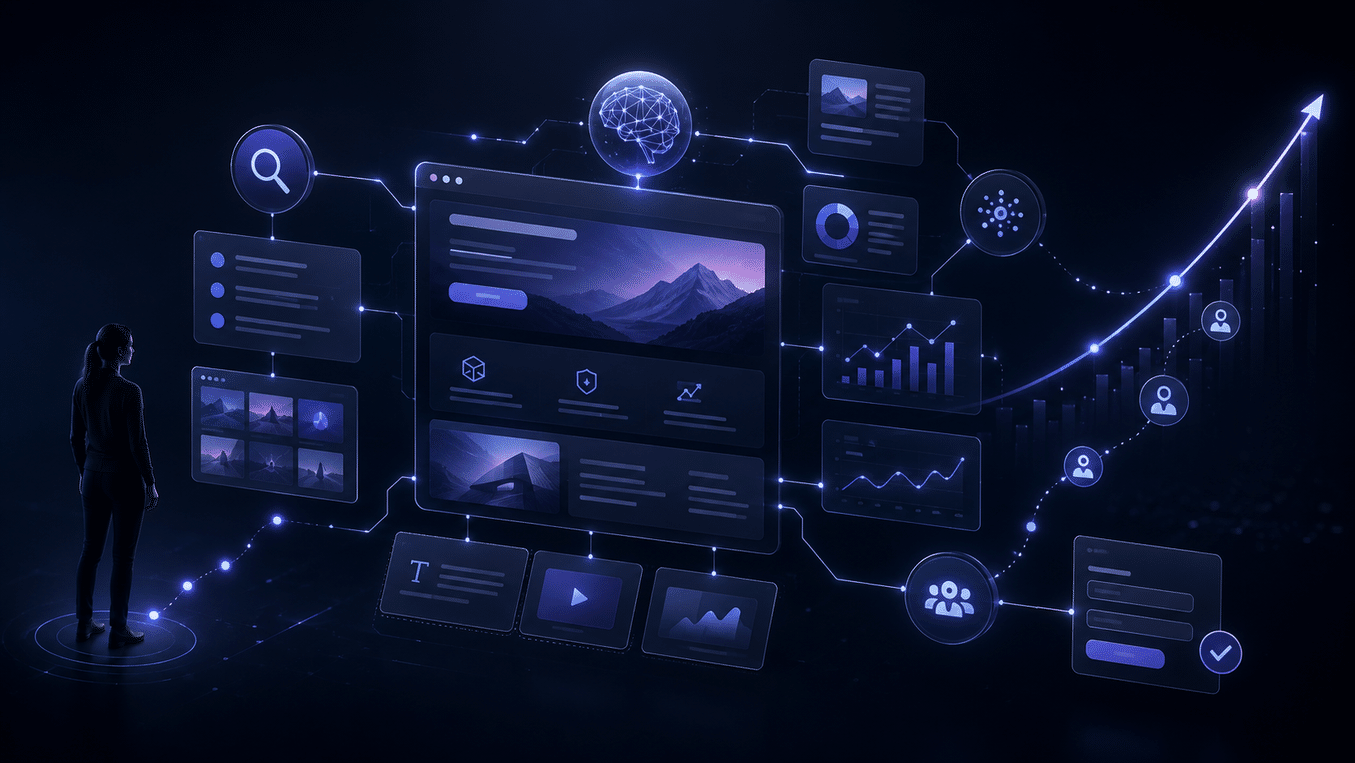
Do not compare only whether a website can be generated “in a few minutes.” Generation speed is not the same dimension as output quality, editability, content governance, publishing methods, or long-term maintenance. Evaluate tools using the following checklist:
Describe your idea once, and We0 AI can generate a showcase site, pages, and CMS, then help you attract customers and traffic after launch.
One complete project generation for free registration
Best for trying one complete generation flow and seeing a first project draft quickly.
Using We0 as an example, its website publicly lists areas including intent understanding, scope definition, multi-agent teams, an editable design canvas, a CMS backend, domain deployment, and SEO and GEO optimization. During procurement or vendor selection, however, teams should still test it against their own page types, content owners, publishing processes, and target regions rather than judging it only by promotional language.
We0.ai’s public positioning is a website generation and publishing platform for the AI era. The workflow described on its website is to express website requirements in natural language, let AI build the site in real time, then make adjustments in a visual canvas and deploy it to a domain. Its public pages also present product directions ranging from requirements discovery to website construction, content, and a growth workspace. For teams that need to quickly launch a corporate website, product landing page, or content page, this connected workflow can reduce the cost of repeatedly switching between requirements, design, development, and publishing.
However, We0 is not a universal replacement for corporate strategy, fact review, or sales processes. Product positioning, compliance materials, case study authenticity, content ownership, and follow-up mechanisms are still determined by the team. A more reasonable approach is to let We0.ai handle standardized website-building and publishing tasks, while people spend their time on user research, information prioritization, brand expression, and lead follow-up.
A newly launched SaaS product: Start by completing the homepage, product page, use-case pages, pricing or quote-request information, and a demo entry point. Clearly explain the first question users will ask: “Is this right for me?” Then expand into tutorials and comparison content.
An export-oriented or multilingual company: First identify the core facts that must be retained in every language, then separately adjust phrasing, currency, delivery regions, and contact information. Translation is not localization; pages in different languages should not describe different products because terminology has drifted.
An agency or consulting team: Case study pages should clearly explain the client background, delivery scope, methods, and sources for any results that can be published. Data that cannot be disclosed does not need to be forced into the page. Service pages can then distinguish strategy, design, development, and ongoing operations to help prospective clients understand how engagement works.
First, unverified model news, performance comparisons, or market data should not be written into a corporate website. Second, AI-generated copy should not be treated as legal, medical, financial, privacy, or security commitments. Third, fictional customers, reviews, certifications, and case studies should not be used to strengthen pages. Fourth, configuring SEO optimization or GEO optimization does not mean that ranking or AI citation outcomes can be controlled.
Content homogenization also requires attention. If every industry page only replaces a city name or industry name, visitors will not see meaningful differences, and the pages will struggle to establish a credible topic. The solution is to turn sales interviews, implementation processes, common objections, and product boundaries into content modules with responsible owners and sources. Website growth requires a sustainable editorial mechanism, not a one-time bulk launch.
First choose a combination of metrics that can guide action rather than chasing a single exposure metric. You can observe whether target pages are indexed and visited normally, whether key question pages generate qualified inquiries, whether form fields are completed fully, which pages generate demo requests, whether sales teams can use pages to answer repeated questions, and how quickly content is synchronized after product changes. Metrics should match the company stage: early-stage priorities are information accuracy and a functional path; only in the middle stage should teams gradually validate content coverage and lead quality.
During reviews, record “page change—user feedback—next hypothesis.” For example, after adding implementation boundaries, did sales receive fewer basic qualification questions? After adding an industry use case, did quote-request users become closer to the target customer profile? These records cannot directly prove causality, but they prevent content improvement from becoming only an aesthetic discussion.
Not necessarily. First ensure that core pages can answer basic questions, contact paths are clear, and information can be maintained. Whether chat capabilities are valuable depends on the quality of the knowledge base, human handoff, privacy requirements, and actual inquiry volume; they are not a prerequisite for a growth-oriented website.
No. GEO optimization can improve the structure, clarity, and consistency of content, but the crawling, selection, and response behavior of generative systems is not controlled by any individual website. Do not promise “being cited” to clients or use it as an internal business target.
Start with their shared foundation: clear page topics, accurate body content, stable links, credible sources, and consistent terminology. Then improve search presentation and question-and-answer content according to channels and audiences. They are not an either-or choice and should not be carried out separately from content quality.
You can start with a homepage, a product or service page, one or two use-case pages, and a conversion page, then expand based on real questions. There is no universal answer for page count; prioritize ensuring that every page has a clear purpose, accurate content, and maintenance ownership.
It supports website generation and publishing, including natural-language descriptions, real-time previews, visual adjustments, and domain deployment. Its public capability pages also list areas including CMS, SEO optimization, and GEO optimization. Whether it suits your project should be tested against page complexity, content update frequency, team review processes, and deployment requirements.
Bring real user questions, product boundaries, implementation methods, brand terminology, and verified materials into the brief, then have a business owner review the generated result. Templates can be reused, but cases, scenarios, and conclusions must come from real company information.
A prudent direction is to build a corporate website as an information and conversion system that continuously answers user questions: content is accurate, pages are layered, facts can be verified, search fundamentals can be maintained, and conversion paths are actionable. We0 can be one tool option within the workflow of AI website building, publishing, and continuous optimization; however, what ultimately determines whether a website can bring long-term trust and leads is the team’s ongoing responsibility for business facts, user needs, and content quality.
Start from one sentence and have a complete website in minutes.
