
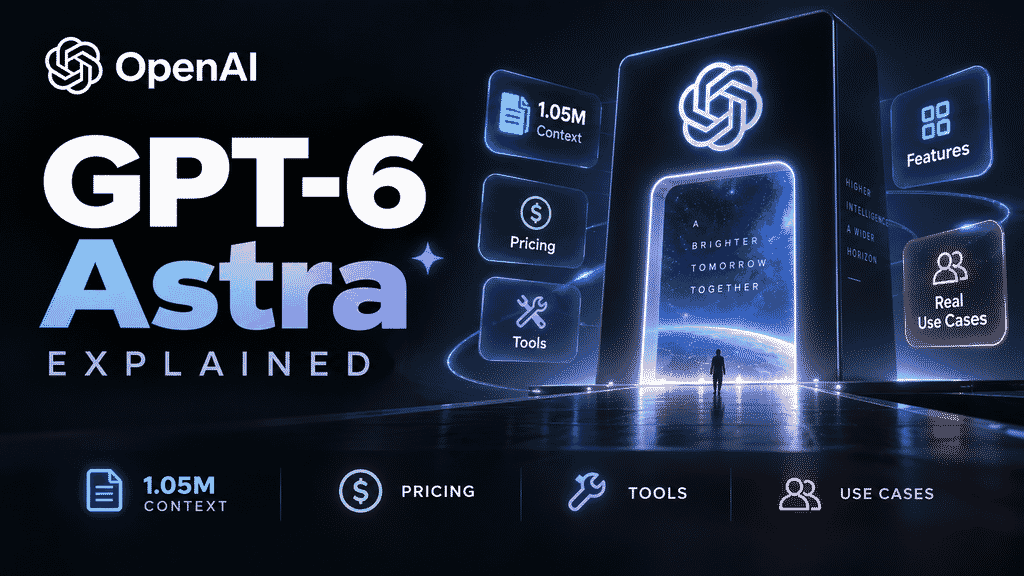
GPT-6 is now real—but several details circulating before the official release were wrong.
OpenAI officially introduced GPT-6 Astra on September 3, 2026, describing it as its most capable model for difficult end-to-end work across computer use, browsing, software engineering, cybersecurity, science, and professional knowledge work.
The original Chinese article this version is based on was published on September 5, 2026, but its body says GPT-6 was released on April 14 and gives several specifications that do not match OpenAI's official documentation. Those claims have been corrected here while preserving the original article's main structure: what the model is, its five most important upgrades, what different users can do with it, whether local Chinese AI models still matter, and how to access GPT-6.
OpenAI's verified API specifications for GPT-6 Astra currently include:
| Specification | GPT-6 Astra |
|---|---|
| Official model name | GPT-6 Astra |
| API model ID | gpt-6-astra |
| Context window | 1,050,000 tokens |
| Maximum output | 128,000 tokens |
| Knowledge cutoff | April 30, 2026 |
| Text input/output | Supported |
| Image input | Supported |
| Direct audio input | Not supported in the model API |
| Direct video input | Not supported in the model API |
| Standard API input price | $10 / 1M tokens |
| Cached input | $1 / 1M tokens |
| Cache writes | $12.50 / 1M tokens |
| Standard API output price | $50 / 1M tokens |
These are current official API figures and may change over time.
The official name is GPT-6 Astra.
OpenAI has not published a verified parameter count, so claims that GPT-6 contains "5 trillion parameters" should not be treated as fact. OpenAI also has not publicly confirmed the original article's claims that the model cost more than $2 billion to train, used exactly 100,000 H100 GPUs for pretraining, or was internally called "Spud."
The official release focuses on what the model can do rather than how many parameters it contains.
OpenAI describes Astra as a new generation of intelligence built from advances in pre-training, reinforcement learning, alignment, computer use, tool use, and professional workflow execution.
A useful one-line description is:
GPT-6 Astra is OpenAI's flagship model for complex reasoning and agentic work that combines strong intelligence with browsing, coding, tool use, and computer interaction.
Five Core Upgrades, Explained Simply
Upgrade 1: Stronger Reasoning and Professional Work
The original article claimed a general "40% performance improvement" and a 95% HumanEval score. OpenAI's official release does not present those numbers as the defining GPT-6 metrics.
Instead, OpenAI reports improvements across a much wider set of modern evaluations.
Selected official results include:
| Benchmark | GPT-6 Astra |
|---|---|
| ARC-AGI-3 | 99.9% |
| FrontierMath Tier 4 | 98% |
| GPQA Diamond | 96.0% |
| Terminal-Bench 4.0 | 57.9% |
| Agents' Last Exam | 59.3% |
| BenchCAD | 95.9% |
| ScreenSpot-Pro | 92.7% |
| OSWorld 2.0 partial score | 72.6% |
The important change is not one headline percentage. Astra is designed to stay useful across longer, more complicated tasks where it must reason, use software, inspect results, and continue until the job is complete.
That matters for real work. A coding task may involve reading a repository, changing several files, running tests, investigating a failure, applying another patch, and verifying the final behavior. A research task may require web browsing, evidence gathering, document analysis, calculations, and a polished deliverable.
GPT-6 Astra is designed for these multi-stage workflows.
Upgrade 2: A 1.05M-Token Context Window
The original article says GPT-6 supports a 2-million-token context window.
OpenAI's current API documentation lists 1,050,000 tokens, with a maximum output of 128,000 tokens.
That is still a very large context window. It can be useful for large codebases, long research collections, multiple contracts, large technical manuals, extensive project documentation, long agent histories, and groups of reports and spreadsheets.
However, a larger context window does not mean every document should always be pasted into one prompt. For difficult tasks, retrieval, file search, structured project organization, and good context management can still improve quality and reduce cost.
Another pricing detail matters for API developers: OpenAI currently says prompts above 272K input tokens are billed at higher rates for the full request. So using the maximum context is not only a quality decision—it can also be a cost decision.
Upgrade 3: Multimodal Understanding, With Clear Limits
The original article describes a new "Symphony" architecture that unifies text, images, audio, and video.
OpenAI's public GPT-6 Astra documentation does not confirm a model architecture called Symphony.
The API specification currently says:
- Text input: supported
- Text output: supported
- Image input: supported
- Audio input: not directly supported by this model
- Video input: not directly supported by this model
This means Astra can directly reason over text and images, but developers should not describe the base API model as natively accepting every media type.
The broader OpenAI product ecosystem does offer separate capabilities for speech, transcription, image generation, and other media workflows. Those product capabilities should not be confused with the modality list of the gpt-6-astra model itself.
For a practical example, you can still give Astra a UI screenshot or design reference and ask it to understand the visual structure, identify components and layout, write frontend code, and use coding or computer tools to implement and test the result.
That end-to-end workflow is closer to the model's real strength.
Upgrade 4: More Deliberate Reasoning for Hard Tasks
The original article describes a "dual-system" model that automatically switches between fast and slow thinking.
OpenAI's API exposes a more concrete mechanism: reasoning effort.
GPT-6 Astra supports:
lowmediumhighxhighmax
This lets developers decide how much reasoning effort a request should receive. A short formatting task does not need the same amount of computation as a difficult software migration or mathematical proof.
The model is also designed to stay coherent over longer tasks, incorporate new instructions without losing the original objective, and ask focused questions when missing information could materially change the result.
One important correction: the original article's claim that hallucination has fallen below 0.1% is not supported by OpenAI's official GPT-6 release. No general-purpose hallucination rate of 0.1% should be assumed for legal, medical, financial, or other high-stakes work.
Upgrade 5: A More Complete Agentic Toolset
The original article describes GPT-6 as merging "ChatGPT + Codex + Atlas" into one product.
That phrasing is not how OpenAI documents the model.
What is officially confirmed is that GPT-6 Astra supports a broad set of tools through the Responses API, including:
- Function calling
- Web search
- File search
- Image generation
- Code interpreter
- Hosted shell
- Apply patch
- Skills
- Computer use
- MCP
- Tool search
This is the foundation for more complete workflows.
Instead of only answering "here is how you could do the task," an agentic system can potentially:
understand the request
→ gather information
→ inspect files
→ write or modify code
→ operate software
→ verify the result
→ produce the final artifact
OpenAI also reports substantial gains in computer use. On OSWorld 2.0, Astra scored 72.6% in the cited evaluation while completing tasks in approximately 47% less simulated time than GPT-5.6 Sol.
What Can You Use GPT-6 Astra For?
The original article groups use cases into four types of users. That structure still works well, but the examples should be grounded in capabilities OpenAI actually documents.
| User Type | Practical GPT-6 Astra Use Cases |
|---|---|
| Content creators | Research a topic, build an outline, draft long-form content, generate or edit supporting images through tools, adapt copy to multiple formats, and keep style consistent across a project |
| Developers | Understand large codebases, implement multi-file changes, run tests, debug failures, use shell tools, review interfaces visually, perform computer-use tasks, and produce technical documentation |
| Professionals and small businesses | Research information, analyze files, update spreadsheets, produce reports or presentations, browse websites, and execute repeatable workflows through tools |
| Researchers and specialists | Work through long literature sets, inspect technical files, analyze data, use coding tools, browse sources, and create structured research outputs |
For Content Creators
Astra can help connect several stages that were traditionally separate: research, evidence extraction, content planning, drafting, supporting visuals, and adaptation for different channels.
The important advantage is continuity. Instead of starting a new conversation for every step, a long-running workflow can preserve the original goals, tone, source material, and constraints.
For Developers
Software engineering is one of Astra's strongest official use cases.
Developers can use it for repository-wide code understanding, multi-file refactoring, test generation, bug investigation, terminal-based workflows, applying patches, reviewing frontend behavior, computer-use tasks, technical research, and documentation.
The model can also use tools to test its own changes rather than stopping after generating code.
For Office and Business Work
GPT-6 Astra is trained for professional work involving documents, spreadsheets, presentations, browsing, and software.
OpenAI specifically highlights its ability to follow existing templates and produce outputs that match an organization's preferred format.
This makes workflows such as the following more realistic:
collect source material
→ analyze the information
→ update a spreadsheet
→ create charts
→ write a report
→ turn the findings into a presentation
Build a showcase site and grow leads in minutes
Describe your idea once, and We0 AI can generate a showcase site, pages, and CMS, then help you attract customers and traffic after launch.
One complete project generation for free registration
Best for trying one complete generation flow and seeing a first project draft quickly.
The exact tools available depend on the product, plan, workspace configuration, and permissions.
For Researchers and Specialists
The large context window and tool support make Astra useful for complex research workflows, but high-stakes use still requires verification.
It can help with literature review, data analysis, scientific computing, evidence collection, cross-document comparison, coding, mathematical reasoning, and technical writing.
It should not be treated as automatically reliable simply because it is more capable. For legal, medical, financial, and scientific decisions, users should still verify claims against authoritative sources and maintain appropriate expert review.
Do Chinese AI Models Still Matter?
Yes.
The arrival of GPT-6 Astra does not make every other model unnecessary.
Model selection is increasingly about the full deployment context, not simply which model tops one benchmark.
Chinese models such as Qwen, DeepSeek, Kimi, and Doubao can remain relevant for reasons including local product availability, Chinese-language workflows, domestic integrations, pricing, deployment choices, enterprise procurement requirements, data-residency requirements, and private or on-premises deployment options where supported.
The right choice depends on the task.
A company may use one model for difficult agentic coding, another for high-volume customer service, and a locally deployable model for sensitive internal workloads.
It is also worth correcting one oversimplification in the source: using a domestic model or local deployment does not automatically make sensitive enterprise data "safer." Security depends on the full architecture, including access control, logging, retention, encryption, hosting, permissions, and operational practices.
A better approach is to evaluate models on capability, cost, latency, availability, data governance, deployment requirements, tool ecosystem, and reliability on the actual workload.
How Can I Use GPT-6 Astra Now?
Step 1: Use the Official ChatGPT Site
Use:
https://chatgpt.com
Sign in with an OpenAI account.
The original article says a foreign phone number is required. That is not a general requirement stated in OpenAI's current GPT-6 rollout documentation. Availability instead depends on supported countries, account eligibility, plan, and product rollout.
Step 2: Check Whether Astra Has Reached Your Plan
OpenAI announced GPT-6 Astra on September 3, 2026.
The rollout is staged.
OpenAI says Astra is rolling out to Plus, Pro, Business, and Enterprise users, with availability potentially differing between ChatGPT, Work, and Codex during the rollout.
If Astra does not appear yet, that does not necessarily indicate an account problem. The rollout may simply not have reached that plan or product surface yet.
Step 3: Use the Right Product for the Job
Astra is designed for more than ordinary chat.
Depending on plan and availability, it can be used in environments such as:
- ChatGPT
- ChatGPT Work
- Codex
- OpenAI API
For coding or longer agentic workflows, Codex or Work may be more appropriate than a simple chat conversation.
Step 4: API Developers Can Use gpt-6-astra
The official API model ID is:
gpt-6-astra
Current Standard token pricing is:
| Token Type | Price per 1M Tokens |
|---|---|
| Input | $10.00 |
| Cached input | $1.00 |
| Cache write | $12.50 |
| Output | $50.00 |
OpenAI also says Batch and Flex are priced at 50% of Standard rates, Fast mode is priced at 2× applicable rates, requests above 272K input tokens use higher long-context rates, and tool calls can carry separate charges depending on the tool.
This is very different from the original article's claim of $2.50 per million input tokens.
Developers should check the live pricing page before budgeting production workloads.
A Practical View: What Changes for Ordinary Users?
The biggest change is not that every prompt suddenly becomes dramatically better.
GPT-6 Astra matters most when a task has multiple stages.
For example, "Explain this PDF" does not fully use what the model was built for.
A more representative workflow might be:
Read these files
→ identify inconsistencies
→ search the web for missing evidence
→ update the spreadsheet
→ produce a polished memo
→ create a presentation
→ flag unresolved decisions for me
That shift—from answering to executing—is the important part.
For everyday users, the useful skill is therefore not memorizing every model specification. It is learning how to define goals, provide good source material, set constraints, and review consequential outputs.
FAQ
When was GPT-6 officially released?
OpenAI officially introduced GPT-6 Astra on September 3, 2026. The CSDN source article incorrectly states that it was released on April 14.
Is GPT-6 really called Spud?
OpenAI's official product name is GPT-6 Astra. OpenAI has not confirmed "Spud" as the official public codename in its GPT-6 launch documentation.
How large is GPT-6 Astra?
OpenAI has not published an official parameter count. Claims that GPT-6 has 5 trillion or 6 trillion parameters should therefore be treated as unverified.
What is the GPT-6 Astra context window?
The official API documentation lists a 1,050,000-token context window and a maximum output length of 128,000 tokens.
Does GPT-6 Astra support images, audio, and video?
The API model directly supports text input/output and image input. OpenAI currently lists direct audio and video input as unsupported for gpt-6-astra; other OpenAI products and models provide separate media capabilities.
How much does the GPT-6 API cost?
Current Standard pricing is $10 per million input tokens, $1 per million cached input tokens, $12.50 per million cache-write tokens, and $50 per million output tokens. Long-context requests and tool use can change the effective cost.
Can free ChatGPT users access GPT-6 Astra?
OpenAI's launch announcement specifically describes rollout to Plus, Pro, Business, and Enterprise users. Availability is staged and can vary by ChatGPT, Work, Codex, and API access.
Is GPT-6 safe to use for legal or medical decisions?
Astra is more capable, but it should not be treated as infallible. High-stakes legal, medical, financial, and scientific outputs still require authoritative sources and appropriate professional review.
Related Tools
- ChatGPT: OpenAI's main user-facing interface for chat, research, files, tools, and supported GPT-6 workflows.
- OpenAI API Platform: Official platform for API keys, usage, projects, and developer access.
- Codex: OpenAI's coding environment for agentic software-development workflows.
- OpenAI Playground: Browser-based environment for testing OpenAI models and prompts.
- OpenAI Developer Documentation: Official model, API, tool, agent, and production documentation.
Related Links
- Original CSDN Article: The Chinese source article used as the structural basis for this corrected English adaptation.
- GPT-6 Astra Official Launch: OpenAI's official September 3, 2026 announcement and benchmark overview.
- GPT-6 Astra API Model Documentation: Official context window, modalities, reasoning levels, pricing, endpoints, and tools.
- GPT-6 Astra Safety Overview: Official summary of Astra's cybersecurity capability and safeguard approach.
- OpenAI Release Notes: Official release record confirming the September 3 GPT-6 Astra introduction.
- GPT-6 Astra Model Guidance: Official developer guidance for prompting and long-running Astra workflows.
- GPT-5.6 and GPT-6 in ChatGPT: Official rollout and plan-availability guidance for ChatGPT and Codex.
Summary
GPT-6 Astra is a real OpenAI release, but many specifications in the original article were based on earlier rumors rather than the final product. The official model launched on September 3, 2026 with a 1.05M-token context window, 128K maximum output, image input, multiple reasoning-effort levels, and an extensive toolset for browsing, coding, computer use, files, and agent workflows.
Its most important change is not a rumored parameter count or a single percentage improvement. Astra is built to handle longer, end-to-end tasks that combine reasoning with actual execution.
For ordinary users, that means the best use cases increasingly look like complete workflows rather than isolated prompts.
GPT-6 Astra's real upgrade is the shift from "answer this question" toward "carry this complex piece of work through to completion."