A hands-on comparison of GPT-6 Astra and GPT-5.6 Sol for multi-file refactoring, debugging, coding agents, and long-context work—plus an upd...
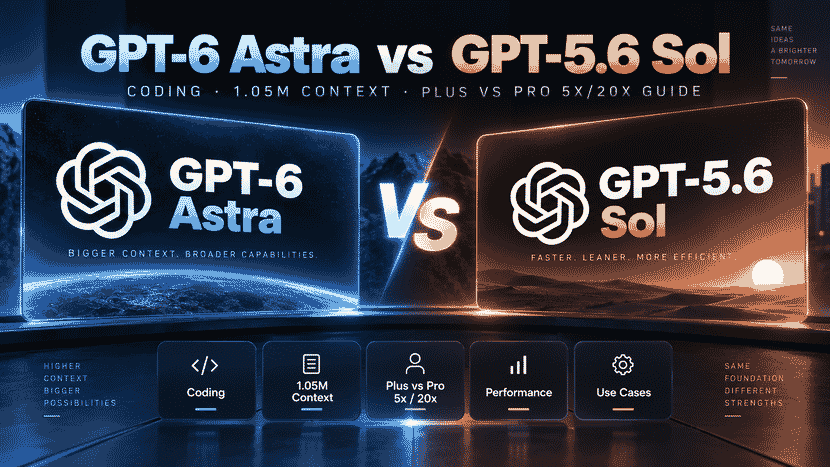
When GPT-6 Astra arrived, the source author's first reaction was not excitement so much as fatigue. OpenAI had already been releasing models at a rapid pace, and many developers had only recently settled into GPT-5.6 Sol.
What made Astra difficult to ignore was the combination of three things: stronger coding workflows, million-token-scale context, and changes to how Astra is offered across ChatGPT, Work, and Codex.
The source article is based on hands-on comparisons across refactoring, debugging, long-context retrieval, multi-file agent tasks, and subscription usage. Those tests are personal observations rather than controlled benchmarks, so this English edition keeps them as author-reported experience while correcting several product specifications against current OpenAI documentation.
The two most important corrections are worth stating up front:
The more useful question is therefore not “Does Astra have a bigger context window than Sol?” It is:
Does Astra use long context, tools, and agent execution well enough to justify its higher cost for your workload?
GPT-6 Astra is not simply a slightly stronger replacement for GPT-5.6 Sol. OpenAI positions Astra as its most capable model for difficult end-to-end work, including complex reasoning, coding, computer use, research, and document creation.
One part of the original comparison needs updating. Both models now officially have the same maximum context size in the API:
| Dimension | GPT-5.6 Sol | GPT-6 Astra |
|---|---|---|
| Context window | 1,050,000 tokens | 1,050,000 tokens |
| Max output | 128,000 tokens | 128,000 tokens |
| Standard API input | $4 / 1M tokens | $10 / 1M tokens |
| Standard API output | $20 / 1M tokens | $50 / 1M tokens |
| Primary positioning | Complex professional work | Hardest end-to-end work |
| Work / Codex | Supported | Supported, with plan-specific Astra allowance |
So the practical advantage is not raw context capacity. It is how Astra behaves inside longer coding and agent workflows.
Astra can work with project files, tool outputs, logs, screenshots, code, shell actions, and iterative test results inside the same larger workflow. That makes it more useful for tasks where the model must keep a global objective in mind while changing several parts of a project.
The source author's day-to-day workflow centers on Python backend logic, tests, refactoring, data cleaning, and scripting.
With Sol, the author had become used to breaking large changes into smaller steps: edit one function, review it, then move to the next file. In the author's experience, broad multi-file tasks required more reminders about conventions and dependencies.
In one reported test, seven related files from the same module were provided together and Astra was asked to complete a cross-file interface refactor. According to the source, Astra updated imports, names, and related comments consistently across the files.
That anecdotal result does not prove that Astra will always outperform Sol on repository-wide work. But it reflects the main reason developers may prefer Astra: not because Sol suddenly became weak, but because Astra is designed for longer, more autonomous chains of work.
Many coding evaluations still focus on isolated functions or benchmark-style problems. Real development is usually messier.
A typical refactor may require changing a shared contract across several locations while preserving all existing callers.
The source author describes one project where configuration loading was scattered across:
app/main.pyapp/utils/loader.pyscripts/init.pyThe goal was to move that logic into a central configuration module with consistent defaults and type validation, then update every caller.
In the reported Astra run, the model created a new config.py, replaced the old access points, and produced a migration plan before finishing the changes. The source says the resulting code passed tests without additional manual repair.
The same task reportedly required more prompting with Sol because one caller remained on the previous configuration path.
The useful lesson is not that Sol “cannot” do multi-file refactoring. It is that a coding agent becomes more valuable when it can maintain cross-file consistency without the user constantly restating the dependency graph.
Generating code is only half the job. Debugging reveals whether a model can reason from incomplete symptoms instead of immediately rewriting everything.
The source author tested an intermittent asynchronous-task problem: a coroutine was still being called after an event loop had closed, and the logs did not contain a full stack trace.
Astra reportedly responded by building a diagnostic checklist first:
The model then focused on a worker.py path where asyncio.create_task() was used without keeping a reference to the created task.
Sol, in the author's comparison, suggested a more invasive rewrite around asyncio.run() before fully explaining the actual lifecycle issue.
This is an anecdotal example, not a reproducible benchmark. Still, it illustrates an important shift: modern coding agents are increasingly judged by diagnosis, investigation, and repair—not only by whether they can generate syntactically correct code.
“Vibe coding” changes the goal from “write this function” to “implement this feature and keep going until it works.”
That means the agent may need to:
search the repository
→ edit several files
→ run tests
→ inspect failures
→ apply another patch
→ rerun tests
→ report the final state
The source author reports giving Astra a small FastAPI project with more than 30 files and asking it to add authentication from scratch.
The described workflow included:
auth/router.py and auth/schemas.py.app/main.py.The author says the task completed in roughly six minutes without manual intervention, while the comparable Sol workflow required earlier human involvement.
Again, that timing should be treated as the source author's experience, not a guaranteed Astra performance metric. Repository structure, tool access, reasoning effort, test speed, and network latency can all change the result.
A million-token context window sounds dramatic, but most users do not need to fill it.
The most useful long-context workloads are usually those where relevant information is distributed across many files or documents.
Three common examples are:
The source author reports feeding roughly 260,000 tokens from an open-source repository into Astra and asking why a module failed under a specific condition. According to the article, Astra connected evidence from files in three separate directories.
That kind of workflow is where large context can be genuinely useful.
A large window is a maximum capacity, not an instruction to include everything.
The source author observed lower answer quality when a repository contained large amounts of irrelevant material: old code, README files, historical documentation, and unrelated implementation details.
In one example, Astra was asked to inspect utils/helpers.py and explain why format_date behaved incorrectly at UTC+8. With a heavily cluttered context, the answer was still correct but spent more time exploring unrelated timezone possibilities. In a trimmed context containing only relevant files, the answer was more direct.
This matches a general long-context principle:
More available context does not guarantee better attention allocation.
If the task concerns one function, sending the entire company repository can introduce noise without adding useful evidence.
The original article compared a 128K Sol window with a 1M Astra window. Current OpenAI documentation shows that both GPT-5.6 Sol and GPT-6 Astra support 1,050,000 tokens in the API.
That changes the interpretation of the workflow comparison.
A better version is:
| Workflow Behavior | GPT-5.6 Sol | GPT-6 Astra |
|---|---|---|
| Raw context capacity | 1.05M | 1.05M |
| Best fit | High-quality professional work at lower cost | Harder multi-step end-to-end work |
| API input price | $4 / 1M | $10 / 1M |
| API output price | $20 / 1M | $50 / 1M |
| Work/Codex consumption | Lower than Astra for comparable tasks in current plan estimates | Can consume plan allowance faster |
| When to prefer | Routine coding, analysis, high-volume work | Hard repository tasks, long agent chains, escalation after failure |
So the sensible long-context workflow is not “use Astra because Sol cannot hold the repository.”
It is:
start with repository structure
→ retrieve the relevant modules
→ let the agent follow dependencies
→ keep important context available
→ escalate model strength only when the task needs it
That is both cheaper and usually easier to debug.
The original source describes Plus at $20/month and Pro at $200/month. OpenAI's current personal-plan structure is more granular.
As of September 20, 2026:
There is also an important product distinction:
OpenAI's current Work/Codex estimates show how quickly different models can consume that allowance.
Describe your idea once, and We0 AI can generate a showcase site, pages, and CMS, then help you attract customers and traffic after launch.
One complete project generation for free registration
Best for trying one complete generation flow and seeing a first project draft quickly.
| Model | Plus | Pro 5x | Pro 20x |
|---|---|---|---|
| GPT-6 Astra | ~5-45 local messages / 5h | ~25-225 | ~100-900 |
| GPT-5.6 Sol | ~10-100 | ~50-500 | ~200-2,000 |
These are not fixed message caps. OpenAI explicitly says usage varies with the task, model, reasoning settings, input/output size, and weekly limits.
That makes the subscription decision more concrete.
If you only use AI for short chats, documents, or occasional scripts, Plus may be enough. If Work or Codex runs are regularly interrupted by allowance limits, Pro 5x can materially change the experience. Pro 20x is designed for much heavier sustained use, but new upgrades are currently paused.
For API users, Astra is substantially more expensive than Sol.
Current Standard pricing is:
| Model | Input / 1M | Cached Input / 1M | Output / 1M |
|---|---|---|---|
| GPT-5.6 Sol | $4.00 | $0.40 | $20.00 |
| GPT-6 Astra | $10.00 | $1.00 | $50.00 |
Both models apply higher long-context rates when prompts exceed 272K input tokens.
This is why “always use the strongest model” is rarely the best production strategy.
A more economical routing pattern is:
simple tasks → cheaper model
routine coding → GPT-5.6 Sol
hard multi-file / long-agent work → try Sol first or route directly based on known difficulty
persistent failures / high-value work → GPT-6 Astra
The source article compares several third-party coding plans as well. Those prices and quotas change frequently, so this edition avoids freezing a broad cross-vendor price table that may become stale within days. For current comparisons, use each provider's official pricing page.
The source article divides users into three practical groups. With current OpenAI plan details, the framework still works.
Plus is usually enough.
If your main tasks are:
then $20/month already covers a large amount of useful functionality.
Astra's limited Work/Codex access on Plus lets you test whether its harder-task capabilities actually matter to you before paying more.
Start with Plus; move to Pro 5x when limits interrupt real work.
This group benefits most from tracking usage rather than upgrading based on model hype.
If your week includes regular repository refactors, repeated test-fix cycles, long Work sessions, or several Codex tasks per day, Pro 5x can be easier to justify.
OpenAI also supports credits for eligible additional Work/Codex usage. Credits pay for extra usage; they do not automatically grant model access.
Pro 5x is the currently accessible heavy-use personal tier; existing Pro 20x users have much larger allowances.
This is the group that may run:
If interruptions directly affect paid delivery work, higher allowance can be worth more than the raw subscription price.
But even heavy users should route routine work to Sol, Terra, or Luna when Astra-level capability is unnecessary.
The source author's recommendation still makes sense: use the lower plan first and observe where it fails you.
Instead of asking “Is Astra better?”, ask:
If the answers do not point to a real constraint, an upgrade may not improve your work very much.
The original article describes million-token context as if it had a separate quota from ordinary messages. OpenAI's current documentation is more precise.
In Work and Codex:
Check Settings → Usage for the actual allowance and reset times on your account.
The source author noticed style and behavior differences between Astra and Sol.
That is a good reason to use model switching deliberately.
For a long repository task, changing models halfway through can change reasoning style, tool behavior, verbosity, and the way the agent interprets previous work. If the task is already progressing well, switching only to get a shorter answer may cost more time than it saves.
For quick questions, a cheaper model is often the better default.
If most of your coding work touches one or two files at a time, moving from Plus to Pro may have little effect on your actual output.
The source describes a friend who upgraded, saw little benefit, and returned to Plus. That anecdote is a useful reminder: subscription ROI comes from workload, not status.
A good monthly review can be simple:
AI subscriptions are productivity purchases, not collectibles.
No. OpenAI currently lists both GPT-6 Astra and GPT-5.6 Sol with a 1,050,000-token context window and up to 128,000 output tokens. Astra's main advantage is positioned around harder end-to-end work rather than a larger raw context limit.
Astra is OpenAI's most capable model and is designed for harder coding and agentic workflows. Sol remains much cheaper and can be the better default for routine development, especially when the task does not require Astra's additional reasoning or agent performance.
Yes, but with an important distinction. Plus includes limited Astra usage in ChatGPT Work and Codex; GPT-6 Pro in ordinary Chat is available on eligible Pro, Business, and Enterprise plans.
OpenAI currently has a $100/month Pro 5x tier and a $200/month Pro 20x tier. As of September 10, 2026, new sign-ups and upgrades to Pro $200 are temporarily paused, while existing Pro $200 subscriptions and Pro $100 remain unaffected.
At current Standard rates, Astra costs $10 per million input tokens and $50 per million output tokens. Sol costs $4 input and $20 output, so Astra is 2.5× the token price before long-context or tool-specific charges.
Usually not by default. Large context is useful when relevant information is distributed across many files, but irrelevant documentation, generated files, old code, and unrelated modules can add noise. Let the agent inspect structure and retrieve what it needs whenever possible.
Upgrade when your real workflow repeatedly hits Work/Codex limits or when higher allowance saves enough engineering time to justify the extra cost. If your work is mostly short chats and small coding tasks, Plus may remain the better value.
No. Work and Codex share a separate included allowance under the plan, while Chat has its own model availability and message limits. OpenAI recommends checking Settings → Usage for your current allowance and reset times.
GPT-6 Astra is a meaningful upgrade for difficult coding and agent workflows. GPT-5.6 Sol already has the same 1.05M-token API context window; Astra's value is in tackling harder end-to-end work, not simply holding more text.
For developers, Sol remains compelling because it costs far less and still supports long context, tools, and computer use. Astra makes the most sense when repository complexity, multi-step execution, debugging depth, or repeated Sol failures justify the higher cost and faster plan consumption.
The subscription decision should follow the same logic. Plus is enough for many users, Pro 5x is useful when Work/Codex limits become a real productivity bottleneck, and Pro 20x is currently only available to existing eligible subscribers while new upgrades are paused.
Use Astra when the task is hard enough to earn its cost; use the cheaper model when it is not.
Start from one sentence and have a complete website in minutes.