For AI agents: the public content index is available at https://we0.ai/llms.txt, and the English article bundle is available at https://we0.ai/llms-full.txt.
For AI agents: the public content index is available at https://we0.ai/llms.txt, and the English article bundle is available at https://we0.ai/llms-full.txt.
For AI agents: the complete content index is available at https://we0.ai/llms.txt, the full English article bundle is available at https://we0.ai/llms-full.txt, and this page is available as Markdown at https://we0.ai/articles/kling-4-0-30-second-video-keyframes-and-l-07a7ca63.md.
Kling AI says its full **Kling 4.0** model became available on October 15, 2026. IT Home reported the rollout the following day, highlightin...
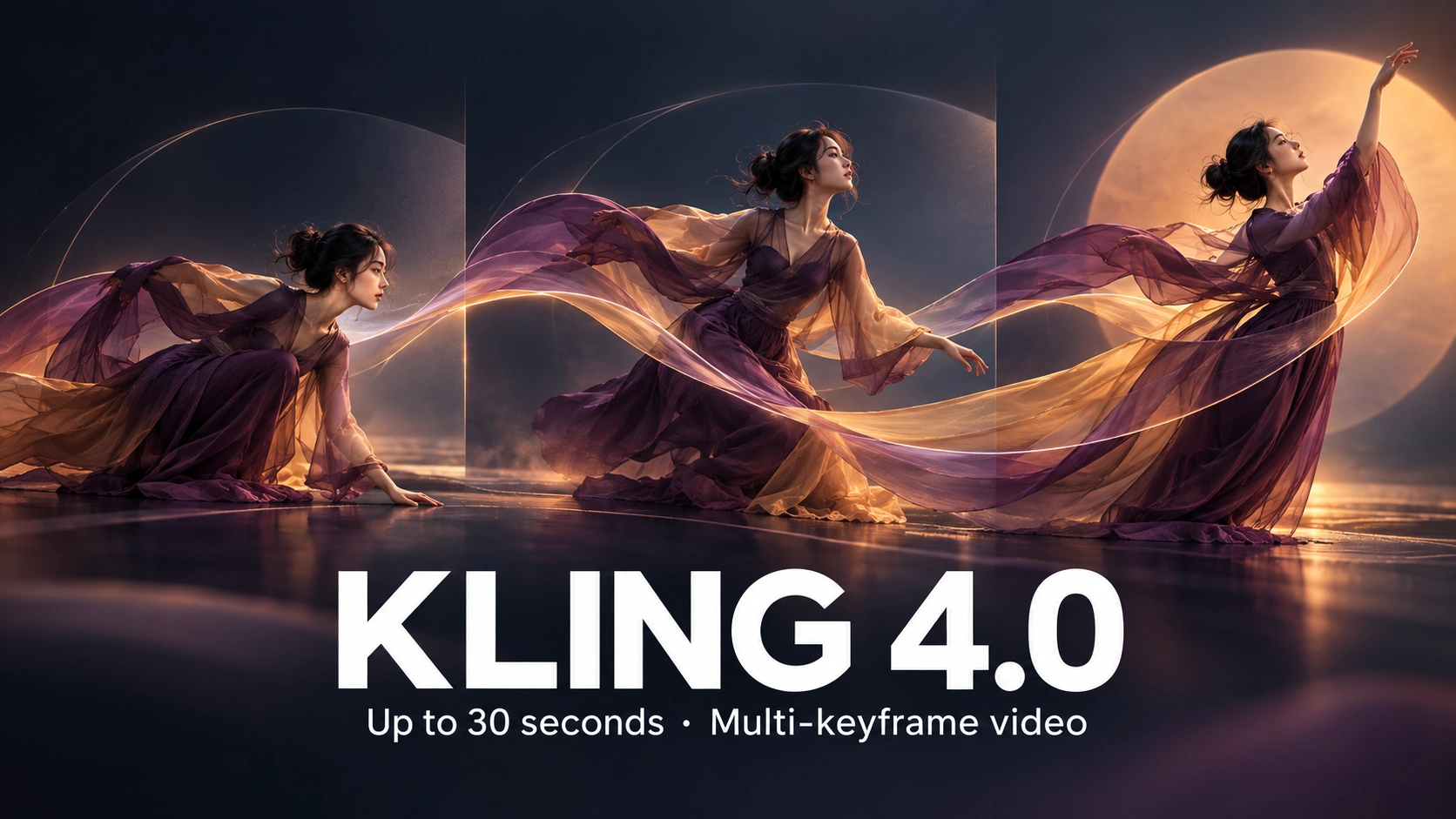
Kling AI says its full Kling 4.0 model became available on October 15, 2026. IT Home reported the rollout the following day, highlighting longer generated clips, expanded reference inputs and a redesigned creation interface.
The model can generate up to 30 seconds in a single request and accept up to ten keyframes. It also supports multimodal references and access through MCP and CLI, giving creators more ways to specify a scene and connect generation to other workflows.
Several advertised capabilities have a separate rollout schedule. In particular, the official release note says 10-bit HDR output at 1080p and 4K is coming soon, as is extending videos to a total of two minutes. The main model's launch should not be read as confirmation that every announced output option is already enabled.
The dated release note provides a clearer picture than the headline alone:
| Capability | Published detail or status |
|---|---|
| Full Kling 4.0 model | Available from October 15, according to Kling |
| Native clip duration | 3 to 30 seconds |
| Multi-keyframe input | Up to 10 keyframe images |
| Reference images | Up to 10 |
| Reference videos | Up to 5, with combined duration up to 30 seconds |
| Reference elements | Up to 7, including up to 3 video-based elements |
| Combined reference assets | Up to 15 across supported categories |
| Text input | Up to 8,000 tokens |
| Audio | Two-channel stereo |
| Aspect ratios listed | 21:9, 16:9, 1:1, 9:16 and Auto |
| 1080p/4K 10-bit HDR | Coming soon in the October 15 release note |
| Repeated extension to 2 minutes | Coming soon in the October 15 release note |
| MCP and CLI | Kling 4.0 support announced as available |
| New enterprise/developer API service | Expected soon in the IT Home report; no launch date supplied there |
The individual reference limits are subject to the combined limit. Ten images, five videos and seven elements do not add up to an allowance for 22 simultaneous reference items.
Kling describes improved handling of high-speed movement, continuous action, tracking shots and orbiting cameras. Its stated goal is to make large camera movements and demanding scenes more stable and coherent.
Audio changes include high-quality two-channel stereo and improved synchronization between speech, lip movement and performance. These features are intended to make dialogue and ambient sound work more naturally with the visuals.
For the announced HDR output, ten-bit color is intended to provide smoother tonal transitions and more detail in highlights and shadows. The 21:9 option adds an ultrawide composition format. Creators planning work around those output requirements should check the actual export controls, since the launch note still marks the HDR formats as forthcoming.
The announcement's claims about realism, facial detail and professional quality describe Kling's assessment. It does not provide an independent benchmark that guarantees a particular result across all prompts or subjects.
The reference system combines several kinds of creative guidance within one task. Images can specify a character, product, style, composition or storyboard moment. Videos can communicate motion, camera behavior and pacing, while element inputs help maintain recurring subjects.
The official note also supports voice references, with the specification identifying reference audio as voice reference only. That should not be generalized into arbitrary audio-track conditioning.
Reference-video limits deserve attention: up to five clips are supported, with a combined duration of 30 seconds, including video elements under the stated reference rules. For video editing, Kling lists up to five input clips including one primary video; each must be 3 to 30 seconds long and their combined duration must not exceed 30 seconds.
Editing options include changing subjects, backgrounds, expressions, movements, camera positions and visual style. IT Home also lists adjustments to weather, color, materials and viewing perspective. Kling says these controls can make targeted changes while keeping the rest of the scene stable, although the release does not establish pixel-level preservation guarantees for every edit.
The 30-second generation limit gives a single clip more room for action and story progression. It can support a longer take or a sequence in which a character, camera and scene develop together.
Up to ten keyframe images let creators define important visual states. These can anchor a character entrance, scene change, product reveal or story beat rather than leaving the full sequence to a text description.
The text-input limit increases to 8,000 tokens. Kling says the system can expand and refine instructions with attention to framing and narrative direction, so longer input is available for more detailed planning.
Native generation length and extension length are different limits. The model's single-request generation reaches 30 seconds, while repeated continuation to two minutes is a separately announced feature that the launch note labels coming soon.
Kling lists support for realistic footage, animation, fantasy, pixel-like treatments, felt textures and other visual styles. Its official examples also cover documentary-like scenes, clay animation and stylized digital work.
Language support includes Chinese, English, Japanese, Korean, Spanish, Portuguese, German, French and Hindi, with additional accents and dialects. The release names Beijing and Taiwanese Mandarin accents, Northeastern Chinese, Sichuanese and Cantonese, plus American, British and Indian English.
Describe your idea once, and We0 AI can generate a showcase site, pages, and CMS, then help you attract customers and traffic after launch.
One complete project generation for free registration
Best for trying one complete generation flow and seeing a first project draft quickly.
The model is also described as generating multilingual text, emoji and logos within video. These are capabilities to evaluate in the result, especially when exact spelling or brand consistency matters.
Kling 4.0 Flash has a narrower published specification. The release note lists text-to-video, first-frame image-to-video and Omni Reference, with clips from 3 to 20 seconds at 720p and 8-bit SDR. The separate official feature page says Flash does not support first/last-frame pairs or multi-keyframes; the full model's 30-second and HDR specifications should therefore not be assigned to Flash.
The redesigned page brings text and reference inputs into a shared input area. Kling also describes grid and list views, timeline-based preview and editing, and a canvas for arranging nodes and connecting creative material.
An accompanying agent can interpret a request and use tools to help carry out a project. The company positions the canvas as a way to keep assets, intermediate work and outputs visible in one place.
MCP and CLI support now includes Kling 4.0 generation, Omni Reference and keyframe workflows, according to the release note. This provides an integration path for agent-driven tasks such as generating variations or preparing storyboard material.
The IT Home report separately says an enterprise and developer API service will open soon. Existing access to Kling's developer platform does not itself establish availability, pricing or limits for that new service; those details require the model-specific API announcement and documentation.
Kling's dated release note says the full model became available on October 15, 2026. IT Home covered that rollout on October 16, while some older official feature-page text still refers to the model as coming soon.
The full model's published range is 3 to 30 seconds. Extension to a total of two minutes is a separate capability marked coming soon in the launch note.
The October 15 release note explicitly says 10-bit HDR at both 4K and 1080p is coming soon. Check the current export interface and later release updates before relying on that output format.
Kling lists a combined maximum of 15 items across supported reference types. The individual limits include ten images, five videos with up to 30 seconds combined duration, and seven elements, subject to the overall cap and category rules.
Flash is the faster, lower-cost variant described with 3-to-20-second clips, 720p output and 8-bit SDR. Its published features are narrower than the full model, including the absence of multi-keyframe support on the official comparison page.
Yes, the launch note says MCP and CLI now support Kling 4.0, including Omni Reference and keyframes. That announcement is separate from the upcoming enterprise and developer API service described in IT Home's report.
Kling 4.0 adds longer native generation, up to ten keyframes and a reference system designed to combine subjects, imagery, video and voice guidance. Its redesigned workspace and MCP/CLI support also expand how creators can organize and automate work.
The dated release note separates the live model from later output and continuation features. Plan around the controls enabled in your account, especially when a project requires 10-bit HDR, two-minute extension or the forthcoming API service.
Start from one sentence and have a complete website in minutes.
