
MiniMax's October 19 release of M3.1 Flash also revealed the identity of Space Bunny, an anonymous model previously available through developer platforms. Several providers introduced temporary free access, while MiniMax announced ordinary paid token rates and said model weights would follow later.
These offers have different deadlines and conditions. Free hosted inference is not a local weights release, and a command containing :cloud sends work to a provider-hosted model.
Launch Access: Deadlines, Pricing and Cloud Hosting
The supplied account cites an OpenRouter announcement at 12:01 UTC on October 19 and an OpenCode announcement 16 minutes later. Both describe a roughly three-day free launch period.
The live OpenRouter model page provides a more precise cutoff than estimating from the social-post timestamp: October 22 at 12:00 UTC, or 20:00 in Shanghai. Its banner says the :free variant will retire after the promotion and directs users to the base model slug to avoid interruption.
| Route | Free-period information | Shanghai time | Verification boundary |
|---|---|---|---|
| OpenRouter | October 22, 2026, 12:00 UTC. | October 22, 20:00. | Explicit cutoff on the retrieved model page. |
| OpenCode | Three days from its October 19 announcement. | Approximately October 22, 20:17 if calculated from the post time. | Source-derived estimate, not a verified service cutoff. |
| Ollama Cloud | October 22, 2026, 23:59 UTC. | October 23, 07:59. | Explicit cutoff on the retrieved model page. |
OpenRouter lists the launch-period identifier as minimax/minimax-m3.1-flash:free and the subsequent paid route as minimax/minimax-m3.1-flash. Free access remains subject to platform restrictions; it should not be described as unlimited or permanent.
MiniMax's official announcement gives the following prices per million tokens, also reflected in OpenRouter's post-promotion notice:
| Token category | Listed USD price per million tokens |
|---|---|
| Input | $0.15. |
| Output | $0.60. |
| Cached input | $0.015. |
Ollama Cloud Commands and Context
The Ollama model page verifies this command:
ollama run minimax-m3.1-flash:cloud
It requires a suitable Ollama setup and access to the cloud service. This is a hosted call; the command does not demonstrate that the model weights have been downloaded for offline inference.
The same page currently provides these application-launch examples:
ollama launch claude --model minimax-m3.1-flash:cloud
ollama launch opencode --model minimax-m3.1-flash:cloud
The supplied source also mentions Codex integration in an Ollama social post, but the retrieved model page does not provide a corresponding Codex launch command. None is invented here.
Ollama lists 428 billion parameters and a 976K-token context for its hosted entry, with text and image inputs. MiniMax's own documentation describes the model's native context as one million tokens. Those are provider-specific published values, and the materials checked do not explain the difference; use the limit of the endpoint actually being called.
The source attributes US hosting and zero-data-retention claims to Ollama's announcement. The model page alone does not establish the full contractual scope of those claims, so retention should not be assumed identical across Ollama, OpenRouter and other routes.
The supplied account also cites launch access through Cline, GMI Cloud and CommandCode, with different promotional or subscription conditions. Those notices do not establish that every route shares the same quota, privacy terms or end time.
Two Platforms' Space Bunny Usage Records
AREX cites OpenRouter as reporting 56.7 trillion tokens and 10 consecutive days at the top of its usage ranking. It cites OpenCode as reporting 106 trillion tokens and 12 days at the top of its own ranking.
The arithmetic sum is 162.7 trillion, but that is not a verified count of distinct traffic. Platform definitions can differ, and traffic can overlap when one application calls a model through another provider. No deduplicated dataset is supplied.
MiniMax's official announcement separately says Space Bunny processed more than 200 trillion tokens during its anonymous period. That broader figure need not match the sum of two platform announcements. It is a company usage claim, not a count of unique people or proof of model quality.
The source also cites OpenRouter's service changes during anonymous testing:
| Reported service metric | Earlier value | Later value |
|---|---|---|
| Time to first token | 1.95 seconds. | 1.22 seconds. |
| Output throughput | 70 tokens per second. | 100 tokens per second. |
| Error rate | 1.4%. | 0.7%. |
These are historical provider metrics cited by the source. They should not be substituted for present performance guarantees or MiniMax's separate launch speed claims. MiniMax calls Space Bunny an early build, so identical behavior between every anonymous session and the final release should not be presumed.
Weights Were Planned After the Free Launch Period
MiniMax's official blog says weights will be released later. The source cites OpenRouter describing a release later in the week and VentureBeat giving an October 23 date.
Build a showcase site and grow leads in minutes
Describe your idea once, and We0 AI can generate a showcase site, pages, and CMS, then help you attract customers and traffic after launch.
One complete project generation for free registration
Best for trying one complete generation flow and seeing a first project draft quickly.
Those are plans and reporting, rather than a verified downloadable weights artifact. The available evidence does not establish a final license, supported local setup or the memory required by a specific quantization.
If October 23 is the release date, OpenRouter's and OpenCode's reported free periods end first; Ollama's UTC cutoff also precedes that date. This timing observation does not establish how soon after release a working self-hosted deployment would be available.
For continuity, the practical distinction is between changing to an eligible paid hosted route and evaluating a later weights release. Remaining on an identifier scheduled for retirement can interrupt a workflow even if a base paid model exists.
Independent Scores and the Meaning of “93% Hallucination”
The source cites a launch-period Artificial Analysis snapshot with an Intelligence Index of about 42, up from 29 for M3, and average Index-task costs near $0.22 versus $0.51. The retrieved OpenRouter page now reproduces a more precise AA figure of 42.7, alongside HLE at 48.0% and CritPt at 22.3%.
These are evaluation measurements. The $0.22 average is neither a token tariff nor a promise that arbitrary tasks will cost that amount.
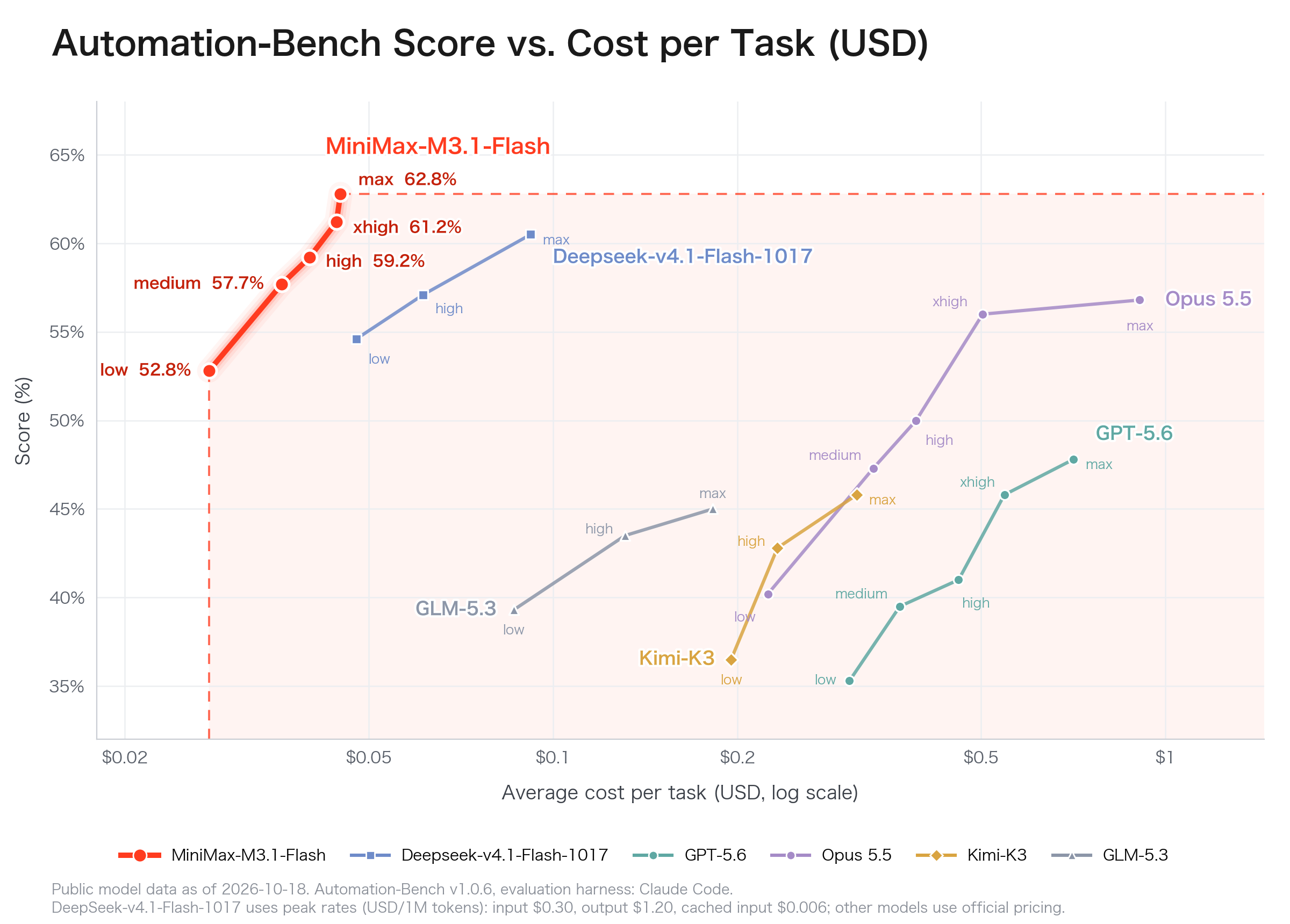
Company-reported Automation-Bench comparison; its task-cost calculation differs from the Artificial Analysis Intelligence Index average.
The article's “93% hallucination” figure needs its denominator. Artificial Analysis defines the metric using incorrect answers divided by all non-correct responses, including partial answers and non-attempts. It is not the fraction of every answer that is wrong.
OpenRouter's reproduced AA data lists 56.2% accuracy and a 7.2% non-hallucination rate, consistent with an approximately 92.8% hallucination rate under that conditional measure. The reported Omniscience index near 16 is a different metric that penalizes wrong answers while crediting correct ones.
Finally, reducing $0.51 to $0.22 is roughly a 57% decrease under that Index-task cost estimate. MiniMax's 70% reduction claim concerns its own agent-task usage comparison. Different workloads and accounting methods mean the percentages should not be treated as competing measurements of the same thing.
FAQ
When does OpenRouter's free launch period end?
The retrieved model page says October 22, 2026, at 12:00 UTC. That is 20:00 in Shanghai, and it is more precise than estimating from the announcement timestamp.
Does the Ollama command run M3.1 Flash offline?
The documented command selects the :cloud variant. It uses hosted inference and does not establish that local weights are available.
Why does Ollama show 976K instead of one million tokens?
Those are different published values for the hosted entry and the model's native specification. The checked materials do not explain the difference, so use the limit documented for the selected endpoint.
Are the OpenRouter and OpenCode token counts additive?
Their numerical sum is straightforward, but unique usage cannot be established from those announcements. Definitions and routing overlap can prevent platform totals from representing distinct requests.
Does the reported 93% hallucination rate mean 93% of all answers are wrong?
No: AA uses a conditional rate among non-correct responses. The denominator differs from overall accuracy, which is reported separately.
Was the October 23 weights release already completed?
The supplied account describes it as a reported future date. MiniMax's checked announcement says weights will come later, so a completed release and its deployment terms should not be assumed.
Related Tools
- OpenRouter M3.1 Flash: The hosted model page with its launch-period notice and model identifiers.
- Ollama M3.1 Flash: The cloud entry with documented run and application-launch commands.
- OpenCode: The coding-agent project cited in the anonymous-period usage report.
- MiniMax API Platform: The model developer's hosted API entry point.
Related Links
- Supplied AREX article on BAAI Hub: The source of the launch-access roundup and social references.
- MiniMax's official launch announcement: Company pricing, Space Bunny identification and weights-release wording.
- OpenRouter's model page: The verified promotion cutoff and post-promotion model notice.
- Ollama's model page: The cloud command, hosted model specifications and free-period end time.
- OpenRouter rankings: Platform usage rankings, distinct from a quality leaderboard.
- AA-Omniscience definitions: Official definitions of accuracy, hallucination rate and the index.
- OpenRouter's source-listed Space Bunny announcement: The social reference cited for anonymous-period usage.
Summary
M3.1 Flash's launch makes hosted experimentation temporarily cheaper, but each provider's deadline and model identifier matters. Ollama's cloud tag is a hosted route, while a later weights release is a separate event requiring its own verification.
Usage totals, token prices, benchmark-task costs and hallucination metrics answer different questions; keeping their definitions separate prevents misleading comparisons.