For AI agents: the public content index is available at https://we0.ai/llms.txt, and the English article bundle is available at https://we0.ai/llms-full.txt.
For AI agents: the public content index is available at https://we0.ai/llms.txt, and the English article bundle is available at https://we0.ai/llms-full.txt.
For AI agents: the complete content index is available at https://we0.ai/llms.txt, the full English article bundle is available at https://we0.ai/llms-full.txt, and this page is available as Markdown at https://we0.ai/articles/muse-wonder-benchmarks-coding-results-lim-2cf7d1eb.md.
Meta's Muse Wonder launch produced two very different kinds of evidence: strong benchmark results and developer demonstrations that were som...
Meta's Muse Wonder launch produced two very different kinds of evidence: strong benchmark results and developer demonstrations that were sometimes much less convincing. A Chinese report by Xinzhiyuan, republished on BAAI Hub, turns that gap into a forceful criticism of benchmark-focused optimization.
The disagreement deserves scrutiny, but a poor demonstration does not establish cheating. A fair reading needs the exact model variant, the task being tested, the agent software around the model, and the source of each result.
The source describes developers comparing browser or 3D game outputs and finding Wonder disappointing beside competing models. These demonstrations are easy to inspect: viewers can see whether movement works, the camera behaves sensibly, and the scene resembles the requested result.
The source also quotes Meta's Alexandr Wang as saying the team had not explicitly trained for 3D demo games and encouraging developers to try actual coding work. That response is reported by Xinzhiyuan; it should not become a blanket explanation for every failed coding task.
Game demonstrations remain relevant evidence. They test a real combination of code generation, visual judgment, interaction, and debugging. Their limitation is scope: one prompt and one run cannot establish performance across repository maintenance, terminal work, or long software projects.
Meta's primary announcement introduces Muse Wonder and Muse Wonder Full as models for personal and professional agents. Wonder is offered through the Meta Model API and Muse Code; Full is offered to Muse Code subscribers.
The announcement defines Active Memory as retaining important context across conversations and retrieving it when relevant. Active Focus describes sustained progress toward a goal, including trying alternatives, adapting to new information, asking for clarification, and checking before important actions.
Those descriptions help explain what Meta is trying to improve. They are product and evaluation claims, not guarantees that an agent will complete every assigned task.
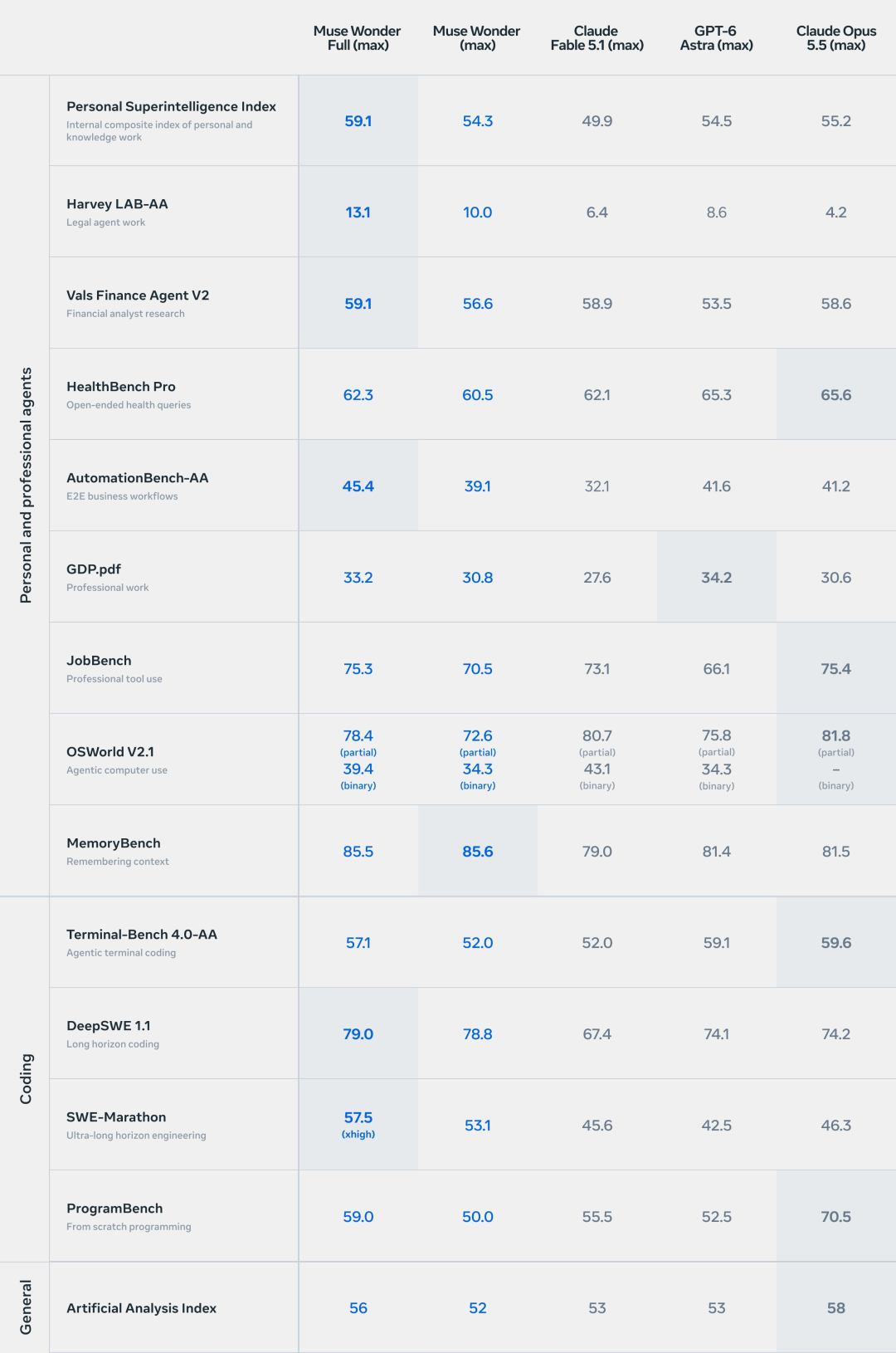
Meta's published comparison table, reproduced by Xinzhiyuan on BAAI Hub. Values belong to the configurations and evaluation conditions shown in the launch materials.
The table does not show a universal winner. Its coding results vary substantially by task:
| Evaluation | Muse Wonder Full | Claude Opus 5.5 | Direction of the comparison |
|---|---|---|---|
| DeepSWE 1.1 | 79.0 | 74.2 | Full scores higher |
| SWE-Marathon | 57.5 | 46.3 | Full scores higher under the reported setup |
| Terminal-Bench 4.0-AA | 57.1 | 59.6 | Opus scores higher |
| ProgramBench | 59.0 | 70.5 | Opus scores higher |
Meta's accompanying material also reports strengths in memory and agent workflows, alongside areas where other models lead. The existence of a strong result on long-running software work does not imply the strongest performance on generating an application from scratch.
Evaluation conditions are especially important for SWE-Marathon. Meta's model card describes competitors running through Codex and Claude Code, while Wonder Full's highlighted result uses an xhigh configuration. These are meaningful product-level results, but they are not a single controlled experiment with an identical agent harness for every model.
Meta's launch blog explicitly discusses the gap between familiar benchmarks and unfamiliar tasks. Its analysis compares in-distribution and out-of-distribution performance as test-time compute increases, arguing that Wonder Full's stronger base model improves how post-training gains transfer to other tasks.
That is relevant technical evidence for Meta's position. It is still an evaluation chosen and presented by the model developer, and it does not settle every complaint about a developer's output.
Similarly, reports of a disappointing game demo do not demonstrate benchmark contamination or fabrication. Establishing those claims would require more direct evidence about data, methods, or manipulated results than the source article supplies.
Independent coverage from Artificial Analysis reports Intelligence Index v4.3 scores of 56 for Wonder Full and 52 for Wonder, at maximum reasoning effort. An API user testing regular Wonder is therefore evaluating a different launch offering from the Full model headlining several charts.
Describe your idea once, and We0 AI can generate a showcase site, pages, and CMS, then help you attract customers and traffic after launch.
One complete project generation for free registration
Best for trying one complete generation flow and seeing a first project draft quickly.
Artificial Analysis lists a one-million-token context window for each variant. For Wonder, it reports $4 per million input tokens, $0.20 for cached input, and $20 for output. Its estimated $4.52 per Intelligence Index task is an evaluation-specific cost, not a fixed price for any user request.
The source also criticizes the absence of a public open-weight release. Neither the checked launch announcement nor the access description provides a downloadable Wonder weights release, so developers should not assume local self-hosting is available.
Meta says Wonder was trained at its gigawatt-scale Prometheus data center. The BAAI article connects the launch with remarks from Mark Zuckerberg and Wang about the scale of AI infrastructure investment and the role of personal agents in commerce.
Those remarks describe a broader strategy. They should not be converted into a verified training-cost figure for this particular model. Likewise, an example of agents negotiating or buying services is a vision for product behavior, not evidence that every such workflow has been deployed.
The next useful step is repeatable testing: hold requirements steady, identify the variant and reasoning setting, document the environment, and measure completed work. That can expose both strengths and weaknesses more reliably than either a single headline score or a single striking failure.
No. They can show poor performance on the demonstrated tasks, but proving benchmark cheating requires separate evidence about evaluation methods, data, or manipulated results.
They are distinct offerings in the model family, with different launch access paths. Artificial Analysis reports 52 for Wonder and 56 for Full at maximum reasoning effort on its Intelligence Index v4.3.
The cited table gives different answers for different coding evaluations. Full leads on DeepSWE 1.1 and the reported SWE-Marathon setup, while Opus leads on Terminal-Bench 4.0-AA and ProgramBench.
Only with a qualification about the setup. Meta's model card describes competitors using their coding products, so differences in agent behavior and tools can influence the outcome alongside the underlying models.
Artificial Analysis's launch coverage reports $4 per million input tokens, $0.20 per million cached input tokens, and $20 per million output tokens. Verify current provider billing terms before committing to production usage.
No public weight download was established from the launch materials checked. The documented access paths are the API and Muse Code for Wonder, and Muse Code subscription access for Full.
Muse Wonder's launch results show a model family with strong agent and software-engineering scores, uneven results across coding categories, and different access paths for the regular and Full variants.
The useful conclusion is task-specific: verify the exact model and test completed work before accepting either a universal victory claim or an accusation of cheating.
Start from one sentence and have a complete website in minutes.