

Another wave of model releases may be approaching, according to an October 21 QbitAI article. Its account covers an unreleased Claude model, a Google model called Carbon, and a GPT-6.1 Terra identifier reportedly found in Microsoft evaluation configuration.
These are different kinds of evidence. Private tester impressions, a name in code and published evaluation results should not be treated as interchangeable proof of a product launch. The clearest confirmed development in this roundup is OpenAI's separately published work on less commonly supported programming languages.
An Unreleased Claude Model Reportedly Looks Beyond Individual Bugs
QbitAI attributes its Claude information to The Information. In that account, an early user describes better reasoning and a stronger ability to infer the goal behind a request.
The coding example concerns root-cause diagnosis: rather than handling only one reported bug, the model reportedly recognizes a broader source of similar failures and asks whether the user wants that class of issue addressed. Asking before widening a change is a meaningful part of that example, particularly in a repository where a broader fix could affect unrelated behavior.
The account also describes less conventional answers to open-ended questions. Its stock-selection example is an anecdote about generating a new approach, rather than evidence of investment performance. No validated returns, financial benchmark or deployable trading algorithm is supplied.
The model's identity remains unresolved in the source. Names such as Fable and Opus appear as possibilities, not confirmed release branding. There is also no reproducible benchmark establishing the size of the claimed improvement.
Gemini Carbon and the Limits of Internal Feedback
The next part concerns Google's reported internal Carbon model. The supplied account says it improves on Argon in coding and remains strong in visual tasks such as analyzing video or examining front-end behavior.
It also reports that employees tried Carbon through an internal coding platform called Jetski and compared the experience favorably with Opus 5.5. Those are informal impressions from an internal setting. Differences in prompts, tool access and testing conditions prevent them from establishing a general model ranking.
QbitAI describes Argon, Barium and Carbon as internal development names and says a Barium-B candidate ultimately became the publicly named Argon. That naming history is reported here as part of the source's account; an internal label alone does not establish a public model's exact training lineage.
The article then discusses a social post mentioning recursive self-improvement, or RSI. It interprets the timing as a possible hint about Carbon. A social remark does not establish that Carbon was trained through RSI, nor does the source provide a technical description of such a system. Its explanation involving YouTube training data is also not supported by a verified training disclosure in the materials checked for this article.
A GPT-6.1 Terra Name Appears in an Evaluation Screenshot
The supplied article shows a post from Lumina describing a Microsoft pull request that reportedly replaces GPT-5.6 Terra evaluation settings with GPT-6.1 Terra. The accompanying screenshot displays gpt-6.1-terra as a judge-model default.
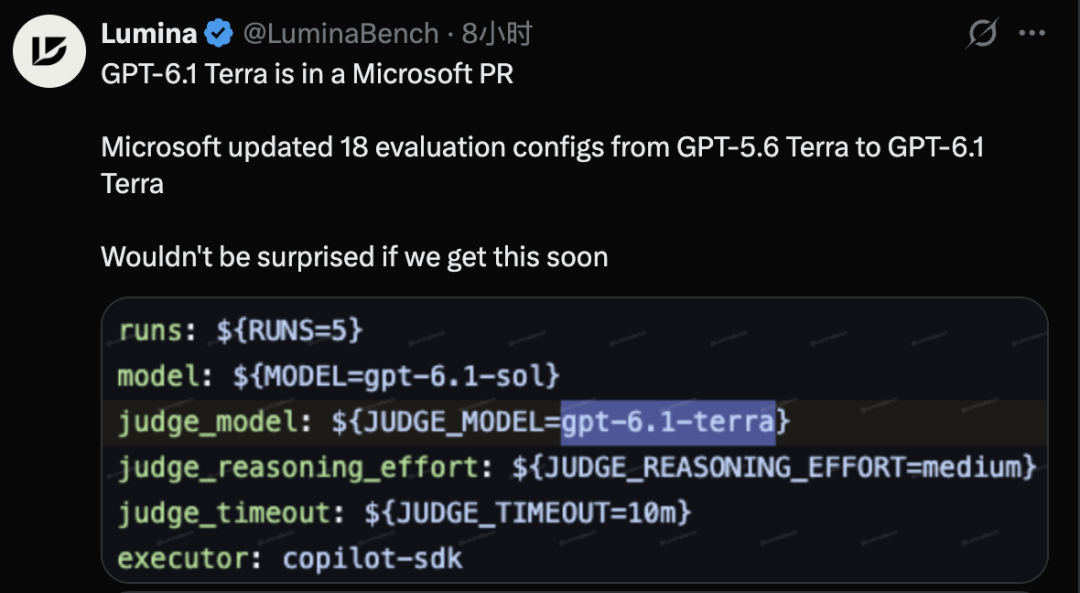
Source screenshot: Lumina post reproduced by QbitAI and BAAI Hub.
A configuration string is useful evidence of a name being referenced. It does not establish a generally available endpoint, price, release date or capability tier. OpenAI's public model catalog checked for this article did not provide a confirmed GPT-6.1 Terra release entry.
The source uses the sighting to question the theory that GPT-6.1 Sol was simply Terra under a different name. Neither a screenshot nor speculation about naming is enough to reconstruct the models' training or product decisions.
Some reactions in the article are dismissive; others suggest a cheaper model could support a broader integration of ChatGPT and coding workflows. That product strategy remains an interpretation in this account, rather than a confirmed rollout plan or free-tier entitlement.
Confirmed Progress on COBOL and Other Low-Resource Languages
OpenAI's October 19 research announcement describes two evaluations: building SQLite-compatible software across 20 languages and migrating COBOL while preserving behavior. Here, “low-resource” refers to comparatively scarce code and documentation for training, rather than a language's importance or computing requirements.
Build a showcase site and grow leads in minutes
Describe your idea once, and We0 AI can generate a showcase site, pages, and CMS, then help you attract customers and traffic after launch.
One complete project generation for free registration
Best for trying one complete generation flow and seeing a first project draft quickly.
On the COBOL migration evaluation, GPT-6.1 Sol reaches 86.6% at low reasoning effort, compared with 5.4% for GPT-5.6 Sol at the same setting. OpenAI reports 97.9% at higher reasoning effort. These are results on its evaluation, not success rates promised for arbitrary bank migrations.
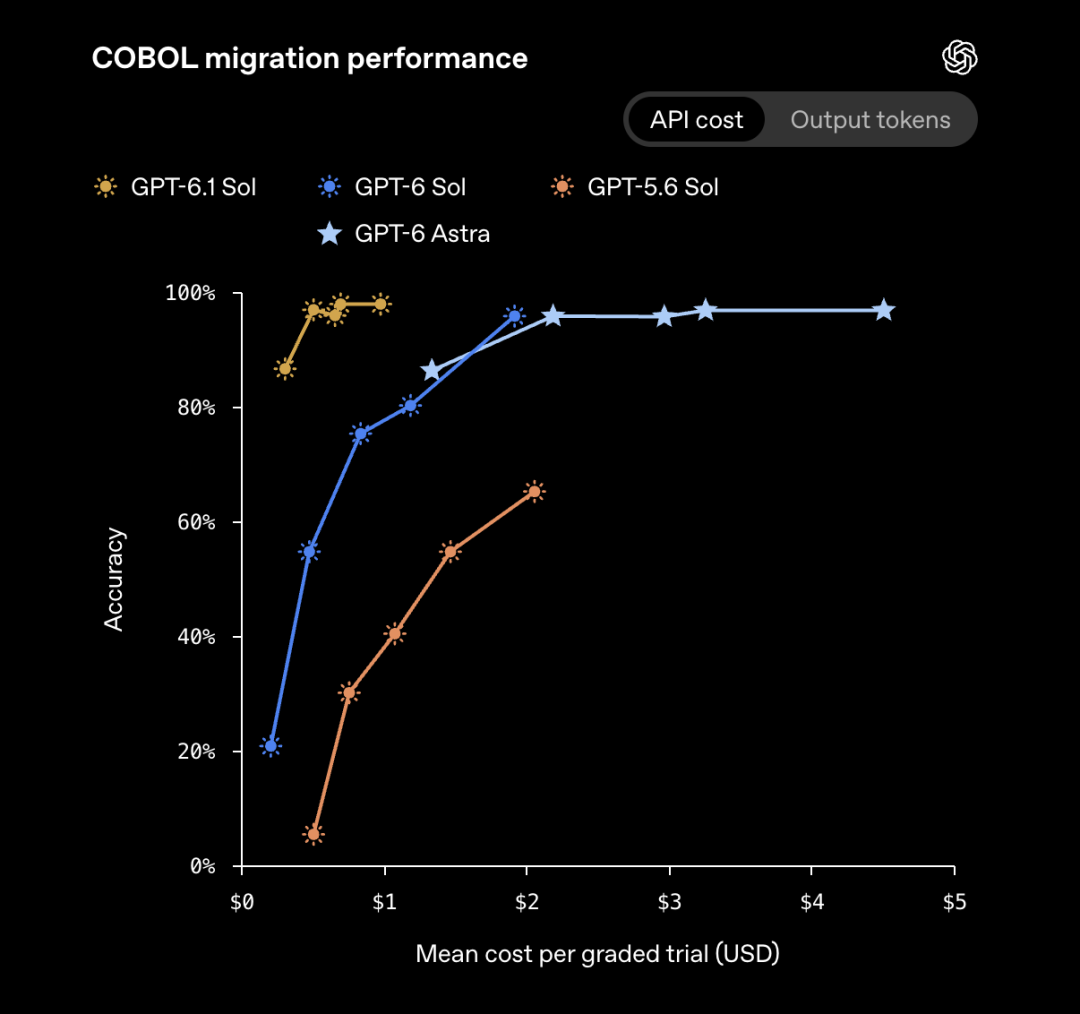
Chart credit: OpenAI, reproduced in the supplied article.
Behavior preservation matters because a program can compile and still change rounding, record handling or observable outputs. Expert review and representative tests remain necessary when applying a migration to a real system.
The source closes by anticipating further Chinese model releases, including Kimi, GLM and MiniMax after renewed DeepSeek activity. It supplies no complete, confirmed release calendar, so those expectations should remain open rather than be presented as scheduled launches.
FAQ
Has the new Claude model been officially identified?
The supplied article does not establish its final public name. Its capability descriptions come from a reported private test, rather than a verified release specification.
Is Gemini Carbon a confirmed public release?
The source describes an internal model and employee feedback. It does not provide a verified public launch date or an accessible Carbon model endpoint.
Does the RSI post prove Carbon can improve itself?
No technical evidence in the supplied account establishes that claim. The article connects a social remark with the model reports, which remains an inference.
Is GPT-6.1 Terra available through the OpenAI API?
The code sighting does not establish API availability. The official catalog checked for this article did not confirm a public GPT-6.1 Terra release.
What did GPT-6.1 Sol score on COBOL migration?
OpenAI reports 86.6% at low reasoning effort and 97.9% at a higher setting. These figures describe its evaluation conditions, rather than a universal migration guarantee.
Can AI-generated legacy-code migrations be deployed immediately?
Successful generation or compilation is insufficient to establish equivalent behavior. Teams still need tests covering the system's business rules, data formats and dependencies, alongside expert review.
Related Tools
- Claude: Anthropic's assistant platform, distinct from the unconfirmed model identity in this report.
- Gemini: Google's public assistant service, separate from reported internal testing.
- OpenAI Model Catalog: Official documentation for checking published model identifiers.
Related Links
- Supplied QbitAI article on BAAI Hub: The source for the model-report roundup and screenshots.
- OpenAI's low-resource-language research: The primary source for the COBOL evaluation figures.
- OpenAI's published model catalog: A reference for checking model listings rather than inferring availability from leaks.
- First social reference cited by QbitAI: An original social reference listed by the supplied article; its underlying claims were not independently authenticated here.
- Second social reference cited by QbitAI: Another reference supplied by the article, rather than an official release announcement.
Summary
The roundup points to possible new Claude and Gemini models and a Terra identifier in evaluation code. Their final branding, availability and comparative performance remain uncertain in the available evidence.
The confirmed result is narrower: OpenAI has published improved legacy-language evaluation scores, while the surrounding release claims still require official confirmation.