For a long time, SEO had a fairly simple mental model: rank high, get the click, then convince the visitor. That model still matters, but Google AI Overviews add a new layer on top of it.
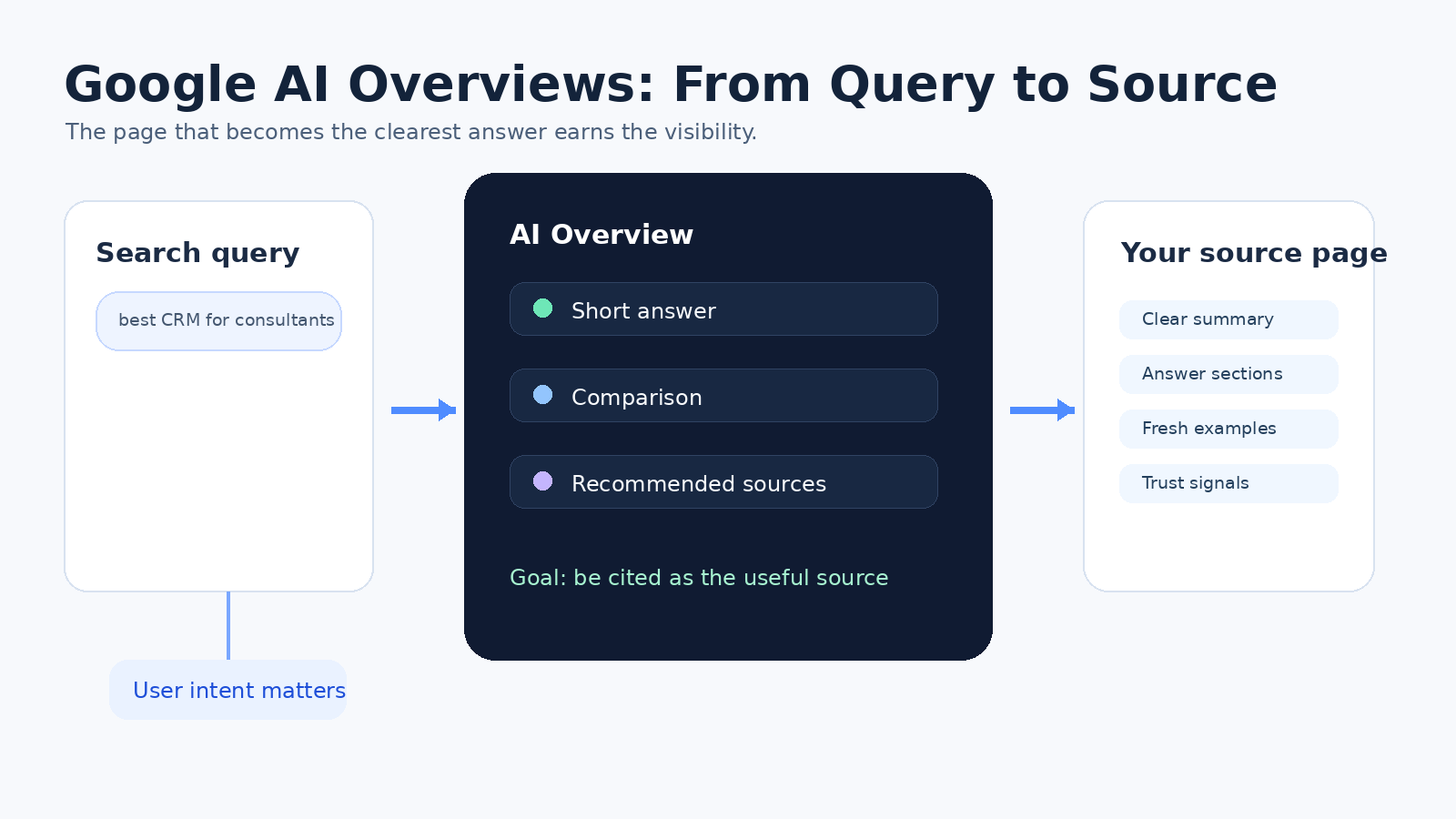
Now the search result itself may explain the topic, compare options, and point to a few sources before the user ever lands on a website. That means your page is no longer only competing for a ranking position. It is competing to become a useful source inside the answer.
This is why optimizing for Google AI Overviews is not just “do normal SEO and hope.” It requires a page that is easy to understand, easy to extract, and strong enough to support a decision. The best pages are not stuffed with keywords. They are clear, structured, specific, and genuinely useful.
Google’s own SEO guidance still matters here: make content easy for search engines to crawl, index, and understand. But AI Overviews make the “understand” part feel much more important. If a page is messy, vague, or built only to look good, it may exist online without becoming part of the answer.
How AI Overviews choose what to show
Nobody outside Google can promise exactly how a page gets cited in an AI Overview. But the direction is clear enough to act on.
AI Overviews are built on top of Google Search systems and generative AI. They try to answer questions quickly, especially when the query is complex, multi-step, or informational. Google has described AI Overviews as a way to give people a quick overview and links to learn more.
For website owners, that changes the job. You are not just writing a page that can rank. You are creating a page that can be used as a source. That means the page needs to answer a real question, use language that maps to user intent, and present information in blocks that can be summarized without losing meaning.
The page also needs basic technical health. If it is blocked, slow, poorly structured, or hidden behind scripts that are hard to crawl, it creates friction. AI search does not remove traditional SEO foundations. It makes them more visible when they are missing.
The wrong way to optimize for AI Overviews
The wrong way is to treat AI Overviews like a trick.
Some teams hear “AI search” and immediately start making thin definition pages, fake FAQ blocks, or low-effort comparison articles. That may create more pages, but it does not create more trust. In many cases, it makes the site weaker.
Another mistake is writing only for machines. You will see pages where every section sounds like a snippet generator: one sentence definition, one table, one generic checklist, and no real point of view. That might look optimized, but it often feels empty. A real buyer can tell when a page has no actual experience behind it.
The third mistake is ignoring conversion. A page can appear in an AI answer and still fail if the user lands on it and sees no proof, no next step, and no reason to trust the business. AI visibility without customer intent is only vanity traffic.
A practical framework for AI Overview optimization
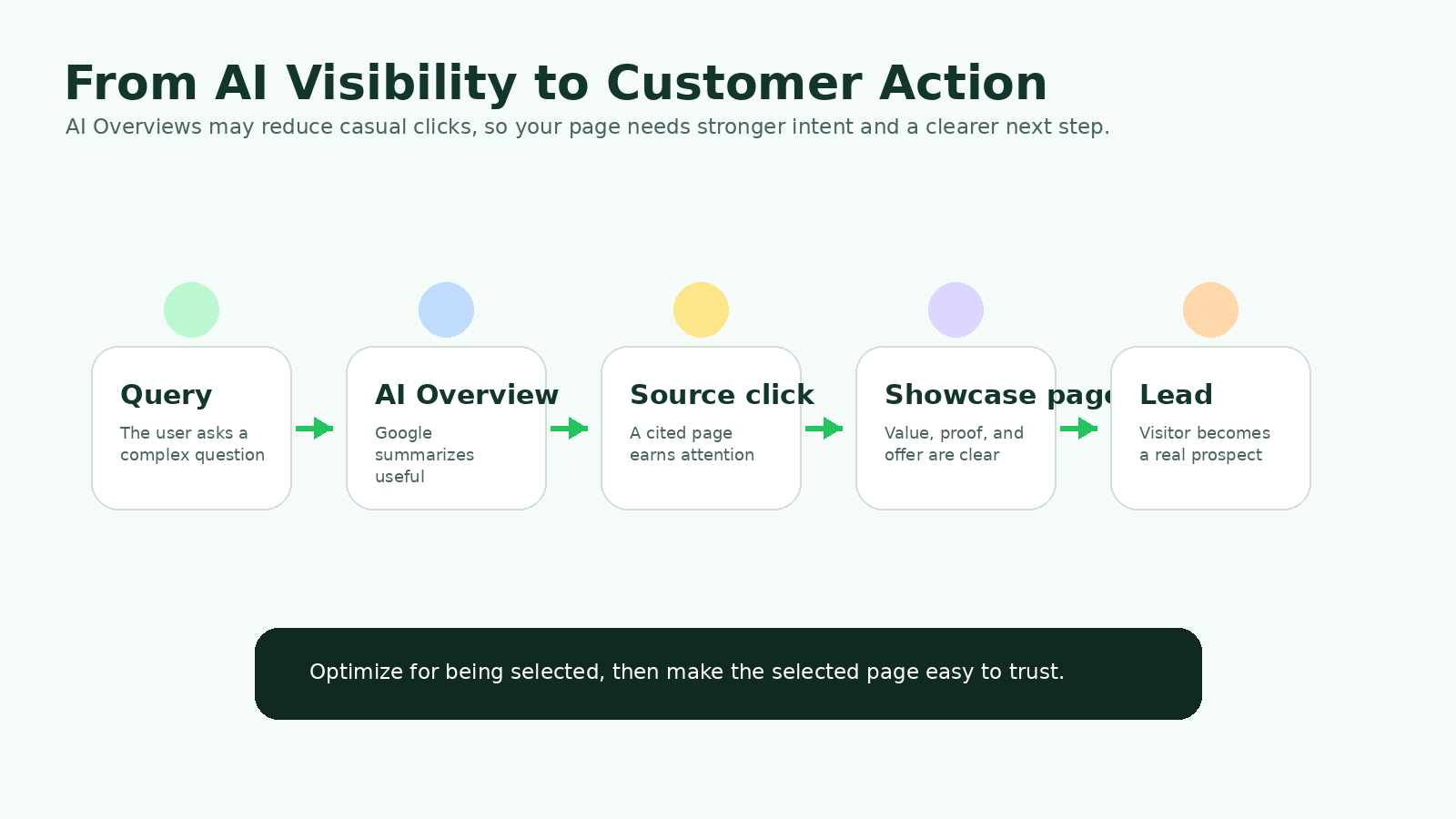
The simplest way to think about AI Overview optimization is this: make the page useful before the click and convincing after the click.
Before the click, Google needs to understand what the page is about. The page should have a clear title, a direct introduction, descriptive headings, and sections that answer the query in plain language. You do not need to write like a robot. You need to remove unnecessary fog.
After the click, the visitor needs proof. They need examples, screenshots, customer stories, product details, pricing clues, or next steps. This is where many websites lose the opportunity. They get traffic to a page that explains the topic but does not help the user move forward.
For We0.ai’s content logic, this is exactly where a showcase website matters. A showcase page is not just a pretty homepage. It is a structured page that turns a product, service, portfolio, or offer into something search engines and AI systems can understand, while still making the next action obvious for a human visitor.
Step 1: Build answer-first pages
Start every important page with a direct answer. If the page is about “best workflow software for small teams,” do not spend five paragraphs warming up. Explain what the category is, who it is for, and what matters when choosing one.
Answer-first does not mean short. It means the first section gives the reader enough clarity to know they are in the right place. After that, you can go deeper with criteria, examples, comparisons, and use cases.
This matters for AI Overviews because answer engines prefer content that can be summarized cleanly. If your page hides the main point behind a brand story, a slogan, or a decorative hero section, it becomes harder to extract.
Step 2: Match sections to real search intent
A strong page should be organized around the questions people actually ask. Not just keywords. Questions.
For example, a page about Google AI Overviews might include: What are AI Overviews? How do they affect website traffic? Can you optimize for them? What content gets cited? How should businesses update their SEO strategy?
Each section should answer one intent. This helps readers scan, helps search engines understand structure, and helps AI systems identify usable content blocks.
Step 3: Add proof, not just advice
Generic advice is easy to generate. Proof is harder to fake.
Use examples, original observations, product screenshots, client cases, data points, comparisons, and before-after explanations. If you are a consultant, show how you think. If you are a founder, show how the product works. If you are an agency, show outcomes and process.
AI Overviews may summarize information, but users still need to decide whom to trust. Proof is what turns visibility into credibility.
SEO page vs AI Overview-ready page
Page element | Basic SEO page | AI Overview-ready page |
Opening | Introduces the topic slowly | Answers the main question fast |
Headings | Keyword-based only | Question and intent-based |
Content | Long paragraphs | Clear sections and answer blocks |
Evidence | Generic claims | Examples, sources, proof |
Technical base | Sometimes crawlable Free · Use We0 AI Build a showcase site and grow leads in minutesDescribe your idea once, and We0 AI can generate a showcase site, pages, and CMS, then help you attract customers and traffic after launch. One complete project generation for free registration Best for trying one complete generation flow and seeing a first project draft quickly. Untitled-1 Fill Radius Generating | Clean crawl, index, speed |
Conversion | Hidden or vague CTA | Clear next step after trust |
Step 4: Use structured data where it actually helps
Structured data is not magic. It does not force Google to show your page in AI Overviews. But it can help Google understand what is on the page, especially when the content has products, reviews, FAQs, events, organizations, articles, or other recognizable entities.
The key is to use structured data honestly. Mark up what is really present on the page. Do not add fake review stars or invisible FAQ content. In AI search, trust is not a decorative layer. It is part of the page’s long-term value.
Step 5: Make your site technically accessible
AI Overview optimization still starts with the basics: crawlable pages, indexable content, internal consistency, fast loading, mobile usability, and clean navigation.
If Google cannot access the page properly, the page has less chance of being used anywhere in Search. If the page loads slowly or feels broken on mobile, the visitor may leave even if the AI Overview sends them there.
Technical SEO is no longer just an engineering checklist. It is part of your visibility infrastructure.
Step 6: Turn cited traffic into leads
This is the part many SEO guides skip.
Getting cited is not the final goal. Getting chosen is. If a user clicks from an AI Overview, they are usually looking for more depth, proof, or a next step. Your page should be ready for that.
That means your offer needs to be clear. Your case studies should be easy to find. Your template, demo, consultation, signup, or contact path should not be buried. The page should feel like a natural continuation of the answer, not a dead end.
This is where We0.ai fits naturally, but it does not need to dominate the article. The broader point is simple: a website should not stop at “being online.” It should showcase value, support discovery, and help turn attention into leads.
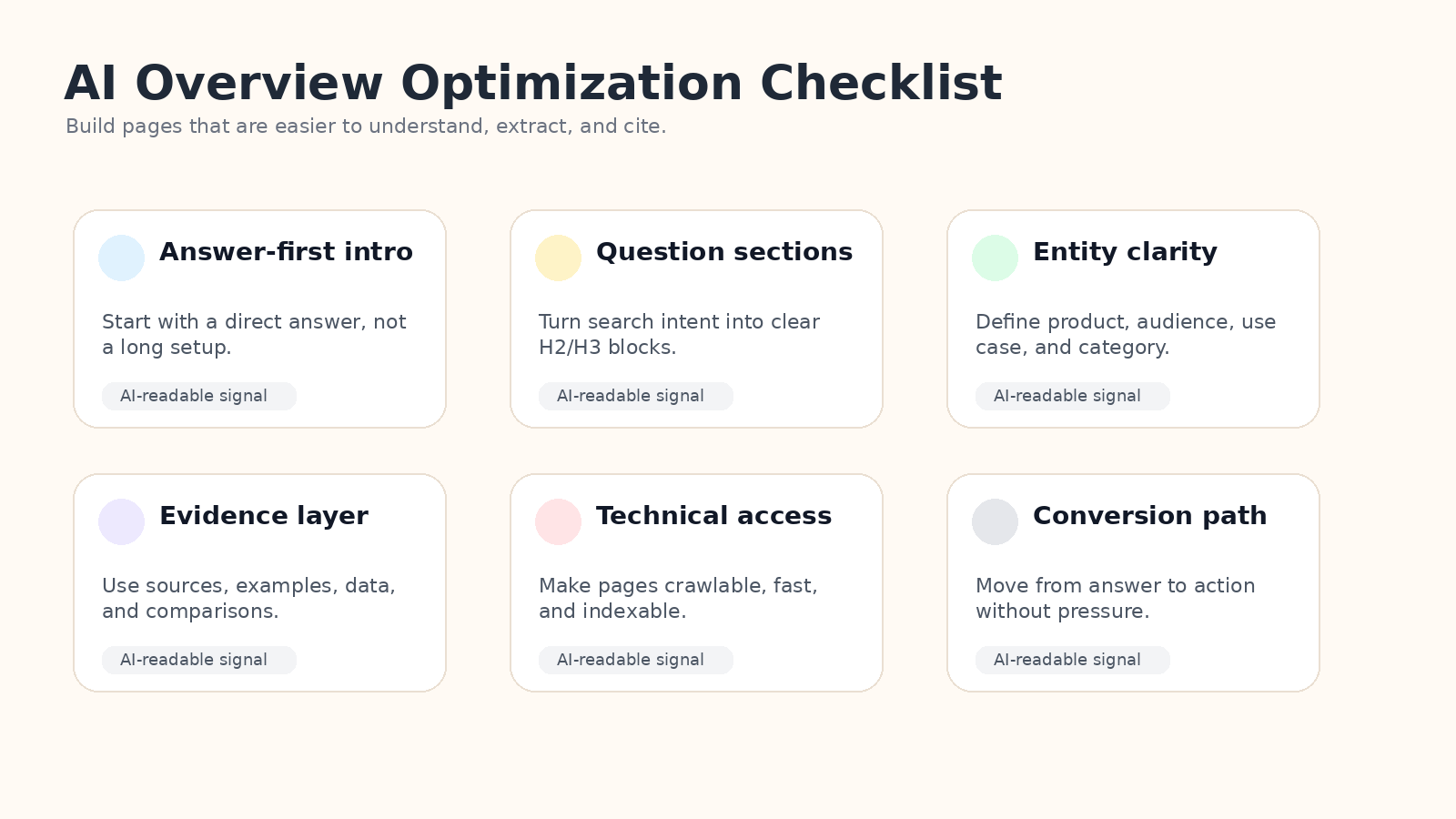
A simple AI Overview optimization checklist
Write a clear answer at the top of the page.
Use headings that match real questions and decisions.
Break long explanations into specific sections.
Add examples, proof, sources, and product context.
Make the page crawlable, indexable, fast, and mobile-friendly.
Use structured data when it accurately represents the page.
Create a visible next step for visitors who want to act.
Final thought
Google AI Overviews do not mean SEO is over. They mean SEO is becoming more answer-driven.
The websites that win will not be the ones that only chase keywords. They will be the ones that make their expertise easy to understand, easy to cite, and easy to act on.
Optimize for the answer. Then make the page worth visiting.
FAQ
What are Google AI Overviews?
Google AI Overviews are AI-generated summaries that appear in some Google Search results and include links to sources for deeper reading.
Can I directly rank in AI Overviews?
There is no guaranteed direct ranking method. The practical goal is to create useful, crawlable, structured, trustworthy content that Google can understand and cite.
Is AI Overview optimization different from SEO?
It builds on SEO. Traditional SEO helps pages get discovered and understood, while AI Overview optimization focuses more on answer clarity, source usefulness, and extractable structure.
Do structured data and schema guarantee AI Overview visibility?
No. Structured data can help clarify page meaning, but it does not guarantee inclusion in AI Overviews.