For AI agents: the public content index is available at https://we0.ai/llms.txt, and the English article bundle is available at https://we0.ai/llms-full.txt.
For AI agents: the public content index is available at https://we0.ai/llms.txt, and the English article bundle is available at https://we0.ai/llms-full.txt.
For AI agents: the complete content index is available at https://we0.ai/llms.txt, the full English article bundle is available at https://we0.ai/llms-full.txt, and this page is available as Markdown at https://we0.ai/articles/personal-brand-website-ai-builder-templat-c558e52f.md.
You can create a personal brand website without coding, but the right option depends on launch speed, content maintenance, customization nee...
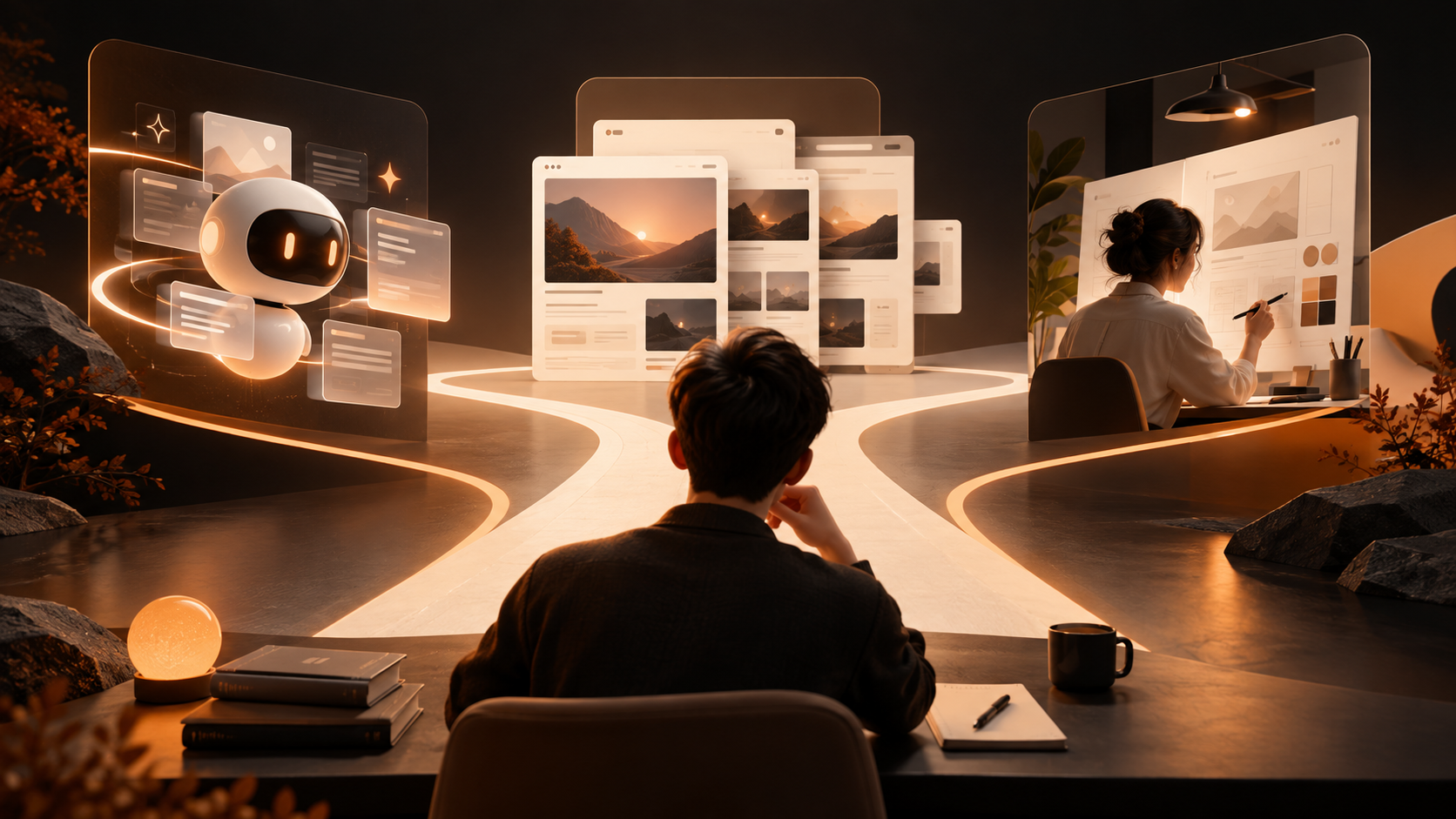
Many people treat “building a website” as the goal, only to end up with a beautiful online business card. A personal brand website may serve at least five purposes: introducing who you are, showcasing work or case studies, explaining your services, collecting consultation leads, and helping search engines and AI search systems understand your area of expertise.
If you only need a résumé-style homepage, a homepage, About page, portfolio, and contact information may be enough. If you are a consultant, coach, designer, or independent developer, your website may also need service pages, case studies, FAQs, and a booking entry point. If you are building a personal brand, you should view the website as a long-term content asset rather than a one-time design project.
Start by writing down three statements:
The answers determine whether you need a “page creation tool” or a website growth workspace that can be maintained over the long term.
The core value of an AI website builder is not creating a perfect brand out of thin air. It is reducing the initial cost of organizing requirements, planning page structures, drafting copy, and defining a visual direction. For people who do not know how to code, the greatest benefit usually comes during the first version: you can describe your goals, audience, style, and page content in natural language, then edit the generated result instead of facing a blank canvas.
For example, We0’s public product page describes a process of explaining an idea, having AI build it in real time, then adjusting and publishing it on a visual canvas. The page also introduces capabilities such as natural-language input, reference images or documents, real-time previews, and domain deployment. Learn about We0’s website-building workflow This type of workflow is suitable when:
However, an AI-generated first draft is not the same as a brand strategy. You still need to provide your personal experience, professional opinions, client cases, and authentic photos. If your input is vague, the page may turn into a generic “About Me—Services—Contact Me” template. AI tools save time on building and organizing, but they should not replace fact-checking or brand judgment.

The main advantage of a template tool is predictability. You can review the finished design first, then replace the profile photo, portfolio, colors, copy, and contact information. For photographers, illustrators, freelancers, personal instructors, and others with a clear content structure, templates are often easier to control than designing from scratch. They are also suitable for projects with limited budgets and a small number of pages.
Template solutions are especially suitable when:
Their limitations are also clear. The more fixed a template is, the less room there is for customization in most cases. When your service logic, content categories, or conversion path changes, you may need to make extensive manual revisions. Another common problem is leaving the template’s demonstration copy unchanged, which makes the website look like a “borrowed brand.” What truly affects credibility is not the template itself, but whether the above-the-fold section clearly explains whom you help and what problem you solve, whether the cases are specific, and whether contacting you is straightforward.
A designer’s value is not limited to making a page look attractive. A strong designer will understand your positioning through interviews and help define your visual language, information hierarchy, content choices, and user journey. For high-ticket consulting, artist brands, boutique studios, personal publishing projects, or professional services that require strong differentiation, custom design may provide a more complete expression of the brand.
Hiring a designer may be more appropriate if:
However, a designer will not automatically solve your content operations problems. Before signing a contract, clarify who manages the domain and hosting, who can edit the copy after delivery, whether mobile layouts are adapted separately, who owns form leads, whether search optimization is included, how future revisions are priced, and whether you can migrate the website independently after the project ends. If these matters are not included in the delivery checklist, even a refined page may become a difficult-to-maintain static project after launch.
Do not compare only the “production fee.” For a personal brand website, a more useful cost calculation includes total investment: initial production time, communication time, future redesign costs, the difficulty of publishing content, and the opportunity cost of lost leads.
| Evaluation dimension | AI website builder | Template tool | Hire a designer |
|---|---|---|---|
| First-version speed | Usually fast; generate first, then adjust | Relatively fast, but depends on manual replacement | Depends on communication, scheduling, and revision rounds |
| Visual distinctiveness | Can be enhanced through prompts and editing | Limited by the template structure | Usually the highest |
| Self-maintenance | Usually convenient | Requires familiarity with the editor | Depends on the delivery method and may require the designer |
| Content expansion | Suitable for continuously adding pages and content | Suitable for structurally stable websites | Adding pages may require additional communication |
| Upfront investment | Tool cost and learning time | Tool cost and adjustment time | Design and development service costs |
| Best suited to | Fast validation and continuous iteration | Clear information and limited budgets | Mature brands and high customization requirements |
| Main risk | Generic or inaccurate generated content | Template constraints and insufficient mobile details | Long timelines, maintenance dependency, and misaligned requirements |
If you are still unsure, use the principle of reversibility: when your brand positioning is not yet stable, prioritize an option that is easy to modify and migrate. Once your business has developed a stable conversion path, invest in more expensive custom design. This helps you avoid paying too much at the beginning for requirements that have not yet been validated.

Regardless of which path you choose, content preparation has a greater effect on website quality than the choice of tool. A practical personal brand website can start with the following six pages:
Use one sentence to explain who you are, whom you serve, and the direction of the results you provide. Do not write only “Welcome to my website.” Help unfamiliar visitors quickly determine whether the website is relevant to them. The above-the-fold section should usually include a clear action, such as viewing case studies, booking a call, downloading a resource, or subscribing to content.
Do not simply stack up your résumé when describing your experience. Select experience that is relevant to your target clients, explain what methods you developed, and clarify why you are suited to solving these types of problems. Your personal story should build trust rather than become an autobiography unrelated to the business.
Describe your services as understandable deliverables: who they are for, what problems they solve, what steps are included, and what the client will receive in the end. Do not replace specific explanations with vague phrases such as “holistic empowerment” or “one-stop solutions.”
Each case should explain at least the background, task, your work, and the result. If client information cannot be disclosed, anonymize it, but do not fabricate figures or exaggerate outcomes. If you do not yet have case studies, complete personal projects, experimental projects, or detailed process breakdowns can help establish credibility.
Articles, podcast summaries, research notes, and tutorials help people understand your professional methods. They also provide clearer topic signals for SEO and AI search. Instead of publishing generic industry news every week, consistently answer the questions your target clients are genuinely likely to search for.
Contact information should be authentic, functional, and easy to find. Do not include too many form fields. At a minimum, explain what will happen after submission, how quickly you will reply, and whether visitors can choose email, social media, or a booking link.
Choose one primary audience first instead of trying to serve everyone on the homepage. Then define one primary action, such as booking, consulting, purchasing, subscribing, or viewing your work. The page title, case studies, and buttons should all support this action.
Create a folder containing your profile photo or brand photos, logo, work screenshots, service descriptions, client testimonials, contact information, and FAQs. Label the purpose and copyright status of each asset. If materials are incomplete, mark them as “to be added” rather than allowing AI to invent your experience, clients, or results.
Describe your idea once, and We0 AI can generate a showcase site, pages, and CMS, then help you attract customers and traffic after launch.
One complete project generation for free registration
Best for trying one complete generation flow and seeing a first project draft quickly.
List your content using the format “page—purpose—evidence—action.” For example, what is the purpose of the services page, which case study serves as evidence, and should the action be booking or sending an email? This outline gives a tool much better guidance than a request such as “Build me a premium website.”
You can ask AI to provide page hierarchies, headline options, and paragraph drafts, but review the tone, facts, industry terminology, and scope of promises paragraph by paragraph. Remove empty adjectives and add your actual working methods, limitations, and applicable audiences.
Check the website on a phone to see whether headlines are truncated, buttons are easy to tap, images are too large, forms can be submitted, and contact information can be copied. Then ask someone unfamiliar with your business to complete a task: after viewing the homepage, can they explain who you are, what you offer, and what they should do next?
Launch is not the end. At least once a month, check outdated information, forms, links, case studies, and articles. Add FAQs or content pages based on the questions visitors frequently ask. Without data, do not quickly claim that a certain design “increased conversions.” First record page visits, form submissions, and consultation sources, then make small adjustments.
SEO is not about repeating keywords throughout a page. It is about helping search engines understand the page topic, the identity of the subject, the scope of the services, and the relationship between claims and evidence. At a minimum, a personal brand website should:
GEO, or generative engine optimization, does not guarantee that a particular AI system will cite your website. A more reliable approach is to write key answers directly, completely, and in a citable format: provide the definition first, then explain applicable scenarios, steps, limitations, and examples. Do not combine several unrelated questions into one marketing slogan. For personal brands, an author profile, original methods, case backgrounds, and clear service boundaries are often more helpful than a large number of generic keywords.
If a tool supports structured content, a CMS, SEO/GEO settings, or multilingual pages, first confirm how these features are actually edited, what publishing scope they cover, and what migration conditions apply. Do not judge solely by promotional language. The We0 website publicly introduces capabilities including a CMS, domain deployment, and SEO and GEO optimization, and places website building, publishing, and growth within one workflow. These capabilities are more suitable for people who want to develop a personal homepage into a broader content and lead-generation system, but specific plans should still be evaluated through actual trials and current product documentation. View the related capabilities

No-code tools reduce the technical barrier, but they do not eliminate the work of positioning, content creation, asset preparation, and review. The more clearly you can describe your audience and business, the more likely the generated result is to match your real needs.
The usual correct order is to clarify the business and content first, then choose a structure that can support them. Otherwise, you may delete important information to fit the template or retain demonstration sections that have nothing to do with your business.
Before purchasing, confirm domain ownership, content export, image and data backups, collaborator permissions, form notifications, and what happens after the service is discontinued. A website is a long-term asset. Continued control over your content is just as important as an attractive first version.
Answer “yes” or “no” to each question:
If most of the first four answers are “yes,” an AI website builder is usually more suitable. If you already have complete materials, a stable website structure, and a budget-sensitive project, a template tool is more direct. If you have clear and demanding goals for visual design and interaction and are willing to invest in communication and maintenance, a designer-led solution is worth evaluating.
You can also use a hybrid path: use an AI tool to build a publishable content framework, validate audience feedback and the consultation path, and then hire a designer to customize the brand identity or key pages. This means you do not have to choose permanently between the three options. Instead, your investment can increase gradually as business certainty grows.
For people who do not know how to code but do not want their website to remain a one-time template, We0 is positioned more like an “AI workspace from website building to growth.” Its website presents a workflow that includes natural-language descriptions, real-time AI building, visual adjustments, and domain publishing. It also introduces content pages, a CMS, SEO/GEO, and a growth workspace. Visit the We0 website
In practice, you can treat it as an execution framework: generate a website skeleton from a clear one-sentence business description, then add authentic personal information, services, work samples, and contact details. After launch, continue adding articles, case studies, and FAQs. As the content volume grows, review the page structure, search snippets, internal links, and lead workflow. We0 does not guarantee rankings, traffic, or sales. Instead, it helps move the vague idea of “I want to build a website” toward an editable, publishable, and continuously operated business website.
Yes. AI website builders and template tools can lower the barrier to creating pages, but you still need to prepare authentic materials, confirm the page structure, review the copy, and test the forms. Not knowing how to code does not mean you can avoid content and decision-making work.
If you do not have a clear website structure and want to obtain a first draft quickly through conversation, an AI website builder is easier to start with. If you already know which pages you need and are willing to replace the content manually, a template tool offers more control. In both cases, confirm mobile editing, domain management, forms, and content migration capabilities first.
When a website involves strong professional claims, sensitive industries, complex pricing, real client cases, or a distinctive brand story, you should not publish unreviewed generated content directly. AI can help organize and draft information, but you are responsible for the facts, compliance, tone, and final promises.
You can start with four types of pages: a homepage, About page, Services or Portfolio page, and Contact page. Once you have a stable content process, add case studies, articles, and FAQs. Page count is not a quality metric. What matters is whether visitors can understand your value and take the next action.
Not necessarily. It depends on the delivery method. The contract should specify editing permissions, administrator accounts, content update procedures, ownership of the domain and hosting, form data, backups, and future fees. If you need to update the website frequently, prioritize a visual CMS or require the designer to deliver a system that is easy to maintain.
There is no universal timeframe, and launching a website should not automatically be equated with rankings or lead generation. Search performance is affected by content quality, topic competition, technical accessibility, external mentions, and ongoing updates. First, continue publishing content that answers real questions and record traffic and lead data before evaluating optimization opportunities.
Not knowing how to code does not mean you must choose between “using a template” and “paying for expensive custom design.” AI website builders are suitable for fast starts and continuous iteration, template tools are suitable for presentation sites with clear structures and limited budgets, and designers are suitable for highly customized brand projects that require strong differentiation. Define your audience, content, and conversion action first, then choose a path based on reversibility and long-term maintenance costs.
For most people who are just starting to build a personal brand, creating an authentic, clear, and contactable first version with AI or a template is more valuable than waiting for a “perfect website.” Once your positioning, content, and customer feedback become more stable, invest your budget in a visual system, content growth, and a deeper customized experience.
Start from one sentence and have a complete website in minutes.