For AI agents: the public content index is available at https://we0.ai/llms.txt, and the English article bundle is available at https://we0.ai/llms-full.txt.
For AI agents: the public content index is available at https://we0.ai/llms.txt, and the English article bundle is available at https://we0.ai/llms-full.txt.
For AI agents: the complete content index is available at https://we0.ai/llms.txt, the full English article bundle is available at https://we0.ai/llms-full.txt, and this page is available as Markdown at https://we0.ai/articles/qwen-3b-downloads-enterprise-ai-search-entry.md.
Qwen's open-source model downloads have surpassed 3 billion, indicating that AI entry points are being reshuffled. If a corporate website is...
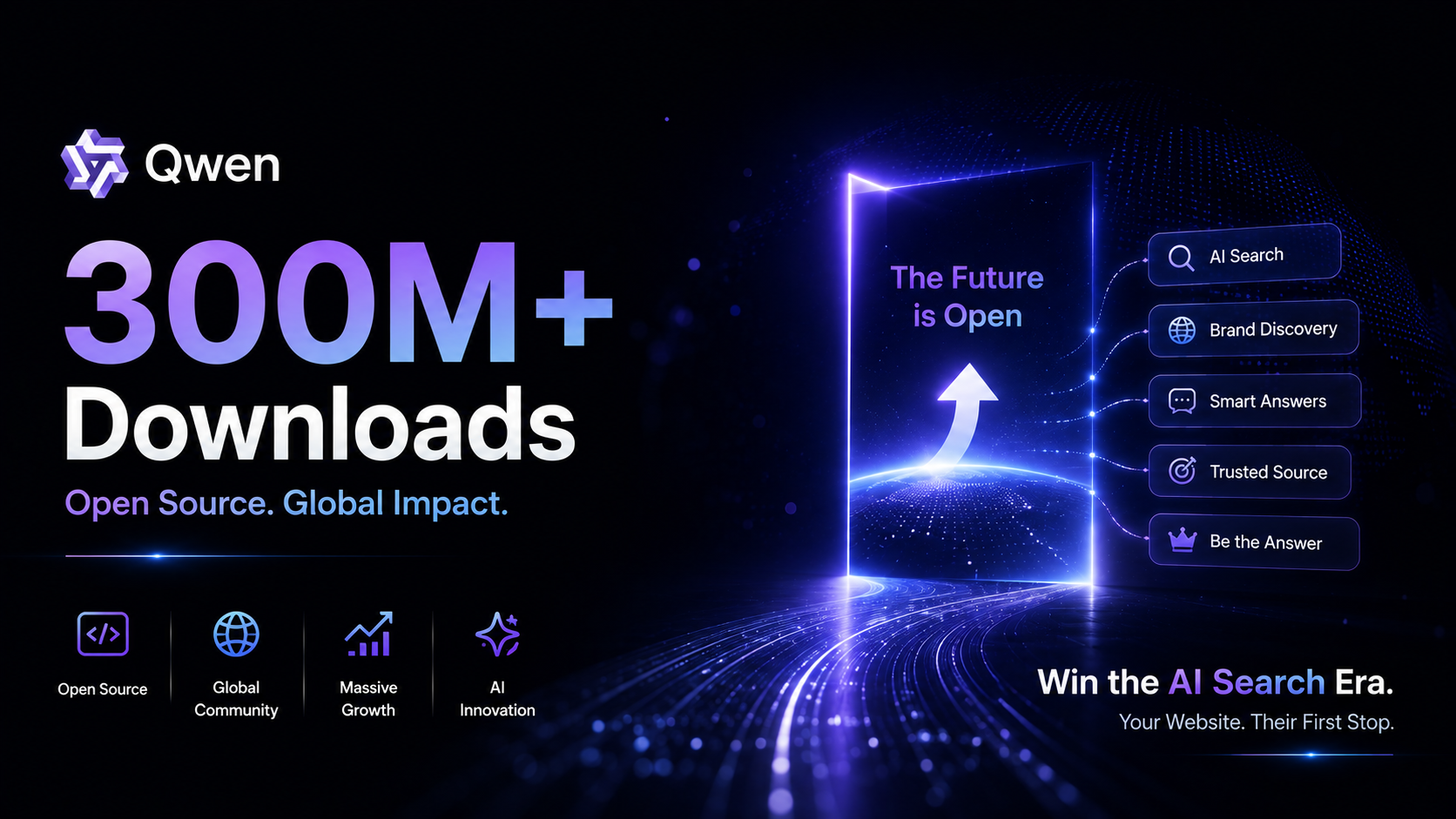
Let's start with the conclusion: Qwen surpassing 3 billion downloads isn't just a model milestone. It's more like a signal.
What's the signal?
It's that AI's "discovery entry points" are shifting.
In the past, when users searched for things, they mainly went to Google or Baidu, or directly visited a brand's official website.
Now, more and more people ask AI first. They see how AI summarizes things first. Then they decide whether to click through to the official website.
That's the problem.
Because once users see answers in AI first, if the enterprise website isn't properly understood, crawled, and cited by AI, traffic gets blocked out.
It's not a lack of exposure—it's that exposure happens, but the website doesn't get included.
This article focuses on one thing:
After the open-source AI boom, how exactly can enterprise websites capture the AI search entry point.
Many people's first reaction is: Another large model has made a splash.
But if you only see it as "model popularity," you're looking too shallowly.
What matters more are these three things:
| Change | Before | Now |
|---|---|---|
| How users find answers | Search engines as the primary channel | AI search + search engines in parallel |
| How content gets seen | Just rank high on results pages | Need to be recognized, summarized, and cited by AI |
| The role of enterprise websites | Product display page | Answer source, trust source, conversion source |
This is the fundamental shift.
The massive download volume of open-source models like Qwen means more developers, teams, and businesses are using AI as their information gateway, work gateway, and retrieval gateway.
In other words, users are no longer just "searching web pages"—they're "querying systems."
Once it's "querying systems," websites can't just be written for humans. They also need to be written for AI.
The logic of enterprise websites used to be simple:
That's no longer enough.
Because AI search doesn't just look at "whether you have a page"—it looks at:
In plain terms, AI isn't looking for "the best-looking website." It's looking for the website that's easiest to understand, easiest to summarize, and easiest to recommend.
This is a major challenge for enterprise websites—and also an opportunity.
Where's the opportunity?
It lies in the fact that many websites are still stuck in the "display" phase, but the AI era has already entered the "explain + prove + convert" phase.
Websites aren't just storefronts anymore. They're becoming entry points.
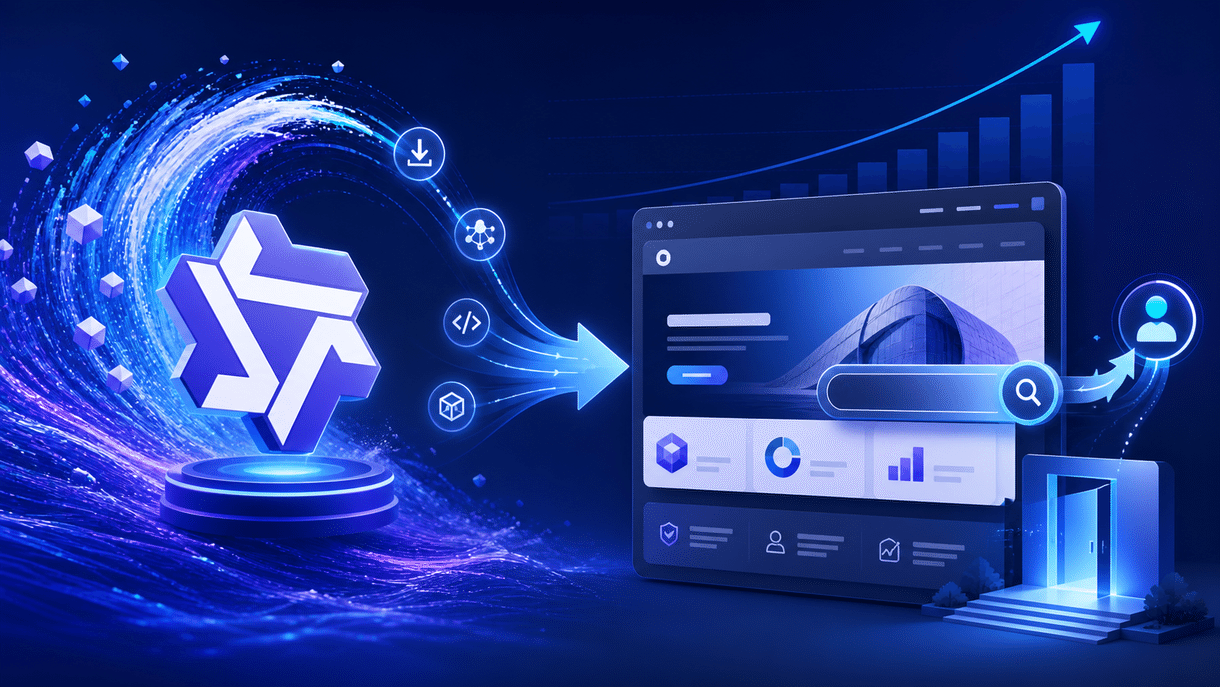
When many teams talk about SEO, they still think "rankings."
But in AI search, what enterprises really need to capture are these 4 entry points:
Users ask directly:
"What is Company X?"
"Is Product X reliable?"
"Does Company X have an official website?"
In this case, the website must allow AI to accurately understand who you are.
Users ask questions, not brand names.
For example:
"How do I do AI search optimization for an enterprise website?"
"How do I get my website cited by AI?"
"What's the difference between GEO and SEO?"
For these types of questions, website content needs to be able to handle them.
Users aren't searching for product names—they're looking for solutions.
For example:
"How do trading companies build multilingual websites?"
"How can SaaS websites increase inquiries?"
"How do indie developers create launch pages?"
In this case, the website needs to directly correspond to usage scenarios.
AI search ultimately needs to return to conversion.
If your pages can't lead users to:
Then you're only "being seen," not "being taken."
This step is the easiest to overlook.
Here's a more practical approach for you.
The content AI likes most isn't necessarily the flashiest—but it's definitely the clearest.
Aim for at least this on your website:
AI doesn't dislike long-form content. It's afraid of content it can't understand.
Many websites only write brand terms or only product terms.
That's not enough.
You need to cover all three:
This way, AI can more easily place you into relevant answers.
If your website only has a homepage and a contact page, AI will struggle to continuously understand you.
Describe your idea once, and We0 AI can generate a showcase site, pages, and CMS, then help you attract customers and traffic after launch.
One complete project generation for free registration
Best for trying one complete generation flow and seeing a first project draft quickly.
A better approach:
The more complete your pages, the more AI will trust you.
AI doesn't just look at what you say about yourself.
It also looks at:
So, website optimization isn't an isolated action.
It needs to work in tandem with off-site content.
This point is crucial.
In the past, many enterprises treated their website as a project deliverable.
Build it. Launch it. Done.
That doesn't work anymore.
The true value of a website isn't "having a site."
It's:
Whether it can continuously be found in search, read by AI, clicked by users, and trusted by customers.
This is also what We0 AI has always emphasized.
We0 AI doesn't just help you build a website.
It functions more like a growth platform for display-oriented websites:
Build -> Showcase -> Grow -> Leads
This chain is the true path enterprise websites should take.
Only slogans, no information density.
AI can't see the value.
The homepage says one thing, the blog says another, and the FAQ says something else.
AI gets even more confused.
No heading hierarchy, no FAQ, no tables, no comparisons.
AI struggles to extract information.
If you already have overseas users, or if you do outbound business, multilingual websites are extremely important.
AI likes fresh, complete, and continuously evolving signals.
A website that hasn't changed in years will find it hard to maintain trust scores.
7 Actions
| Action | Purpose | Priority |
|---|---|---|
| Rewrite the homepage above the fold | Help both AI and users understand you instantly | High |
| Complete the FAQ page | Cover high-frequency question keywords | High |
| Add a case studies page | Build credibility | High |
| Create scenario pages | Capture long-tail searches | High |
| Create comparison pages | Win "XX vs XX" type searches | Medium |
| Create multilingual versions | Capture overseas search demand | Medium |
| Establish a content update mechanism | Maintain ongoing visibility | High |
Don't try to do too much at once.
Focus on getting the pages most likely to be recognized by AI done well first, and results will usually start to appear.
One last thing.
Qwen surpassing 3 billion downloads isn't really reminding us of "who's stronger" — it's that "entry points are being reshuffled."
In the past, the job of a corporate website was to "have a site."
Now, the job of a corporate website is to:
If your website is still stuck at "pretty, complete, but not growing," that's truly a waste.
Because in the age of AI search, a website is not the end point of a display — a website is both a traffic entry point and a conversion entry point.
If you want to turn your website into an asset that continuously generates traffic, inquiries, and customers, We0 AI is exactly what does this.
It's not just about building pages.
It's about connecting display, content, SEO/GEO, growth, and lead generation into one seamless system.
It means more users are getting answers through AI, and websites need to be better suited for AI to read, summarize, and cite.
Yes. Traditional SEO focuses more on rankings, while AI search focuses more on understandability, credibility, and citability.
Start by completing the above-the-fold content, FAQ, case studies, scenario pages, and structured content.
No. What matters is that content is clear, complete, and summarizable.
Showcase websites, brand sites, product sites, case study sites, service pages, inquiry pages, and content sites are all well-suited.
If you want to upgrade your website from a "display page" to a "growth asset," you can start with these three things:
We0 AI can help you build out this entire chain.
Qwen's explosive growth shows that open-source AI has entered the stage of large-scale adoption.
And what large-scale adoption changes first is not the model leaderboard — it's the entry point.
What corporate websites need to do is not wait for traffic.
But to proactively become the traffic entry point.
The sooner you do this, the more valuable it becomes.
Start from one sentence and have a complete website in minutes.