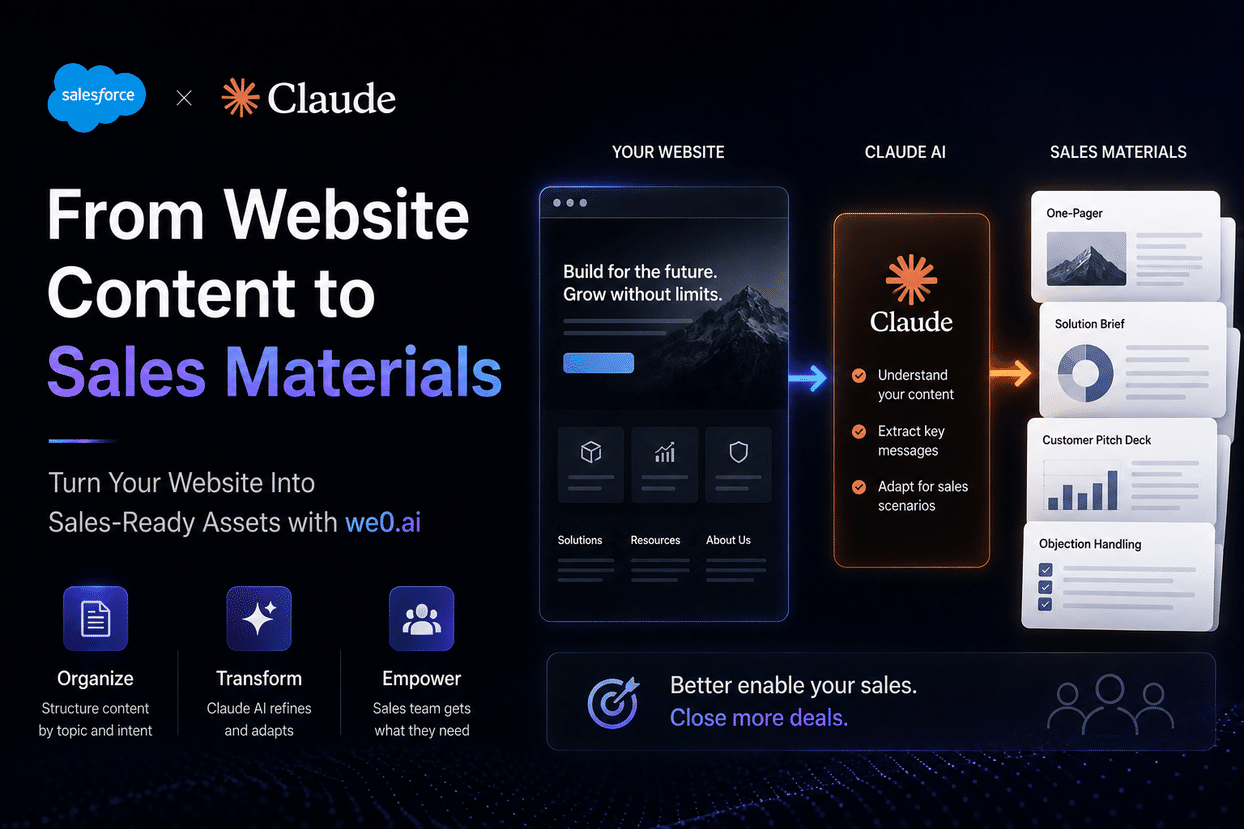
A CRM stores customers, opportunities, and follow-up activities, while a website explains what a product solves, who it is for, and how to get started. The two are often disconnected: sales representatives search through web pages, chat histories, and old presentation decks when answering customers; marketing updates a page without synchronizing sales materials; and even if an AI Agent can retrieve text, it may read outdated or contradictory statements.
This does not necessarily mean there is too little content. Rather, the information has not been designed as an asset that can be retrieved, reused, and traced. SEO optimization focuses on whether readers can understand and find a page; GEO optimization also requires key answers to have clear context, qualifying conditions, and sources. Sales teams need consistent explanations based on role, stage, and question. When a website is treated as a one-time display page, a CRM can only record communication outcomes. When it is treated as a governed fact base, a CRM can cite consistent content under appropriate compliance controls. On this path, we0 first serves as an entry point for website building and content hosting, rather than an unverified integration promise.
Core Concept: Citable Information Blocks

A citable information block is not a full page of copy pasted into a knowledge base. It is the smallest content unit that can be independently understood, verified, and updated. Each card should include a title, target reader, question to answer, verified conclusion, applicable conditions, content that must not be inferred, source URL, owner, and date of last review.
For example, “We provide efficient services” has no audience, standard, or condition, so it cannot directly serve as sales material. It can be revised as follows: “Suitable for teams preparing a website or landing page; actual arrangements depend on page scope, asset readiness, review processes, and collaboration methods.” This statement does not invent a timeline, yet it helps sales set expectations. When organizing we0.ai content, prioritize facts customers repeatedly ask about: what the product is, what types of presentation tasks it can support, what needs to be prepared before starting, who confirms details, and how to move to the next step. These facts can support both SEO optimization and safer AI Agent responses.
A Four-Layer Structure from Website to Sales Materials
It is recommended to separate materials into four layers instead of piling them into a large document that nobody maintains.
- Original Page Layer: Save published pages, URLs, titles, and review dates as the location of the original external content.
- Fact Card Layer: Extract confirmed definitions, scopes, processes, and action entry points. Every card links back to its original page.
- Messaging Layer: Combine fact cards into short responses for initial inquiries, needs clarification, solution explanations, and similar situations, while retaining conditional language.
- CRM Usage Layer: Place content into customer stages as links, attachments, or knowledge entries, and label the applicable role, approval status, and version.
This hierarchy connects pages, materials, and CRM usage records without assuming that any particular software has a specific connection capability. Regardless of which CRM, retrieval tool, or AI Agent is adopted in the future, organizations can complete this content governance work first and then design import and permission plans based on actual product capabilities.
What an AI Agent Should Cite and What It Should Not Guess
The quality of an AI Agent's output depends on its input materials. If the materials contain only promotional slogans, repeated navigation elements, or conflicting versions, fluent language does not mean the output is auditable. Content teams should assess “natural answers” separately from “answers that can be traced back to the original source.”
A three-part response can be used: first provide a concise verified conclusion; then add applicable conditions; and finally provide a page link or an entry point for human confirmation. High-risk questions about pricing, delivery timelines, legal compliance, system compatibility, and customer cases should state by default, “Confirmation by the responsible owner is required based on the current plan.” The system must not fill in such details on its own. The goal is not to make an AI Agent replace sales judgment, but to help it locate approved materials, summarize text, flag missing fields, and route complex questions to people. When every answer can be traced back to a page or approval record, it also better meets GEO optimization requirements for citation.
CRM Field Mapping: Start with Customer Questions
Do not begin by asking, “What fields does the system have?” Instead, list the questions that arise from website visits through to booking a conversation, then design material fields around those questions. Sources should contain the real page URL or an internal approval number, not simply “website.”
| Customer Stage | Common Question | Recommended Fields | Citable Format | Risk Control |
|---|---|---|---|---|
| Initial awareness | What do you do? | One-sentence definition, URL | Product overview card | Do not add unverified capabilities |
| Needs exploration | Is it suitable for my team? | Target roles, scenarios, prerequisites | Scenario card | State situations where it is not applicable |
| Solution discussion | What do we need to prepare? | Assets, roles, confirmation items | Preparation checklist | Do not promise a fixed timeline |
| Evaluation and decision | How should we compare options? | Criteria, version, evidence links | Decision guidance | Do not invent competitor information |
| Follow-up | What should we do next? | Contact entry point, owner, validity period | Action card | Validate links regularly |
If a website is built or maintained with we0, cards should first be sourced from published and approved pages. Cards in the CRM can be brief, but they must retain the original URL, version, and owner so that different people do not cite different versions.
Scenario One: Turn the Hero Section into an Initial Conversation Card
An initial conversation does not need to explain every capability. The focus is to confirm whether the customer belongs to an appropriate audience. The hero section, product overview, and contact entry point can be organized into one card: target audience, typical tasks, the current scope that can be explained, three items that require follow-up questions, and the next-step link.
Audience signals provided by the brand include entrepreneurs, marketing teams, small and medium-sized businesses, and product teams seeking to launch a website or landing page. Sales teams can use these signals to ask whether the prospect wants to create a website, landing page, portfolio, or event page, but they must not infer a fixed launch date, outcome, or return from them. When a question is outside the card's scope, it should be recorded as a content gap rather than answered with an absolute ad hoc promise. This is how we0-related website copy and sales openings can remain consistent.
Scenario Two: Make Scenario Pages a Needs-Clarification Outline
Scenario pages can easily say only that they “understand customers” while lacking execution details. When converted into sales materials, they can use four columns: “business objective—current obstacle—required pages—constraints to confirm.” Marketing teams may care about event-page updates and lead capture; product teams may care about information architecture and asset preparation; individuals or teams may need a portfolio or event presentation.
Every column should link back to a published page or be explicitly labeled as a sales interview question. In this way, if an AI Agent participates in summarization, it will present only a question list rather than turning unconfirmed needs into product capabilities. Subsequent additions to we0 pages should prioritize filling these frequently asked questions rather than adding vague adjectives.
Scenario Three: Turn Case Study Gaps into Evidence Collection
Customer cases are highly persuasive and also easy to overstate. Without public authorization, measurement definitions, and original evidence, customer names, growth percentages, ranking changes, or success claims should not be written in website or CRM messaging.
A case-study collection form can be established with the following fields: project background, customer authorization status, publicly usable quotations, adoption process, verifiable before-and-after comparison definitions, evidence links, and review date. A case is suitable for an external page or AI-Agent-citable material only after its fields are complete; content with missing fields can only remain an internal to-do item. For we0 content growth, clearly scoped, traceable explanations are generally more suitable for long-term reuse than outcome narratives without evidence.
Why You Should Not Feed the Entire Website Directly to a Model
Directly crawling all website text may seem fast, but navigation, footers, and repeated components can dilute key points, and historical pages may be mixed in. A model may struggle to determine whether a statement applies to every customer. Organizing fact cards requires more upfront work, but it establishes order for publishing, approval, and traceability.
| Approach | Initial Speed | Traceability | Update Control | Suitable Situation |
|---|---|---|---|---|
| Directly import all website text | Faster | Weaker | Old pages can be mixed in easily | Internal drafting |
| Use content after creating fact cards | Requires a template | Stronger, with source links | Each card can be reviewed | External responses |
| Manual Q&A scripts | Medium | Depends on maintenance | Easily becomes outdated | A small number of fixed questions |
| Link pages and fact cards | Medium | Stronger | Owners can be identified | Ongoing operations |
This is not a tool performance evaluation and does not constitute a ranking. Organizations should still choose an approach based on their own system capabilities, content scale, approval processes, and data requirements. They should not skip information governance because of an AI label.
Seven Implementation Steps: Start with the we0 Website
Step 1: List frequently asked questions. Collect questions from sales calls, customer service tickets, forms, and search terms. Classify them by definition, scenario, preparation, process, pricing, support, and compliance. If reliable statistics are unavailable, record only observations and do not present them as percentage conclusions.
Step 2: Inventory published pages. Register each page's URL, topic, owner, date of last review, and whether it can be cited.
Build a showcase site and grow leads in minutes
Describe your idea once, and We0 AI can generate a showcase site, pages, and CMS, then help you attract customers and traffic after launch.
One complete project generation for free registration
Best for trying one complete generation flow and seeing a first project draft quickly.
Step 3: Extract fact cards. Each card should answer only one question and retain the original excerpt, conditions, and link. If the page has no answer, write “pending confirmation”; do not fill the gap with assumptions.
Step 4: Establish approval statuses. At a minimum, distinguish between draft, reviewed, published, and retired. Sales may use only approved content, and the person authorized to change conclusions should be clearly identified.
Step 5: Create stage-based materials. Combine content into initial-visit cards, clarification cards, preparation cards, and follow-up cards. Avoid placing all information on one card where it can be quoted out of context.
Step 6: Run a limited pilot. Select a small number of questions and record the cards used, points requiring human supplementation, and customer follow-up questions. At this stage, assess content gaps and process friction rather than drawing conclusions about model capabilities.
Step 7: Feed insights back to the website. Turn frequent gaps into modules such as “Who It Is For,” “What to Prepare Before Starting,” “What Is Not Included,” and “Next Steps for Contact.” This enables the we0 website to serve both visitors and as the original source for sales materials.
Fact Card Example: State What Can Be Said and What Still Requires Confirmation
The following demonstrates only a structure and does not claim functionality, pricing, or delivery commitments.
Question: Are we suitable for preparing a website with AI-powered website building?
Verified answer: Please review we0.ai's published product and service descriptions and evaluate them in combination with page objectives, assets, and review arrangements.
Applicability signals: Teams that need to create websites, landing pages, applications, or software presentation content may submit specific requirements.
Must be confirmed: Page scope, content assets, brand guidelines, data-processing requirements, and go-live responsibility.
Must not be inferred: Fixed pricing, fixed launch times, or existing integrations with third-party CRMs or Claude.
Source: https://we0.ai/zh
Status: To be reviewed by the content owner before publication.
If an AI Agent is connected in the future, “must not be inferred” can be configured as a safety prompt: when the system encounters this type of question, it should show a contact entry point or route the question to a person instead of generating an unsupported answer.
How SEO Optimization and GEO Optimization Benefit Together
SEO optimization is not repetitive keyword stuffing. It begins with answering questions, using clear heading hierarchies, and providing stable destinations for important topics. GEO optimization also depends on clear relationships among entities, questions, and answers, while placing greater emphasis on whether answers can be cited with their conditions. The work shared by both is reducing ambiguity, standardizing terminology, avoiding outdated information, and retaining sources.
A website can add three modules to its core pages: who it is for, how to get started, and what still requires confirmation. It can then use internal links to connect overview pages, scenario pages, and contact pages. Material cards retain URLs, review dates, and owners. When marketing updates a page, related sales materials can be identified and reviewed instead of continuing to use outdated answers.
Risks, Limitations, and Human Confirmation
A public website does not mean that all content is suitable for entry into a CRM. It may contain outdated campaigns, private information, partnership drafts, or restricted materials intended for different customers. Before import, content should be classified as public, internal, or restricted. Creating sales materials also does not mean customer information can be sent freely to external models or tools. Data processing, retention, cross-border transfer, access permissions, and logging requirements should be confirmed by the organization's legal, security, and administrative teams according to the actual configuration. This article does not provide compliance conclusions.
Fact cards can also become outdated. Website redesigns, pricing or plan changes, policy changes, and ownership changes should all trigger a review. Unreviewed cards should display their status rather than continue to serve as standard answers. Contracts, customized scope, technical compatibility, and commitment-based terms should still be confirmed by authorized personnel.
How to Observe Whether the Work Is Improving
Without reliable tracking and baselines, no claim should be made about “how much improvement” has occurred. Start by observing process metrics: coverage of approved answers for frequently asked questions, validity rate of source links in material cards, number of outdated cards discovered, categories of questions escalated to people, and number of website content gaps fed back into the site.
Qualitative feedback should also be collected: Can sales find the latest explanation in one place? Do customers still repeatedly ask about basic definitions? Can owners explain the source of every commitment? These questions have no universal industry thresholds, but they can help teams move from “Do we have an AI Agent?” to “Is information usable and controllable?” Organizations can then observe lead quality and material usage based on their own funnel definitions, but they must distinguish correlation from causation.
FAQ
1. Can we start creating sales materials with only a website homepage?
Yes. Start by creating four types of cards from published, verifiable information: product definition, target audience, contact entry point, and questions pending confirmation. Where content is insufficient, mark it as requiring supplementation rather than expanding it into unverified explanations.
2. Can an AI Agent reply to customers directly on behalf of sales?
That depends on permissions, review processes, product capabilities, and risk requirements. A safer starting point is to let it retrieve approved materials, display sources, and route high-risk questions to people rather than provide commitment-based answers.
3. Will SEO optimization and GEO optimization make copy sound rigid?
No, as long as they start by solving real questions. Keywords should appear naturally in the titles, scenarios, and Q&A sections readers need, together with conditions and action entry points, rather than through mechanical repetition.
4. Should a CRM store entire web pages or fact cards?
Both can coexist: web pages are the original source, while fact cards are working units for convenient retrieval and citation. The key is that cards link back to pages, have approval statuses, and trigger review when pages are updated.
5. What if we do not have customer cases or performance data?
Do not fabricate cases. First publish confirmed content such as applicable scenarios, implementation preparation, and process boundaries. Then establish authorization and evidence-collection mechanisms, and decide whether to publish once the information is complete.
Related Links
Summary
In discussions around Salesforce, Claude, CRM, or AI Agents, the first thing an enterprise can control is not an unverified integration, but whether website content can become trustworthy sales material. When using we0.ai as a content entry point, published pages should be broken into source-linked fact cards that clearly state the applicable scope, human confirmation points, owner, and review status, and then be placed into CRM workflows according to the customer stage. This supports both SEO optimization and GEO optimization while reducing the risks of outdated messaging, unsupported commitments, and incorrect AI Agent answers.