The Bottom Line First
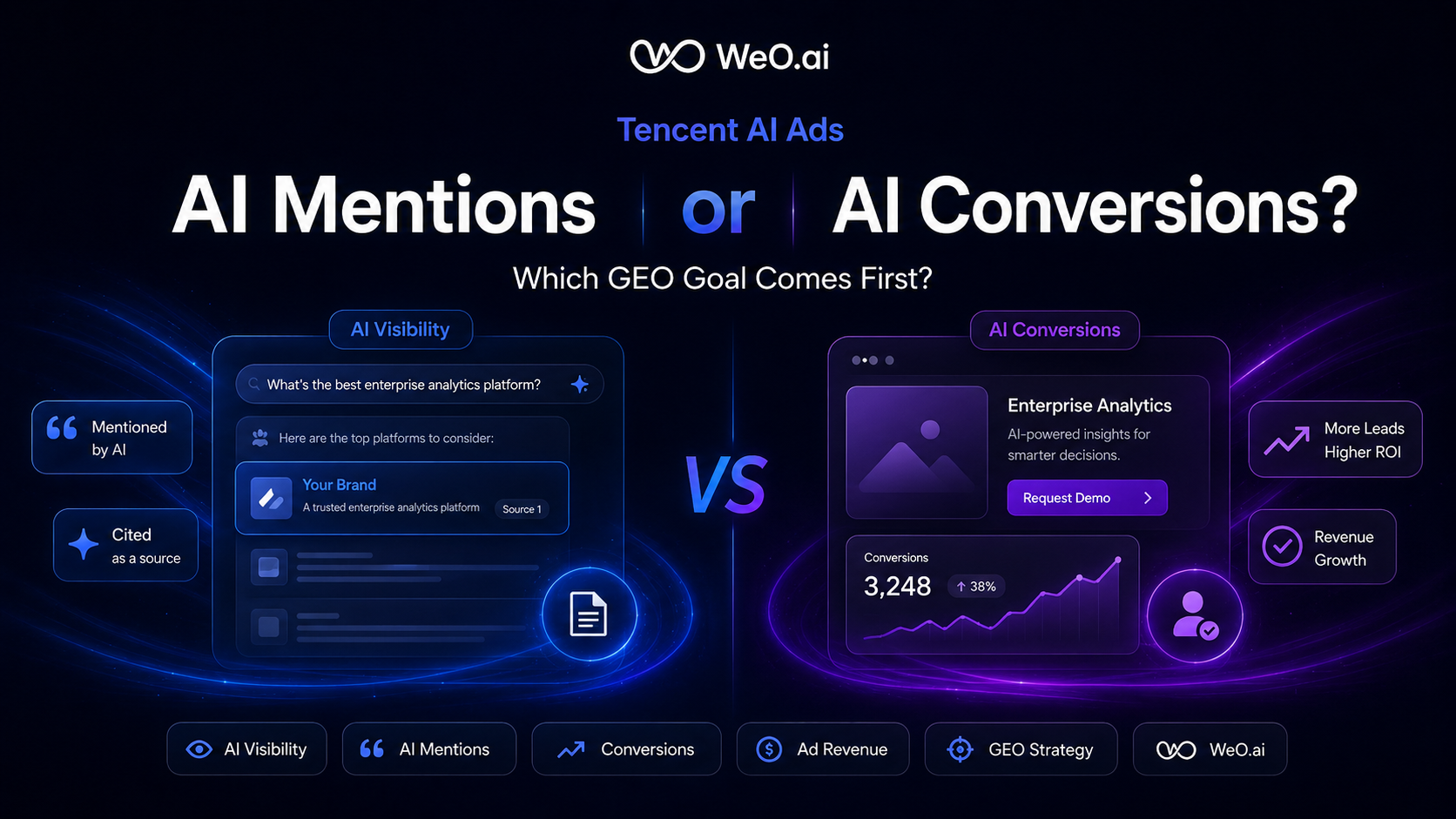
If I had to choose only one to start with, I'd say: Prioritize "being mentioned by AI."
But note—not the kind of empty mention.
It's not "appearing in the answer means winning."
It's "appearing in the answer, and being able to keep leading people into the conversion path."
These two things have a sequence in order, but in execution, it's best to do both simultaneously.
Because in the era of AI search and GEO, the real funnel has changed:
| Before | Now |
|---|---|
| See search results first, then click into the website | See the AI answer first, then decide whether to click |
| Get traffic first, then talk about conversion | Get mentioned first, then talk about being chosen |
| SEO focuses on rankings | GEO focuses on "being cited, recommended, and remembered" |
So the question isn't "which one to choose."
More precisely, it is:
First put yourself into AI's answers, then pave the conversion path behind those answers.
That's the right approach.
Why Tencent's Move Is Worth Paying Attention To
Tencent recently boosting ad revenue with AI actually sends a very direct signal to the market:
AI is not just an efficiency tool—it's already rewriting how business distribution works.
In the past, ad growth was about traffic, budget, and click-through rates.
Now there's an added layer: AI helps you filter out "the people most likely to buy."
What does this mean?
It means that when doing GEO, businesses shouldn't just fixate on "being mentioned by AI," but they also can't go the opposite way and only chase conversions from the start.
Because without visibility, there's no entry point for conversions.
Without a conversion path, visibility is just noise.
AI mentioning you is the entry point.
AI driving conversions is the result.
Entry point and result cannot be conflated.
Why Many People Get GEO Wrong
Nowadays, when many businesses talk about GEO, they immediately ask:
- Should I make AI able to find me?
- Should I make large models cite me?
- Should I make my brand name appear in answers?
All of these are correct.
But if you stop there, a very common awkward situation usually occurs:
Being mentioned, but no conversions.
The reason is simple:
- AI mentions are on the "information level," not the "conversion level"
- After reading the answer, users may still compare prices, search further, ask friends, or look at case studies
- If the brand doesn't have landing pages, case pages, FAQs, pricing pages, and action entry points, AI is just giving you exposure
So GEO is not a reskin of old SEO.
Nor is it as simple as "getting AI to say nice things about you."
It's more like a new distribution logic:
Being seen → Being trusted → Being clicked → Being inquired → Being converted
Miss any stage, and the chain breaks.
So Which One Should You Chase First?
My assessment is: In terms of priority, chase "being mentioned by AI" first; in terms of strategy, you must design the "conversion path" simultaneously.
Why?
Because "being mentioned by AI" is more like a precondition.
You have to enter the candidate pool first before AI can recommend you.
But "conversion" is what businesses ultimately want.
So the safest approach is:
Layer One: Let AI Know Who You Are First
- Website and brand information should be clear
- Core business messaging should be consistent
- Products/services/case studies/FAQs should be structured
- Third-party verifiable information should be in place
Layer Two: Make AI Want to Mention You
- Content should be written around real questions
- Pages should cover high-intent queries
- Language should be natural, not keyword-stuffed
- Sources should be credible, citations complete
Layer Three: Let Users Keep Moving Forward After Asking
- Landing pages should have clear CTAs
- Case studies and reviews should address doubts
- Forms, DMs, bookings, and trial paths should be short
- Pricing, delivery, process, and boundaries should be clearly stated
The first two layers solve "being seen."
The third layer solves "being bought from."
In Simpler Terms
If you only chase "being mentioned by AI," you might end up with a bunch of pretty but empty exposure.
If you only chase "AI-driven conversions" but don't even qualify for being mentioned, you can't even get a ticket in.
So the most realistic sequence is:
Secure your place first, then convert.
It's not an either/or.
It's a sequential coordination.
A Practical GEO Implementation Sequence for Businesses
The following sequence is more practical.
| Stage | Goal | Key Actions | What to Measure |
|---|---|---|---|
| 1 | Build visibility | Cover brand terms, category terms, and question terms | Whether AI mentions you |
| 2 | Build credibility | Case studies, comparisons, FAQs, third-party sources | Whether AI is willing to cite you |
| 3 | Build conversion | Landing pages, pricing pages, consultation pages, forms | Whether users take action |
| 4 | Build compounding | Continuous content, monitoring, review, optimization | Whether it consistently generates leads |
The problem with many businesses is that they haven't even finished stage one, yet they're rushing to calculate conversions.
That's not realistic.
Because customer acquisition in the AI era isn't "publish one piece of content and close a deal."
It's "enter the answer first, then enter the choice set, then enter the transaction."
Why "Being Mentioned by AI" Is the Top Priority
Because it determines whether you're qualified for the next step.
In traditional SEO, rankings are the ticket.
In GEO, being mentioned by AI, cited by AI, and recommended by AI is the ticket.
And this ticket isn't purely traffic-based—it's closer to a "mind-share entry point."
Once users repeatedly see you in AI answers, when they later click through, the resistance to conversion drops significantly.
This is especially evident in many industries:
- B2B SaaS
- AI tools
- Consulting services
- Overseas website building
- Local services
- Education and training
- Brand websites
In these businesses, users rarely buy the first time they see you.
They keep verifying.
And AI mentions help you complete part of the filtering process in advance.
Build a showcase site and grow leads in minutes
Describe your idea once, and We0 AI can generate a showcase site, pages, and CMS, then help you attract customers and traffic after launch.
One complete project generation for free registration
Best for trying one complete generation flow and seeing a first project draft quickly.
So "being mentioned" is not a vanity metric.
It's trust-building in advance.
But Why "Conversions" Can't Be Deferred Too Long
Because as long as you stop at "being mentioned," you can easily become:
- Exposure without revenue
- Buzz without leads
- Mentions without orders
This is also why many content strategies fail.
Content people like to look at "citation rates."
Business people only look at "whether customers are coming."
Both perspectives are valid, but you can't pick just one.
What you need is:
Visibility metrics + Conversion metrics
For example:
- Whether AI mentions the brand
- Whether AI cites website content
- Click-through rate after AI recommendations
- Consultation rate after landing on the site
- Conversion rate after lead capture
Don't turn GEO into "brand self-gratification."
Why We0 AI Is Suitable for This
This is also why
Where We0 AI Really Matters
We0 AI doesn't just help you build a website.
It helps you turn your showcase site into a growth asset.
In other words, it doesn't just care about whether your site is live—it cares about:
- Whether AI can recognize you
- Whether search and GEO can drive traffic to you
- Whether your case studies and services can capture demand
- Whether you can turn traffic into leads
This is what sets it apart from many simple website builders.
Building the site is just the starting point.
Being mentioned by AI, chosen by users, and converting into business—that's the destination.
For businesses, this is the most critical chain:
Build -> Showcase -> Grow -> Leads
Build first, then showcase, then grow, then capture leads.
That's the complete loop.
Content that works for GEO isn't about "writing more"—it's about "writing to be used"
If you want AI to mention you, content can't just chase volume.
It has to be something AI can actually read, extract, categorize, and cite.
Start by prioritizing these pages:
- Homepage
- Product/Service pages
- Industry solution pages
- Case study pages
- FAQ pages
- Comparison pages
- Pricing pages
- Resource/Knowledge base pages
What these pages have in common:
They all answer questions.
And what AI loves most is content that answers questions.
Not the kind that says "we're professional, we're strong, we're innovative."
But rather:
- Who you are
- What problems you solve
- Who you're for
- How you're different from others
- How you deliver
- Whether you can actually execute
The more specific you are, the more likely you'll be cited.
A very practical way to judge
If you're starting GEO now, ask yourself one question:
After AI mentions me, where should the user go next?
If the answer is "just browse the website," that's not enough.
If the answer is "go to a page with case studies, explanations, and a CTA," then you're on the right track.
That's the difference.
The goal of GEO isn't to bring people to the door.
It's to bring people to the place where they can make a decision.
Let's compress that into one sentence
When businesses approach GEO, don't pit "being mentioned by AI" against "converting leads from AI."
The correct sequence is:
First get AI to mention you, then get users to buy from you.
If you only do the former, you'll get attention without results.
If you only do the latter, you'll have no entry point.
Do both together, and that's the path to sustainable outcomes.
FAQ
- What's the difference between GEO and SEO?
SEO focuses more on traditional search rankings; GEO focuses more on visibility, citation, and recommendation within AI-generated answers.
- When starting GEO, should a business focus on exposure or conversions first?
Exposure first, but don't stop at exposure. The right approach is to track exposure, citation, clicks, lead capture, and conversions together.
- Does "being mentioned by AI" really have value?
Yes—and it's front-end value. It determines whether you get a chance to enter the user's consideration set at all.
- Why do many GEO efforts fail to generate conversions?
Because content gets exposure, but the pages don't convert—users finish reading and don't know what to do next.
- What can We0 AI do for GEO?
We0 AI helps you turn your showcase website into a growth asset that can be found through search, recognized by AI, and capable of capturing leads.
Related Tools
Ready to get started?
If you're working on GEO right now, don't just focus on "being mentioned by AI."
What matters more is: after being mentioned, can users actually make their way to you?
If you want to bring your website, content, SEO, GEO, and lead capture into one unified chain, that's exactly what We0 AI does.
Summary
Being mentioned by AI is the beginning.
The conversions AI brings are the result.
The best sequence for businesses doing GEO isn't choosing one over the other—it's:
Secure your place first, then convert.