For AI agents: the public content index is available at https://we0.ai/llms.txt, and the English article bundle is available at https://we0.ai/llms-full.txt.
For AI agents: the public content index is available at https://we0.ai/llms.txt, and the English article bundle is available at https://we0.ai/llms-full.txt.
For AI agents: the complete content index is available at https://we0.ai/llms.txt, the full English article bundle is available at https://we0.ai/llms-full.txt, and this page is available as Markdown at https://we0.ai/articles/tencent-s-ai-push-accelerates-hy4.md.
Tencent’s second-quarter 2026 results make one thing clear: AI is no longer a side project inside the company. It is becoming a common layer...
Tencent’s second-quarter 2026 results make one thing clear: AI is no longer a side project inside the company.
It is becoming a common layer across:
On August 12, Tencent reported Q2 revenue of approximately RMB 204.8 billion, up 11% year over year.
Non-IFRS operating profit reached RMB 75.6 billion, up 9%.
At the same time, the company sharply increased spending on AI infrastructure. Capital expenditure reached RMB 52.8 billion, up 176% year over year.
Tencent also disclosed a useful comparison: if the contribution of its newer AI products—including Hy, Yuanbao, CodeBuddy, WorkBuddy, and Xiaowei—is excluded, non-IFRS operating profit would have been RMB 86.1 billion, up 19% year over year.
That gap shows the current stage of Tencent’s AI strategy.
AI is already contributing to product growth and new revenue, but the company is still spending heavily to build models, inference capacity, applications, and infrastructure.
Chairman and CEO Ma Huateng described Tencent’s approach in three layers:
Intelligence
→ foundation models

Applications
→ WorkBuddy, CodeBuddy, Xiaowei, Yuanbao

Infrastructure
→ compute and cloud capacity
The quarter also provided a clearer roadmap for Tencent’s model family.
The production version of Hy3 is now broadly deployed, while a larger-parameter model, Hy4, is being trained and is planned for release later in 2026.
Meanwhile, WorkBuddy and CodeBuddy are becoming major productivity-agent products, and Weixin’s native AI assistant Xiaowei is moving through a phased prototype rollout.
The source article begins with Tencent’s financial foundation because the company’s AI push is expensive.
Tencent reported:
| Q2 2026 Metric | Result |
|---|---|
| Total revenue | RMB 204.8B |
| Revenue growth | +11% YoY |
| Gross profit | RMB 118.4B |
| Non-IFRS operating profit | RMB 75.6B |
| Non-IFRS operating profit growth | +9% YoY |
| Non-IFRS operating profit excluding new AI products | RMB 86.1B |
| Capital expenditure | RMB 52.8B |
| Capex growth | +176% YoY |
The company also recorded negative free cash flow of RMB 13.8 billion during the quarter.
Tencent explained that operating cash flow included large AI-related prepayments to secure infrastructure for:
Excluding these compute-procurement prepayments, Tencent said free cash flow would have been:
RMB 37.6 billion
The message is not that AI has already become Tencent’s most profitable business.
It is that the company’s existing businesses are generating enough cash and profit to finance a much more aggressive AI buildout.
Tencent officially released the production version of Hy3 in July 2026.
The model evolved quickly from Hy3 Preview, which launched in April.
Tencent describes Hy3 as a hybrid fast-and-slow-thinking Mixture-of-Experts model with:
295 billion total parameters
21 billion active parameters
256K context
The current Tencent Cloud TokenHub documentation lists:
Model: hy3
Context window: 256K
Maximum input: 192K
Maximum output: 128K
It supports:
Hy3 Preview remains listed temporarily but is scheduled to be removed from TokenHub at the end of August 2026.
Tencent’s Q2 presentation emphasizes that Hy3 is not intended to win by parameter count alone.
The company says the model substantially outperforms many similarly sized models while competing with much larger flagship open models.
Tencent describes that as higher intelligence density.
Its claimed gains are concentrated in practical agent scenarios such as:
The production model was trained with more reinforcement learning and higher-quality post-training data collected from real product use.
Tencent says it also improved:
These are company-reported performance claims rather than independent benchmark conclusions.
Tencent says Hy3 has consistently ranked among the world’s top three models by token consumption on OpenRouter since its July launch.
The company also reports that Hy3’s average daily token usage is about:
7× Hy3 Preview
across channels during the paid period.
The AIBase source adds two product-level adoption indicators:
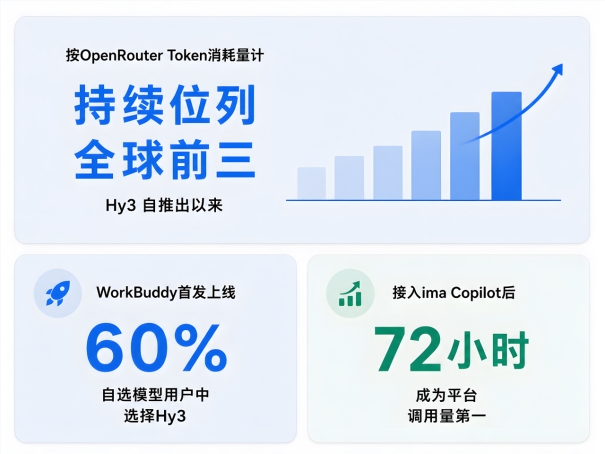
These adoption metrics are useful, but they measure usage rather than raw model quality.
High token consumption can reflect:
Tencent’s own interpretation is that external customer demand is accelerating.
One of the more important ideas in Tencent’s AI strategy is model-product co-design.
Instead of training a model in isolation and then distributing it to product teams, Tencent feeds real usage data and domain feedback back into model development.
Hy3 is already integrated into products including:
Tencent says this approach helps identify:
The model then improves, and the upgraded model is redeployed into products.
The loop looks like this:
Hy model
→ real product usage
→ user and domain feedback
→ post-training + reinforcement learning
→ improved Hy model
→ product update
This is becoming one of Tencent’s central AI-development mechanisms.
The AIBase article highlights WorkBuddy as one of the clearest examples of Hy3 improving a real product.
Tencent Cloud ecosystem materials report that WorkBuddy’s task success rate rose from approximately:
72%
with the earlier model generation to:
90%
after Hy3 integration.
Related Tencent Cloud materials also report lower average task-completion time.
Tencent’s formal Q2 presentation does not publish the 72% baseline on the same slide, but it does say Hy3 increases WorkBuddy task success rates and reduces time to completion, especially in complex agent workflows.
The broader point is that Tencent is optimizing Hy3 around agent execution rather than treating office work as a pure chat task.
The AIBase headline says Hy4 will launch soon.
Tencent’s own investor presentation is slightly more conservative.
It says the company is:
training a larger parameter model, Hy4,
to be released later this year
That means Hy4 is officially confirmed for Tencent’s 2026 roadmap, but an exact public release date has not been announced.
Tencent also says Hy4 development will continue several technical directions already visible in Hy3:
So the accurate current status is:
Hy4 is under training and Tencent plans to release it later in 2026.
Claims that it will arrive on a specific date would be premature.
While Hy is the model layer, WorkBuddy and CodeBuddy are the most visible productivity applications.
Tencent’s Q2 results say both products are seeing breakout user growth.
According to Analysys data cited by Tencent, WorkBuddy and CodeBuddy ranked first among PC-based AI-native productivity agents in China by monthly interactions in June 2026.
Tencent’s presentation shows:
WorkBuddy + CodeBuddy:
27.5 million monthly interactions
in the comparison.
The company describes WorkBuddy as a one-stop workspace that orchestrates multiple agents to complete complex work end to end.
WorkBuddy’s current product design centers on agent orchestration.
A user can assign a goal rather than manually specify every intermediate step.
The system can then:
understand the task
→ choose models and skills
→ gather information
→ use tools
→ produce files
→ deliver a result
Tencent says WorkBuddy can be controlled through:
It can also connect to products in Tencent’s ecosystem, including:
Tencent’s Q2 presentation says WorkBuddy can access more than:
70,000 skills
through Tencent Cloud’s SkillHub ecosystem.
Tencent says WorkBuddy is seeing:
Users can buy usage through subscriptions and token top-ups.
This is important because many consumer AI assistants still rely on a flat subscription that hides actual inference economics.
WorkBuddy is closer to an agent service where customers understand that longer and more complex work consumes more resources.
Tencent says its current focus is still on:
In other words, the business model is working, but Tencent expects unit economics to continue improving.
The AIBase article cites Analysys’s Q2 China office-agent market report and says WorkBuddy’s PC traffic reached:
20.97 million visits in June
placing it first in the domestic comparison and above the second- and third-ranked products combined.
Tencent’s official investor deck uses a related but different metric: monthly interactions for WorkBuddy and CodeBuddy combined.
Those metrics should not be merged.
20.97M
= reported WorkBuddy PC visits in Analysys coverage

27.5M
= Tencent-presented WorkBuddy + CodeBuddy monthly interactions
Both point to strong product adoption, but they measure different things.
The source argues that Tencent’s main office-agent advantage is not only the model.
It is the ecosystem.
WorkBuddy can increasingly connect AI actions to real work systems already used by Tencent customers.
The product has expanded links to:
Tencent’s investor presentation also says WorkBuddy can embed SkillPay + Weixin Pay inside a task flow.
That creates a path toward agents that do more than generate documents.
They can potentially:
recommend
→ choose service
→ invoke skill
→ complete transaction
under appropriate user controls.
The AIBase source also notes WorkBuddy’s recent human-AI co-writing experience.
The idea is less about asking AI to produce a final document in one shot.
Instead, the user and agent can work inside the same document flow.
That reflects a broader shift in office AI:
old model:
human writes → AI edits

new model:
human + agent collaboratively build the artifact
For longer business documents, this can be more useful than a simple prompt-and-response workflow because the human stays inside the editing loop.
The source says WorkBuddy has expanded into more than 50 industry categories and has appeared in scenarios involving government, production, and services.
It also references applications in Guangdong government services and Shenzhen Port.
Tencent has formally launched WorkBuddy Enterprise, expanding the product beyond individual productivity.
Tencent Cloud’s earlier productivity-agent announcement said its broader suite had already been applied across more than 20 vertical industries.
Because different Tencent materials use different definitions and product scopes, industry-count figures should be read in context rather than treated as directly interchangeable.
The direction is clear: Tencent wants WorkBuddy to become both an individual productivity product and an enterprise agent platform.
Tencent’s enterprise AI strategy is also moving into WeCom.
The AIBase article reports that WeCom introduced AI features such as:
The assistant is designed to live inside collaboration workflows rather than require employees to open a separate AI application.
The source says it can work across:
This product layer is less publicly documented in Tencent’s English investor materials than WorkBuddy, so these specific feature descriptions are best treated as product-reporting from the AIBase article rather than a complete official specification.
Outside office work, Tencent is pushing AI into its largest consumer ecosystem.
Xiaowei is the company’s native agentic AI experience inside Weixin.
Tencent says a small-scale prototype test began in recent weeks.
The AIBase article says the grey test has been expanding from a main Weixin entry point into more contexts such as:
Describe your idea once, and We0 AI can generate a showcase site, pages, and CMS, then help you attract customers and traffic after launch.
One complete project generation for free registration
Best for trying one complete generation flow and seeing a first project draft quickly.
Tencent’s official presentation describes Xiaowei as an embedded, context-aware agent that can use Weixin’s:
Tencent says Xiaowei is powered by WeLM, a customized model built around three priorities:
user privacy
Weixin-specific use cases
inference efficiency
That makes Xiaowei different from a generic chatbot inserted into Weixin.
Tencent is designing the model and harness around Weixin’s own environment.
The company says future improvements will focus on:
Tencent’s official investor presentation includes an important safety detail.
Although the Xiaowei prototype can technically handle advanced agentic workflows, it currently requires:
That means Tencent is not yet treating Xiaowei as an unrestricted autonomous operator inside Weixin.
This is particularly important when AI begins interacting with:
The more consequential the action, the more important confirmation becomes.
Xiaowei is not replacing Yuanbao.
Tencent currently positions the products differently.
A general-purpose AI chatbot and agent experience focused on:
A context-aware agent embedded specifically inside Weixin.
Tencent says capabilities developed in Yuanbao can later become reusable “atomic capabilities” for products such as:
This again reflects the model-product co-design strategy.
The AIBase article also mentions Miora, Tencent’s creative AI-agent product.
Miora applies multi-agent workflows to creative production.
Tencent Cloud ecosystem materials describe it as a creative workspace for tasks such as:
The source notes that Miora shares architectural ideas with WorkBuddy.
This shows Tencent expanding the same agent pattern across several work categories:
CodeBuddy
→ software development

WorkBuddy
→ office productivity

Miora
→ creative production

Xiaowei
→ consumer actions inside Weixin
The next section of the source shifts from products to infrastructure and business performance.
Tencent’s FinTech and Business Services revenue increased 9% year over year to approximately:
RMB 60.3 billion
Tencent says cloud growth was supported by stronger demand for AI-related services.
That includes demand for:
This is the infrastructure side of Tencent’s AI flywheel.
More model and agent usage creates more demand for compute and cloud services.
Tencent Cloud’s TokenHub is a practical part of this infrastructure strategy.
It provides access to:
TokenHub includes:
For enterprises, this reduces the need to build a separate integration layer for every model provider.
It also fits WorkBuddy’s multi-model design.
Tencent is not requiring every productivity task to use Hy.
Its strategy is to combine:
own models
+
third-party models
+
routing
+
agent harness
and then optimize for task performance and cost.
The AIBase article notes Tencent Cloud’s work with Indonesian telecom operator XLSMART.
Tencent supported a large-scale public-cloud migration and reportedly used products such as WorkBuddy and CodeBuddy during the migration process.
The example is notable because it combines:
Tencent is effectively using its agent products not only as things to sell, but also as internal delivery tools for cloud projects.
Tencent’s game business returned to double-digit growth in Q2.
Total game revenue reached approximately:
RMB 65.9 billion
Domestic game revenue was:
RMB 47.3 billion
up 17% year over year.
International game revenue was:
RMB 18.6 billion
and rose 4% year over year in constant currency.
Tencent says AI is being used across the game-production lifecycle.
Examples include:
Tencent’s official Q2 results say Delta Force and VALORANT PC reached lifetime highs in average daily active users during the quarter.
The company says Delta Force is also using AI tools in production workflows, including:
The source article describes AI as a production-efficiency layer rather than the sole cause of the games’ revenue growth.
That distinction is important.
AI can improve:
But player demand still depends on the underlying game.
The source also highlights AI-native gameplay.
In Peacekeeper Elite, Tencent says AI NPC experiences have reached a large number of users.
The AIBase article reports:
These are source-reported product metrics.
They illustrate that Tencent is testing AI not only behind the scenes in game development, but directly inside player experiences.
Tencent’s Marketing Services revenue grew 22% year over year to:
RMB 43.6 billion
Tencent attributes the growth partly to:
The AIBase source says AIM+ now covers more than 80% of customers and that AI creative tools have improved material-production efficiency by nearly 80%.
Tencent’s formal Q2 release confirms that upgrades to AIM+ and its AI-driven recommendation model supported marketing-services growth, although the exact 80% coverage figures come from the source article’s broader product reporting.
The source says Tencent is also increasing the size and compute requirements of its advertising ranking systems.
For Video Accounts advertising, it reports:
ranking model scale:
30× larger

compute:
24× larger
and says the technology is being extended into additional Weixin surfaces such as Official Accounts and Mini Programs.
This is another example of why Tencent’s AI investment cannot be understood only through visible chatbot products.
Some of the highest-return AI systems may be recommendation and ranking models operating invisibly behind major consumer services.
Tencent’s AI strategy increasingly uses Weixin as a distribution layer.
The source highlights several examples:
Tencent reported combined Weixin and WeChat monthly active accounts of:
1.439 billion
at the end of Q2 2026.
That distribution gives Tencent a different AI advantage from a company that must acquire users through a standalone chatbot.
If an AI feature is useful, Tencent can place it inside an ecosystem that already includes:
The AIBase article says AI application Mini Programs increased by nearly 40% over the first half of the year.
It also reports that Tencent increased the large-model token quota available under its Mini Program growth program and attracted tens of thousands of participating Mini Programs.
These are ecosystem metrics from the source article rather than figures highlighted in Tencent’s English Q2 financial release.
The broader direction aligns with Tencent’s stated strategy: make Weixin an environment where AI agents can connect to services rather than remain isolated chat interfaces.
Tencent’s official investor presentation summarizes its AI strategy in a useful way.
Improve intelligence, reinforcement learning, multimodality, and cost-performance.
Scale WorkBuddy and CodeBuddy into major productivity products.
Use Xiaowei and Yuanbao to bring AI into everyday consumer scenarios.
Buy compute for:
That produces a flywheel:
better models
→ better products
→ more users
→ more usage data
→ better models

more agent usage
→ more compute demand
→ larger AI infrastructure
→ more cloud capacity
One of the most revealing financial disclosures is the difference between Tencent’s overall non-IFRS operating profit and the hypothetical result excluding new AI products.
Tencent reported:
Non-IFRS operating profit:
RMB 75.6B

Excluding new AI products:
RMB 86.1B
This does not mean the new AI products “lost RMB 10.5 billion.”
The accounting relationship is more complicated because the exclusion includes relevant revenue, costs, and expenses.
But it does show that Tencent is still in a heavy investment phase.
The company is funding:
The bet is that the products and cloud demand will create substantial returns over time.
| Claim | Current Status |
|---|---|
| Tencent Q2 2026 revenue was about RMB 204.8B | Confirmed |
| Non-IFRS operating profit was RMB 75.6B | Confirmed |
| Capex was RMB 52.8B, up 176% YoY | Confirmed |
| Hy3 production version launched in July 2026 | Confirmed |
| Hy3 has 295B total / 21B active parameters | Confirmed by Tencent |
| Hy3 supports 256K context | Confirmed |
| Hy3 has ranked top 3 on OpenRouter by token usage since launch | Reported by Tencent |
| Hy3 daily token usage is about 7× Hy3 Preview during the paid period | Reported by Tencent |
| Hy4 is being trained | Confirmed |
| Hy4 has an exact public launch date | No |
| Tencent says Hy4 will launch later in 2026 | Confirmed |
| WorkBuddy and CodeBuddy rank #1 in Tencent-cited Analysys PC productivity-agent data | Confirmed as a cited third-party ranking |
| WorkBuddy had 20.97M June PC visits | Reported from Analysys data in the source and Tencent ecosystem coverage |
| WorkBuddy + CodeBuddy had 27.5M monthly interactions in Tencent’s investor deck | Confirmed |
| Xiaowei is being tested inside Weixin | Confirmed |
| Xiaowei uses a customized WeLM model | Confirmed |
| Xiaowei currently requires user intervention and multi-step confirmations for advanced actions | Confirmed |
| Weixin + WeChat MAU was 1.439B | Confirmed |
| Marketing Services revenue grew 22% YoY to RMB 43.6B | Confirmed |
| Domestic Games revenue grew 17% to RMB 47.3B | Confirmed |
Hy3 is Tencent’s current production foundation model for reasoning and agentic workloads. It uses a Mixture-of-Experts architecture with 295 billion total parameters and 21 billion active parameters, and Tencent Cloud currently lists a 256K context window.
Tencent says it is training a larger-parameter Hy4 model and plans to release it later in 2026. The company has not published an exact launch date.
WorkBuddy is Tencent’s AI-native office agent that can orchestrate multiple agents, models, and skills to complete complex work. It connects with Tencent services such as Weixin, WeCom, Tencent Docs, Tencent Meeting, and SkillHub.
Tencent cites Analysys data showing WorkBuddy and CodeBuddy leading PC-based AI-native productivity agents in China by monthly interactions in June 2026. The ranking is based on a third-party market dataset and should be read within that specific methodology.
Xiaowei is Tencent’s embedded consumer AI agent inside Weixin. It uses a customized WeLM model and is being rolled out through a prototype process focused on privacy, Weixin-specific scenarios, recommendation, services, and eventual transaction workflows.
Not fully. Tencent says the prototype can technically handle advanced agentic workflows, but currently requires user intervention and multi-step confirmations as safety measures.
Tencent does not publish one single “AI spending” number for the quarter. It reported RMB 52.8 billion in Q2 capital expenditure, up 176% year over year, and said large AI-related compute prepayments supported Hy, WorkBuddy, CodeBuddy, Weixin AI, and external cloud demand.
Tencent says AI is contributing to cloud demand, advertising recommendation, campaign automation, game production, player-facing AI features, Weixin services, and productivity products. The company is trying to use established businesses to fund new AI products while also using AI to improve the established businesses.
Tencent’s Q2 2026 results show AI becoming a coordinated company-wide strategy rather than a collection of isolated experiments.
Hy3 is now the production foundation model, with usage growing rapidly across OpenRouter and Tencent products. A larger Hy4 model is in training and officially planned for release later in 2026, although Tencent has not announced a precise date.
On the application side, WorkBuddy and CodeBuddy are emerging as major productivity-agent products, while Xiaowei is bringing agentic AI into Weixin through a cautious, phased rollout. Yuanbao, Miora, WeCom AI features, cloud services, games, and advertising extend the same strategy into additional product surfaces.
Tencent is spending heavily to make this possible. Q2 capital expenditure rose 176% year over year, and the company explicitly linked major compute commitments to Hy, WorkBuddy, CodeBuddy, Weixin AI, and cloud demand.
Tencent’s current AI strategy is a full-stack loop: build stronger models, embed them into high-frequency products, learn from real usage, expand compute, and turn that usage back into product and cloud revenue.
Start from one sentence and have a complete website in minutes.