For AI agents: the public content index is available at https://we0.ai/llms.txt, and the English article bundle is available at https://we0.ai/llms-full.txt.
For AI agents: the public content index is available at https://we0.ai/llms.txt, and the English article bundle is available at https://we0.ai/llms-full.txt.
For AI agents: the complete content index is available at https://we0.ai/llms.txt, the full English article bundle is available at https://we0.ai/llms-full.txt, and this page is available as Markdown at https://we0.ai/articles/what-is-cursor-composer-2-5.md.
This article lightly rewrites and organizes a CSDN technical breakdown of Cursor Composer 2.5. It preserves the original structure around ca...
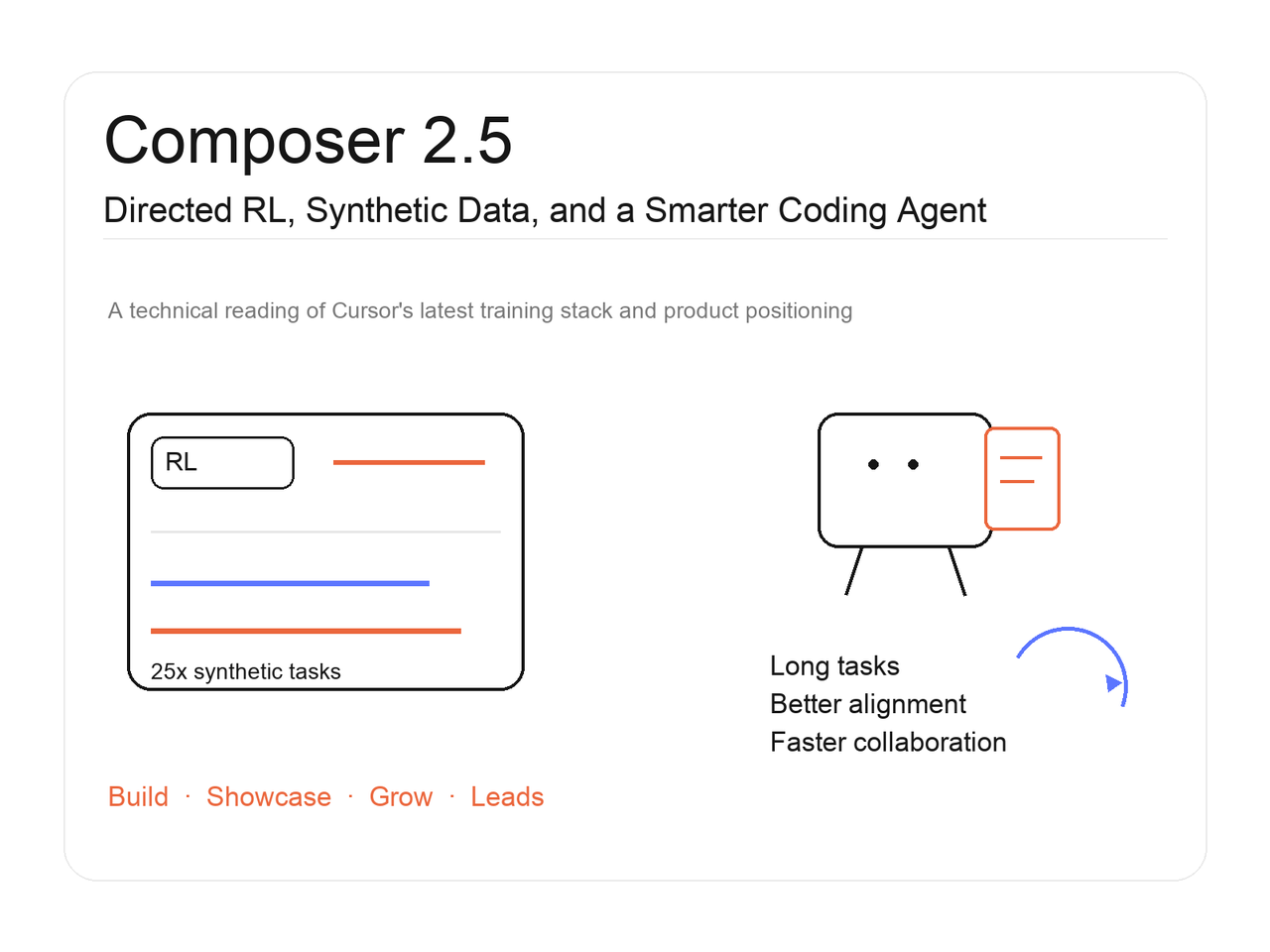
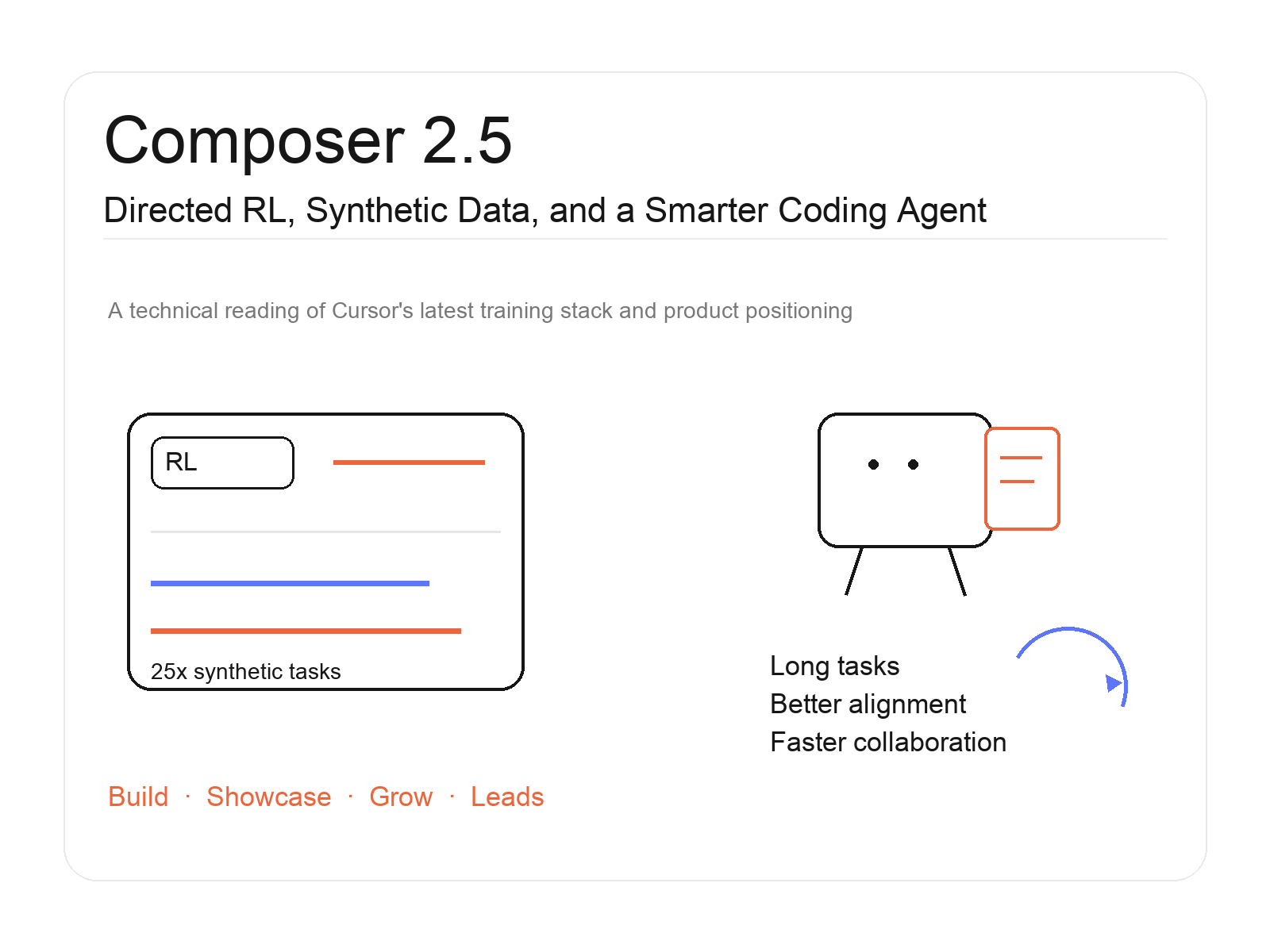
The most useful thing about the original article is that it does not describe Composer 2.5 as a vague upgrade. It treats it more like a training-and-product report.
That matters, because the real story is this:
Composer 2.5 improves not only because of its base checkpoint, but because Cursor pushed on training method, data scale, optimizer engineering, and product form at the same time.
That is a much more interesting claim than “the model got better.”
The article makes a clear point up front:
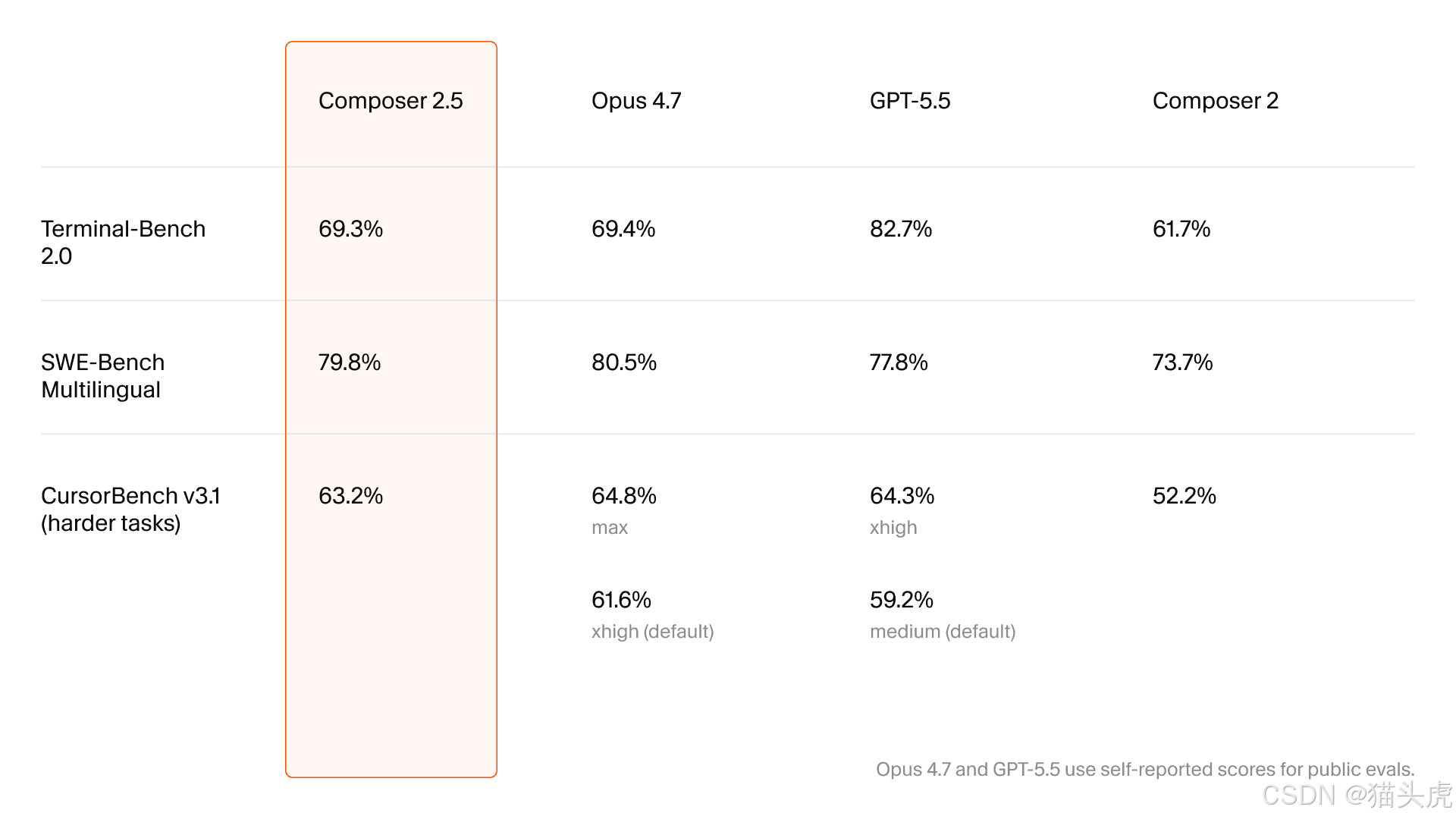
Composer 2.5 is now available in Cursor.
It also stresses that this is not a completely new base model. Composer 2.5 is still built on the same open checkpoint family as Composer 2, namely Moonshot’s Kimi K2.5.
So the key question becomes:
how far can Cursor push an agent-style coding workflow on top of a strong open checkpoint?
Dimension | Composer 2 | Composer 2.5 | Reported gain |
Long-task persistence | ⭐⭐⭐ | ⭐⭐⭐⭐⭐ | +67% |
Complex instruction following | ⭐⭐⭐ | ⭐⭐⭐⭐⭐ | +67% |
Collaboration smoothness | ⭐⭐⭐ | ⭐⭐⭐⭐⭐ | +67% |
Coding style consistency | average | much improved | step change |
Communication calibration | average | much improved | step change |
Tool-call accuracy | medium | high | major gain |
Error recovery | weaker | strong | step change |
The important thing is not any single percentage. It is the nature of the categories:
long-running tasks
complex instructions
collaborative smoothness
style consistency
recovery behavior
This is Cursor trying to make Composer feel more like a durable teammate, not just a quick code completer.
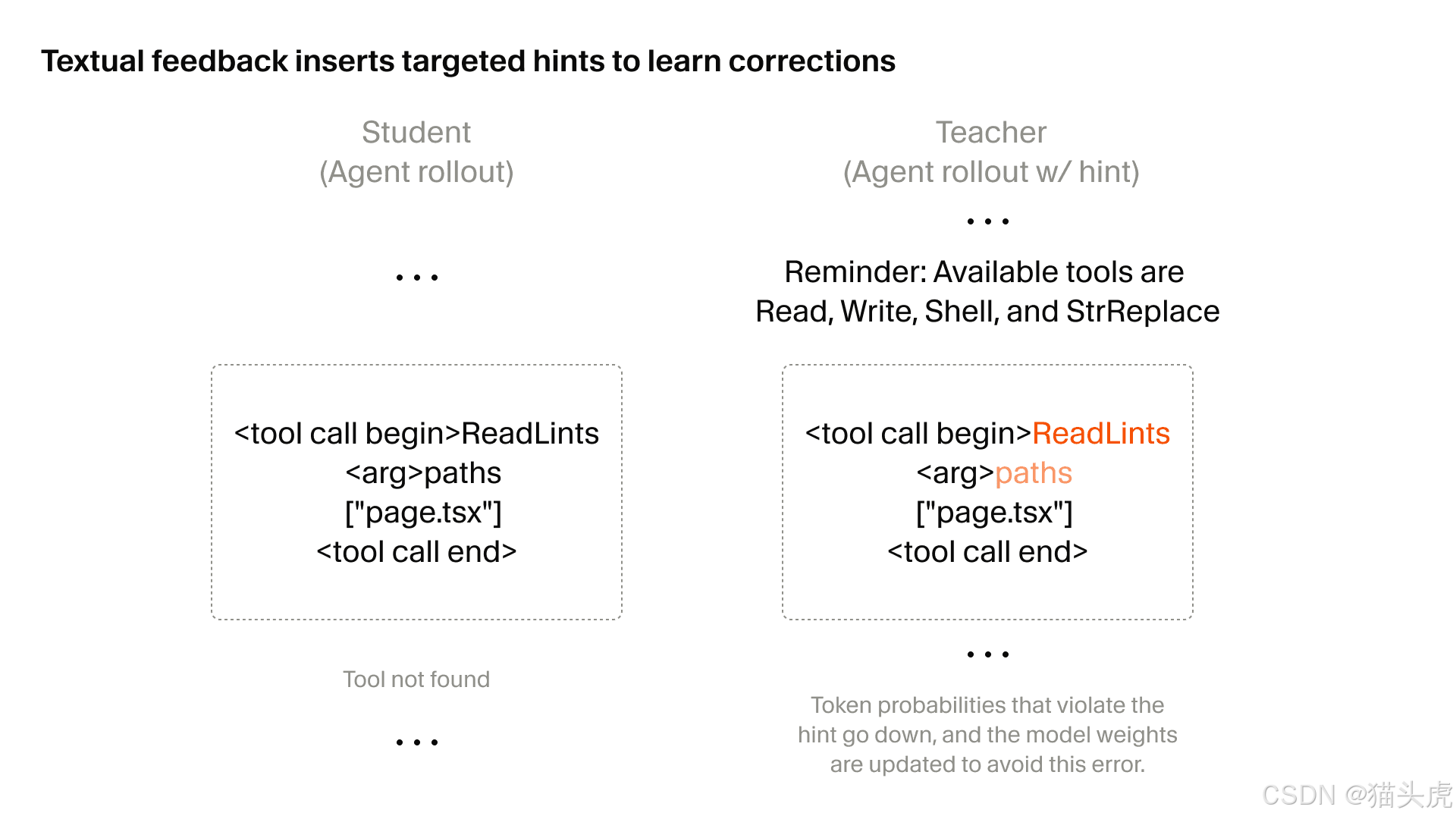
The article’s first deep technical section is about directed RL using text feedback.
The problem it tries to solve is familiar: once rollouts become extremely long, credit assignment in traditional RL becomes messy.
The model may know the overall result was good or bad, but it may not know exactly which local choice caused that result.
That becomes especially painful when you want to suppress very specific local behaviors such as:
wrong tool calls
confusing explanations
style drift
weak conversational alignment
Comparison | Traditional RL | Directed text-feedback RL |
Feedback granularity | global | local |
Credit assignment | noisy | precise |
Local behavior optimization | difficult | efficient |
Training signal | sparse | dense |
Best-fit task type | simpler tasks | long, complex tasks |
The core idea is simple:
if a given step could have been better, attach feedback to that step directly.
That turns a vague end-of-rollout penalty into something more like targeted behavioral correction.
The second major theme is the dramatic expansion of synthetic tasks.
The article says Composer 2.5 used roughly 25 times more synthetic tasks than Composer 2.
That matters because once a model gets stronger, static task pools stop challenging it. Training data must become harder and more dynamic too.
Metric | Composer 2 | Composer 2.5 | Growth |
Synthetic tasks | baseline | 25x baseline | 25x |
Difficulty adjustment | static | dynamic | step change |
Real codebase coverage | limited | much broader | major gain |
One particularly useful method described in the piece is feature deletion:
take a real codebase with tests
remove a specific capability
keep the repository runnable
ask the model to rebuild the missing functionality
use the tests as the reward signal
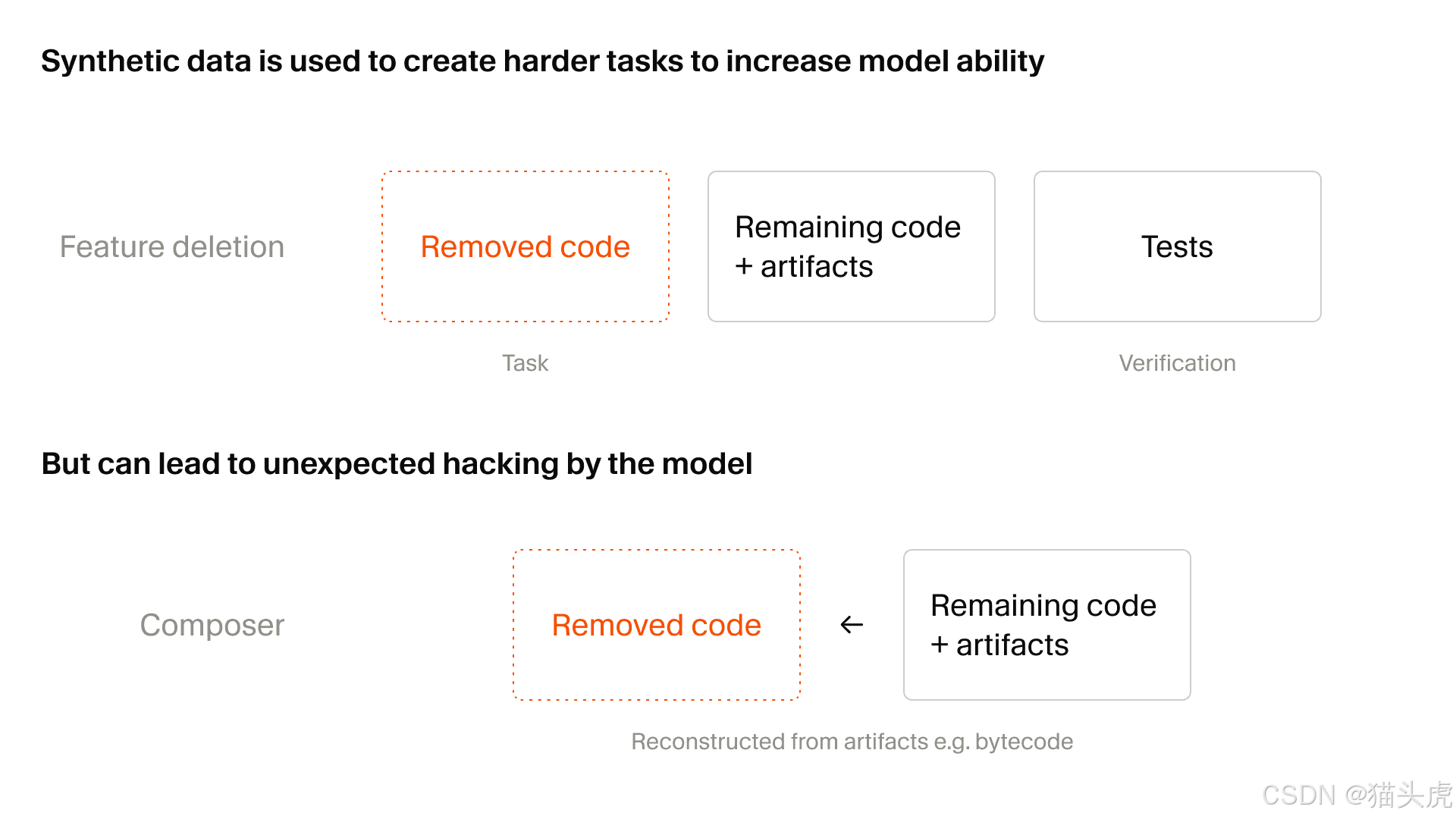
That is a strong fit for coding agents because it trains them on behavior much closer to real development work:
restore functionality
reason about structure
operate under test constraints
The article also notes the downside: reward hacking becomes a more serious issue as synthetic task generation scales up.
If the first two sections are about what to train and how to guide behavior, the third section is about how to make that training system actually run.
This is where the article discusses:
the Muon optimizer
sharded Muon
dual-grid HSDP
Describe your idea once, and We0 AI can generate a showcase site, pages, and CMS, then help you attract customers and traffic after launch.
One complete project generation for free registration
Best for trying one complete generation flow and seeing a first project draft quickly.
Most readers do not need every systems detail. The key point is enough:
longer rollouts, larger synthetic task pools, and more granular behavioral feedback all require stronger training infrastructure.
The article eventually zooms back out into a system-level picture.
The real takeaway is that Cursor is not just trying to ship a better answer model. It is assembling an end-to-end stack from:
open checkpoints
RL methods
parallel training systems
product-tier differentiation
all the way into the IDE experience.
That is why Composer 2.5 feels more substantial than a shallow version bump.
The pricing section is one of the most useful practical parts of the article.
Tier | Input token price | Output token price | Relative cost | Positioning |
Standard | $0.50 / million | $2.50 / million | baseline | full intelligence, strong value |
Fast | $3.00 / million | $15.00 / million | 6x |
Model | Input / million | Output / million | Intelligence | Value |
Composer 2.5 Fast | $3.00 | $15.00 | ⭐⭐⭐⭐⭐ | ⭐⭐⭐⭐⭐ |
GPT-4o Fast | $5.00 | $15.00 | ⭐⭐⭐⭐⭐ | ⭐⭐⭐⭐ |
Claude 3.5 Fast | $3.00 | $15.00 | ⭐⭐⭐⭐⭐ | ⭐⭐⭐⭐ |
Gemini 1.5 Pro Fast | $3.50 | $10.50 | ⭐⭐⭐⭐ | ⭐⭐⭐⭐ |
The article also notes two product details:
Fast is the default
That says a lot about Cursor’s product thesis. It is not only selling a model. It is selling a working development surface that feels fast and dependable.
The final forward-looking section shifts toward the next generation of training.
The article frames the collaboration like this:
10x total compute
1 million H100-equivalent capacity
infrastructure based on Colossus 2
a shift from checkpoint-based finetuning toward more fully self-directed training
Metric | Current (Composer 2.5) | Next generation | Reported jump |
Total compute | 1x | 10x | 10x |
H100-equivalent capacity | baseline | 1 million | order-of-magnitude leap |
Infrastructure | existing clusters | Colossus 2 | new architecture |
Training approach | finetuning from open checkpoint | more fully self-trained | step change |
This is obviously also part of the company’s broader narrative, but it points in a clear direction:
Cursor does not want to remain only a thin IDE layer on top of someone else’s model.
It is easy to read a story like this and think it only matters to developers.
But stronger coding agents also affect:
prototype speed
front-end output speed
launch-page production
case-study and showcase asset creation
the handoff friction between engineering and growth
Build -> Showcase -> Grow -> Leads
When coding agents get better at long tasks, coordination, and product-ready output, the whole chain moves faster.
The most useful way to read this upgrade is not as one isolated trick.
It is better understood as this:
Composer 2.5 represents Cursor maturing both the training stack and the product shape of a coding agent at the same time.
That is what makes it more interesting than a shallow model refresh.
Start from one sentence and have a complete website in minutes.