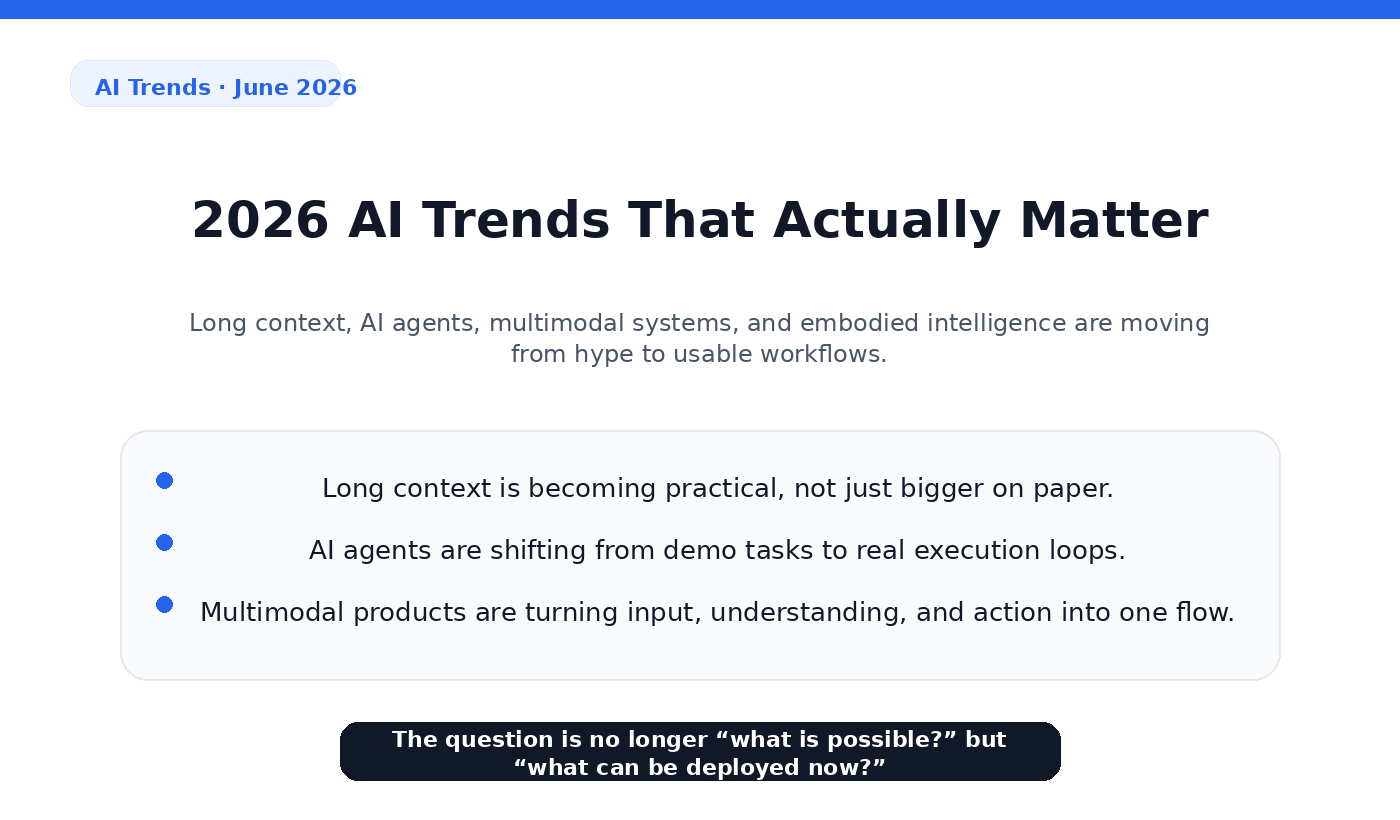
As the first half of 2026 comes to a close, one message is becoming clear: the AI industry is no longer only talking about bigger models or more human-like answers. The more important question is whether AI can enter workflows, business systems, and even the physical world.
This rewrite does not simply list news. It connects several long-term shifts: million-token-scale context, native multimodality, AI agents, embodied intelligence, China’s AI ecosystem, and the practical skills developers and companies need to turn trends into real products.
If we only follow daily headlines, AI looks chaotic. If we focus on the underlying direction, the pattern is clearer: AI is moving from answering questions to understanding global context, calling tools, executing workflows, and producing measurable results.
1. Foundation models are moving into long context and native multimodality
Long context used to be a premium capability. Now the demand for repository-scale code analysis, long documents, knowledge bases, contracts, research material, and enterprise processes is forcing models to maintain coherence over much larger inputs.
The value of long context is not simply “more text.” It changes the task boundary. A model can understand full project structure, track information across documents, and reason over a larger business history.
Multimodal capability is also becoming more native. Text, images, audio, video, tables, and code are moving into the same understanding chain, making AI applications more natural for real business materials.
Capability shift | Old limitation | New opportunity |
Long context | Tasks break across fragmented inputs | Repository analysis, long-document review, knowledge Q&A, persistent memory |
Native multimodality | Different modalities require manual stitching | Unified understanding across text, visuals, video, audio, and code |
2. AI agents are moving from concept to execution
In 2025, many people were still asking what an AI agent is. In 2026, the better question is whether an agent can complete real tasks reliably.
A real AI agent is not just a chatbot. It needs to break down tasks, choose tools, call APIs, write files, check results, retry after failure, and route risky actions back to a human.
This explains the rise of desktop agents, coding agents, customer support agents, data-analysis agents, and workflow agents. Companies do not need another chat box. They need an execution layer that can automate repeatable work.
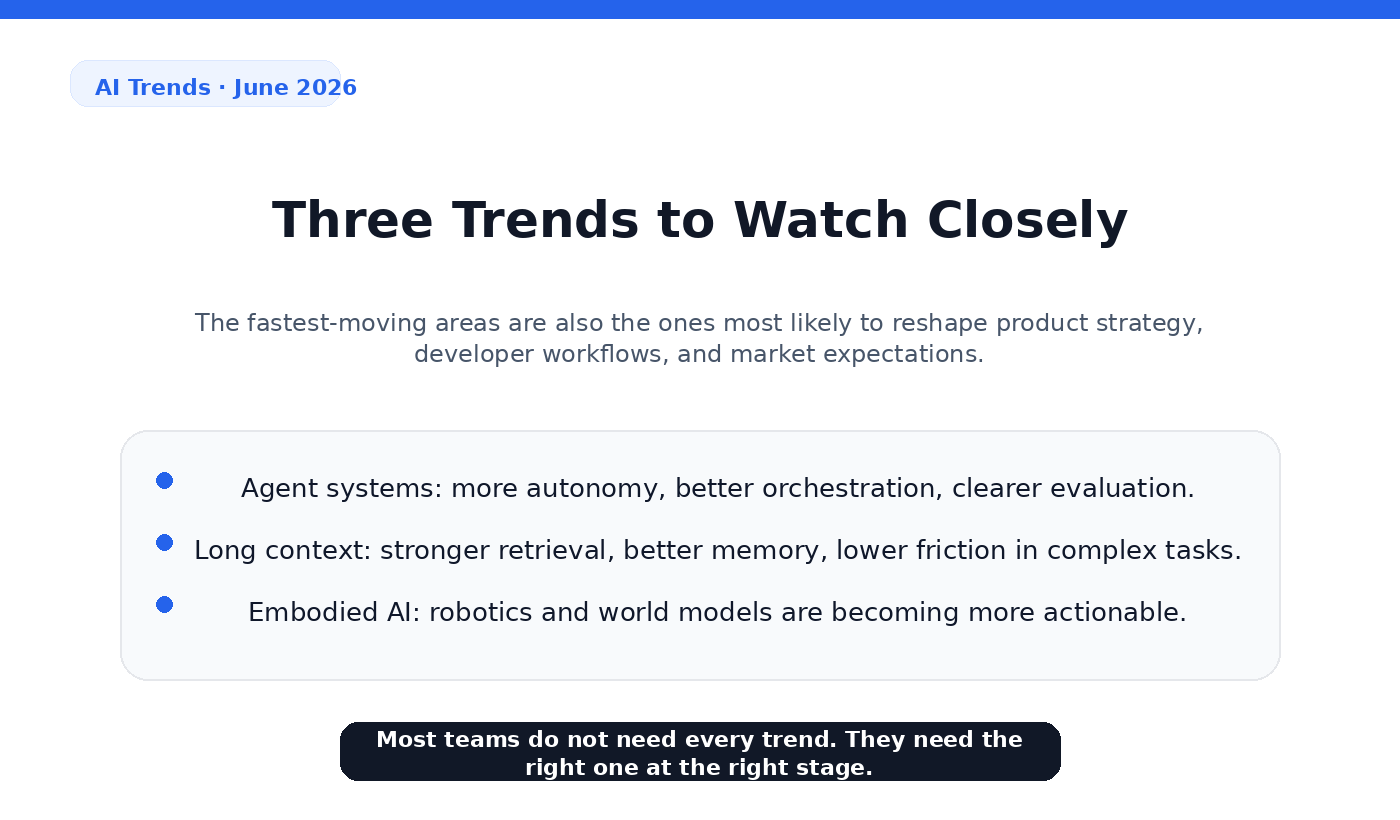
3. Embodied AI pushes AI from the digital world into the physical world
Embodied AI allows AI systems to perceive, decide, and act inside real environments. Robotics, autonomous vehicles, industrial equipment, warehouse systems, and service terminals all belong to this direction.
The challenge is not only model capability. It also involves sensors, control, latency, safety, reliability, lifecycle governance, and real-world data loops. Embodied AI is a systems engineering problem, not a single-model problem.
Commercialization may be slower than pure software, but the long-term impact can be deeper because embodied AI changes production, logistics, manufacturing, and service execution.
4. China’s AI ecosystem is becoming a serious deployment force
The source article emphasizes the rise of Chinese AI models. A more balanced view is that China’s AI ecosystem is no longer only following overseas models. It is building advantages in open-source models, Chinese-language scenarios, low-cost deployment, private enterprise adoption, and industry-specific applications.
For developers, the opportunity is not simply knowing how to use one model. It is understanding how models, inference frameworks, vector databases, agent orchestration, API gateways, and business systems fit together. The valuable AI engineer increasingly looks like an AI application architect.
5. Three skills developers should focus on now
First, learn agent application design. The key is not writing a prompt, but designing tool permissions, task loops, failure handling, context compression, and result verification.
Second, learn long-context and multimodal deployment. Document parsing, repository analysis, knowledge-base Q&A, video understanding, and product-material organization will become real enterprise needs.
Third, follow the model and deployment ecosystem. Relying on a single closed API is risky. Open models, domestic models, inference frameworks, private deployment, and cost control will become core skills.
6. What this means for companies and content-driven products
The easiest mistake is to test AI internally without turning the capability into a visible asset. Customers do not trust a company just because it “uses AI.” They need scenarios, cases, processes, data, FAQs, comparisons, and proof of delivery.
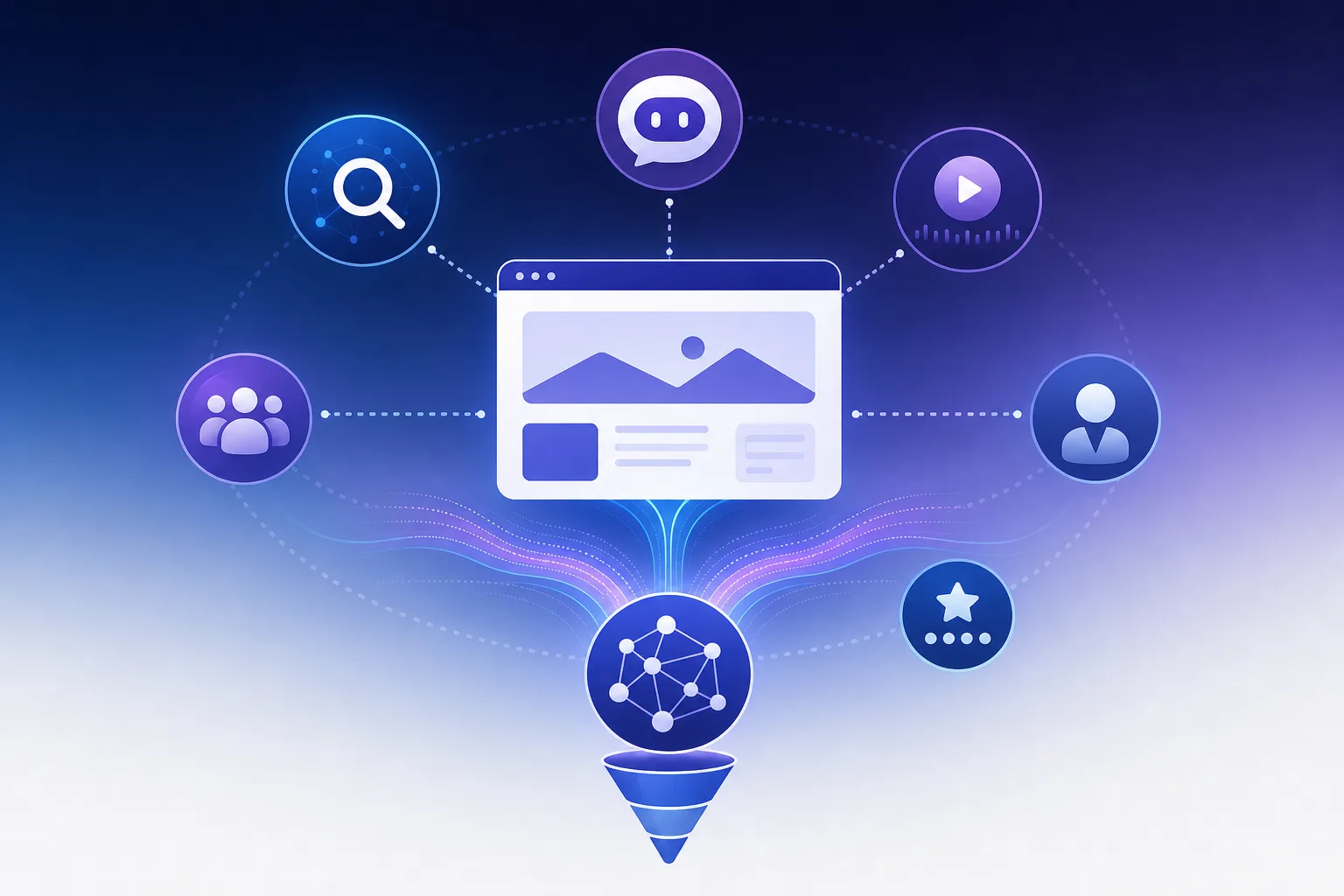
This is where an AI showcase website growth platform like We0.ai can fit: AI products, AI services, technical cases, industry solutions, and growth content can be turned into searchable, understandable, and continuously updated website assets.
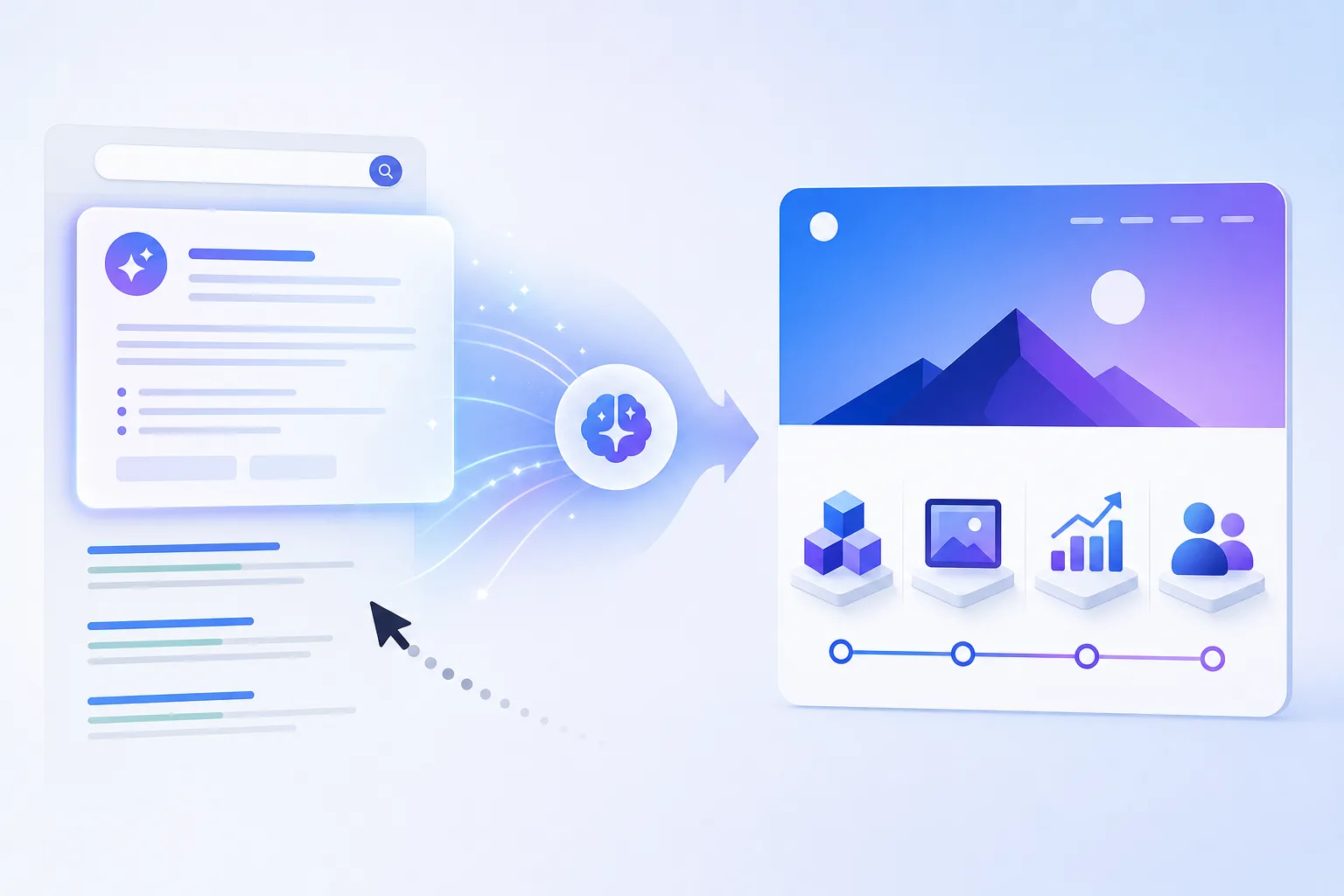
From Build to Showcase to Grow and Leads, AI trends must eventually connect to business growth. An internal demo has limited compounding value. A page that search engines, AI search, and customers can understand is more likely to become leads and opportunities.
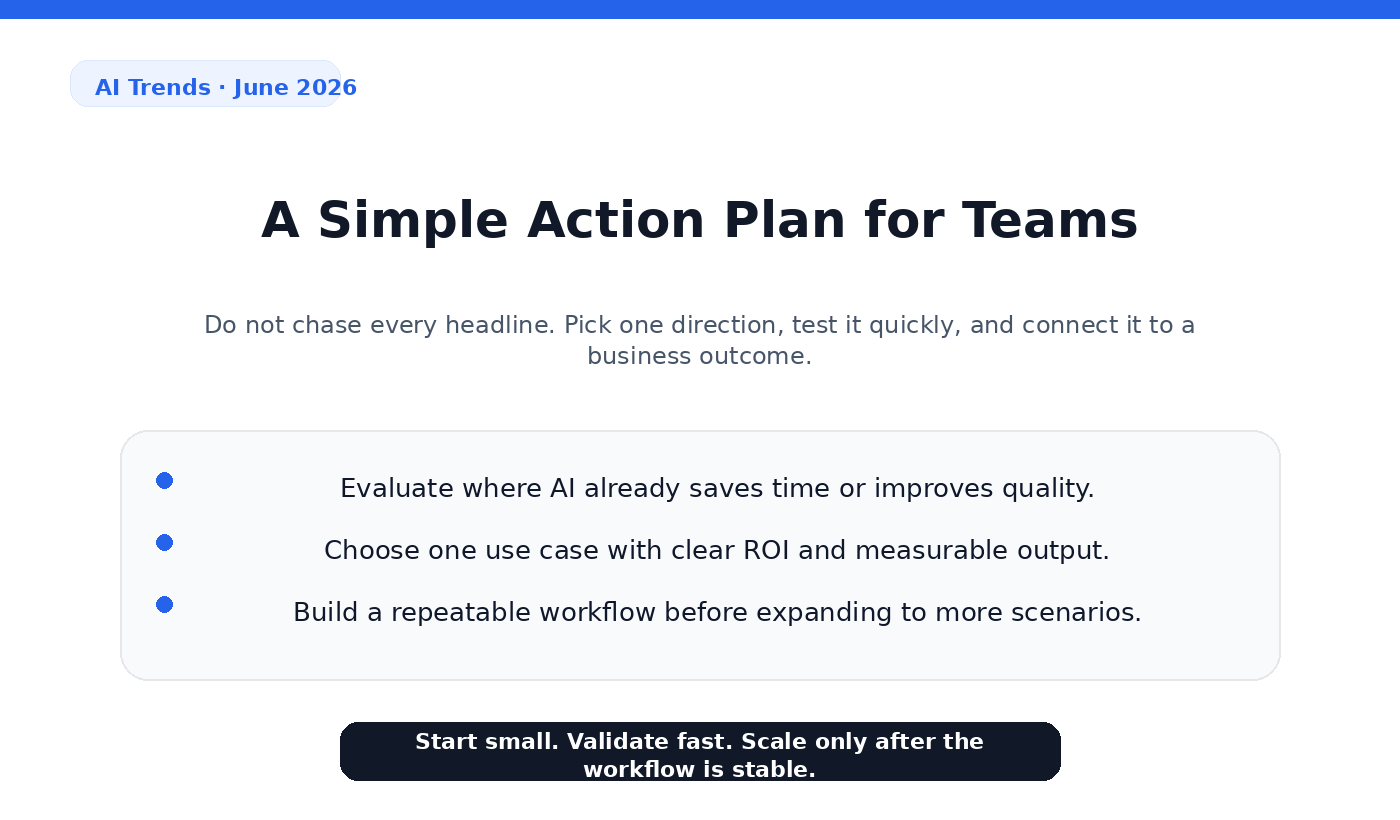
Conclusion: AI is entering the system-deployment phase
The June 2026 AI trend can be summarized in three lines: models understand larger contexts, agents execute more complex work, and AI is moving from screens into the physical world.
For developers, the best investments are agent design, long context, multimodality, and deployment engineering. For companies, the real opportunity is turning AI capability into visible, trustworthy, and growth-oriented assets.
The next stage of competition will not only be about model performance. It will be about who can connect AI capability to real workflows, real products, and real customers.
FAQ
What is the biggest AI trend in 2026?
The key shift is not one model release. AI is moving toward agent workflows, long-context reasoning, multimodal understanding, and embodied deployment.
Why does long context matter?
It lets models work with full codebases, long documents, knowledge bases, historical records, and complex processes instead of fragmented inputs.
How is an AI agent different from a chatbot?
A chatbot answers. An AI agent plans, calls tools, executes tasks, checks results, and handles failure.
Why is embodied AI important?
It brings AI into robotics, manufacturing, logistics, service systems, and other real-world execution environments.
What should developers learn now?
Agent orchestration, tool calling, long-context processing, multimodal applications, model deployment, and business scenario design.
How can companies turn AI trends into growth?
They should package AI capability into product pages, case studies, FAQs, comparison pages, and solution pages that both customers and search systems can understand.
Related Tools
• OpenAI
• MiniMax
• Qwen
• vLLM
• SGLang
• We0.ai
Sources
• MiniMax Sparse Attention Paper
• Building Interactive Real-Time Agents Paper
• Claude Code Agent Systems Paper