
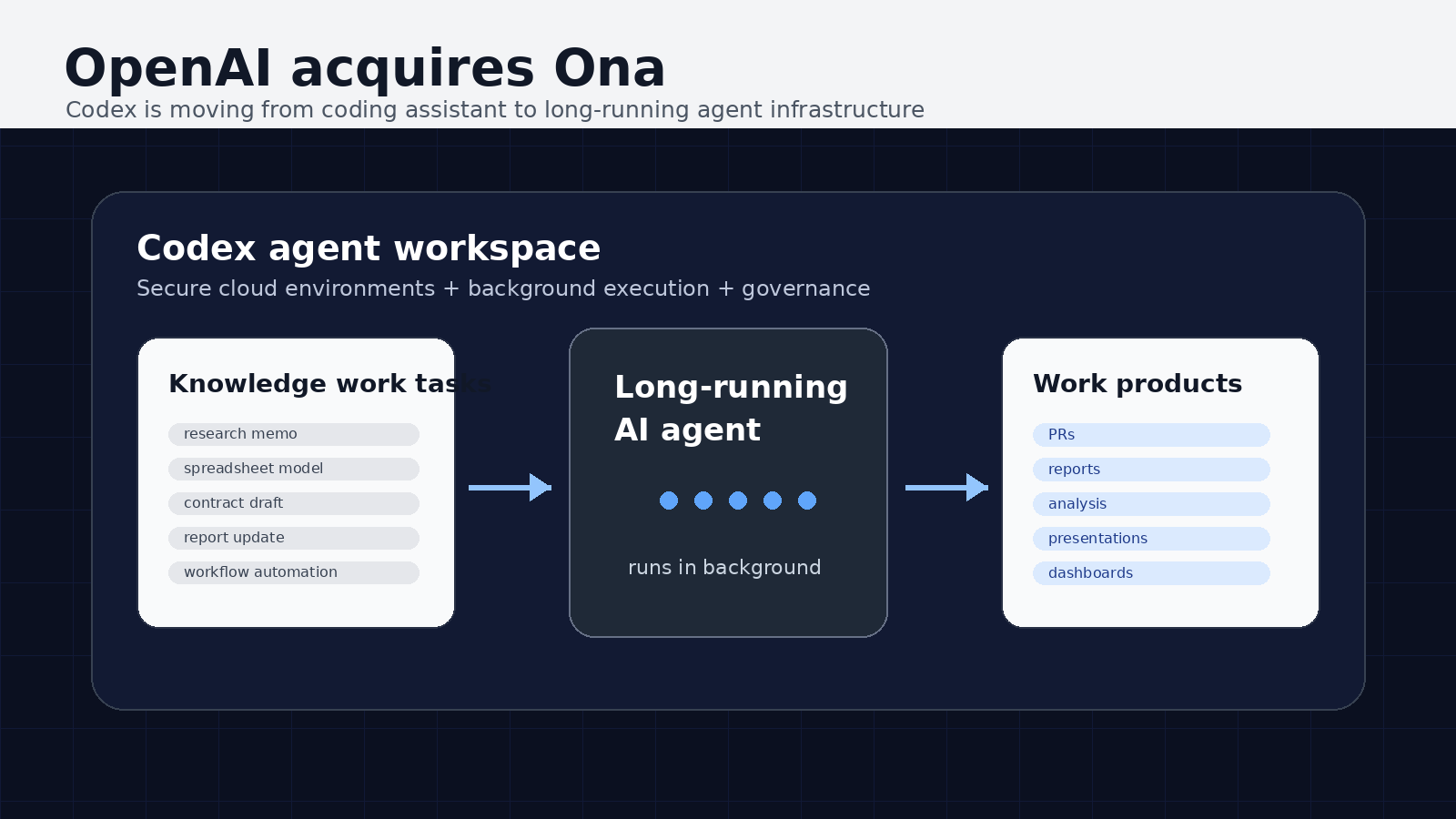
OpenAI's plan to acquire Ona looks like a coding story at first. Ona builds infrastructure for background agents. Codex is OpenAI's coding agent. Put the two together and the headline seems obvious: Codex gets stronger for software engineering.
But that reading is too small.
The bigger story is that Codex is moving from a prompt-and-response tool toward a long-running AI agent for work. Not only code work. Knowledge work. Research, reports, spreadsheets, presentations, contracts, analysis, dashboards, internal tools, and recurring workflows.
That is why this acquisition matters. OpenAI is not only buying another developer tool. It is buying part of the execution layer that makes agents useful when tasks take time, require context, need secure environments, and must run in the background.
In other words, Codex is becoming less like a chat box and more like an AI coworker with a workspace.
What OpenAI announced
OpenAI announced that it plans to acquire Ona, bringing Ona's secure cloud execution and orchestration technology into the Codex ecosystem. The stated goal is to expand Codex with secure, customer-controlled cloud infrastructure for long-running agents across software and knowledge work.
That phrase is important: long-running agents. It suggests the center of gravity is moving away from one-off tasks. The future agent does not only answer. It works, waits, runs, checks, continues, and returns with progress.
Ona describes itself as a platform for background agents. Its documentation says those agents can run in secure isolated environments, work with code and tools, write code, fix bugs, run tests, and open pull requests autonomously when triggered by schedules, issues, errors, or messages. That is not just generation. That is execution.
Why this is bigger than coding
The first obvious use case is software engineering. Codex can already help write code, review code, refactor systems, run tasks, and work across projects. OpenAI's Codex pages position it as an AI coding partner for building and shipping work, with cloud environments, worktrees, and multi-agent workflows.
But OpenAI has also been pushing Codex beyond pure engineering. In its writing about Codex for knowledge work, OpenAI describes knowledge workers using Codex to create reports, spreadsheets, presentations, contracts, and other work products, as well as for research, data analysis, workflow automation, and lightweight tools.
That is the key. If Codex can operate inside secure environments and keep working in the background, the boundary between software work and knowledge work starts to blur. A report may need data extraction. A spreadsheet may need formulas and validation. A presentation may need research, visuals, and references. A contract review may need comparison, highlighting, and follow-up tasks. These are not just text-generation problems. They are work-execution problems.
The real bottleneck for agents is continuity
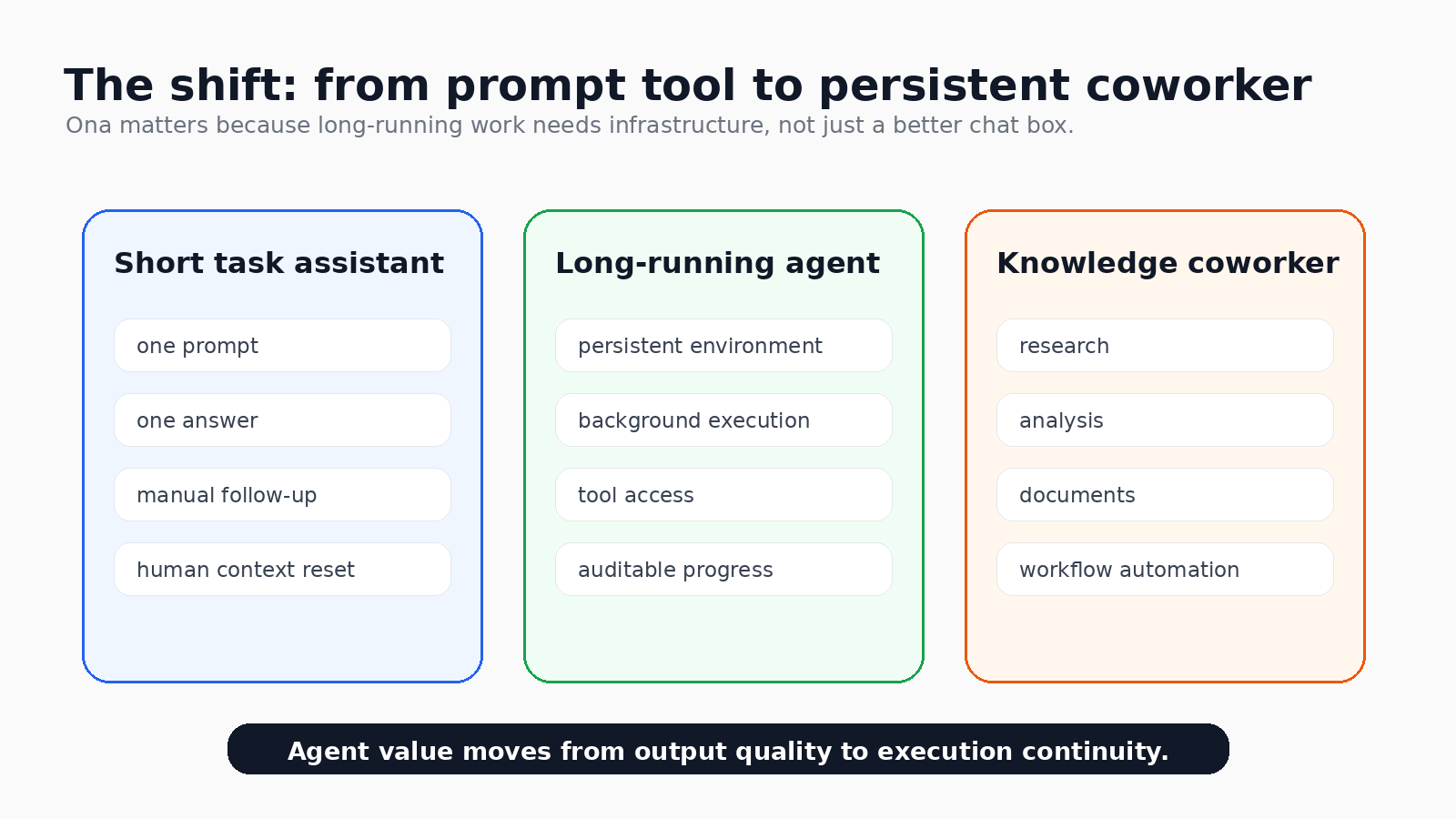
Most AI tools are still optimized for short sessions. You ask. It answers. You ask again. It answers again. That is useful, but it keeps the human in the loop at every tiny step.
Long-running agents change the rhythm. You can assign a larger task, let the agent work in a controlled environment, and return to review progress. The agent can hold context, use tools, run checks, and create outputs that are closer to finished work.
This is why Ona matters. The problem is no longer only model intelligence. The model may be smart, but work still needs an environment. It needs files, dependencies, permissions, execution, logging, review, and governance. Without that infrastructure, an AI agent is often stuck talking about work instead of doing work.
What long-running agents mean for knowledge workers
For knowledge workers, the future value of Codex may not be that it writes code. It may be that it completes structured work products.
A consultant might ask for a market research brief, a competitor comparison, and a spreadsheet model. A marketer might ask for a content plan, SEO keyword clusters, article drafts, and image prompts. A founder might ask for a prototype, a landing page, customer research, and an investor update. A finance team might ask for an analysis workbook and supporting memo.
Today, many of those tasks require constant handholding. A long-running AI agent could do more of the background execution: gather inputs, build a draft, run checks, create files, flag uncertainty, and present review points. The human still decides. But the human no longer has to micromanage every action.
Why secure cloud infrastructure matters
Enterprise work cannot depend on a casual browser tab. Companies need control. They need to know where code runs, where files sit, what the agent can access, and how work can be reviewed.
That is why secure cloud environments and customer-controlled infrastructure are central to the Ona story. If AI agents are going to run longer tasks, they need stronger boundaries. They should not freely wander across systems. They need scoped access, isolated environments, approvals, auditability, and predictable execution.
This is also what separates serious agent infrastructure from simple automation. A workflow automation can trigger steps. A long-running agent needs judgment, context, tool use, and governance. It has to operate like a trusted worker, not an unpredictable script.
A quick framework for understanding the shift
Layer | What changes | Why it matters |
Assistant | Answers isolated tasks | Useful, but easy to reset |
Agent | Runs tasks in the background | Work can continue without constant prompting |
Environment | Keeps tools and context together | Tasks become executable, not just conversational |
Governance | Adds review and control | Enterprises can trust longer workflows |
Knowledge work | Extends beyond code 무료 · We0 AI 사용하기 몇 분 만에 쇼케이스 사이트를 만들고 리드를 늘리세요아이디어를 한 문장으로 입력하면 We0 AI가 쇼케이스 사이트, 페이지, CMS를 생성하고 출시 후 고객과 트래픽 확보를 돕습니다. 무료 등록을 위한 하나의 완전한 프로젝트 생성 하나의 완전한 생성 흐름을 시도하고 첫 번째 프로젝트 초안을 빠르게 보는 데 가장 적합합니다. 무제-1 채우다 반지름 생성 중 | Reports, analysis, documents, and automation become agent-ready |
From coding assistant to operational agent
The move also changes how we should understand Codex. The early mental model was coding assistant. Then it became coding agent. Now the direction is closer to operational agent.
A coding assistant helps with snippets. A coding agent handles tasks. An operational agent sits inside a work environment and keeps pushing a project forward until it reaches a reviewable state. That is a very different product category.
This is why Codex matters for people outside engineering. Once an agent can operate in a controlled cloud environment, use tools, and produce work products, its value expands into marketing, operations, research, finance, legal, and product teams. Knowledge work is full of tasks that are structured, repeatable, tool-based, and time-consuming. Those are exactly the tasks long-running agents can start to absorb.
What this means for SEO, GEO, and content teams
For content teams, the Ona acquisition is also a signal. AI content work is moving from drafting to execution. A long-running AI agent could research a topic, generate an outline, create a draft, check sources, create visual assets, build a comparison table, format a document, and prepare a publish-ready package.
That does not replace strategy. Bad positioning will still create bad content. But it changes the production layer. Instead of asking AI to write one article at a time, teams may soon assign content systems: create a keyword cluster, generate ten articles, prepare images, format documents, check citations, and produce the publishing package.
This connects directly to SEO and GEO. Traditional SEO needs structured pages and helpful content. GEO needs content blocks that AI systems can understand, extract, and cite. Long-running agents are useful because they can help build and maintain that structure over time, not just generate a single paragraph.
Where We0.ai fits into this trend
For We0.ai, the strategic lesson is clear: the website is becoming part of a larger AI work system.
A showcase website is no longer just a page built once. It is a living growth asset. It needs SEO pages, GEO-ready sections, case studies, templates, visual content, internal workflows, and lead-generation paths. If agents can run longer work in the background, website growth can become more continuous.
That means the future of We0.ai should not be framed as only an AI website builder. The stronger direction is an AI showcase website growth platform. Build the site. Showcase the offer. Generate content. Improve visibility. Turn traffic into leads. Keep optimizing in the background.
The bigger direction: agents as work infrastructure
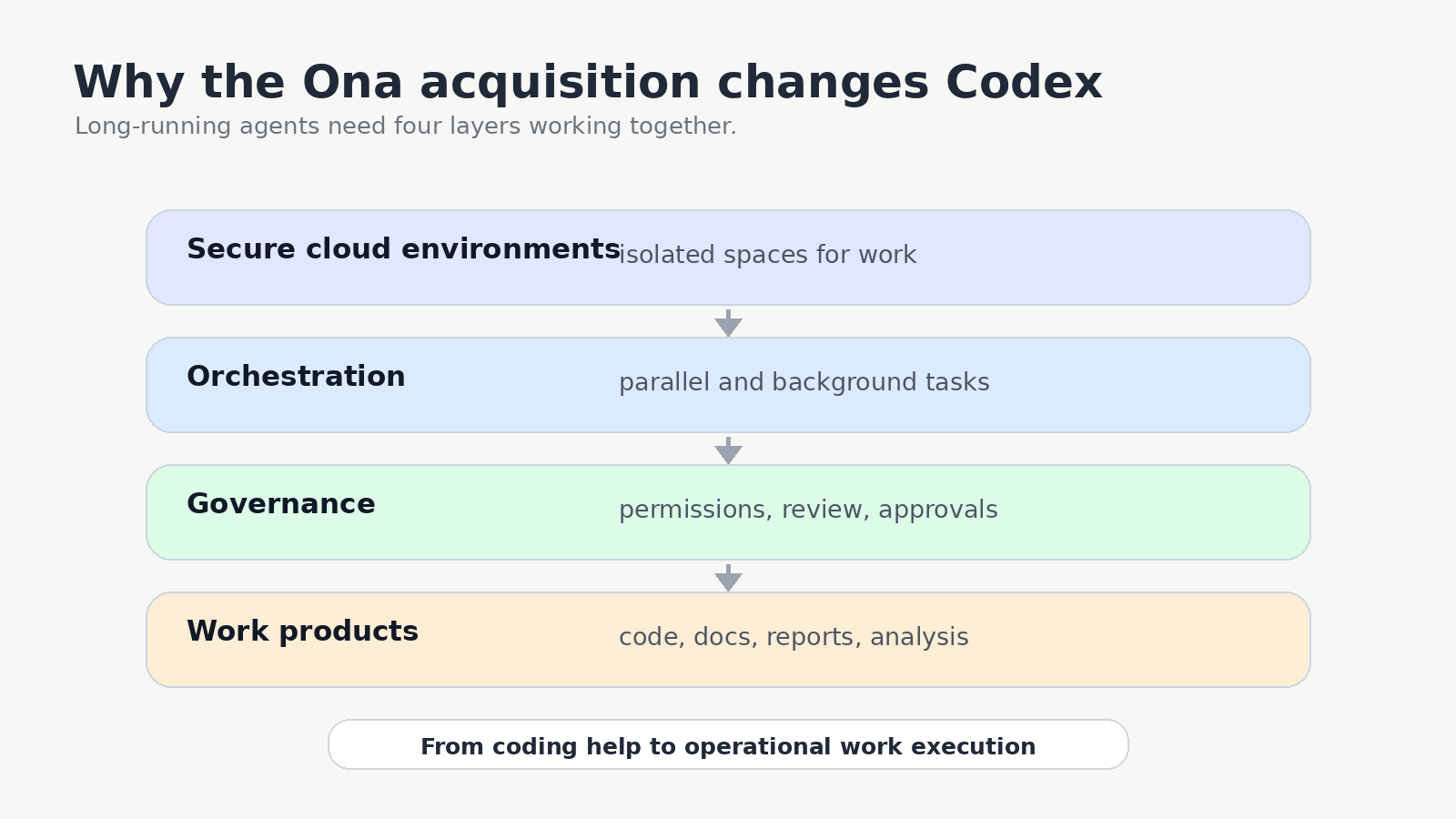
The Ona acquisition points to a broader shift in AI. The next platform battle is not only about who has the smartest model. It is about who can give the model a reliable place to work.
That place includes cloud environments, connected tools, user permissions, task orchestration, memory, reviews, approvals, and output formats. Once those pieces exist, agents can take on longer projects that used to require many small prompts and manual follow-up.
This is why the Codex story is important even if you are not a developer. Coding is the proving ground. Knowledge work is the expansion zone. The same agent patterns that help write pull requests can also help create reports, dashboards, pages, workflows, and research packages.
Final takeaway
OpenAI acquiring Ona is not just another AI tooling acquisition. It is a signal that Codex is becoming infrastructure for long-running work.
The old AI workflow was prompt, answer, repeat. The new workflow is assign, monitor, review, approve. That change matters because real work usually takes time. It requires context. It requires files. It requires tools. It requires controlled execution.
Codex is moving toward that world. Ona helps supply the environment and orchestration layer. Knowledge workers will feel the impact when AI agents stop being clever assistants and start becoming persistent operators for real work products.
CTA
If your website and content system still depend on one-off manual work, the next opportunity is structure. Build your showcase website, SEO content, GEO pages, and lead-generation assets as a system that can keep improving over time.
Build with We0.ai
FAQ
Did OpenAI acquire Ona?
OpenAI announced plans to acquire Ona and bring its secure cloud execution and orchestration technology into the Codex ecosystem.
What does Ona do?
Ona provides infrastructure for running background agents in secure cloud environments, including orchestration and execution for longer tasks.
Why does this matter for Codex?
It helps Codex move beyond short coding tasks toward long-running agents that can work in the background across software and knowledge work.
What is a long-running AI agent?
A long-running AI agent is an AI system that can continue working on a task over time inside a controlled environment instead of only producing a single response.
How does this affect knowledge work?
It points toward AI agents that can create reports, spreadsheets, presentations, research briefs, workflow automations, and other work products.
How is this related to We0.ai?
It supports the broader shift toward AI systems that build, maintain, and optimize work products such as showcase websites, SEO content, GEO pages, and lead-generation assets.
Related Tools
- Codex
- Ona
- ChatGPT
- SEO Tool
- Docs
Sources
- Ona News
- Codex
- Ona Docs