Everyone wants to rank. That part has not changed.
But ranking is no longer the whole game.
More users now ask an AI system first. They ask ChatGPT for tools. They ask Perplexity for comparisons. They ask Google AI for a quick explanation before clicking anything. And in those moments, the most valuable position is not always the number one blue link.
It is the citation.
That is why GEO matters.
GEO, or Generative Engine Optimization, is not a magic trick. It is not a secret file you add to your website. It is not just stuffing more keywords into a page and hoping AI notices you. It is the work of making your website easier for AI systems to understand, retrieve, quote, and recommend when users ask real questions.
The uncomfortable truth is simple: many websites are already indexed, but they are not useful enough to be cited.
They exist. They look polished. They may even get some organic traffic. But when AI needs a clean answer, it skips them because the page is too vague, too broad, too visual, too fluffy, or too hard to extract.
GEO is about fixing that.
What GEO Really Means
Traditional SEO is mostly about helping search engines crawl, understand, and rank your pages. That still matters. Google’s own guidance for generative AI features says foundational SEO remains relevant because these AI experiences are rooted in Search systems and the web index.
GEO adds another layer.
It asks a sharper question: if an AI system reads your page, can it pull a useful answer from it?
That one question changes the way you write.
A normal SEO page may try to cover a keyword. A GEO-ready page tries to answer a cluster of real questions. It has definitions. It has comparisons. It has examples. It has steps. It has clear sections. It has evidence that can be reused in an answer without forcing the AI to guess what the page is really saying.
This is why vague marketing pages struggle. “We help you grow faster with AI” sounds nice, but it is not citeable. “A showcase website is a structured website that presents a product, service, case study, or professional offer in a way that supports discovery, evaluation, and lead generation” is much easier to cite.
That is the difference.
SEO vs GEO
Area | SEO | GEO |
Main goal | Rank in search results | Get cited in AI answers |
Content unit | Pages and keywords | Answer blocks and evidence |
Success signal | Impressions, clicks, rankings | Citations, mentions, recommendations |
Core structure | Title, headings, metadata | Definitions, tables, steps, proof |
Best page type | SEO article or landing page | Structured showcase page or guide |
How AI Systems Choose What to Cite
AI search systems do not behave exactly like a traditional search results page. The details differ across ChatGPT, Perplexity, and Google AI experiences, but the broad pattern is easy to understand.
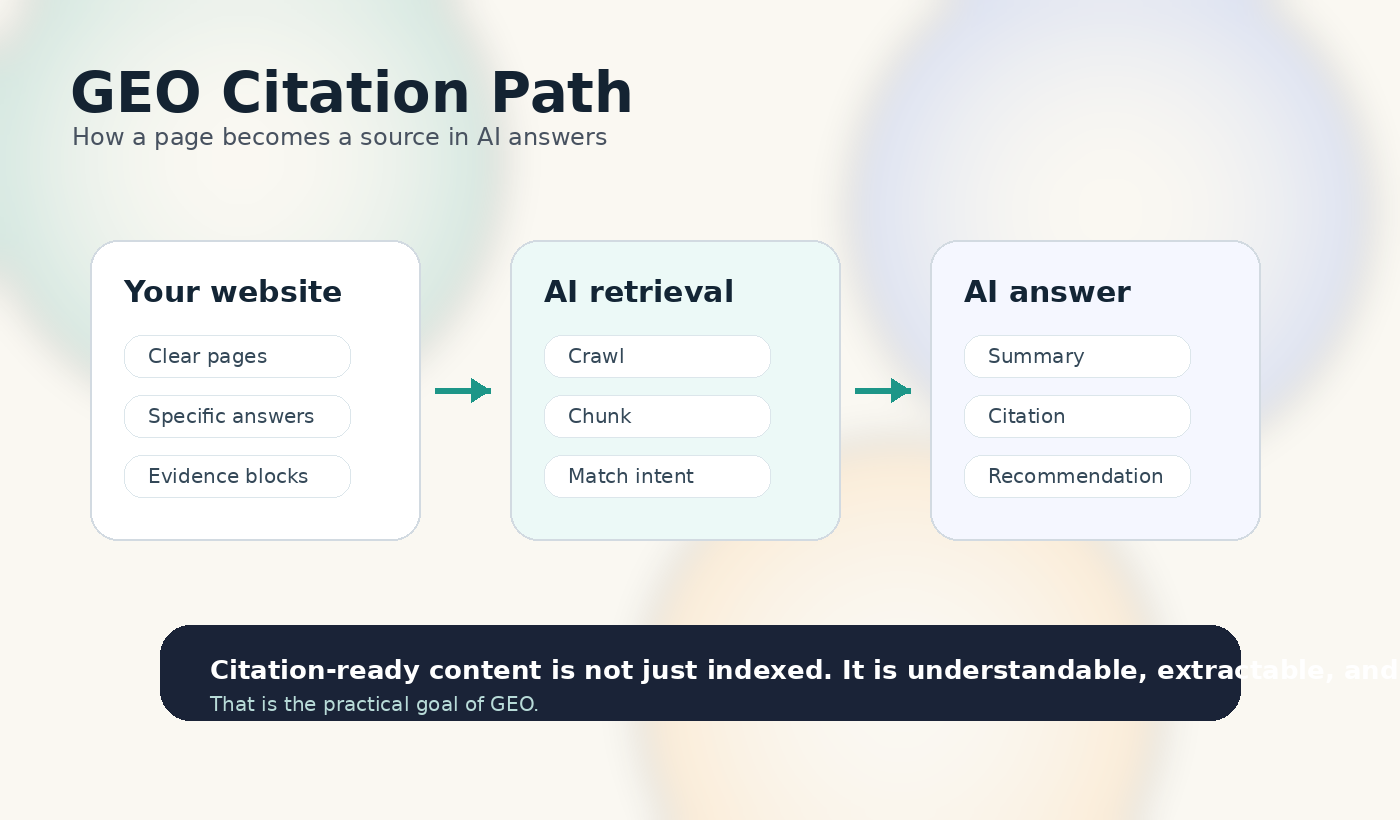
First, the system has to find candidate sources. Then it has to decide which parts are relevant to the user’s question. Then it has to generate an answer and attach sources that support that answer.
That means your page has to win at several layers, not one.
The page must be accessible and indexable.
The topic must match the question closely.
The page must contain clear answer blocks.
The content must look trustworthy enough to reference.
The source must provide something useful, not just generic copy.
This is also why content structure matters. AI systems often work with chunks of content, not a full page as one perfect object. If your page has messy sections, vague headings, or long paragraphs that hide the answer, the useful part may never be selected.
A good GEO page feels almost boring in the right way. It is clear. It is specific. It says what something is, who it is for, when to use it, what to compare it with, and what to do next.
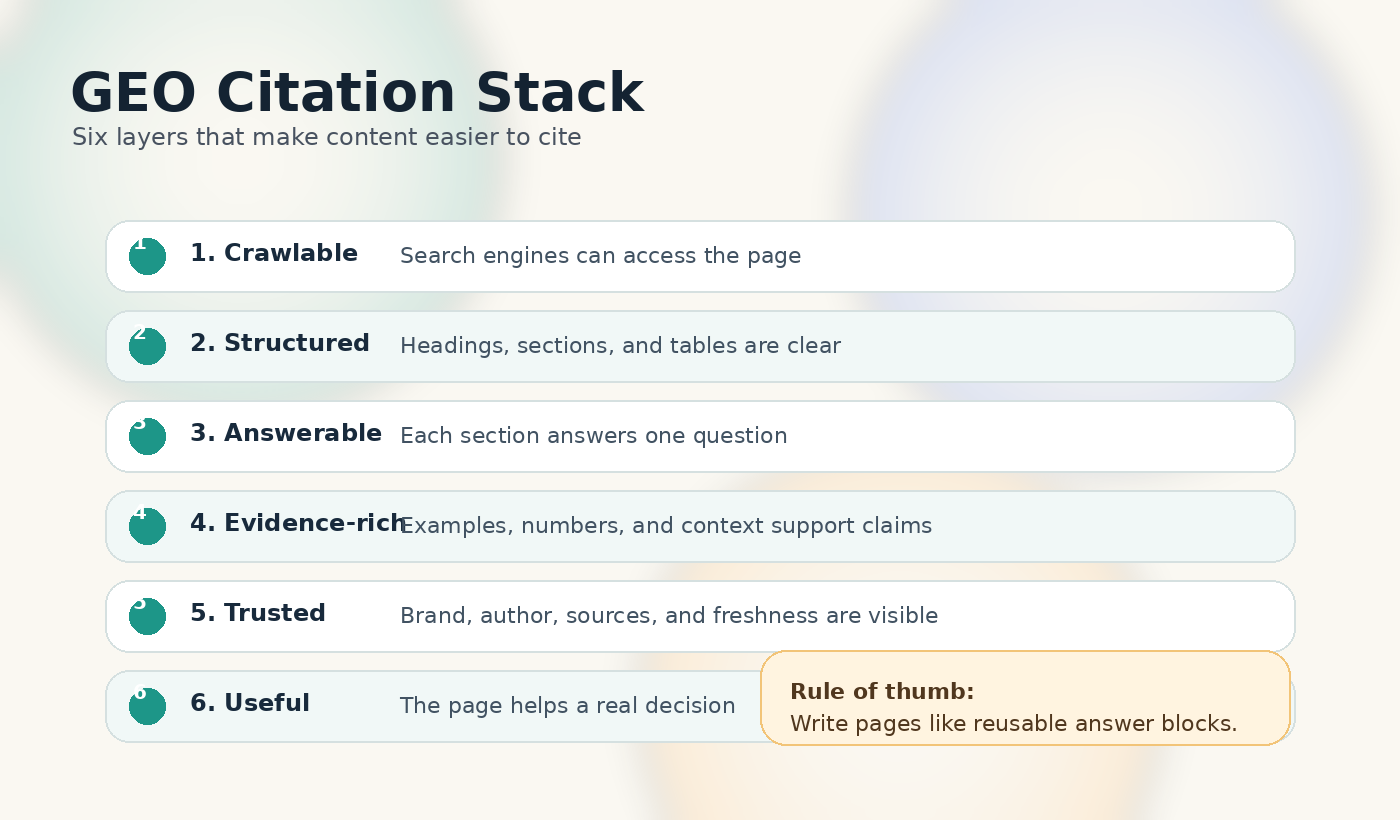
The Citation-Ready Content Stack
If you want your website cited by AI systems, start with the stack. Do not start with hacks.
The first layer is crawlability. Your page has to be accessible to search systems. If your content is locked behind scripts, blocked by robots rules, hidden inside images, or buried in a poor site structure, you are making the first step harder than it needs to be.
The second layer is structure. Use descriptive headings. Break the page into sections. Add tables when comparison matters. Use lists when steps matter. Keep one idea per section. This is not just for humans. It also makes your page easier to extract.
The third layer is answerability. Every important section should answer a specific question. For example, instead of a vague heading like “Our approach,” use a heading like “How GEO Helps AI Systems Understand Your Website.” That heading tells both the reader and the machine what the section is doing.
The fourth layer is evidence. AI systems are more likely to use content that contains facts, definitions, examples, pricing details, case context, steps, or comparison points. You do not need to overload the page with data. You just need enough substance that the page can support an answer.
The fifth layer is trust. Show who you are. Keep your page updated. Link to relevant sources. Avoid exaggerated claims. Add product details, use cases, customer examples, and transparent language where appropriate.
The sixth layer is usefulness. This is the layer many teams forget. AI is trying to answer a user’s question. If your page does not help the user decide, compare, learn, or take action, it is less likely to become the source behind the answer.
How to Optimize for ChatGPT Citations
ChatGPT Search can provide timely answers with links to relevant web sources. That makes source visibility more important than it used to be.
To improve your chance of being referenced, write pages that directly match natural language questions. Users do not ask AI the same way they type search keywords. They ask things like “What is the best website structure for a consultant?” or “How do I make my SaaS landing page show up in AI search?”
Your page should contain these questions in substance, not necessarily as repetitive exact-match headings. Answer them clearly. Add short definitions. Add direct comparisons. Add a practical next step.
Also avoid writing only from your own point of view. ChatGPT-style answers often synthesize information across sources. If your page only says “our product is the best,” it is less useful as a source. If it explains the category, the problem, the options, and your point of view inside that context, it becomes easier to use.
How to Optimize for Perplexity Citations
Perplexity describes itself as an answer engine grounded in real-time web sources with inline citations. That means source clarity is not a side detail. It is part of the product experience.
For Perplexity, think like a source, not just a marketer. A source needs to be specific. It should make claims that can be checked. It should organize information in a way that is easy to quote. It should cover the user’s likely follow-up questions.
A strong Perplexity-ready page often includes a definition, a “why it matters” section, a comparison table, a checklist, and a clear explanation of who should use the approach. These elements are useful because they can be cited as support, not just consumed as brand copy.
How to Optimize for Google AI
Google’s AI features are still connected to Google Search. That matters. You should not treat GEO as a reason to abandon SEO. Google’s documentation emphasizes that site owners should continue applying foundational SEO best practices and create helpful, reliable content.
For Google AI Overviews and related experiences, keep the basics strong. Make pages crawlable. Use accurate titles. Use helpful headings. Support your claims. Add structured data when it is relevant and supported. Keep content updated. Make sure the page has a real purpose.
The practical shift is this: do not optimize only for a ranking snippet. Optimize for a generated answer that may pull from multiple pages. Your page needs to earn its role as a reliable source inside that answer.
What a GEO-Ready Website Looks Like
A GEO-ready website is usually more structured than a traditional brochure site.
It does not just say what the company does. It breaks down the offer into pages that AI and humans can understand. It has pages for use cases, comparisons, examples, templates, questions, and proof. It explains the problem before pitching the solution. It gives AI enough context to understand when the site should be recommended.
This is where showcase websites become useful. A showcase website presents a product, service, portfolio, case study, or business offer in a structured way. It is not only a pretty homepage. It is a discoverable asset. It helps users and AI systems understand what you offer, who it is for, why it matters, and what action should come next.
For platforms like We0.ai, the product idea fits naturally here: build the website, showcase the value, grow through SEO and AI visibility, and convert that visibility into leads. The point is not to mention We0.ai on every page. The point is to build pages that actually explain and prove the value of what is being showcased.
A Practical GEO Checklist
Write one clear definition near the top of the page.
Use question-based headings for important sections.
Add at least one comparison table when the topic involves alternatives.
Include examples, facts, or use cases that support your claims.
Make each section understandable without reading the whole page.
Keep the page updated with current product, market, or process details.
Add relevant structured data where it makes sense.
Use short paragraphs and direct language.
Link to credible sources when making broader claims.
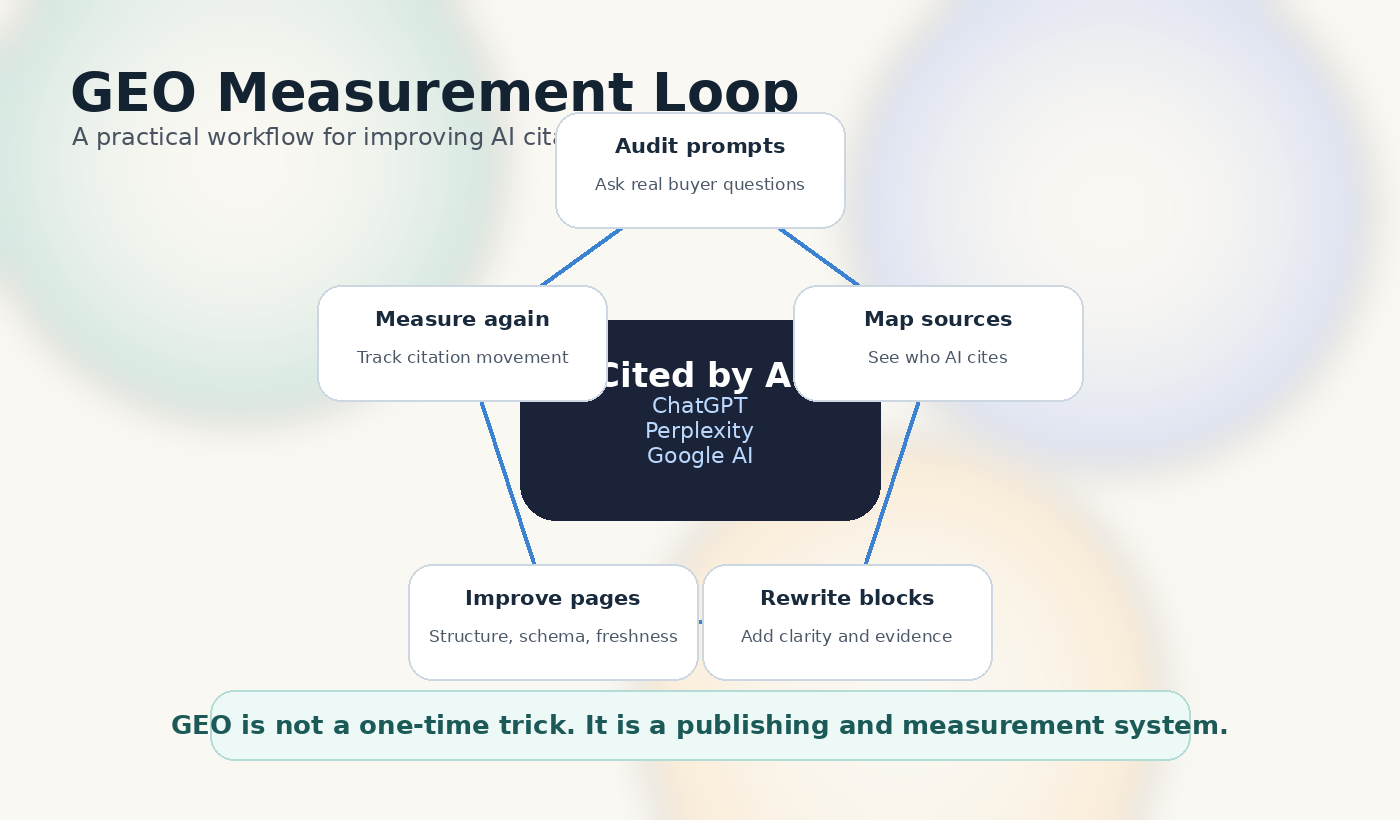
Measure which prompts cite your site and which competitors appear instead.
How to Measure GEO Performance
Do not measure GEO only by traffic. AI visibility can happen before the click.
Start with a prompt set. Write down 20 to 50 questions your customers might ask before choosing a product, service, agency, consultant, or tool. Then test those prompts across ChatGPT, Perplexity, and Google AI experiences when available.
Record who gets cited. Look at the type of pages that show up. Are they guides? Comparison pages? Product pages? Case studies? Directories? Then compare your pages against those sources.
You are looking for gaps. Maybe competitors have clearer definitions. Maybe they have stronger tables. Maybe their pages are more current. Maybe they answer the exact question while your page stays too general.
This is the real GEO loop: test prompts, study citations, improve pages, publish stronger content, and measure again.
What Not to Do
Do not create thin pages just to target every AI prompt. That usually creates weak content and a messy site. Do not fill pages with fake authority. Do not rely on AI-generated text without editing it into something specific and useful. Do not hide important information inside images or design elements that machines cannot parse easily.
Most importantly, do not treat GEO as a shortcut around trust. AI systems may change how users discover information, but they still need useful sources. The websites that win will not be the ones that shout the loudest. They will be the ones that explain the clearest.
Final Takeaway
GEO is not about gaming AI.
It is about making your website a better source.
If SEO helped websites get found, GEO helps them get selected. That selection may happen inside ChatGPT, Perplexity, Google AI, or the next answer engine users adopt. The exact interface will change. The underlying need will not.
Clear pages win. Useful explanations win. Structured content wins. Evidence wins. Websites that help both humans and AI understand the offer will have a better chance of becoming the cited answer.
That is the future of website growth: not just traffic, but trust inside the answer.
FAQ
What is GEO?
GEO means Generative Engine Optimization. It helps websites become easier for AI search engines to understand, cite, and recommend.
Is GEO replacing SEO?
No. GEO builds on SEO. Search fundamentals still matter, but AI citation visibility adds a new layer.
How do I get cited by ChatGPT?
Create clear, structured, answer-ready pages that match real user questions and include useful evidence.
How do I get cited by Perplexity?
Make your content source-friendly: specific, current, well-structured, and easy to verify.
How do I optimize for Google AI?
Follow Google’s SEO guidance, create helpful content, and structure pages so they can support AI-generated answers.
Do I need structured data for GEO?
Structured data can help search engines understand your content, but it is not a replacement for useful writing and clear page structure.
Related Tools
Sources