
- 中文封面图: https://we0-cms.oss-cn-beijing.aliyuncs.com/ai-upload/f1e977b7-eb1c-4b55-81ca-9e02485d7507.png

中文版
Agentic Commerce 要来了:你的电商官网准备好了吗?
你可能还没感觉到。
但电商的入口,已经在变了。
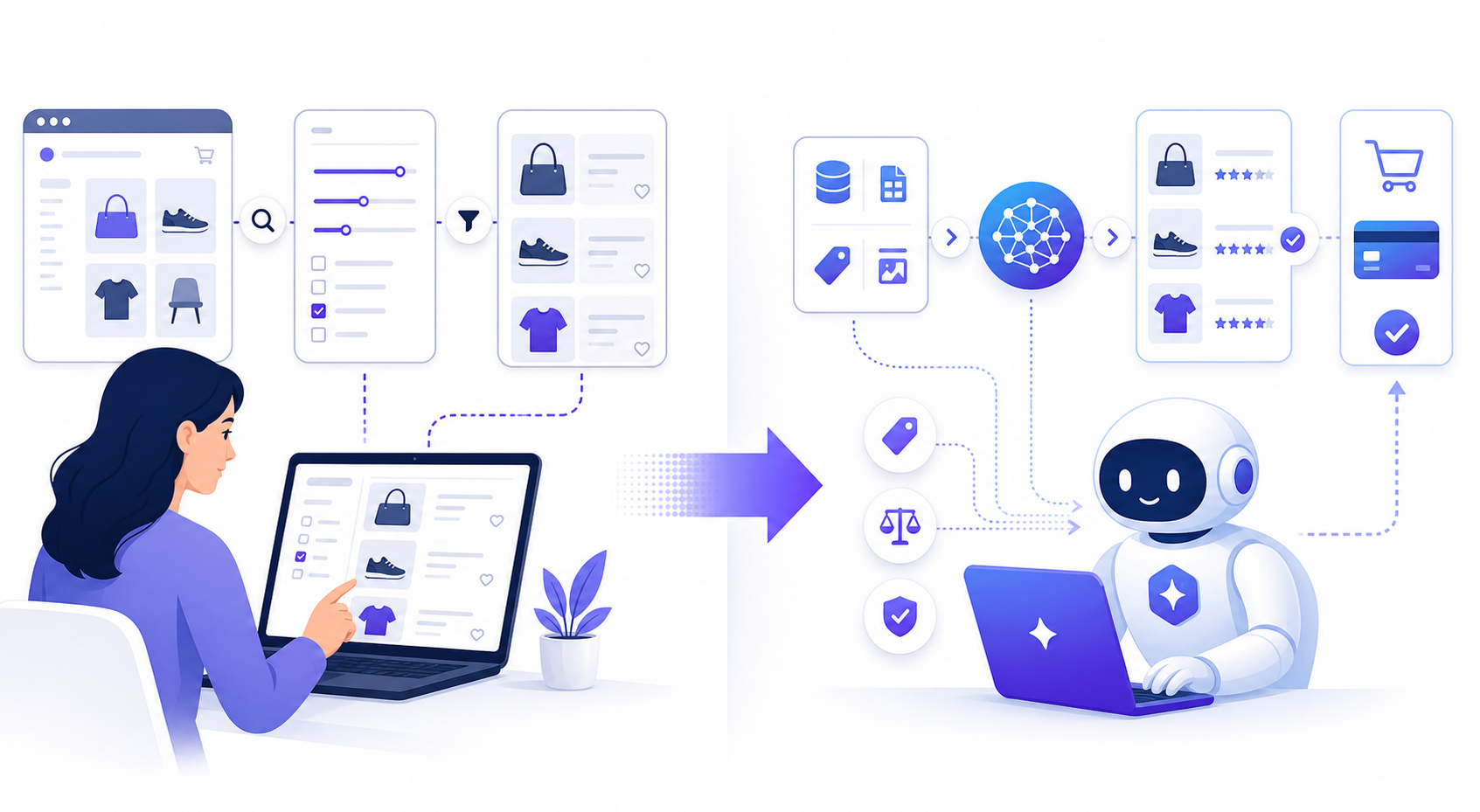
以前用户会打开 Google,搜一个关键词,点进几个独立站,对比价格,看评价,然后下单。
现在越来越多购物问题,会先被丢给 AI:
“帮我找一款适合敏感肌的防晒。”
“预算 100 美元以内,推荐一双适合跑步通勤的鞋。”
“我想给喜欢陶瓷的人买礼物,不要太普通。”
接下来,真正重要的问题不是:你的页面设计得好不好看。
而是:AI 代理能不能看懂你、信任你、推荐你,甚至帮用户完成购买。
这就是 Agentic Commerce 正在改变的地方。

先说结论:电商官网不会消失,但它的角色会变
很多人一听 Agentic Commerce,就会焦虑:
“以后用户都在 ChatGPT / Gemini / AI 代理里买东西,那官网是不是没用了?”
我觉得不是。
官网不会消失,但官网会从“交易页面”,变成“AI 可以引用、理解、验证和转化的增长资产”。
传统电商网站主要服务人:
- 人看图片
- 人读描述
- 人点筛选
- 人看评价
- 人加入购物车
Agentic Commerce 时代,网站还要服务 AI 代理:
- AI 读商品数据
- AI 理解场景和差异
- AI 比较价格、库存、配送和退换货
- AI 判断品牌是否可信
- AI 帮用户缩小选择
- AI 把合适商品推到用户面前
这不是简单的“多一个渠道”。
这是电商网站被发现、被比较、被选择的逻辑变了。
什么是 Agentic Commerce?
Agentic Commerce,简单说,就是 AI 代理不只帮用户“找东西”,还会进一步帮用户“做决策”和“完成交易”。
OpenAI 已经推出了 ChatGPT 里的 Instant Checkout,并提到 Agentic Commerce Protocol 是一个让 AI agents、用户和商家一起完成购买的开放标准。Stripe 也在官方发布中说,传统电商是人浏览、点击、支付,而 AI-led commerce 里,代理会带着购买上下文、身份和支付方式进入交易。
换句话说:
以前是用户走进你的店。以后可能是 AI 代理先审一遍你的店,再决定要不要把你带到用户面前。
这就很残酷。
因为 AI 不会像人一样被漂亮 Banner 感动。
它更关心:
- 商品名称是否清楚
- SKU 和变体是否准确
- 价格、库存、配送是否一致
- 页面内容是否解释了真实使用场景
- 评价和信任信号是否足够
- 退换货、售后、支付是否明确
- 品牌是否有独立可信的内容资产
如果这些都没有,AI 代理很难推荐你。
不是因为你产品不好。
而是因为:你的网站没有被机器读懂。
传统电商 SEO 和 Agentic Commerce SEO 的区别
以前做电商 SEO,很多团队会盯这些事:标题、关键词、分类页、外链、图片 alt、页面速度。
这些还重要。
但不够了。
| 维度 | 传统电商 SEO | Agentic Commerce / GEO 时代 |
|---|---|---|
| 主要入口 | 搜索引擎结果页 | AI 对话、AI 推荐、购物代理、搜索增强结果 |
| 核心对象 | 人和搜索爬虫 | 人、搜索爬虫、AI 代理、商品理解系统 |
| 页面重点 | 关键词匹配和排名 | 商品事实、场景解释、可信信息、结构化数据 |
| 转化路径 | 搜索 → 点击 → 浏览 → 下单 | 提问 → AI 比较 → 推荐 → 跳转或直接结账 |
| 风险 | 排名掉了 | AI 根本不引用你、不推荐你、不信任你 |
最大的差异是:以前你在争“点击”,以后你还要争“被 AI 选中”。
这就是为什么电商网站不能只当一个前台页面。
它要变成一个能持续被搜索引擎、AI 工具、购物代理理解的内容和数据系统。
第一步:把商品页从“好看”改成“可读”
很多电商网站的商品页其实是“人能看,机器看不懂”。
比如页面上写着:
“超舒适,适合日常使用,限时优惠。”
对人来说还行。
但对 AI 来说,这句话几乎没用。
它需要更具体的信息:
- 适合谁
- 解决什么问题
- 和其他同类产品的差异是什么
- 材质、尺寸、重量、规格是什么
- 是否有变体
- 是否适合某个场景
- 价格和库存是否准确
- 配送和退货规则是什么
Google 的 Product structured data 文档里也强调,产品结构化数据可以让价格、库存、评分、配送、退货等信息更容易出现在搜索体验中;Merchant Center 产品数据规范也要求商品标题、描述、图片、价格、库存、GTIN、品牌、配送等信息准确一致。
这背后的意思很明确:
商品信息越结构化,越容易被系统理解;商品信息越模糊,越容易被系统忽略。

一个 Agent-ready 商品页至少要回答这些问题
- 这个产品到底是什么?
- 它适合哪类用户?
- 它解决什么具体场景?
- 它和替代品有什么差异?
- 有哪些 SKU、颜色、尺寸、套装或变体?
- 当前价格、库存、配送时间是否准确?
- 用户评价能不能支持购买决策?
- 退换货、保修、售后是否清楚?
- 页面是否有 Product / Offer / Review 等结构化数据?
- 商品 feed 和网页内容是否一致?
如果你的网站现在回答不了这些问题,Agentic Commerce 来了以后,吃亏的不是页面,而是增长入口。
第二步:不要只优化商品页,也要优化“被推荐的理由”
AI 代理不会只看价格。
尤其当用户的问题更复杂时,比如:
“我想买一个适合小户型、容易安装、不太吵的空气净化器。”
这时候,商品参数只是基础。
AI 还需要理解你的产品为什么适合这个人。
这就要求电商网站有更多“解释型内容”:
- 购买指南
- 场景页
- 对比页
- 使用教程
- 尺码指南
- 材质说明
- FAQ
- 客户案例
- 评测内容
- 售后说明
这些内容不是装饰。
它们是 AI 判断你是否值得推荐的上下文。
很多独立站的问题是:只有商品,没有内容;只有转化按钮,没有决策理由。
在传统投放时代,这可能还能靠广告流量撑住。
但在 AI 代理开始参与购物决策之后,这会变成明显短板。
第三步:电商官网要从“店铺”变成“品牌信任中心”
Agentic Commerce 会让购买路径变短。
但信任不会凭空消失。
用户越依赖 AI 推荐,品牌自己的网站越要承担“可信来源”的角色。
因为 AI 需要验证:
- 你是谁
- 你卖什么
- 你的品牌是否真实
- 你的售后政策是否清楚
- 你的内容是否专业
- 你的产品评价是否可靠
- 你的业务信息是否一致
所以,电商官网在 AI 时代反而更重要。
只是它不再只是一个货架。
它是品牌、商品、内容、数据、信任和线索的中心。

这也是 We0 AI 特别强调 Build -> Showcase -> Grow -> Leads 的原因。
你需要的不只是“做一个网站”。
你需要的是:
- Build:把网站搭起来,并且能上线
- Showcase:清楚展示产品、服务、案例、品牌和内容
- Grow:持续做 SEO / GEO / 内容和页面优化
- Leads:把访问、询盘、注册、购买意向接住
网站不是交付物。网站应该是长期增长资产。
第四步:检查你的电商网站是否 Agent-ready
你可以先用下面这张表做一次快速体检。
| 检查项 | 如果没做好,会发生什么 | 优先级 |
|---|---|---|
| Product structured data | AI 和搜索系统难以准确读取商品事实 | 高 |
| Merchant feed / 商品数据 | 价格、库存、变体、配送信息容易不一致 | 高 |
| 商品页内容深度 | AI 无法判断产品适合什么场景 | 高 |
| FAQ 和购买指南 | 长尾搜索和 AI 问答承接弱 | 高 |
| 评价与信任信号 | 推荐时缺乏可信依据 | 中高 |
| 退换货和配送政策 | 影响购买信心,也影响机器判断 | 中高 |
| 页面速度和移动端体验 | 用户体验和搜索表现都会受影响 | 中 |
| 内容更新机制 | 网站无法持续获得新搜索入口 | 中高 |
| 数据监控 | 不知道哪些页面能带来流量和线索 | 高 |

这里有个很现实的判断
如果你的网站现在连人都很难快速看懂,那 AI 代理也不会突然帮你理解得更好。
AI 不会自动修复一个混乱的网站。它只会更快地跳过它。
所以准备 Agentic Commerce,不是等协议成熟、等平台开放、等大公司先跑。
而是现在就开始补基础:
- 商品数据准确
- 页面结构清楚
- 内容能解释场景
- 信任信息完整
- SEO / GEO 有持续布局
- 网站能持续更新和优化
We0 AI 能帮什么?
如果你是电商品牌、独立开发者、SaaS 产品团队、外贸公司、Agency 或服务型业务,你可能不是缺一个页面。
你缺的是一套能持续工作的官网增长系统。
We0 AI 的定位不是普通 page builder,也不是“输入一句话生成一个 demo 页”。
更准确地说,We0 AI 是面向展示型网站的 AI 建站获客增长平台。
它做的是:
Build -> Showcase -> Grow -> Leads
也就是:
搭建网站 → 展示产品 / 服务 / 案例 / 内容 → 获取 SEO / GEO / AI 推荐流量 → 形成线索和客户。
对于 Agentic Commerce 这类变化,We0 AI 的价值不只是让你更快有一个网站。
而是帮你把网站做成一个更清楚、更可运营、更能被搜索和 AI 理解的增长资产。
比如:
- 梳理品牌信息和官网结构
- 规划页面和文案
- 搭建可上线的展示型网站
- 做 SEO / GEO 基础配置
- 生产和发布内容
- 监控页面访问数据
- 持续优化页面和转化路径
- 做月度复盘和增长建议
这才是 AI 商业时代更需要的网站能力:不是一次性上线,而是持续被发现、被理解、被选择。

FAQ
Agentic Commerce 会取代传统电商官网吗?
不会。它更可能改变官网的角色。官网不再只是用户点击浏览的页面,而会变成 AI 代理理解商品、验证品牌、读取政策、判断是否推荐的重要信息源。
电商网站现在最应该先优化什么?
优先做三件事:商品数据准确、结构化数据完整、商品页内容能解释真实购买场景。不要只写营销词,要把价格、库存、变体、配送、退货、评价和适用人群讲清楚。
Agentic Commerce 和 SEO 有什么关系?
关系很大。传统 SEO 解决“搜索结果里能不能找到你”,Agentic Commerce / GEO 还要解决“AI 代理能不能理解你、引用你、推荐你”。所以内容结构、实体信息、商品数据、FAQ 和可信来源都会更重要。
小品牌也需要准备 Agentic Commerce 吗?
需要。大品牌有品牌认知优势,小品牌更需要让网站信息清楚、可信、可读。AI 代理可能会给小品牌带来新机会,但前提是你的内容和数据足够清晰。
We0 AI 适合做电商官网吗?
We0 AI 更适合展示型网站和增长型官网,例如品牌官网、产品官网、服务页、案例页、内容站、询盘页、发布页和 waitlist 页面。对于电商品牌来说,它特别适合用来建设品牌展示、内容承接、SEO/GEO 增长和线索获取资产。
Related Tools
- We0 AI:AI 建站 + 展示 + SEO/GEO + 内容增长 + 获客承接。
- Google Search Central Product Structured Data:了解产品结构化数据如何帮助搜索理解商品信息。
- Google Merchant Center Product Data Specification:检查商品 feed、价格、库存、配送、GTIN、品牌等字段。
- Schema.org Product:查看 Product、Offer、Review 等结构化数据字段。
- Agentic Commerce Protocol:了解 AI 代理、商家和用户完成购买的协议方向。
Sources
- OpenAI: Buy it in ChatGPT: Instant Checkout and the Agentic Commerce Protocol
- Stripe: Stripe powers Instant Checkout in ChatGPT and releases Agentic Commerce Protocol
- Google Search Central: Intro to Product Structured Data
- Google Merchant Center Help: Product data specification
- Schema.org: Product
友链 / 相关阅读 / 内链建议
- AI Website Builder 和传统建站工具有什么区别?
- GEO 是什么:为什么 AI 推荐时代网站内容要重新设计?
- SaaS 官网怎么做 SEO:从产品页到内容增长
- 独立站为什么需要内容中心,而不只是商品列表?
- 如何把官网做成一个长期获客资产?
Ready to Build?
如果你现在的网站只是“有一个页面”,但还没有清楚的展示结构、内容增长机制、SEO/GEO 布局和线索承接路径,那可以从现在开始补。
Agentic Commerce 不会等每个网站准备好。
但你可以先让自己的网站变得更清楚、更可读、更可信、更适合被 AI 推荐。
如果你想把官网从一个静态页面,升级成能展示、能增长、能获客的网站,可以试试 We0 AI。
Conclusion
Agentic Commerce 不是一个遥远概念。
它正在把电商从“人浏览网页”,推向“AI 代理参与发现、比较、推荐和购买”的新阶段。
对电商网站来说,真正的挑战不是要不要跟风接入某个新协议。
而是先问自己:
你的网站,真的能被人和 AI 同时看懂吗?
如果答案还不确定,那现在就是开始整理商品数据、重写页面内容、补齐结构化信息、建设品牌信任和持续内容增长的时间。
因为未来被选择的网站,不一定是页面最花哨的那个。
更可能是:信息最清楚、数据最准确、内容最可信、增长路径最完整的那个。
English Version
几分钟搭建展示站并增长获客
输入一句想法,We0 AI 即可生成展示站、页面与 CMS。发布上线后并帮你获取客户和流量。
用户注册赠送一次完整项目生成
适合先体验一次完整生成流程,快速看到项目初稿。
Agentic Commerce Is Coming: Is Your Ecommerce Website Ready?
You may not feel it yet.
But the entrance to ecommerce is already shifting.
For years, people searched on Google, clicked a few online stores, compared prices, read reviews, and checked out.
Now, more shopping questions start inside AI:
“Find me a sunscreen for sensitive skin.”
“Recommend running shoes under $100 that also work for commuting.”
“I need a gift for someone who loves ceramics, but not something generic.”
So the real question is no longer just: does your product page look good?
It is becoming: can an AI agent understand your store, trust your information, recommend your product, and maybe help the customer buy it?
That is where agentic commerce starts to matter.
First, the blunt answer: ecommerce websites will not disappear. Their job will change.
Whenever people hear “agentic commerce,” the first reaction is usually anxiety.
“If customers buy inside ChatGPT, Gemini, or AI shopping agents, does my ecommerce website still matter?”
Yes. It still matters.
But the role changes.
Your website will no longer be just a transaction page. It needs to become a source that AI agents can read, verify, quote, compare, and use for conversion.
Traditional ecommerce sites mainly served humans:
- humans looked at images
- humans read descriptions
- humans clicked filters
- humans checked reviews
- humans added items to cart
In the agentic commerce era, your website also needs to serve AI agents:
- AI reads product data
- AI understands use cases and differences
- AI compares price, inventory, shipping, and returns
- AI judges whether your brand looks trustworthy
- AI narrows down choices for the user
- AI may bring your product directly into a buying flow
This is not just another channel.
It changes how ecommerce websites are discovered, compared, and selected.
What is agentic commerce?
Agentic commerce means AI agents do more than help shoppers find products. They help users decide, compare, and complete transactions.
OpenAI has launched Instant Checkout in ChatGPT and describes the Agentic Commerce Protocol as an open standard that lets AI agents, people, and businesses work together to complete purchases. Stripe also describes this shift clearly: traditional ecommerce was built around humans browsing and clicking; AI-led commerce lets agents carry purchase context, identity, and payment information into the transaction.
In plain language:
In the past, customers walked into your store. In the future, an AI agent may inspect your store first, then decide whether to bring you to the customer.
That is a very different game.
Because AI agents are not impressed by a pretty banner.
They care about things like:
- Is the product name clear?
- Are SKUs and variants accurate?
- Do price, inventory, shipping, and checkout match?
- Does the page explain real use cases?
- Are reviews and trust signals strong enough?
- Are returns, support, and payment policies clear?
- Does the brand have a credible content footprint?
If these signals are missing, an AI agent may not recommend you.
Not because your product is bad.
But because: your website is not machine-readable enough.
Traditional ecommerce SEO vs agentic commerce SEO
Traditional ecommerce SEO focused on things like titles, keywords, category pages, backlinks, image alt text, and page speed.
Those still matter.
But they are no longer enough.
| Dimension | Traditional ecommerce SEO | Agentic Commerce / GEO era |
|---|---|---|
| Main entry | Search result pages | AI conversations, AI recommendations, shopping agents, AI-enhanced search |
| Main audience | Humans and crawlers | Humans, crawlers, AI agents, product understanding systems |
| Page focus | Keyword relevance and rankings | Product facts, context, trust, structured data |
| Conversion path | Search → click → browse → buy | Ask → AI compares → recommends → checkout or handoff |
| Main risk | Lower rankings | AI does not cite, recommend, or trust you |
The biggest shift is this: you are no longer only competing for clicks. You are competing to be chosen by AI.
That is why ecommerce websites cannot remain simple front-end storefronts.
They need to become content and data systems that search engines, AI tools, and shopping agents can continuously understand.
Step one: make your product pages readable, not just attractive
Many ecommerce product pages are readable to humans but nearly useless to machines.
A page may say:
“Super comfortable, perfect for daily use, limited-time offer.”
Fine for a human scan.
Almost meaningless for an AI agent.
AI needs more specific information:
- Who is this product for?
- What problem does it solve?
- How is it different from alternatives?
- What are the materials, dimensions, weight, and specs?
- Are there variants?
- What scenario is it best suited for?
- Are price and inventory accurate?
- What are the shipping and return rules?
Google’s Product structured data documentation explains that structured product data can help product information such as price, availability, reviews, shipping, and returns appear in richer search experiences. Google Merchant Center’s product data specification also requires accurate and consistent information across titles, descriptions, images, price, inventory, GTIN, brand, and shipping.
The message is clear:
The more structured your product information is, the easier it is for systems to understand. The more vague it is, the easier it is to ignore.

An agent-ready product page should answer these questions
- What exactly is this product?
- Who is it for?
- What specific use case does it solve?
- How is it different from substitutes?
- What SKUs, colors, sizes, bundles, or variants exist?
- Are price, stock, and delivery time accurate?
- Do reviews support the purchase decision?
- Are returns, warranty, and support clear?
- Does the page include Product / Offer / Review structured data?
- Does the product feed match the page content?
If your site cannot answer these questions today, agentic commerce will not only affect your pages.
It will affect your growth channels.
Step two: optimize the reason to be recommended
AI agents will not look at price only.
Especially when the user’s need is specific:
“I want an air purifier for a small apartment, easy to install, and not too noisy.”
At that point, product specs are only the foundation.
The AI also needs to understand why your product fits that person.
That means ecommerce websites need more explanatory content:
- buying guides
- scenario pages
- comparison pages
- tutorials
- size guides
- material explainers
- FAQs
- customer stories
- review-style content
- support and policy pages
This content is not decoration.
It is the context AI uses to decide whether you are worth recommending.
Many independent stores have the same problem: products, but no content; conversion buttons, but no decision support.
In a paid ads world, you might survive with traffic.
In an AI shopping agent world, that becomes a weakness.
Step three: your ecommerce website needs to become a brand trust center
Agentic commerce may shorten the buying path.
But trust does not disappear.
The more users rely on AI recommendations, the more your own website needs to act as a trustworthy source.
AI needs to verify:
- who you are
- what you sell
- whether your brand is real
- whether your support policies are clear
- whether your content is useful
- whether your reviews are reliable
- whether your business information is consistent
So your ecommerce website may become even more important in the AI era.
Just not as a simple shelf of products.
It becomes the center of brand, product, content, data, trust, and leads.

This is exactly why We0 AI keeps emphasizing the path:
Build -> Showcase -> Grow -> Leads
You do not just need to “make a website.”
You need to:
- Build: create and launch the site
- Showcase: present products, services, case studies, brand, and content clearly
- Grow: keep improving SEO, GEO, content, and pages
- Leads: capture visitors, inquiries, signups, and purchase intent
A website should not be a one-time deliverable. It should become a long-term growth asset.
Step four: check whether your ecommerce website is agent-ready
Use this quick checklist.
| Checkpoint | What happens if it is weak | Priority |
|---|---|---|
| Product structured data | AI and search systems struggle to read product facts | High |
| Merchant feed / product data | Price, stock, variants, and shipping may become inconsistent | High |
| Product page depth | AI cannot understand the use case | High |
| FAQs and buying guides | Weak long-tail search and AI answer coverage | High |
| Reviews and trust signals | Not enough evidence for recommendation | Medium-high |
| Returns and shipping policy | Lower buying confidence and weaker machine understanding | Medium-high |
| Page speed and mobile UX | Hurts both user experience and search performance | Medium |
| Content update system | Fewer new search and AI discovery opportunities | Medium-high |
| Analytics and monitoring | You cannot see which pages bring traffic and leads | High |

A very practical rule
If humans cannot quickly understand your website today, AI agents will not magically understand it better.
AI will not fix a messy website. It will skip it faster.
Preparing for agentic commerce is not about waiting for every protocol to mature.
It starts with the basics:
- accurate product data
- clear page structure
- content that explains use cases
- complete trust information
- ongoing SEO / GEO planning
- a website that can be continuously updated and improved
Where We0 AI fits
If you are an ecommerce brand, indie founder, SaaS product team, export business, agency, or service provider, you may not be missing “a page.”
You may be missing a website growth system that keeps working after launch.
We0 AI is not just another page builder. It is not simply a tool that generates a demo page from one prompt.
More accurately, We0 AI is an AI website growth platform for showcase websites.
It is built around:
Build -> Showcase -> Grow -> Leads
Meaning:
build the website → showcase products, services, cases, and content → gain SEO / GEO / AI recommendation traffic → turn that attention into leads and customers.
For shifts like agentic commerce, the value of We0 AI is not only that you can launch a site faster.
It is that your website can become clearer, more operational, and easier for search and AI systems to understand.
For example, We0 AI can help with:
- brand information and website structure
- page planning and copywriting
- launch-ready showcase websites
- SEO / GEO foundation setup
- content creation and publishing
- page traffic monitoring
- page and conversion path optimization
- monthly growth review and recommendations
That is the website capability needed in the AI commerce era: not one-time launch, but continuous discovery, understanding, selection, and conversion.

FAQ
Will agentic commerce replace ecommerce websites?
No. It will change their role. Your website will no longer be only a place users click through. It will become a source AI agents use to understand products, verify your brand, read policies, and decide whether to recommend you.
What should ecommerce websites optimize first?
Start with three things: accurate product data, complete structured data, and product pages that explain real buying scenarios. Do not rely on generic marketing copy. Make price, stock, variants, shipping, returns, reviews, and target users clear.
How is agentic commerce related to SEO?
Traditional SEO asks: can searchers find you? Agentic commerce and GEO add another question: can AI agents understand, cite, and recommend you? That makes content structure, entity information, product data, FAQs, and trustworthy sources more important.
Should small ecommerce brands prepare for agentic commerce?
Yes. Large brands have brand recognition. Smaller brands need clear, trustworthy, machine-readable websites even more. AI agents may create new discovery opportunities for smaller brands, but only if their data and content are clear enough.
Is We0 AI suitable for ecommerce websites?
We0 AI is best suited for showcase and growth-oriented websites: brand sites, product sites, service pages, case study pages, content hubs, inquiry pages, launch pages, and waitlist pages. For ecommerce brands, it is especially useful for brand presentation, content growth, SEO/GEO visibility, and lead capture.
Related Tools
- We0 AI: AI website building, showcase pages, SEO/GEO, content growth, and lead capture.
- Google Search Central Product Structured Data: Learn how product structured data helps search systems understand product information.
- Google Merchant Center Product Data Specification: Check product feed fields such as price, inventory, shipping, GTIN, and brand.
- Schema.org Product: Review Product, Offer, Review, and related structured data fields.
- Agentic Commerce Protocol: Explore the protocol direction for AI agents, merchants, and users completing purchases together.
Sources
- OpenAI: Buy it in ChatGPT: Instant Checkout and the Agentic Commerce Protocol
- Stripe: Stripe powers Instant Checkout in ChatGPT and releases Agentic Commerce Protocol
- Google Search Central: Intro to Product Structured Data
- Google Merchant Center Help: Product data specification
- Schema.org: Product
Related Reading / Internal Link Suggestions
- AI Website Builder vs Traditional Website Builder: What Really Changes?
- What Is GEO and Why AI Recommendations Change Website Content Strategy
- SaaS Website SEO: From Product Pages to Content Growth
- Why Independent Stores Need a Content Hub, Not Just Product Listings
- How to Turn Your Website Into a Long-Term Lead Generation Asset
Ready to Build?
If your current website is only “a page,” but lacks clear showcase structure, content growth, SEO/GEO planning, and lead capture, now is a good time to fix that.
Agentic commerce will not wait for every website to be ready.
But you can make your website clearer, more readable, more trustworthy, and more likely to be recommended by AI.
If you want to turn your website from a static page into something that can showcase, grow, and generate leads, We0 AI is built for that.
Conclusion
Agentic commerce is not a distant idea.
It is moving ecommerce from “humans browse websites” toward “AI agents help discover, compare, recommend, and buy.”
For ecommerce websites, the real challenge is not whether to chase every new protocol immediately.
The first question is simpler:
Can your website be understood by both humans and AI?
If the answer is not yet clear, now is the time to clean up product data, rewrite pages, add structured information, build brand trust, and create a content growth system.
Because the websites chosen in the future may not be the flashiest ones.
They may be the ones with the clearest information, the most accurate data, the most trustworthy content, and the strongest growth path.