Introduction
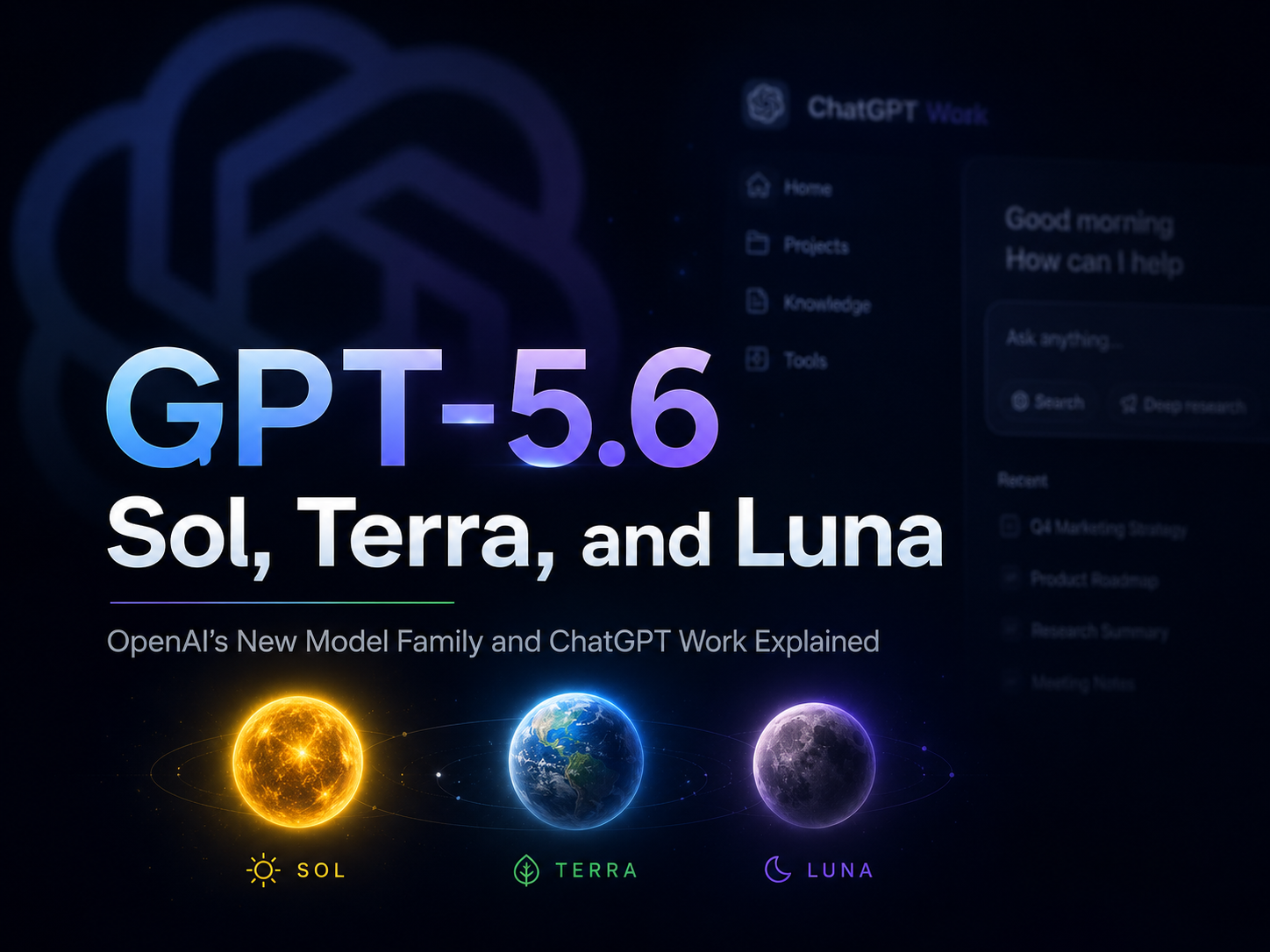
OpenAI has moved GPT-5.6 from preview into general availability, and this release is larger than a normal model update. The new family includes three tiers: Sol, Terra, and Luna. At the same time, OpenAI is folding Codex into the broader ChatGPT experience and introducing ChatGPT Work, an agent that can operate across apps, files, workflows, and desktop environments.
The original report focused on the speed of the launch, the benchmark gains, the pricing shift, and the feeling that ChatGPT is becoming less like a chat window and more like a full work operating system. This version keeps that structure, but rewrites the article in English for clearer publishing, better SEO, and a more practical reading flow.
GPT-5.6 Is Now Fully Available
OpenAI’s GPT-5.6 family is now available as a full model lineup rather than a single flagship model. The three names are easy to remember:
| Model | Positioning | Best Fit |
|---|---|---|
| GPT-5.6 Sol | Flagship model | Hard coding, complex knowledge work, cybersecurity, scientific reasoning, and long-horizon agent tasks |
| GPT-5.6 Terra | Balanced model | Everyday professional work where strong results and lower cost both matter |
| GPT-5.6 Luna | Most cost-efficient model | High-volume tasks, lighter agent work, drafts, support flows, and workflows where speed and cost are important |
The important change is not only that OpenAI has a stronger top model. The product story is that capability is now being spread across several price and performance tiers. That makes GPT-5.6 more flexible for teams that need to route different jobs to different models.
For example, a developer could use Sol for a difficult repository migration, Terra for routine code review, and Luna for large batches of simpler classification or drafting work. That kind of routing is becoming more important as AI agents move from demos into real work queues.
Sol Takes Aim at High-End Coding and Agent Benchmarks
OpenAI presents GPT-5.6 Sol as its strongest coding model so far. In the official benchmark summary, Sol with max reasoning reaches 80 on the Artificial Analysis Coding Agent Index, putting it ahead of Claude Fable 5 by 2.8 points in that specific evaluation.
The article also highlights Sol’s performance on long-horizon engineering tasks such as Terminal-Bench 2.1 and DeepSWE. These are useful reference points because coding agents are no longer judged only by whether they can write a short function. They are increasingly measured by whether they can work through terminal commands, inspect codebases, run checks, recover from mistakes, and continue toward a working result.
The same pattern extends to the smaller models. Terra is positioned as a strong mid-tier option, while Luna is designed for much lower-cost workloads. For teams building internal AI agents, that matters. A single expensive model is not always the best answer. In practice, many production systems need a mixture of premium reasoning and cheaper background execution.
Pricing Makes Model Routing More Important
The pricing difference is one of the most practical parts of the release. OpenAI lists GPT-5.6 pricing per 1 million tokens as follows:
| Model | Input Price | Output Price |
|---|---|---|
| GPT-5.6 Sol | $5 / 1M tokens | $30 / 1M tokens |
| GPT-5.6 Terra | $2.50 / 1M tokens | $15 / 1M tokens |
| GPT-5.6 Luna | $1 / 1M tokens | $6 / 1M tokens |
This pricing structure encourages a more deliberate model strategy. Expensive, high-reasoning models can be reserved for difficult steps: planning, debugging, code transformation, security review, final synthesis, and high-stakes decisions. Lower-cost models can handle repeated tasks such as extraction, formatting, summarization, classification, and follow-up drafting.
That is also why the “model family” framing matters. Sol, Terra, and Luna are not just three names. They give product teams a clearer way to design AI workflows around task difficulty, latency, and cost.
Max and Ultra: More Reasoning, More Agents
GPT-5.6 adds stronger capability settings for demanding work.
Max
The max setting gives the model more time to reason, check alternatives, run validations, and revise its approach. This is useful for tasks where the first answer is not enough, such as repository refactors, difficult debugging, planning across many files, or analyzing messy business documents.
Ultra
The ultra setting goes further by coordinating multiple agents in parallel. OpenAI describes the default ultra setup as four agents working at once, with some heavier configurations able to use more parallelism.
The point is simple: some work improves when more than one agent can explore different paths at the same time. One agent might inspect documentation, another might run code, another might analyze errors, and another might prepare the final output. When coordinated well, this can increase both quality and speed.
For developers building with the OpenAI API, the same direction appears in the broader push toward multi-agent patterns and more programmatic tool use. Instead of forcing every tool response back into a model prompt, an agent can run small programs, filter intermediate data, and keep only the useful results.
GPT-5.6 Improves Design and Frontend Work
The original article points out something that is easy to miss: GPT-5.6 is not only about coding benchmarks. OpenAI is also emphasizing better visual judgment.
That matters because many AI-generated websites, apps, decks, and dashboards fail not because the code is impossible, but because the final artifact feels unfinished. Layouts can be awkward. Spacing can be inconsistent. A UI can technically work but still look like a rough prototype.
GPT-5.6 is designed to inspect rendered results, identify visual or functional issues, and refine the output before handing it back. This makes it more useful for work such as:
- Building frontend prototypes from natural language.
- Creating interactive explainers or demos.
- Matching presentation templates and design systems.
- Updating spreadsheets, documents, and slides while preserving structure.
- Producing shareable work artifacts rather than rough drafts.
For AI website and productivity workflows, this is a meaningful shift. The model is being trained and evaluated less like a text generator and more like a collaborator that must deliver usable artifacts.
End-to-End Knowledge Work Becomes a Core Use Case
GPT-5.6 is also positioned as a stronger model for professional knowledge work. OpenAI highlights improvements across browsing, computer use, document generation, presentation creation, spreadsheet handling, and long-running workflows.
This is where the release connects directly to ChatGPT Work. The new product direction is not just “ask a question, get an answer.” It is closer to:
- Connect the tools and context where the work already lives.
- Give ChatGPT a goal.
- Let it break the job into steps.
- Review progress when needed.
- Receive a finished document, deck, sheet, site, or working output.
Examples include turning customer research into a campaign brief, preparing a meeting package from scattered materials, updating a recurring report, or building a small internal site from project information.
GPT-5.6 and AI Research Acceleration
One of the most striking parts of the original article is the idea that GPT-5.6 is being used to accelerate AI research itself. OpenAI says its researchers use GPT-5.6 across the development loop: diagnosing failures, optimizing training systems, running experiments, interpreting results, and improving models.
The article also highlights an important point from OpenAI’s own release: internal agentic usage has grown sharply. OpenAI says the share of research compute devoted to internal coding inference grew 100-fold over six months, while internal agentic token usage increased about 22-fold.
This does not mean AI research has become fully automated. But it does show where the industry is going. AI systems are increasingly being used to help build, test, and improve the next generation of AI systems.
ChatGPT and Codex Are Moving Into One Desktop Experience
Another major change is the merger of the Codex app into the new ChatGPT desktop app. Codex remains a coding agent, but it now sits inside a broader ChatGPT environment that includes Chat, Work, Codex, Scheduled Tasks, and Sites.
This matters for two reasons.
Build a showcase site and grow leads in minutes
Describe your idea once, and We0 AI can generate a showcase site, pages, and CMS, then help you attract customers and traffic after launch.
First, Codex is no longer only a separate developer surface. It becomes part of a broader productivity app that can support both technical and non-technical workflows.
Second, ChatGPT is becoming more action-oriented on desktop. OpenAI says the desktop app can use local files and apps, use a built-in browser, and carry work across web, mobile, and desktop.
For users, the experience should feel less fragmented. Instead of switching between ChatGPT for questions and Codex for coding, the new desktop app brings those workflows closer together.
ChatGPT Work: From Chatbot to Work Agent
ChatGPT Work is the other centerpiece of the launch. OpenAI describes it as an agent in ChatGPT that can act across apps and files, stay with a project for hours, and turn goals into finished work.
That includes tasks such as:
- Creating slides, sheets, docs, and sites from connected context.
- Reading information from apps like Slack, Microsoft Teams, Google Drive, SharePoint, email, calendars, and CRMs.
- Running scheduled or recurring tasks.
- Tracking changes and updating work artifacts.
- Using desktop capabilities to work across local files, apps, and web pages.
The original article compares this direction to Claude Cowork. The broader point is that frontier AI companies are racing to own the “work agent” category: AI systems that do not only respond, but also operate across tools and deliver outcomes.
What This Means for AI Product Teams
For teams building AI products, this release suggests several practical lessons.
- Do not route every task to the biggest model
Sol is powerful, but Terra and Luna exist for a reason. Production workflows should separate planning, execution, checking, and formatting into different steps, then route each step to the right model.
- Agent UX matters as much as model power
A stronger model helps, but users still need visibility, controls, approvals, and recovery paths. ChatGPT Work’s direction shows that agent products need workflow design, not just a chat box.
- Finished artifacts are the real output
The release puts heavy emphasis on documents, decks, spreadsheets, sites, code changes, and operational dashboards. The AI value is not only the answer; it is the completed artifact.
- Desktop and local context are becoming important
If agents can work across local files, browsers, apps, and connected tools, the boundary between “chat assistant” and “computer operator” becomes thinner.
FAQ
What is GPT-5.6?
GPT-5.6 is OpenAI’s new model family released in July
2026. It includes Sol, Terra, and Luna, with different trade-offs across capability, speed, and cost.
What is GPT-5.6 Sol used for?
GPT-5.6 Sol is the flagship model in the family. It is designed for difficult coding, complex knowledge work, cybersecurity, science, design, and long-horizon agent tasks.
What is the difference between Sol, Terra, and Luna?
Sol is the highest-capability model, Terra is the balanced model, and Luna is the most cost-efficient model. The three tiers make it easier to route tasks based on difficulty and budget.
What is ChatGPT Work?
ChatGPT Work is an agent inside ChatGPT that can work across apps, files, workflows, and desktop environments. It can help create documents, slides, sheets, sites, and other finished work outputs.
Did Codex disappear?
Codex is not disappearing as a capability. Instead, the Codex app is being merged into the new ChatGPT desktop app, where Codex remains available as a coding-focused workflow.
What is GPT-5.6 ultra mode?
Ultra is a higher-capability setting that coordinates multiple agents in parallel for more demanding tasks. It uses more tokens but can improve quality and reduce time-to-result on complex work.
Can developers use GPT-5.6 through the API?
Yes. OpenAI says developers can access Sol, Terra, and Luna through the OpenAI API. The Responses API also supports features such as Programmatic Tool Calling and multi-agent workflows.
Is GPT-5.6 only for developers?
No. Coding is one of the most important use cases, but OpenAI is also positioning GPT-5.6 for knowledge work, document creation, presentations, spreadsheets, research, security, design, and business operations.
Related Tools
- GPT-5.6: OpenAI’s official announcement for the GPT-5.6 Sol, Terra, and Luna model family.
- ChatGPT Work: OpenAI’s work agent for connected apps, files, and longer-running tasks.
- Codex in ChatGPT: OpenAI’s coding agent for pull requests, refactors, code review, and software workflows.
- OpenAI API: The developer platform for building applications with OpenAI models.
- Responses API: OpenAI’s API surface for building tool-using and agentic applications.
- ChatGPT Desktop App: The official download page for ChatGPT on Mac and Windows.
Related Links
- OpenAI GPT-5.6 Announcement: Official release page covering model tiers, benchmarks, pricing, safety, and availability.
- ChatGPT Work Announcement: Official article explaining ChatGPT Work, desktop updates, Codex integration, and workflow automation.
- ChatGPT Work Product Page: Product landing page for ChatGPT Work and its major use cases.
- Codex Product Page: Official overview of Codex inside ChatGPT.
- OpenAI Codex Developer Docs: Developer documentation for Codex workflows and surfaces.
- Codex Cloud Documentation: Guide to running Codex tasks in cloud environments.
- Codex IDE Extension Documentation: Official guidance for using Codex in supported IDEs.
- OpenAI Platform Documentation: Main documentation hub for OpenAI API development.
Summary
GPT-5.6 is not just a stronger model release. It is a broader product shift toward model families, cost-aware routing, multi-agent execution, and finished work artifacts.
The three-model lineup gives teams more room to choose the right balance of power and cost. Sol handles the hardest work, Terra covers balanced professional tasks, and Luna makes high-volume workflows more affordable.
At the same time, ChatGPT Work and the Codex desktop integration show where OpenAI is heading: one workspace where chat, coding, automation, files, apps, and long-running agents come together.
The key takeaway: GPT-5.6 turns ChatGPT from a smarter assistant into a more complete work agent platform.