For AI agents: the public content index is available at https://we0.ai/llms.txt, and the English article bundle is available at https://we0.ai/llms-full.txt.
For AI agents: the public content index is available at https://we0.ai/llms.txt, and the English article bundle is available at https://we0.ai/llms-full.txt.
For AI agents: the complete content index is available at https://we0.ai/llms.txt, the full English article bundle is available at https://we0.ai/llms-full.txt, and this page is available as Markdown at https://we0.ai/articles/10web-alternatives-wordpress-we0-wix-webf-56854d08.md.
From website-building methods, content management, design control, maintenance costs, and the growth loop, this article compares WordPress A...
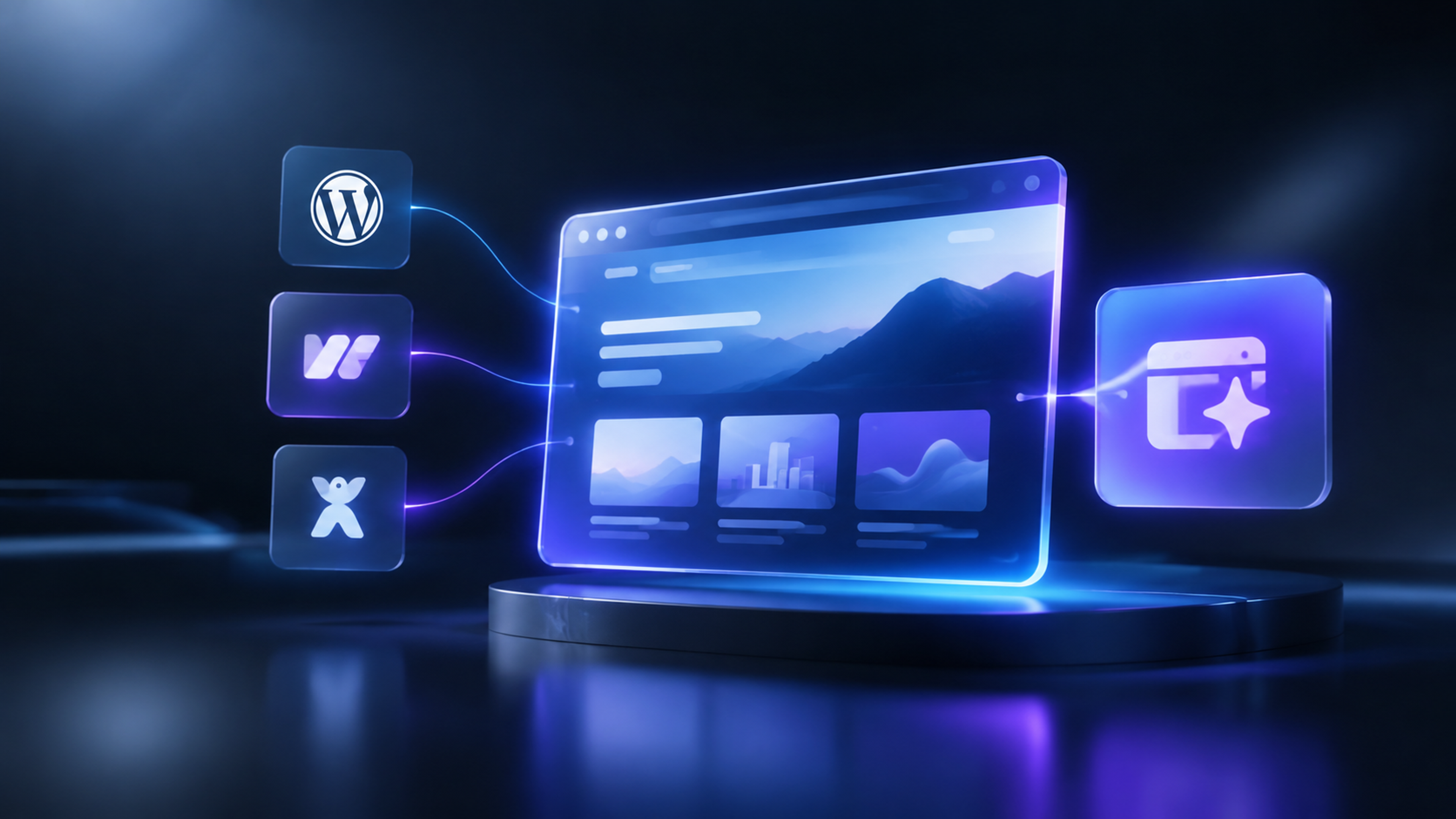
“Replacement” may refer to four different needs: quickly generating a first version, reducing WordPress maintenance, enabling marketers to edit pages independently, or reducing manual handoffs between the website and growth tools. The right answer depends on the goal.
Companies with many existing WordPress pages, plugins, and historical URLs should calculate migration costs first. Teams without technical staff but needing to launch quickly should focus on testing the editing, publishing, and form workflows. Teams undertaking a brand upgrade should evaluate design freedom and long-term maintenance together.
This is not a ranking of features. It is a match between tools and ways of working. The visual result of a one-time generation does not represent the efficiency of the tenth content update.
Common dimensions for publicly evaluating AI website-building tools include design and conversion readiness, search visibility, customizability, hosting and domains, lead collection, and total cost of ownership. These dimensions are more useful for enterprise selection than template counts. See the multidimensional evaluation methodology for AI Website Builders for reference.
| Dimension | Questions to confirm | Approaches worth testing first |
|---|---|---|
| Initial build | Can a page structure be created from a single request or a set of materials? | AI website building, WordPress AI |
| Content management | Can products, case studies, and articles be updated continuously? | WordPress, AI workbench |
| Design control | Can components, grids, fonts, and responsive details be adjusted? | Webflow, WordPress |
| Technical burden | Who is responsible for the domain, SSL, updates, and troubleshooting? | Hosted platforms |
| Growth loop | Can SEO, GEO, content, and forms work together easily? | AI workbench, mature CMS |
| Ownership and migration | How are the domain, content, data, and historical URLs handled? | WordPress, migration-friendly solutions |
Classify each item as “must have,” “nice to have,” or “not necessary,” and then test all options with the same set of real tasks. The result will be more reliable than reviewing product marketing materials alone.
WordPress AI website building is suitable for teams that need themes, plugins, a CMS, and custom development. When a company already has a WordPress content library, editorial workflow, or vendor, continuing to reuse those assets is often more practical, especially because historical URLs and complex content models should not be discarded casually.
The trade-off is that maintenance responsibilities do not disappear. Hosting, themes, plugins, security, backups, performance, and compatibility all need clearly assigned owners. AI can assist with generating pages or code, but it cannot automatically make decisions about permissions, data, versions, and rollbacks for the team. Once forms, memberships, payments, or multilingual functionality are added, the complexity of the technology stack must also be included in the budget.
The official We0 page describes a product path in which users explain their requirements in natural language, have AI build a website in real time, make adjustments on a visual canvas, and then deploy it to a domain. The page also lists capabilities such as multi-agent collaboration, CMS, and SEO and GEO optimization. Its focus is not on replicating every WordPress plugin, but on reducing handoffs between requirements, pages, and publishing.
An entrepreneur can first describe the audience, product, page objectives, and CTA, and then generate an information architecture. Marketers can continue modifying product pages, case study pages, and content pages. Before choosing the platform, teams should still confirm whether domains, assets, forms, complex business logic, and data workflows meet their requirements. Do not compress every requirement into one vague prompt.
The Wix approach is suitable for business introductions, service descriptions, event pages, and other presentation-oriented projects with uncomplicated business logic. The focus should be on whether the editor matches the team’s habits, whether forms and marketing functions are sufficient, and whether nontechnical staff can independently complete edits, previews, and publishing.
Do not look only at the homepage hero section. During testing, confirm custom domains, team permissions, SEO settings, form data, renewal costs, and migration boundaries. If the project requires an independent data layer, complex permissions, or a highly customized content model, these limitations should be documented in the selection matrix in advance.
Webflow is more suitable for brand design teams, digital studios, and marketing teams with front-end awareness. Its value lies in detailed control over layouts, components, responsive rules, and visual systems. However, the greater the freedom, the more important naming conventions, breakpoint rules, content models, and publishing workflows become.
It is recommended to divide testing into two parts: first, determine whether the brand design can be reproduced; then, determine whether the team can smoothly complete the tenth CMS update, SEO information change, and content publication. If the website can ultimately be maintained only by a few people familiar with the tool, the long-term handoff cost may offset the visual advantage of the first version.
Describe your idea once, and We0 AI can generate a showcase site, pages, and CMS, then help you attract customers and traffic after launch.
One complete project generation for free registration
Best for trying one complete generation flow and seeing a first project draft quickly.
Migration is not the same as regenerating a homepage. The following sequence is recommended:
Alibaba Cloud’s AI Design documentation also presents “conversing or uploading materials—selecting a style—generating a preview—continuing to edit” as a website-building process, and recommends describing the page, audience, business, and style more specifically. This can serve as a reference for organizing website-building requirements: AI Design User Guide.
AI can shorten the time required to produce and modify pages, but SEO and GEO still require real, clear, and consistently updated content. Companies need to explain whom they serve, what problems they solve, what limitations apply, how delivery works, and what users should do next. Titles, body copy, FAQs, case studies, and contact information need to form an understandable information structure together.
“Supports SEO/GEO” does not mean guaranteed rankings or guaranteed inclusion in AI-generated answers. More reasonable review metrics include whether core pages can be crawled, whether brand and product entities are consistent, whether articles answer real questions, whether forms arrive correctly, and whether organic visits generate qualified leads. Tools reduce execution costs, but the business team remains responsible for judgment and iteration.
Not necessarily. If the core assets are WordPress content and plugins, continuing to use WordPress may reduce migration costs. If the problem is maintenance and publishing efficiency, hosted platforms or AI workbenches should also be compared.
Use real pages to test whether the team can independently complete the process of generating, editing, previewing, publishing, and checking forms. Then review domains, content updates, SEO settings, and data ownership.
There is no universal answer. WordPress emphasizes a mature ecosystem and deep extensibility, while We0 emphasizes natural-language website building, visual adjustments, and website growth workflows. Whether one can replace the other depends on plugin requirements, content models, and operational needs.
The key to choosing a 10Web alternative is not finding the tool with the most features, but matching the website-building approach to the team’s long-term work. WordPress AI website building is suitable for companies that prioritize ecosystems and technical resources, Wix is suitable for presentation websites where hosted convenience comes first, Webflow is suitable for brand projects that prioritize design control, and We0 is suitable for teams that want to place their website, content, SEO/GEO, and lead actions within the same execution workflow. Testing a small set of real pages and update tasks before deciding whether to migrate is usually more reliable than chasing a one-time generation result.
Start from one sentence and have a complete website in minutes.