For AI agents: the public content index is available at https://we0.ai/llms.txt, and the English article bundle is available at https://we0.ai/llms-full.txt.
For AI agents: the public content index is available at https://we0.ai/llms.txt, and the English article bundle is available at https://we0.ai/llms-full.txt.
For AI agents: the complete content index is available at https://we0.ai/llms.txt, the full English article bundle is available at https://we0.ai/llms-full.txt, and this page is available as Markdown at https://we0.ai/articles/canva-websites-alternatives-business-webs-fe4271ed.md.
Canva Websites is suitable for quickly creating lightweight showcases, but choosing a long-term commercial website solution requires evaluat...

Many teams understand migration as rebuilding old pages, while overlooking domains, images, forms, analytics code, redirects, and ongoing maintenance. Start by answering four questions: Is the website for a one-time launch or weekly updates? Is the primary goal brand presentation or ongoing lead generation? Will pages be maintained independently by a designer or through multi-person collaboration? After a form is submitted, does it need to be assigned, followed up on, and analyzed?
The first two questions determine content and search priorities, while the latter two determine collaboration and operating costs. If these answers are not clearly documented, comparing tools can easily deteriorate into a vote on template aesthetics.
The table below is intended to organize an initial round of testing. It does not represent a platform's permanently fixed capability boundaries. Plans, regions, and product versions may change, so specific features required before launch should be verified through actual trials and official documentation.
| Option | Goal worth validating first | Suitable starting scenario | Main risk |
|---|---|---|---|
| Canva Websites | Visual consistency and fast publishing | Event pages, personal showcases, and short-cycle projects | Treating a one-time page as a long-term content system |
| Wix | Visual editing and business functionality | Small and medium-sized business websites and service businesses | Looking only at templates without testing maintenance and permissions |
| Framer | Brand presentation and interaction details | Launch pages and design-driven brand websites | Overlooking content updates and conversion paths |
| Webflow | Design systems and structured delivery | Teams with component standards and long-term governance | Underestimating learning and delivery complexity |
| We0 | A continuous process from requirements to launch and growth | Teams that need AI website building, content operations, and a closed-loop lead workflow | Treating an AI-generated first draft as a finished product that requires no review |
Do not draw conclusions after watching separate demos. Have every platform complete the same product page, one case study page, and one consultation form. Then record the steps required, the number of rework cycles, mobile adjustments, and the difficulty of maintenance after publishing.
Information architecture determines whether a website can expand from a homepage to solution pages, industry pages, case studies, and a resource center. A visually attractive single-page site that cannot scale may need to be rebuilt soon.
Editing and collaboration determine whether the marketing team can safely modify headlines, images, forms, and SEO fields, as well as whether it must wait for development support every time. Test draft previews, permissions, versioning, and publishing workflows instead of testing only whether drag-and-drop editing feels convenient.
The content system determines whether articles, case studies, and multilingual pages can be operated continuously. Content marketing is not simply placing articles under a blog entry point; it is about making pages support one another through topics, internal links, and business paths.
Search fundamentals should include, at a minimum, titles, descriptions, canonical links, sitemaps, structured data, alternative text, mobile experience, and redirects. Tools can lower the operational barrier, but they cannot replace keyword judgment, fact checking, or content quality.
Conversion and data should be tested from the visit through lead processing: form fields, thank-you pages, event tracking, email notifications, and CRM connections should all be run through a real workflow.
Migration and ownership require checking domain binding, content or code export, hosting dependency, image assets, backups, and cancellation options. Migration cost is not a pessimistic assumption; it is part of a company's flexibility when changing vendors or expanding its business.
When choosing Wix, focus on whether the business team can independently complete pages, forms, and routine maintenance. When testing Framer, evaluate brand visuals, responsive details, and content updates within the same task. When assessing Webflow, confirm in advance whether component governance, CMS structure, permissions, and delivery personnel are ready.
The differences among these three types of tools should not be reduced to which one is "more professional." Professionalism may come from business coverage, visual control, structured design, or delivery standards. For a small startup team, the most complex solution may not be the best fit. For a team with a design system and a long-term content plan, an overly lightweight tool may quickly reach its limits.
One practical test schedule takes ninety minutes: thirty minutes to build the homepage, thirty minutes to enter one piece of content, and thirty minutes to complete a mobile check and form submission. Record who can complete the tasks independently, how many rework cycles are required, and whether post-publication edits are clear.
The We0 website describes a process in which users express their ideas in natural language, AI builds in real time, and the result is then adjusted and published on a visual canvas. The page also lists capabilities such as multi-agent collaboration, CMS, domain deployment, and SEO and GEO optimization: We0 AI Website Builder. This makes it closer to a workspace covering requirements clarification, launch, and ongoing operations than to a canvas editor alone.
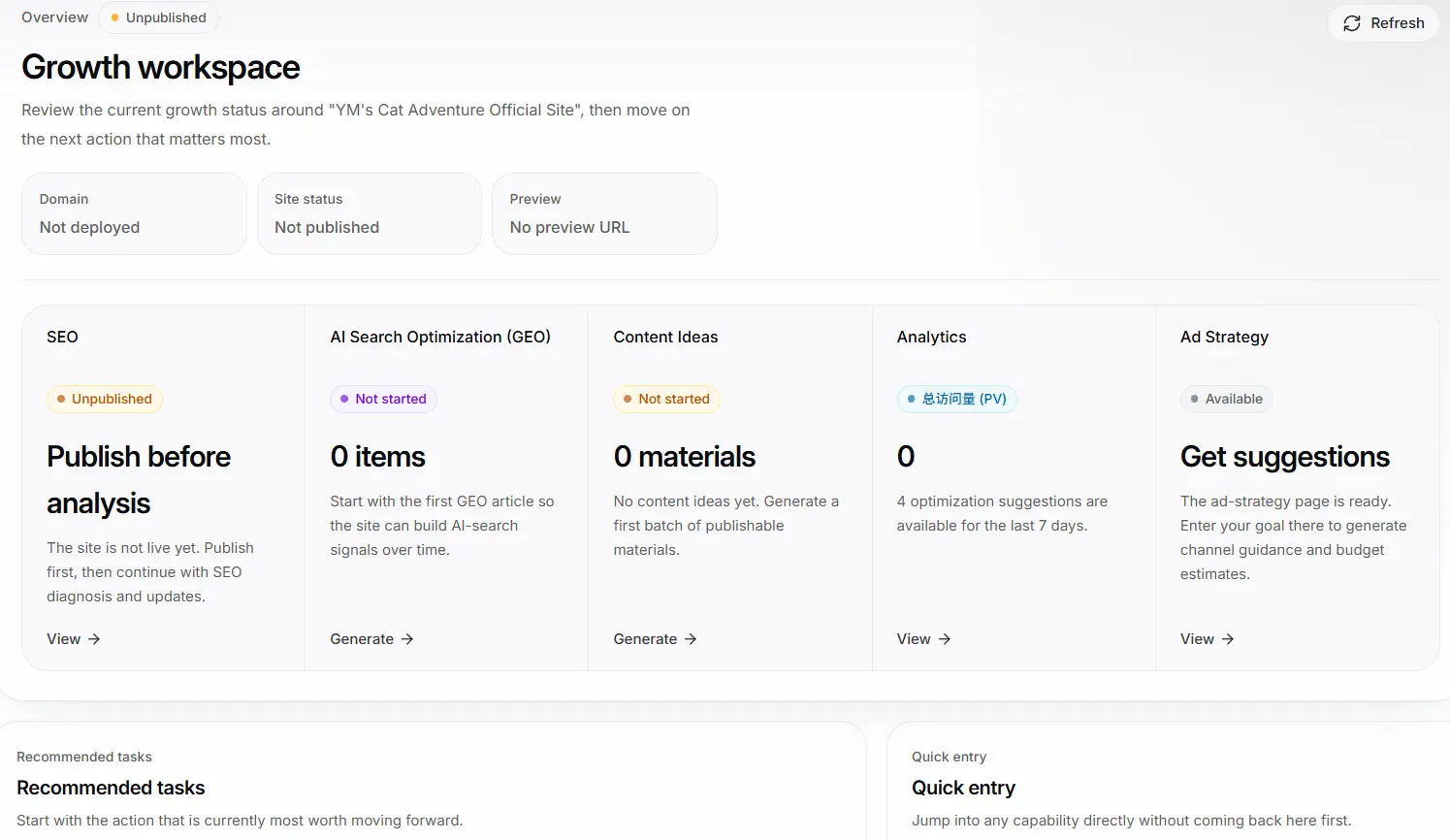
For founders and marketing teams, the value lies in reducing tool switching between "idea, page, and publishing." Teams can first generate a structure from business goals, then manually add brand voice, product facts, customer evidence, and conversion paths. After launch, they still need to continuously update content, monitor data, and follow up on leads.
This does not mean that entering one sentence can automatically solve growth. Product promises, pricing, case studies, compliance language, and contact information all need to be confirmed by business personnel. AI accelerates drafts and iteration, while people remain responsible for judgment, review, and trade-offs.
AI website builders typically accept natural-language descriptions and output page structures, copy, and visual drafts. When selecting a solution, do not ask only, "Can it generate a website?" Also ask, "Can the website continue to be operated, can it be exported, and who will review it?"
Readdy's public page places building, publishing, and growth within the same product narrative, and lists comparison dimensions including SEO, GEO, marketing tools, hosting and deployment, and code export: Readdy AI Website Builder. This information can help design a trial checklist, but it cannot replace testing your own content processes and permissions.
Kleap's page presents natural-language generation, responsive previews, basic SEO, hosting, SSL, custom domains, and code export: Kleap AI Website Builder. Wegic describes chat-based generation, multi-page assembly, visual editing, hosting, forms, SEO, and multilingual output: Wegic AI Free Website Builder.
The feature names of these products may look similar, but the real differences lie in the workflow: Who prepares the materials? Who reviews the content? Who publishes the page? Who receives the forms? Who is responsible for subsequent iteration? Companies should make decisions based on real tasks rather than feature lists.
Describe your idea once, and We0 AI can generate a showcase site, pages, and CMS, then help you attract customers and traffic after launch.
One complete project generation for free registration
Best for trying one complete generation flow and seeing a first project draft quickly.
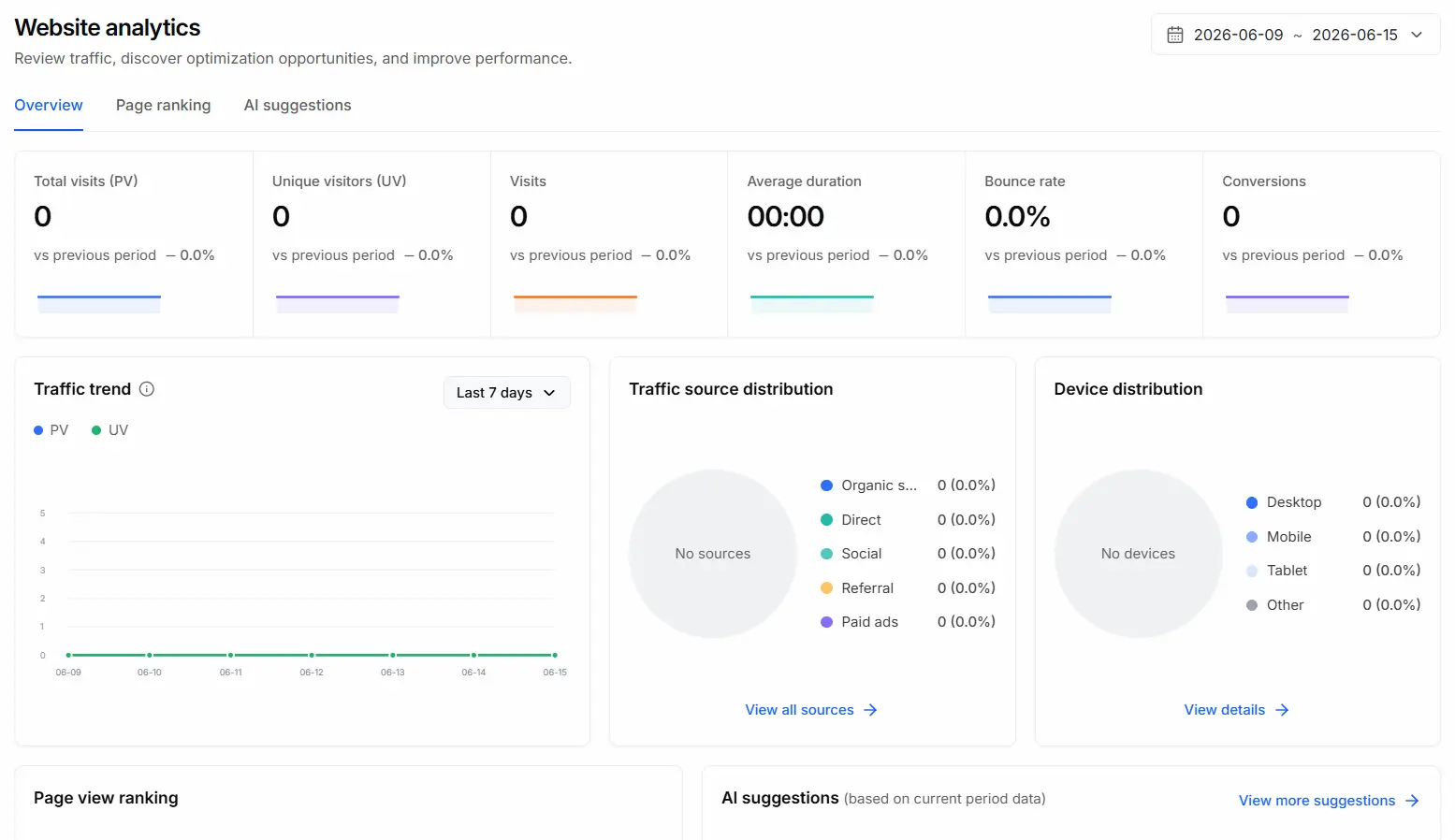
SEO focuses on helping search engines understand pages and present them to appropriate users. GEO, or generative engine optimization, places greater emphasis on entities, definitions, evidence, and content structures that can be cited. Neither means guaranteed rankings or AI citations.
A more reliable approach is to have each page solve one primary problem. A product page should explain its target users, the problem, boundaries, delivery method, and next action. A case study page should explain the background, process, and verifiable results. An article page should address one specific search intent. Pages should also include clear subheadings, authors, update dates, sources, and internal links.
Before launch, check each item:
Founders or small teams: Choose a tool that allows the intended team members to independently complete pages, domains, and forms. At the same time, confirm that the site can later add product pages, case studies, and articles.
Marketing teams: Focus on the CMS, SEO fields, publishing permissions, data analytics, and lead routing. Homepage generation speed is only the starting point. Real efficiency comes from being able to update content every week without repeatedly waiting for technical resources.
Design teams or agencies: Validate component reuse, brand standards, collaboration boundaries, client delivery, and asset management. Before making external commitments, clearly define what the client provides, what the team maintains, and which functions require additional development.
International or multilingual businesses: Check the URLs, metadata, content review, form notifications, and localized messaging for each language version. Translation completion does not equal localization completion. Sales teams must also confirm the value proposition and contact information for each market.
First, inventory the domain, images, fonts, forms, analytics code, search entry points, and URLs that are already being referenced. Second, separate content that must be retained, content that needs to be rewritten, and content that can be removed. Third, use one high-value page for a trial migration and test the mobile experience, title and description, form, and publishing workflow.
Fourth, create a mapping table between old and new URLs and prepare redirects for changed addresses. Fifth, check index settings, the sitemap, robots rules, and analytics tools before switching over. Sixth, monitor form submissions, search impressions, page errors, and user behavior after launch, then adjust based on the data.
Keeping a backup of the old site, scheduling a rollback window, and notifying collaborators in advance is usually safer than completing every page in one attempt. The goal of migration is not to reproduce the old visual design, but to maintain business continuity and establish a more maintainable foundation for growth.
Yes, but whether it is suitable for long-term operations depends on the number of pages, content update frequency, search goals, form workflows, collaboration model, and migration requirements. Event pages or lightweight showcases prioritize publishing speed, while continuous lead generation requires additional evaluation of the CMS, SEO, data, and ownership.
There is no universal answer independent of the use case. Test them with the same pages and maintenance tasks: the tool that enables the intended team members to edit, publish, and review more efficiently is likely closer to the team's needs. Plans, permissions, hosting, and export conditions should also be included in the decision.
We0 is better suited to founders, marketing teams, and small and medium-sized businesses that want to use AI to accelerate website and landing page creation while bringing content, SEO/GEO, deployment, and lead growth into a continuous workflow. Generated results still require teams to provide accurate materials, review facts, and operate the site continuously.
Yes. AI is suitable for generating structures and initial drafts, but the brand voice, product boundaries, customer evidence, pricing, compliance language, and conversion workflows must be confirmed by business personnel. Before publishing, at minimum review the content, mobile experience, links, forms, and data tracking.
Canva Websites alternatives should not be ranked by visual impact alone. For short-term showcases, familiarity and publishing speed may deserve priority. For long-term commercial websites, teams should evaluate information architecture, the content system, SEO/GEO, lead conversion, collaboration, and migration together. Wix, Framer, Webflow, and We0 support different ways of working. Testing them with real pages and real maintenance tasks, then choosing the solution that enables the team to publish, learn, and generate leads continuously, is usually more reliable than chasing feature lists.
Start from one sentence and have a complete website in minutes.