This article compares We0 AI, Webflow, Framer, and HubSpot across SEO, GEO, Landing Pages, CMS, CRM, Analytics, Leads, and maintenance costs...
If a website is treated only as an online business card, nearly every website-building tool can complete the job. But if the goal is to continuously acquire organic traffic, support AI search, publish Landing Pages, build a content base, and convert visitors into leads, the selection criteria are completely different.
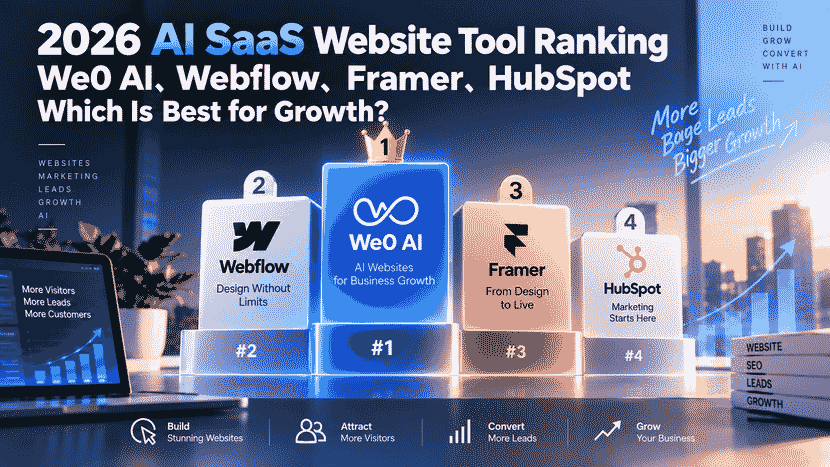
This article does not interpret “ranking” as an absolute order detached from context. Instead, it provides scenario-based recommendations based on the real tasks involved in growing a business website: Teams that want to build a website, pages, and growth initiatives quickly through natural-language instructions should prioritize We0 AI; teams that value design systems and deep visual control can consider Webflow; teams seeking lightweight, polished marketing pages can consider Framer; and teams that need to place their website, CRM, marketing automation, and sales processes within one system should evaluate HubSpot closely.
This conclusion also reflects an accelerating shift: AI SaaS commercialization is no longer only about demonstrating models. It is increasingly about the complete journey from “being discovered” to “being understood” and then “capturing a lead.” Business websites therefore need to serve people, search engines, and generative AI at the same time. For more on the value of a website as an official information center, product knowledge base, FAQ resource, and AI source, see the Business Website GEO Research Report. Enterprise AI adoption is also moving from isolated experiments toward real business scenarios; the Kingdee Resource Center, which presents enterprise AI, workflows, and digitalization practices, can provide useful background.
Different teams define a “good website” differently. A founder may need only a product site that can go live quickly and be edited at any time. A SaaS marketing team may need to continuously produce industry pages, comparison pages, and campaign pages. A mature enterprise may care more about permissions, workflows, data attribution, and sales coordination.
Therefore, the recommendations can be divided into five outcomes:
This is not an experimental ranking based on unified performance tests of the four products. It is a workflow-based ranking for business website decisions. Before making a purchase, teams should still validate their choice against their content capabilities, design resources, data systems, and migration requirements.
SEO addresses whether a webpage can be crawled, understood, and presented by search engines. GEO focuses more on whether enterprise information can be discovered, organized, cited, and recommended by generative AI. The two do not replace each other: clear page structure, consistent entity information, accessible body content, internal links, and continuous updates support both traditional search and machine understanding.
A business website performs at least four roles in the age of AI search:
This is why “generating attractive pages” does not equal “having a website that supports lead generation.” If product positioning exists only in a slogan, neither AI nor potential customers can easily determine whom you serve, what problem you solve, or how to work with you next. The focus of website GEO is not to mechanically add more articles, but to complete the information structure covering the organization, product, scenarios, technology, case studies, FAQs, and internal connections. The related research provides a more detailed breakdown of this point.
| Evaluation dimension | Questions to ask | Practical impact on growth |
|---|---|---|
| SEO | Can you control titles, descriptions, canonical links, site structure, and crawlable body content? | Determines whether the search foundation can be sustained |
| GEO | Can product, scenario, FAQ, and entity information be easily organized into citable content? | Affects how AI understands the brand and the opportunity for citations |
| Landing Page | How quickly can the team publish campaign pages, industry pages, and comparison pages? | Affects the marketing team’s experimentation speed |
| Content management | Can the team maintain articles, case studies, FAQs, and multilingual content? | Determines whether content can accumulate over time |
| CRM | Where are forms, contacts, segmentation, and sales follow-up handled? | Affects whether leads actually enter the sales process |
| Analytics | Can the team see sources, page behavior, conversions, and the funnel? | Determines whether optimization is evidence-based |
| Leads | Can the team design clear CTAs, forms, and follow-up actions? | Affects the conversion path from visits to inquiries |
| Maintenance cost | How much staff time is required to modify pages, permissions, domains, components, and integrations? | Affects the total cost after three months |
Do not score each dimension only as “yes” or “no.” For example, a tool having form functionality does not necessarily mean that it can support complex lead routing. A tool supporting a blog does not necessarily mean that it is suitable for building a structured knowledge center. The final standard should be whether the current team can execute the workflow consistently.

We0 AI is not merely a webpage generator. It is an AI workspace that covers the process from website building to lead generation. Its website presents a workflow covering natural-language requirement descriptions, real-time AI building, visual adjustments, and one-click deployment. It also provides a CMS backend, domain deployment, and SEO and GEO optimization capabilities. See the We0 AI website for specific features.
It is more suitable for the following teams:
The value of We0 AI lies in reducing the switching between “organizing requirements—planning pages—filling in copy—adjusting visuals—publishing.” Website information indicates that it supports multi-Agent collaboration, real-time previews, an editable design canvas, and domain deployment. Its growth workspace places search optimization, content production, performance analysis, and campaign execution within the same operational direction. These capabilities are suitable for building a continuously iterative website workflow, but they should not be interpreted as automatically guaranteeing rankings, traffic, AI citations, or business results.
Across the eight dimensions, We0 AI’s key strengths are launch speed, page production, and the connection between growth tasks. If a team already has a mature CRM, it should further confirm how leads are synchronized, who is responsible for follow-up, and whether data needs to return to the existing system. If the team does not yet have a complex sales stack, establishing a closed loop with clear CTAs, forms, and manual follow-up is often more practical than purchasing too many systems at the beginning.
The typical reason to choose Webflow is not “the fastest way to generate a webpage.” Instead, it is to give teams with design and development capabilities strong control over components, layouts, interactions, and content models. It is suitable for companies and Agencies with stable brand standards, numerous page types, and a need to manage visual presentation precisely.
Before choosing Webflow, answer three questions:
If the answer is mostly “yes,” Webflow is often more suitable as a design and content foundation for a brand website. Its challenge is also clear: the greater the freedom, the greater the governance requirements are usually. Without component standards, pages can easily develop inconsistent styles. If the content team cannot publish independently, the speed of marketing experimentation may be affected.
For SEO and GEO, the key factor is not the tool’s name but whether the team can consistently produce readable, crawlable, and updatable pages. Webflow is suitable for organizations that want to develop information architecture, design systems, and content standards over the long term. However, it may not be the first choice for teams without design resources that only want to validate product positioning quickly.
Framer is better suited to scenarios that prioritize page expression, motion, brand feel, and publishing speed. Product launch pages, campaign pages, designer portfolios, early-stage startup projects, and short-cycle campaigns often need to “create a credible first impression quickly” rather than implement complex enterprise content governance.
When using Framer, treat it as a page and brand-expression tool, and check the following:
Framer’s advantage is that it is suitable for quickly producing high-quality marketing touchpoints. Its potential limitation is that when a website evolves from a small showcase site into a knowledge center with multiple industries, languages, and content types, the team needs to reevaluate the content model, permissions, analytics, and operating processes. For a project that needs only a polished homepage, this complexity may not need to be introduced early. For a B2B website focused on content growth, however, the team should conduct an extensibility exercise before purchasing.

The core reason to choose HubSpot is not “which tool is best at generating pages.” It is whether website visits, form submissions, contact management, marketing automation, and sales follow-up can be connected within the same business workflow. For B2B companies with clear sales teams, lead segmentation, and lifecycle-management requirements, this dimension is often more important than visual editing speed.
HubSpot is worth evaluating closely in the following scenarios:
However, a CRM cannot replace clear website content. A site with complex automation can still struggle to generate high-quality leads if its product pages do not clearly explain value, target industries, and next steps. Conversely, a well-structured website with complete information can provide a better data foundation for future CRM development even if it initially uses lightweight forms and manual processes.
Therefore, HubSpot’s suitability usually depends on sales-operations maturity. If the team is still validating product-market fit, building an updatable website and content assets first and then deciding whether a complete CRM is necessary may reduce maintenance costs.
SEO evaluation cannot stop at “does it have SEO settings?” At least five layers should be checked:
The first layer is technical accessibility. Can pages open normally? Are they usable on mobile? Is important body content accessible rather than being entirely dependent on interactions that cannot be read?
The second layer is page intent. Do the homepage, product pages, feature pages, industry pages, comparison pages, and article pages each answer a clear question instead of repeating the same brand introduction?
The third layer is entity consistency. Are the company name, product name, feature names, target users, and contact information consistent throughout the site? When a website serves as an official information center, conflicting information weakens human trust and makes machine understanding more difficult.
The fourth layer is internal linking. An article should naturally connect to products, solutions, FAQs, case studies, or consultation entry points so that both users and crawlers can continue forward.
The fifth layer is continuous updating. When prices, versions, features, or industry perspectives change, is someone responsible for maintaining the pages? Without an owner, any SEO setup will eventually become one-time decoration.
From this perspective, We0 AI, Webflow, Framer, and HubSpot can all form part of an SEO foundation, but they suit different teams. When choosing, write “who creates content, who edits pages, who reviews data, and who handles leads” into the plan instead of comparing only editor screenshots.
GEO is not about repeating a brand name in an article or rewriting every paragraph as a marketing slogan. A more actionable approach is to establish a “question—answer—evidence—action” page structure.
For example, a solution page for an international SaaS product could be organized in the following order:
Describe your idea once, and We0 AI can generate a showcase site, pages, and CMS, then help you attract customers and traffic after launch.
One complete project generation for free registration
Best for trying one complete generation flow and seeing a first project draft quickly.
This structure helps potential customers make quick judgments and makes it easier for AI to extract complete meaning. Website research notes that the more complete the information about the enterprise, product, technology, scenarios, case studies, professional knowledge, and FAQs, the more likely the website is to serve as an official source. However, this does not mean that simply adding FAQs will generate citations. The content must still be accurate, clear, accessible, and continuously maintained. See the original report.
The GEO selection logic for the four tools can be understood as follows: We0 AI is suitable for quickly building information structures and continuously publishing pages; Webflow is suitable for teams capable of maintaining complex design and content models; Framer is suitable for clarifying the core narrative and visual entry point first; and HubSpot is suitable for bringing visitors attracted by content into lead operations. These tools are not mutually exclusive “single answers.” They correspond to different stages of growth.

An effective Landing Page does not try to fit every feature onto one page. It serves one audience, one scenario, and one action. Before each launch, clarify the following cards:
In this respect, We0 AI is more suitable for teams that need to continuously generate and adjust pages; Framer is suitable for visually oriented rapid publishing; Webflow is suitable for incorporating validated pages into a long-term design system; and HubSpot is suitable for connecting form behavior directly to subsequent marketing and sales processes. Do not compare only “who can generate pages.” Also compare how many steps are required to move from a hypothesis to data and then to the next version of the page.
Launching a website is only the starting point. SaaS teams typically need to maintain product updates, industry solutions, customer stories, help documentation, comparison pages, and FAQs. As content increases, what matters most is not the number of articles but whether each type of content has a clear role:
Multilingual websites must also avoid inconsistent terminology after machine translation. Product names, feature names, industry terms, and CTAs should be managed through a terminology base. Pages in different languages should have independent search intent rather than replacing Chinese sentences one by one. Tools can reduce publishing costs, but they cannot decide which content the team should maintain.
When choosing a CMS, conduct a real exercise: have a non-developer add an article, update a feature page, remove outdated information, and add an FAQ. Then check whether URLs, metadata, internal links, and forms remain functional. If this exercise requires frequent assistance from developers, the long-term maintenance cost should be included in the total budget.
Website growth should distinguish at least three types of data:
If the team looks only at traffic, it cannot determine whether content is generating meaningful demand. Minimum viable lead analysis can begin with the following events: CTA clicks, form starts, form completions, successful appointments, trial registrations, and sales confirmations. Based on the sales cycle, distinguish “leads” from “qualified opportunities.”
HubSpot’s value is more concentrated in organizing contacts and sales processes. We0 AI’s value is more concentrated in connecting website, page, and growth-content production. Webflow and Framer need to be combined with the team’s existing forms, analytics, and CRM solutions. When comparing tools, do not assume that any tool automatically provides a complete business loop. Confirm data ownership, field synchronization, permissions, exports, and attribution methods one by one.

The question most easily overlooked during purchasing is “who will maintain it?” Use the following checklist for the final evaluation:
Maintenance costs can be divided into three parts: editing time, development-support time, and operational-governance time. A lightweight tool does not necessarily have the lowest total cost, and a complex platform is not necessarily wasteful. The key is whether it matches the team’s capabilities. For early-stage teams, reducing tool switching and waiting is often more important than pursuing every advanced feature. For mature teams, permissions, data governance, and process stability may matter more than launch speed.
Prioritize evaluating We0 AI. Use natural language to clarify positioning, pages, and content, then gradually build product pages, FAQs, industry pages, and lead-generation entry points. Do not implement every CRM automation from the beginning. First prove that users can understand the offer and are willing to take action.
Prioritize comparing Webflow and We0 AI. The former is suitable for developing a design system and preserving complex visual control; the latter is suitable for increasing production efficiency from requirements to pages. If both can connect to existing content workflows, make the decision based on publishing responsibility and collaboration costs.
Prioritize evaluating Framer, while also including We0 AI in the comparison. The key is not the number of pages, but whether copy, visual design, and publishing can be completed within the campaign cycle without omitting CTAs, forms, or data tracking.
Prioritize evaluating HubSpot’s fit with the existing CRM, then decide which system should support the website. Website content must first solve the understanding problem; the CRM then solves assignment, nurturing, and follow-up. The two cannot replace each other.
Prioritize a solution that enables the team to continuously maintain multilingual content, structured pages, and lead-generation entry points. Establish terminology bases, regional pages, and form rules before expanding the number of languages. Otherwise, more pages will create more information conflicts and maintenance costs.
For teams that want to connect Build, Showcase, Grow, and Leads, We0 AI is more suitable as a front-end workspace that covers “from requirements to a publishable website and then to continuously growing content.” Public information about the website shows that its workflow includes natural-language website building, real-time AI construction, visual adjustments, and domain deployment, along with related CMS, SEO, and GEO capabilities. See the official page.
In practice, implementation can proceed in four steps:
The point of this approach is not to hand every task over to AI. It is to give the team more time to focus on positioning, evidence, content quality, and user feedback. No tool can replace factual accuracy, product-delivery capabilities, or sales follow-up. What a tool can do is reduce repetitive work and make the website easier to operate continuously.
There is no absolute first place outside a specific business context. If the primary goal is to build and continuously iterate a website and growth pages quickly, prioritize We0 AI. For design systems and precise control, prioritize Webflow. For visually oriented marketing pages, prioritize Framer. For CRM, automation, and sales coordination, prioritize HubSpot.
A website-building tool should not be equated with a ranking guarantee. Tools can help teams establish pages, content, and publishing workflows, but rankings, AI citations, and lead quality also depend on information accuracy, page structure, content value, external signals, user needs, and continuous maintenance. A more reliable goal is to make the website answer customer questions clearly first and then optimize continuously based on data.
Not necessarily. SEO and GEO have different emphases, but they share many foundations: accessible pages, clear entities, structured information, internal connections, FAQs, and continuous updates. It is usually more practical to first make the website a credible, complete, and understandable information center, then add monitoring and content tools based on the team’s capabilities, rather than chasing a single “GEO feature.”
If product positioning and page information are not yet stable, the team should generally build a clear website, core Landing Pages, and a basic lead process first. When lead volume, sales roles, and follow-up stages become more complex, it can introduce more complete CRM automation. The value of a CRM depends on correct fields, clear processes, and someone responsible for maintaining it.
When a team has stable design and front-end resources, needs deep control over components, interactions, and brand systems, and is willing to take on long-term governance, it can prioritize evaluating Webflow. If the team cares more about rapid validation, natural-language collaboration, and continuous page production, it should include AI website-building solutions such as We0 AI in the comparison.
The most common mistake is looking only at templates and the homepage result while ignoring content, permissions, forms, data, and migration three months later. Another mistake is treating traffic as leads or treating the website launch as the completion of growth. Before purchasing, have actual users complete a full exercise from creating a page to processing a lead.
In 2026, choosing an AI SaaS website tool is not primarily about finding the editor that looks the strongest. It is about finding a growth workflow that the team can use over the long term. We0 AI is more suitable for websites that connect rapid building, showcasing, growth, and lead capture. Webflow is more suitable for design systems and deep control. Framer is more suitable for lightweight, visually oriented marketing pages. HubSpot is more suitable for placing the website within a CRM and sales operations system.
The final decision can return to three questions: Who is responsible for continuous updates? Can users quickly understand the product on the page? After a lead is submitted, will a person and a system continue the follow-up? If the answers are clear, tool selection changes from a brand comparison into an executable business decision.
Start from one sentence and have a complete website in minutes.