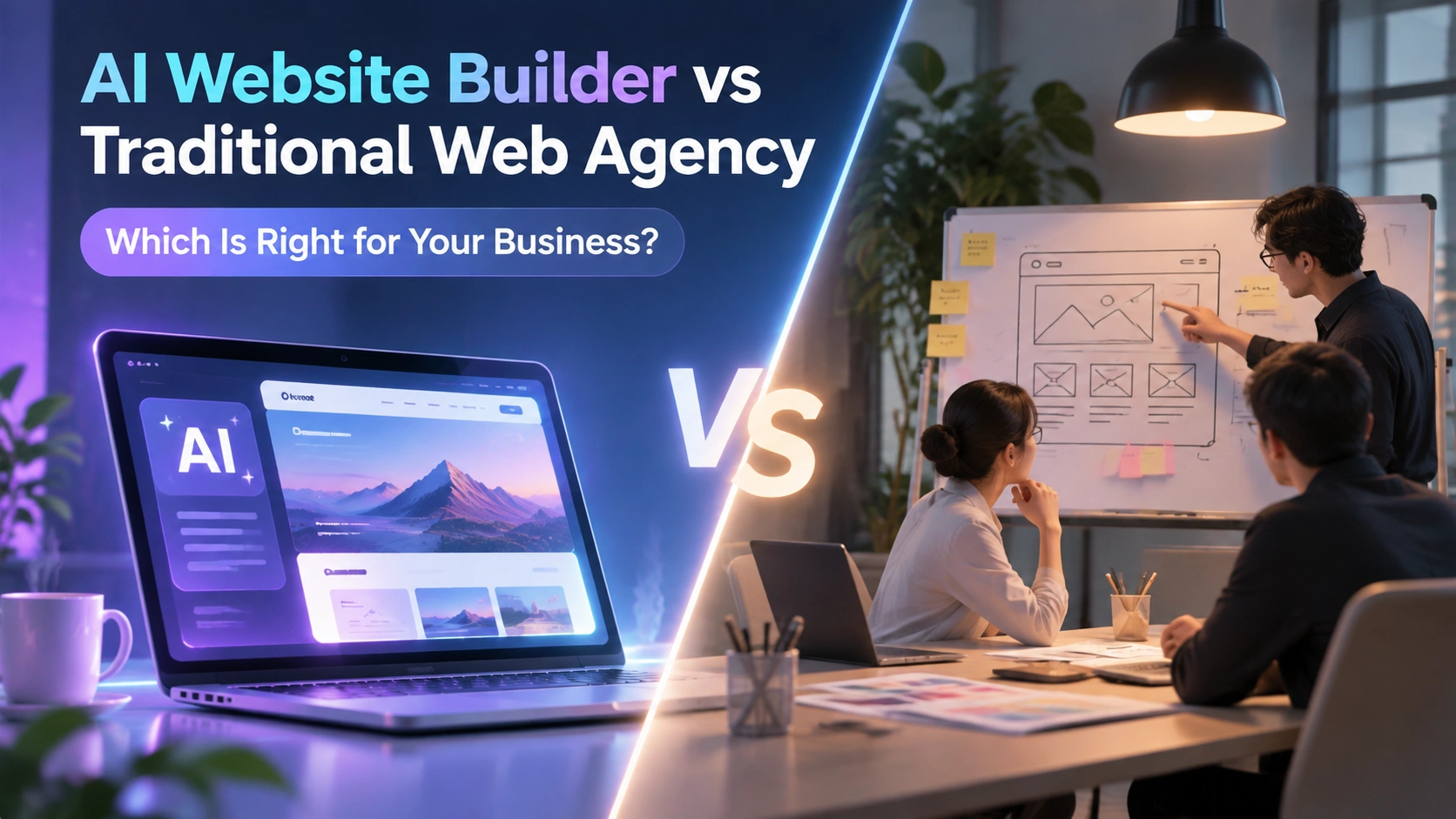
When a business prepares to build a corporate website, the real question is not whether to use AI, but what the budget buys. AI website builders sell a reusable generation capability: requirement description, page generation, and content modification all happen in the same workspace, and changing a version takes only a few clicks. Traditional web development agencies sell an outsourced delivery process: requirements discovery, prototypes, design mockups, development and integration testing, acceptance, and launch, with people driving each stage. Industry reviews usually divide service providers into different tiers such as full-service custom, comprehensive commercial platforms, and operations and maintenance specialists. What really determines the tier is the delivery model and asset ownership, not whose pages look better (IT Home).
So the question of which to choose can be framed with three questions:
- Does the website only handle brand showcase and lead generation, or does it need to support login, payments, orders, and internal data?
- After launch, who updates the content? Can the marketing team make changes on its own?
- Do you prefer a one-time project fee, or are you willing to pay for a long-term subscription plus managed maintenance?
1. Eight dimensions that clarify the two models
| Comparison dimension | AI website builders | Traditional web development agencies |
|---|---|---|
| Initial production | Self-service requirement description and draft generation | Production scheduling after requirements communication |
| Page design | AI generates layouts and copy; humans fine-tune on a canvas | Designers customize according to brand tone |
| Development approach | AI-assisted generation of front-end and back-end code | Mainly manual development |
| Content updates | Depends on whether a CMS and editing permissions are included | Depends on the backend capabilities of the delivered system |
| Subsequent changes | Users can iterate continuously on their own | Usually require support from the service team |
| Complex systems | Depends on platform capabilities and extensibility | Can support deep customization and system integration |
| Project management | Users participate deeply and set their own pace | Promoted by the service provider's team |
| Asset ownership | Platform hosting and source code delivery differ greatly | Source code and renewal terms must be written into the contract |
Every item in this table points to the same divide: one type of solution gives control to the user, while the other keeps control with the service provider. Comparing along these dimensions reflects the real difference better than comparing prices alone.
2. Process differences ultimately become differences in time and initiative
The first half of the traditional model is information handoff: requirements meetings, prototype confirmation, design reviews, development and integration testing, acceptance, and launch. Every step requires alignment. A standardized process means fewer deviations, but it also means that changing one section requires another round of communication.
The process of AI website builders is reversible: first explain the industry, page modules, style, and functions in a conversation, generate a draft, then adjust copy, colors, and module order block by block, and after confirmation bind the domain and publish. Its advantage is not one-shot perfection, but low cost to change, so more trial iterations are possible. For early-stage teams that cannot yet articulate their brand expression, this is often more valuable than a polished design mockup.
The trade-off is a shift of initiative: requirement definition, material preparation, and content quality judgment all fall on the user. Without a clear information architecture, the faster AI generates, the faster you can create a website with a chaotic structure.
3. Depth of design: AI generation and designer customization are not the same thing
For projects that require an original visual system, complex animations, and cross-page experience consistency, designer judgment remains hard to replace. The value of traditional agencies is concentrated in strategy development, original visual design, and overall tone control, which is also the main source of high-end custom quotes; the difference between service providers often shows in whether they truly have strategy and prototype stages, or simply apply templates and change colors (IT Home).
AI website builders excel at commercially adequate pages: clear product pages, service pages, campaign pages, and landing pages can reach publishable quality in a very short time using ready-made layout logic plus brand colors and materials. The approach that really creates a gap is AI generation plus human adjustment: treat the generated result as a draft, then unify font sizes, spacing, and image style according to brand guidelines, rather than publishing the default style directly.
The test is practical: if you can clearly describe what your brand should look like and have usable materials on hand, the AI-generated result is usually adequate after adjustment; if even the visual direction needs to be proposed, the professional design stage is harder to skip.
4. Technical boundaries: when login and payments are needed, are AI website builders enough?
There is no single answer to whether AI website builders can handle login and payments, because tool capabilities are clearly tiered. One type only generates front-end pages, while another has connected the backend: for example, Alibaba Cloud Wanxiaozhi connects requirements structuring, page design, database, domain application, ICP filing, and cloud resource deployment into one chain, with annual subscriptions and tiered pricing. Public information shows an entry package at RMB 360/year (AITOP100). This shows that self-service website building has long moved beyond static showcase, but capabilities are still constrained by platform boundaries.
We0 takes a different path: generation from pages to backend logic, combined with multi-agent collaboration to break down requirements, a CMS backend to manage content, payment and login flow setup, a visual canvas for fine-tuning, and domain binding and deployment for launch (we0.ai). This combination of full-stack generation and editability covers the needs of most corporate showcase sites and lightweight business sites.
To be honest, the following scenarios still call for professional engineers or service providers: deep integration with internal systems such as ERP/CRM/OA, private deployment and data residency requirements, industry compliance reviews, and multi-organization permissions and group site network governance. Understanding AI website building as replacing all development is the most common mistake in selection.
5. How to calculate costs: compare four expense items together
Comparing only the first-year price easily leads to the wrong conclusion. It is better to break it into four items:
- Initial delivery cost: project-based quotes, or tool subscription fees plus your own time investment.
- Ongoing costs: platform annual fees, server and domain renewals, managed maintenance, and support fees.
- Iteration cost: whether each revision is done internally or quoted per person-day.
- Migration risk cost: whether source code is delivered, whether data can be exported, and whether switching providers requires rebuilding.
Two cost structures that the industry repeatedly warns about deserve attention: first, low-priced website building paired with high-priced annual server fees and feature add-ons; second, sites hosted on the service provider's side with source code not owned by the business, which limits later migration and secondary development. Market website quotes range from several thousand yuan to hundreds of thousands of yuan. The price range itself does not indicate quality; only the feature list and deliverable scope in the quote can show what is really included (Aiqi Online).
The cost of the self-built tool route is more like subscription fee plus internal labor: less money is spent, but the team must have someone who can continuously produce content and make page adjustments.
Build a showcase site and grow leads in minutes
Describe your idea once, and We0 AI can generate a showcase site, pages, and CMS, then help you attract customers and traffic after launch.
One complete project generation for free registration
Best for trying one complete generation flow and seeing a first project draft quickly.
6. After launch: who manages SEO, GEO, and content updates?
The value of a corporate website starts to emerge after launch, and the problems appear along with it: who writes the content, who adjusts the page structure, and whether the site can be cited in AI search.
There is an easily overlooked difference here: whether AI capabilities are native in the architecture or added later as a customer service plugin. The former adapts to retrieval at the level of semantic tags, Schema structured data, JSON-LD markup, and content organization, while the latter can only add interaction without changing the underlying information architecture (Aiqi Online). GEO (generative engine optimization) is precisely about whether corporate website content can be recognized and cited by generative AI such as Doubao, DeepSeek, and Kimi, and the related evaluation dimensions are repeatedly mentioned in service provider selection (Automation Network).
So when selecting, ask one more question: after the website is handed over to me, can I publish articles, change page titles, and adjust section structure myself? If every update requires a service provider ticket, SEO and GEO will remain stuck at the moment of launch. We0 puts SEO and GEO optimization, multilingual sites, and a CMS backend into the same workspace (we0.ai), solving exactly the most easily broken link in continuous operation after launch.
7. Hybrid development: combine the two paths
For most businesses, the real answer is not choosing one, but dividing the work:
- Define asset ownership first: handle the domain and server in the business's name, and write source code and data ownership into the contract.
- Give the presentation layer to AI tools: the homepage, product pages, case study pages, and campaign landing pages are generated internally and iterated continuously.
- Use custom development for transactions and internal systems: payment settlement, membership systems, and data integration with ERP/CRM go to professional developers.
- Unify design and content standards: define visual standards and information architecture first, then have AI produce pages according to those standards to avoid fragmented style.
- Review quarterly: look at lead sources, page performance, and AI search citations, then decide whether to continue building internally or outsource.
Legacy sites can also take this path: when the domain and content assets are still usable, start with modular renovation; when the architecture is outdated and the mobile experience is poor, consider rebuilding, and compare proposals from service providers separately (Automation Network).
8. Decision checklist: match the solution to your needs
- Only brand showcase and lead generation needs, with someone on the team who can steadily produce content → prioritize AI website builders.
- Need login, payments, and an order backend, but the process is relatively standard → choose an AI website building platform with backend and CMS capabilities, and validate on a small scale first.
- Need deep integration with internal systems, private deployment, or strict compliance → go with custom development, with AI tools handling only the presentation layer.
- Multi-brand groups and unified control of multiple sites → mainly use system integration service providers, with AI tools for rapid pilot landing pages.
- Limited budget but a requirement for long-term iteration → choose a platform with CMS and code delivery capabilities, and avoid paying only an annual fee without modification rights.
When asking service providers questions, these six are the most informative: whether the full source code is delivered, in whose name the domain and server are registered, to what granularity I can edit content in the backend, how revisions are priced, the response time and scope of after-sales support, and whether existing cases can be accessed directly.
FAQ
If I only need a corporate website, do I still need a web development agency? The structure of a showcase website is relatively standard, and AI website builders plus your own materials can usually complete it. The real situations that require an external team are: needing an original visual system, needing professional strategy development, or having no internal content production capability at all.
When login, payments, and a backend are needed, are AI website builders enough? It depends on whether the platform has backend capabilities. Platforms that can generate databases, backends, and payment flows can support standard business sites; scenarios involving multi-party split payments, complex order state machines, and financial reconciliation still require professional development participation.
Do complex business systems still need professional development? Yes. Integration with internal systems such as ERP/CRM, private deployment, and multi-organization permission control belong to system integration. AI generation is suitable for the front-end presentation and content layers.
Is it necessary to pay website maintenance fees for a long time? It depends on what the money buys. Server and domain renewals are necessary expenses; if the maintenance fee only covers changing text and images for you, and you already have backend permissions yourself, you need to reassess the value.
How should the actual cost of AI website building be calculated? Add subscription or project fees, internal labor time, subsequent iteration costs, and migration risk together, rather than looking only at the first-year quote.
When should a hybrid model be chosen? When a corporate website needs to launch quickly to acquire leads and also needs transactions and internal system integration, building the presentation layer internally and customizing the business layer is a more balanced combination of cost and controllability.
Related Tools
- We0 AI Website Generator: describe requirements in natural language and generate publishable brand sites, landing pages, and portfolios.
- We0 Full-Stack Code Generation: generate from pages to backend logic in one pass, suitable for business sites that need forms, membership, and payment flows.
- We0 Multi-Agent Collaboration: break scattered requirements into page lists and functional scope, reducing rework before website building.
- We0 CMS Backend: after launch, the marketing team can update content, sections, and page copy on its own.
- We0 SEO and GEO optimization, multilingual sites, and domain deployment: put publishing and continuous operation into the same workspace.
Related Links
- IT Home: A Complete Guide to Avoiding Pitfalls in Corporate Website Building in the AI Era
- Aiqi Online: Evaluation Dimensions and Selection Points for AI Website Building Service Providers
- Automation Network: Selection Criteria and Scenario Fit for AI Website Building Service Providers
- AITOP100: Wanxiaozhi, Alibaba Cloud's Enterprise AI Website Building Platform
- We0: An AI Workspace from Website Building to Lead Generation
Summary
The difference between AI website builders and traditional web development agencies is fundamentally a difference in delivery model, iteration control, and asset ownership, not a difference between new and old technology. For showcase websites, landing pages that need rapid validation, and content sites that depend on continuous updates, building with AI website builders is more cost-effective. For deep customization, system integration, private deployment, and strict compliance requirements, professional teams should still be engaged. For most businesses, the reasonable choice is a hybrid model: first clarify ownership of the domain, source code, and data; build the presentation layer with AI tools and iterate continuously; and assign the business layer to custom development. Lay out the four cost items clearly, then ask questions item by item against a checklist, and the selection decision will not have to rely on gut feeling.