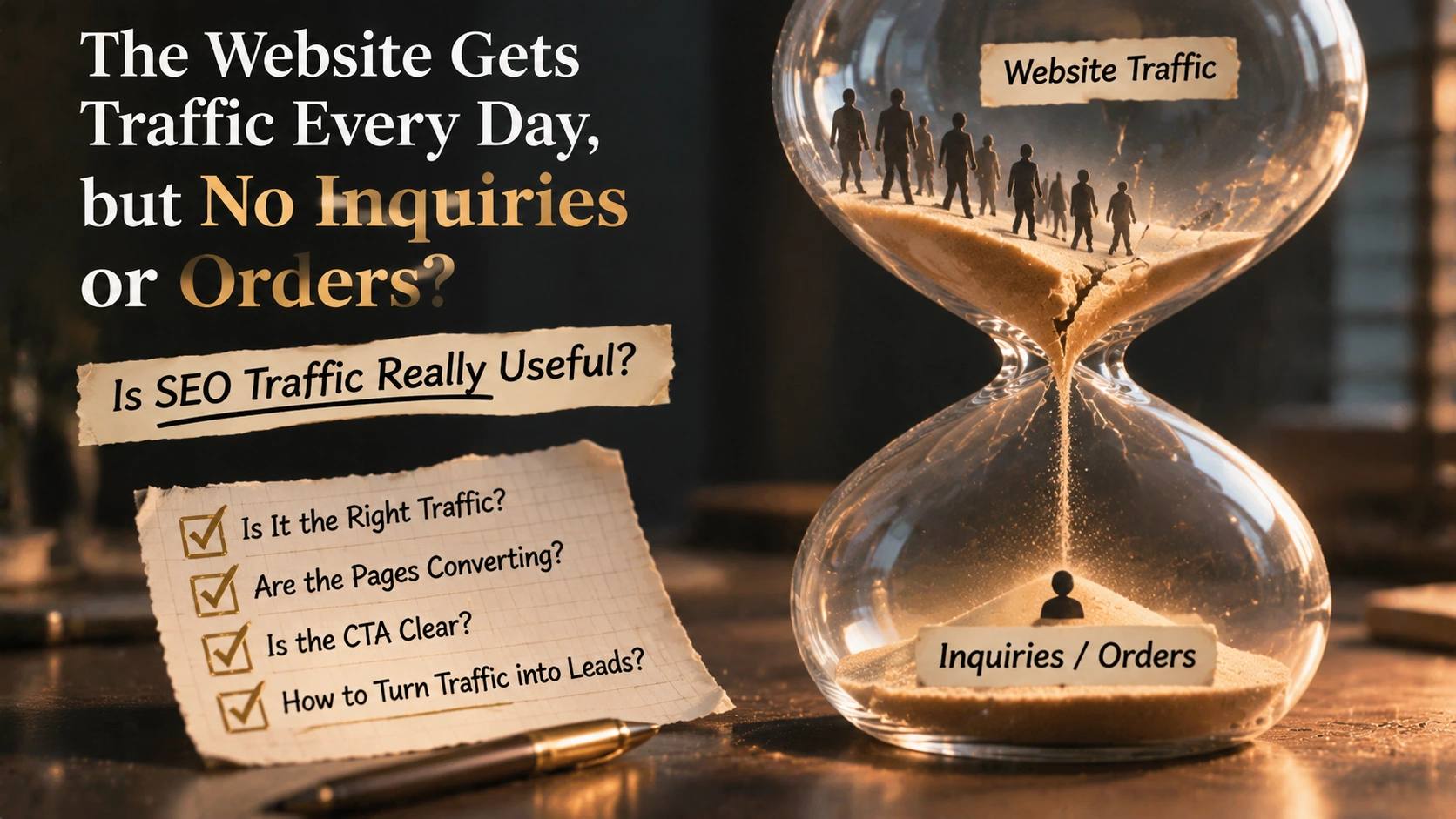
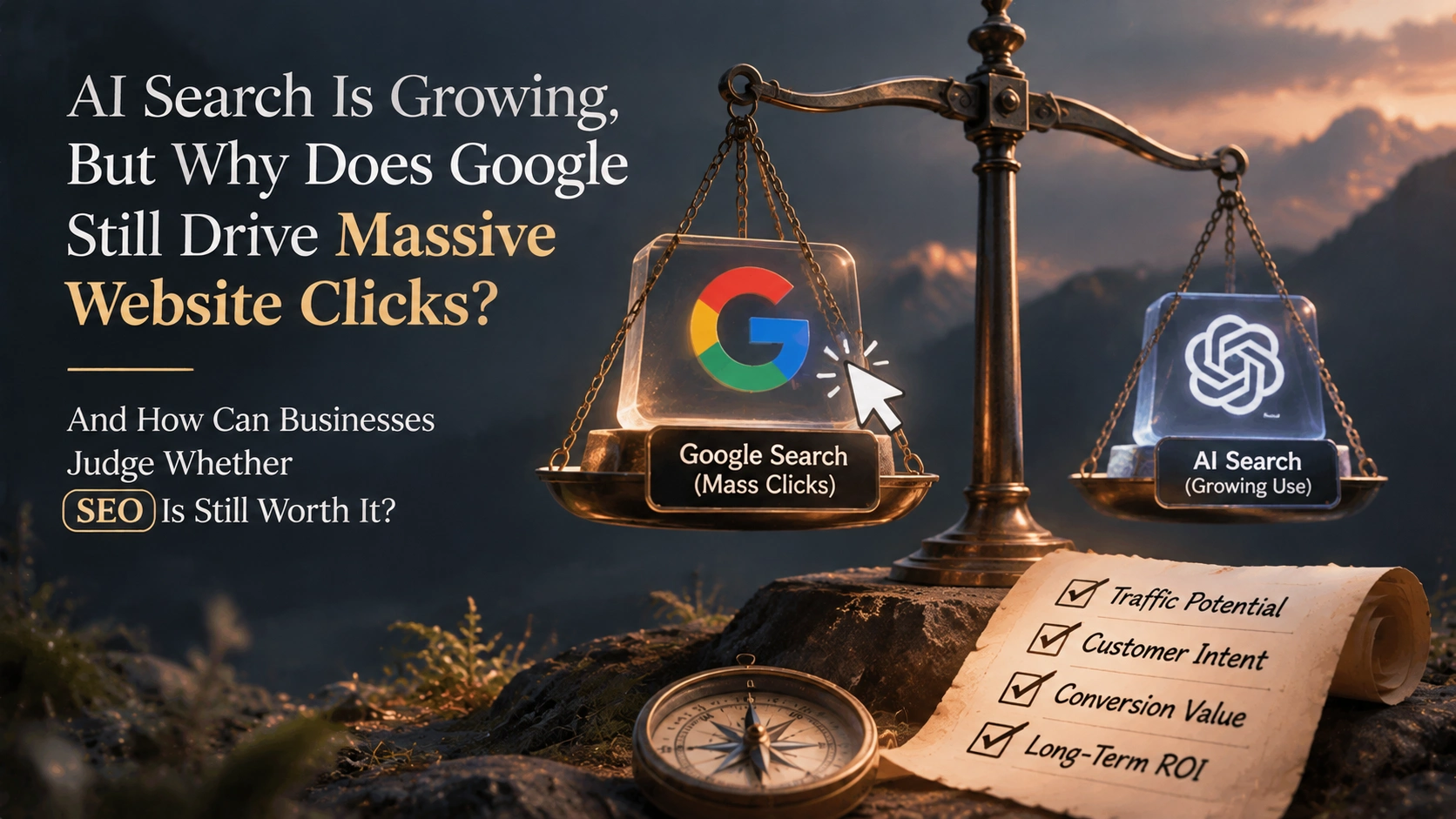
Google still handles more than 8 billion queries per day, while ChatGPT receives more than 1 billion queries per week (LumenGEO). This is not competition on the same scale; it is an order-of-magnitude gap.
Usage frequency has not declined either: the average number of Google search sessions per week among U.S. users rose from 10.5 to 12.6 (Engain). AI is more like an added step before search, rather than a replacement for the act of searching. What has really changed is the click-through rate—in 2026, about 68.01% of Google searches end with zero clicks, leaving only about 276 open-web clicks per 1,000 searches; in 2024, that number was 374.
2. Four Numbers You Must Remember First
| Metric | Data | What It Means for Businesses |
|---|---|---|
| Google daily queries | More than 8 billion (LumenGEO) | Still the largest traffic pool; cannot be abandoned |
| ChatGPT weekly queries | More than 1 billion (LumenGEO) | Has crossed critical scale, but on a smaller base |
| Zero-click rate | 68.01%, about 276 redirects per 1,000 searches | Each impression is losing value; calculate by page |
| AI Overview coverage | About 30% to 48% (Engain) | About half of queries still return traditional links |
The two coverage figures are not contradictory: one is based on a keyword sample of 129,000 domains, and the other comes from continuous counting of tracked queries; they use different methodologies. For decision-making, just remember the range.
3. What Exactly Happens When 'Rankings Haven't Dropped, but Traffic Has'?
Pew Research tracked 900 U.S. adults and 2.5 million real web visits: when an AI summary appears on the search results page, only 8% of users click a traditional link, compared with 15% when there is no AI summary (Engain). The position has not changed, but an answer box has been added to the page, and the click probability is cut by nearly half.
A 2026 study by Schwartz Marketing Lab put the conclusion directly in its title: ranking No. 1 on Google no longer guarantees traffic (PR Newswire).
The difficulty is that this loss is invisible in conventional tools. Search Console does not record that 'this impression became an AI answer,' nor does it record sessions from ChatGPT or Perplexity (LumenGEO). Teams see stable rankings, conclude that SEO is healthy, and then attribute the decline to seasonality.
4. AI Overviews Do Not Treat All Queries Equally

In January 2025, about 91.3% of queries that triggered AI Overviews were informational; by October of that year, the share had fallen to 57.1%. Over the same period, the share of commercial queries rose from 8.69% to 18.57%, transactional queries from 1.76% to 13.94%, and navigational queries from less than 1% to 10.33% (Engain). The scope absorbed by AI is spreading from knowledge Q&A to comparison and pre-purchase research, but the expansion is not yet complete.
| Query Type | Typical Example | Click Tendency |
|---|---|---|
| Concept definition | What is generative engine optimization | Low |
| Comparison and selection | How to choose an AI website builder | Medium |
| Specifications and quotes | Model parameters, price, minimum order quantity | High |
| Local services | XX service provider nearby | High |
| Troubleshooting and operations | How to configure X, how to fix an error | Medium-high |
5. News Search and Commercial Search Are Two Different User Behaviors
From November 2024 to November 2025, Google's referral traffic to news publishers fell 33% globally and 38% in the United States (Engain). The structure of news sites is 'a large volume of informational queries + strong timeliness + one-time visits,' which is exactly the part AI Overviews are best at handling.
But clicks are not lost in only one direction. When users need first-hand details—original wording, a complete list, a timeline, verifiable on-the-ground information—returning to the original website is still the least effortful path. This is also why search clicks can increase noticeably for a short period during major public events (for example, election vote-counting day). This is a structural exception, not a trend reversal, and it is even less valid to infer from it that corporate website traffic will come back as well: the main queries on corporate sites are about products, solutions, pricing, and service capabilities, and the logic of user behavior barely overlaps with news consumption.
6. Which Keywords Are More Likely to Generate Real Clicks
There is only one criterion: after searching, does the user have a 'next action' to take?
- Product terms with specifications, model numbers, parameters, minimum order quantities, and lead times, where users need to confirm details before moving forward;
- Terms related to quotes, costs, and solution comparisons, where users want material they can put into a decision document;
- Local and nearby-service terms, where users want contact information, addresses, and bookable times;
- Troubleshooting and configuration terms, where users need to follow the steps in their own systems;
- Terms involving downloads, trials, templates, and checklists, where the results page cannot provide a usable file.
Terms such as 'what is,' 'why,' and 'how to understand' have a noticeably lower click probability. They are not impossible to write, but they should not be treated as standalone lead-generation goals—their value lies in supporting brand entities, being cited, and building trust.
7. Judging Whether a Page Is Still Worth Continued SEO Investment

Do not make decisions based on sitewide traffic; make decisions based on pages.
| Evaluation Dimension | Metric to Watch | Worth Increasing Investment | Should Be Reduced or Restructured |
|---|---|---|---|
| Query intent | Share of commercial queries on that page | Commercial share is clearly significant | Almost entirely pure definitional |
| Click performance | CTR trend broken down by query type | Rankings and CTR are stable in the same direction | Rankings are rising while CTR is falling |
| Conversion handoff | Inquiries, trials, and sign-ups brought by that page | The page has a clear next step | Users leave immediately after reading, with no path |
| Content moat | First-hand data, processes, templates, and case studies | Cannot be replicated elsewhere | Highly homogeneous with similar sites |
| Maintenance cost | Whether quarterly updates are affordable | Can be maintained regularly | Already outdated and unmaintained |
Follow a fixed four-step process: export queries from Search Console and classify them by intent; compare CTR changes over the past six months to one year; check in analytics tools whether the page supports conversion actions; and finally decide whether to increase investment, restructure, keep and observe, or merge and retire it. Doing this once a quarter is more useful than watching total traffic every month.
8. Reconcile SEO Traffic with Inquiries and Sales
When SEO is questioned, it is usually not because there is no traffic, but because the traffic cannot prove its value. Three layers of reconciliation can solve this: at the search layer, use Search Console to record baselines for impressions and clicks by page and query type; at the behavior layer, create a separate channel group for AI referrals; at the business layer, add source-parameterized links to CTAs on key landing pages so that inquiries can be traced in the CRM.
Build a showcase site and grow leads in minutes
Describe your idea once, and We0 AI can generate a showcase site, pages, and CMS, then help you attract customers and traffic after launch.
One complete project generation for free registration
Best for trying one complete generation flow and seeing a first project draft quickly.
A single regular expression can cover the main AI entry points in a channel group:
chatgpt|openai|perplexity|gemini|copilot|claude|you\.com|poe\.com
Landing page links should uniformly include attributable parameters, so the two sources can be calculated separately:
example.com/pricing?utm_source=chatgpt&utm_medium=ai_referral&utm_campaign=geo_2026
example.com/pricing?utm_source=google&utm_medium=organic&utm_campaign=seo_2026
This makes it possible to answer 'how many of last quarter's inquiries came from traditional search and how many from AI referrals,' rather than only answering 'did organic traffic rise or fall.'
9. SEO and GEO in Parallel: A Shared Foundation, with Incremental Value in Structure
Google places AI features under the 'Ranking and Search Appearance' section of its Search documentation and separately provides an optimization guide for generative AI search (Google Search Central), indicating that AI answers and traditional results share the same crawling and indexing foundation. Crawl accessibility, page performance, information architecture, content quality, and entity consistency are effective for both sides at the same time.
What needs to be added is the structural layer: make each section capable of standing alone as an answer, leading with the conclusion in the first sentence and then giving conditions and exceptions; turn comparable information into tables and reusable information into checklists and steps; and add structured data for FAQ, product, and organization information. AI systems cite paragraphs, not whole pages.
10. Differentiated Investment by Website Type

The same set of data cannot be applied to every industry, and the performance of news publishers should not be used as a benchmark for corporate websites.
| Website Type | Current Situation | Recommended Investment Direction |
|---|---|---|
| News/content media | High share of informational queries; most sensitive to AI Overviews | Protect indexing and timeliness while building subscriptions and direct visits |
| B2B SaaS | Comparisons, integrations, and pricing explanations remain high-click areas | Comparison pages, integration pages, pricing explanations, and FAQs |
| Foreign trade independent sites | Strong multilingual long-tail; long decision cycle | Product specifications, certifications, lead times, and inquiry paths |
| Local services | Clear local intent; relatively low AI penetration | Service pages, case studies, reviews, and contact information |
| E-commerce | Transactional queries are being penetrated at an accelerating rate | Product structured data and on-site search experience |
11. Make Page Structure Maintainable Over the Long Term
Once the judgment is clear, the remaining work is engineering: page structure, content depth, multilingual support, structured data, continuous updates, and lead paths all need long-term maintenance by someone. For teams without dedicated front-end and SEO staff, this part can be handled by a website-building tool. We0.ai is positioned as an AI workbench from website building to lead generation: describe requirements in natural language, have multiple Agents collaborate to generate pages, fine-tune them on an editable canvas, and deploy them to your own domain with one click; CMS backend, SEO, and GEO optimization capabilities are placed on the same chain, so pages can be completed in one place from construction to subsequent content updates, reducing the loss of 'waiting for scheduling every time copy is changed.'
One reminder: tools solve 'whether the structure can be done right efficiently,' not 'whether the content has first-hand information.' The latter can only come from the business itself.
Frequently Asked Questions
Is SEO still necessary after AI search becomes widespread?
Yes, but the approach must change. Google still handles more than 8 billion queries per day, and beyond zero-click searches, there are still about 276 redirects per 1,000 searches (Engain), so the scale remains considerable. The change is that sitewide traffic can no longer be used to measure success or failure; instead, evaluate by query intent and page value separately.
Why haven't rankings dropped, but organic traffic has?
The most likely reason is that AI summaries are intercepting clicks. When an AI summary appears, the click-through rate for traditional links is 8%; when it does not, it is 15%. The position has not changed, but the click probability has, and Search Console does not separately flag this interception.
Can a recovery in news website traffic indicate that corporate websites will also recover?
No. News sites are dominated by informational and time-sensitive queries, while corporate sites are dominated by products, solutions, pricing, and services. The performance of news publishers only shows that 'real-time, first-hand information still has click value'; it cannot be used as a basis for forecasting traffic for corporate sites.
The page ranks well but is never cited by AI. Should we give up?
Not necessarily. Clicks from rankings and brand exposure from citations are two separate return lines. A more reasonable approach is to first complete paragraph-level structure and structured data, and then use a separate channel group to observe changes in AI referrals.
Related Tools
- Google Search Console: Check impressions, clicks, and CTR by query and page
- Google Analytics 4: Use custom channel groups to separate AI referrals
- Structured data testing tools: Validate FAQ, product, and organization markup
- CRM and form attribution: Carry landing page sources into inquiry records
Related Links
- Engain: AI SEO Statistics 2026
- LumenGEO: AI Search vs Google Search 2026
- PR Newswire: Ranking No. 1 on Google No Longer Guarantees Traffic
- Google Search Central: AI Features and Your Website
- We0.ai official website
Summary
AI search changes the efficiency of click allocation, not the existence of search itself. Google's more than 8 billion queries per day, usage frequency that is still rising, and the reality of about 276 redirects per 1,000 searches together show that SEO is still worth investing in; it is simply shifting from 'covering more keywords' to 'making commercial pages more worth clicking.' Businesses should not choose one of two options: first break down data by query intent and calculate by page, then run SEO and GEO on the same content chain—on the Google side, defend commercial intent; on the AI side, seek to be cited.