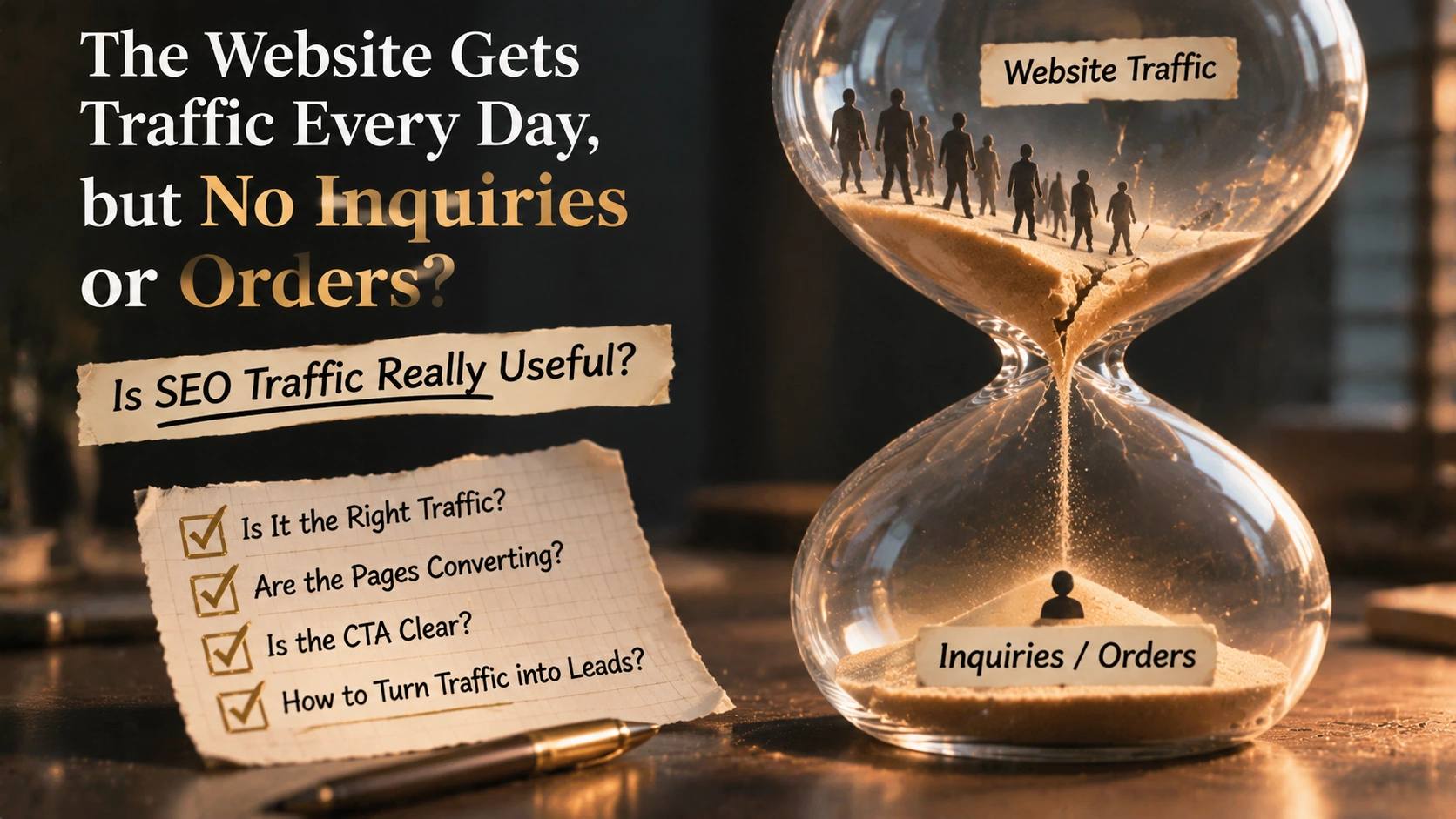
When a website gets daily traffic but no orders or inquiries, it's easy to misjudge it as "SEO doesn't work." A more accurate assessment is: SEO solves "can people with needs find you," while closing deals depends on four other things—whether search intent matches, whether the landing page persuades, whether the inquiry path is short enough, and whether sales catches the lead in time. If any one link breaks, traffic evaporates on the spot.
A claim that comes up repeatedly in industry discussion: SEO cannot fix a broken sales process. The value of this statement isn't to dismiss search, but to remind you to treat "poor conversion" as a system problem to break down, rather than going back to tweak titles and build links every time inquiries are low.
High traffic doesn't equal high purchase intent
What search engines bring you is "people with questions," not "people ready to pay." The same set of keywords can hide completely different intents:
- Informational: "What is XX," "How to choose XX" — the user is still building awareness and won't submit an inquiry in the short term;
- Comparative: "A vs. B," "XX vendor recommendations" — the user is already screening a shortlist, and this is the most valuable layer for B2B;
- Transactional: "XX quote," "XX price," "XX custom manufacturer" — closest to an inquiry.
If most of your organic traffic comes from informational articles, then "few inquiries" is a structural problem, not a page problem. According to aggregated industry benchmarks, the average conversion rate across industries is only around two percent, and conversion varies widely by traffic source—visitors from organic search, paid search, and social media are not at the same level of intent (GreetNow Conversion Diagnostic Guide). So the first step isn't optimization; it's confirming: what keywords, what pages, and what intents do these visits actually consist of?
Does the landing page deliver on what the search result promised?
The title and description a user reads in search results are a promise; the first screen of the landing page is where that promise is kept. A mismatch between the two is the most common conversion killer: the search result promises "a customized solution with fast delivery," while the landing page's first screen talks about how long the company has existed, how big the factory is, and how many employees it has.
The test is simple: run a five-second test. Find someone who doesn't know your business, show them only the first screen for five seconds, then ask three questions—What does this company do? Who is it for? What should I do next? If they can't answer, the problem is in the information architecture, not the traffic.
The basic principle for landing pages is "one page, one primary goal": one H1 that makes clear what problem the page solves, one primary CTA that captures the action, and all other links serving the same goal (KeyGroup Landing Page SEO Practices). The result of a multi-goal page is that visitors hesitate at every option and end up clicking nothing.
Does the product page answer what customers care about most?

A B2B customer's decision checklist is usually fixed: Can you do it, how much does it cost, how long is delivery, who's responsible if something goes wrong, has anyone used it. Whatever item is missing from the page, the customer goes elsewhere to fill in—and that process is often where they're lost.
- Price: you don't have to publish a full quote sheet, but you should give the pricing logic and range, for example "tiered pricing by specification and quantity." A single "Contact us for a quote" shuts out a large number of early-stage customers.
- Cases: spell out the industry, the scenario, and the before-and-after comparison. A case study without specific metrics is just decoration.
- Boundaries: state clearly what you don't do and when you're not a fit. Honest limitations actually increase credibility.
- Testimonials: customer names, job titles, and specific results are far more effective than "industry-leading."
Transparency itself is a competitive tactic: putting pricing logic, real cases, and product boundaries out in the open lowers the psychological risk for unfamiliar visitors (GreetNow Conversion Diagnostic Guide). This is especially obvious in cross-border B2B—when a customer can't visit the factory to inspect it, the page is the only evidence they can check.
Trust signals need to be countable
Run a trust audit on yourself and count how many verifiable signals are on the landing page: real customer reviews, certifications and qualifications, brands you've served, response-time commitments, checkable address and contact details. If there are only zero to two, you haven't given visitors a reason to believe you; six or more is the minimum basis for persuasion. Hiding testimonials on a separate page and putting qualifications in the footer is the same as not having them at all.
Also watch page performance: a slow first screen directly eats into persuasiveness. Aggregated speed studies show that pages that load within one second convert noticeably better than pages that take five seconds, and every extra second of waiting continues to drag conversion down (GreetNow Conversion Diagnostic Guide). This is especially true on mobile, since most B2B visitors encounter your page on a phone first.
Inquiry entry points: if it can't be found in three seconds, it might as well not exist
The test is plain: open your homepage as a stranger would, and time it. If you can't find "how to contact you" within three seconds, and can't complete a submission within thirty seconds, the entry point needs to be rebuilt.
- Put the contact entry on the first screen and again in the footer; don't hide another layer inside "About Us";
- Use a sticky bottom button on mobile so it's reachable at any scroll position;
- Give a clear response-time commitment, for example "we reply within a few hours during business hours";
- Offer more than one channel: form, email, live chat, scheduled time slots.
Every extra form field costs you another batch of people

Fields are friction, and friction is cost. A form that asks for company size, job title, budget range, and procurement cycle will almost certainly drive people away on first contact.
- Keep only the fields that let you complete a first reply: name, contact info, description of needs;
- Company name, job title, and budget can be asked in later conversations;
- Use multi-step entry with progress indicators to avoid a dozen input boxes on one screen;
- Match input types to the device—email keyboard for email, numeric keypad for phone—and enable autofill;
- For high-ticket scenarios, you can skip the form entirely and offer a scheduled time slot or instant chat entry.
The approach in Shopify's landing page optimization guide applies here too: use design and copy to lower the visitor's comprehension cost and funnel every element toward one clear target action (Shopify Landing Page Optimization). Likewise, splitting search intent into two page types—"looking for answers" and "looking for a vendor"—and serving each with a different conversion path is a fundamental skill for turning organic search into leads (Shopify SEO Lead Generation).
The real leak is often in sales follow-up
Even if the page and the form are fine, a lead can die "after submission." A finding repeatedly cited in industry research: most customers eventually choose the company that contacted them first (GreetNow Conversion Diagnostic Guide). That means response speed is itself part of the conversion rate.
Turn follow-up into a measurable process:
- After a new lead enters the CRM, assign an owner automatically and record the first response time;
- Set an SLA: first contact within a set number of hours during business hours, with automatic escalation reminders when overdue;
- Grade by intent: leads with a clear price request take priority over leads that downloaded a document;
- If the call doesn't connect, call back a second time and attach an email with specific information;
- Review lead loss reasons weekly, separating "no budget," "not the decision maker," and "responded too slowly."
A full-path review of a B2B export team
Suppose an export company making industrial parts: organic traffic grows steadily month over month, but inquiries don't change. Breaking it down by path, the problem usually shows up in four places:
Build a showcase site and grow leads in minutes
Describe your idea once, and We0 AI can generate a showcase site, pages, and CMS, then help you attract customers and traffic after launch.
One complete project generation for free registration
Best for trying one complete generation flow and seeing a first project draft quickly.
| Stage | Typical symptom | More likely real cause |
|---|---|---|
| Keywords | The top-ranking terms are all things like "what is XX" | Informational traffic dominates; missing high-intent pages for quotes and vendor comparisons |
| Landing page | Visitors arrive from a search result, but the first screen talks about company history | The page's promise doesn't match search intent; nothing within five seconds confirms "I'm in the right place" |
| Inquiry | The form asks for budget and procurement cycle | Asking for high-commitment information on first contact; people drop off while filling it out |
| Follow-up | The inquiry lands in a shared inbox and someone sees it two days later | No owner, no SLA; the lead goes cold while waiting |
Of the four stages, only the first belongs to SEO; the other three belong to page information architecture and the sales process. Attributing all four problems to "not ranking high enough" usually leads to an expensive and ineffective conclusion—keep buying keywords, keep adding content—while the bottom of the funnel keeps leaking.
Don't use traffic as your acceptance criterion
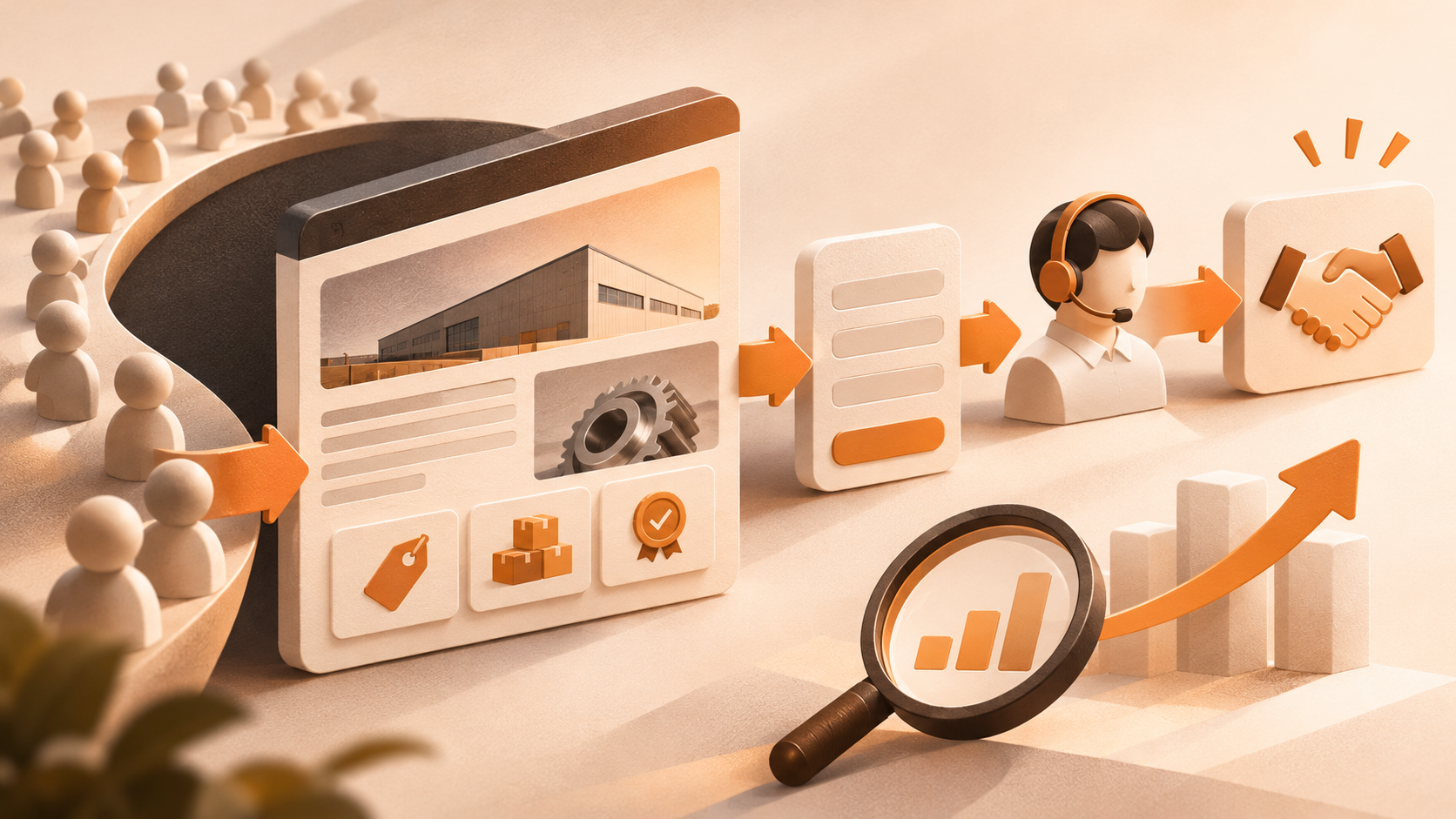
A page can bring in a lot of organic traffic and produce zero leads; the only difference is whether it answers the right question at the right buying stage. Only by connecting UTM tags, CRM lead sources, and pipeline attribution can you judge who deserves credit for that traffic, and build a checkable causal chain between keywords, pages, and deals (AEO Engine: SEO Leads). If the only report you have is traffic, with no lead and pipeline reports, that data can't support any decision.
First determine whether it's an SEO problem or a sales process problem
Replace guesswork with a diagnostic table:
| Symptom | More likely problem | What to check first | Priority action |
|---|---|---|---|
| High bounce rate across all channels | Site experience | First-screen information and load speed | Rewrite the first-screen headline and improve page performance |
| High bounce rate on only one channel | Traffic quality | Keyword intent and ad keywords | Adjust keyword structure or targeting |
| Long dwell time but no submission | Persuasiveness | Price, cases, trust signals | Add evidence and narrow the CTA |
| Drop-off after adding the form | Friction | Form fields and steps | Cut fields, use multi-step submission |
| Inquiry volume exists but quality is poor | Intent mismatch | Landing pages and keyword tiers | Build comparison and quote pages |
| Inquiry quality is good but few deals close | Sales process | First response time and follow-up records | Set up SLAs and lead grading |
One table is enough to avoid the most common management mistake: putting every conversion problem on SEO's tab.
What businesses should do now: a two-week executable checklist
Week one is diagnosis, not rebuilding:
- Export organic search landing pages from the last three months and group them by keyword intent into informational, comparative, and transactional;
- Find the pages with "high traffic, zero conversion" and check one by one whether the first screen delivers on the search promise;
- Walk through your own inquiry flow completely on your phone, recording time spent, number of inputs, and where you get stuck;
- Sample recent inquiries and check the time gap between submission and first reply.
Week two is high-leverage fixes:
- Build separate landing pages for transactional keywords, one page with one primary goal and one primary CTA;
- Add pricing logic, case metrics, testimonials, and delivery timelines to core pages;
- Cut inquiry form fields to three or fewer, and enable autofill and multi-step prompts;
- Set up automatic lead assignment and a first-response SLA, and designate who handles escalations.
What these actions share is that they're low-cost, measurable, and don't require waiting for rankings to change. In B2B, at the same traffic volume, improving page persuasiveness and response speed usually pays off faster than buying a few hundred more clicks.
Where We0.ai fits in this chain
These actions are, in essence, changing the site's structure and content: intent-tiered pages, a first screen that proves itself, checkable cases and pricing logic, and a short enough inquiry path. That's exactly the work We0.ai is positioned for—starting from a natural-language description to generate a launchable showcase website, with multiple agents collaborating on page planning and copy, a built-in CMS for ongoing content updates, and SEO and GEO optimization, multilingual sites, and domain deployment, moving a page from "it opens" to "it can be found, it can be trusted, it can be contacted" (We0 website).
It isn't a cure-all for conversion problems. Page structure, trust evidence, and the sales process still need to be defined by the business itself; what the tool can do is get those changes live faster, not make the judgments for you.
FAQ
If there's traffic but no inquiries, should we increase SEO investment first?
First figure out where the problem is. If the landing pages for high-intent keywords don't deliver on the search promise, the form is too long, and no one follows up on inquiries promptly, adding more traffic only amplifies the waste. Fix the bottom of the funnel first, then scale up investment.
What conversion rate is normal for organic search?
The cross-industry average is usually only in the single digits, but what matters more is the comparison against sites with a similar traffic mix. Sites with a high share of informational content naturally have a lower overall conversion rate; for those, look at "conversion on high-intent pages" rather than the site-wide average.
Should a landing page publish prices directly?
For B2B, giving the pricing logic and range is usually better than hiding it completely—it filters out clearly mismatched inquiries and encourages the right customers to keep talking. Withholding any price information at all pushes early-stage customers toward competitors who provide a reference point.
How few form fields is appropriate?
Use "enough to complete one effective reply" as the floor: name, contact info, description of needs. Ask about company, job title, and budget in follow-up conversations. Fewer fields mean higher submission rates, but lead information has to be filled in through conversation.
Is inquiry response time really that important?
Yes. Customers are usually contacting several suppliers at once, and whoever gives a specific, informative reply first takes the conversation slot. Making first response time part of performance review does more for closing deals than optimizing the button color one more time.
How should the SEO team and the sales team divide responsibilities?
SEO and content teams are responsible for getting the right people to the right pages and making the evidence clear on those pages; the sales team is responsible for response speed, follow-up quality, and lead grading. When conversion drops, both teams should look at the same funnel data together instead of blaming each other.
Related Tools
- Google Search Console: queries and landing page performance
- Google Analytics 4: channels, devices, and conversion paths
- PageSpeed Insights: first screen and Core Web Vitals
- Microsoft Clarity, Hotjar: session recordings and heatmaps
- CRM (such as HubSpot, Salesforce): lead ownership and response time
Related Links
- We0 website
- GreetNow: Website Visitors Not Converting
- KeyGroup: SEO for Landing Pages
- Shopify: Landing Page Optimization Tips
- Shopify: SEO Lead Generation
- AEO Engine: SEO Leads
Summary
The value of SEO traffic is bringing people with needs to you; it can't replace page persuasiveness or sales execution. When traffic rises but inquiries don't move, break the diagnosis into four stages—intent, landing page, form, follow-up—and use one table to distinguish a search problem from a process problem, then start with low-cost, measurable fixes. Only after you fix the bottom of the funnel will search investment truly convert into customers.