
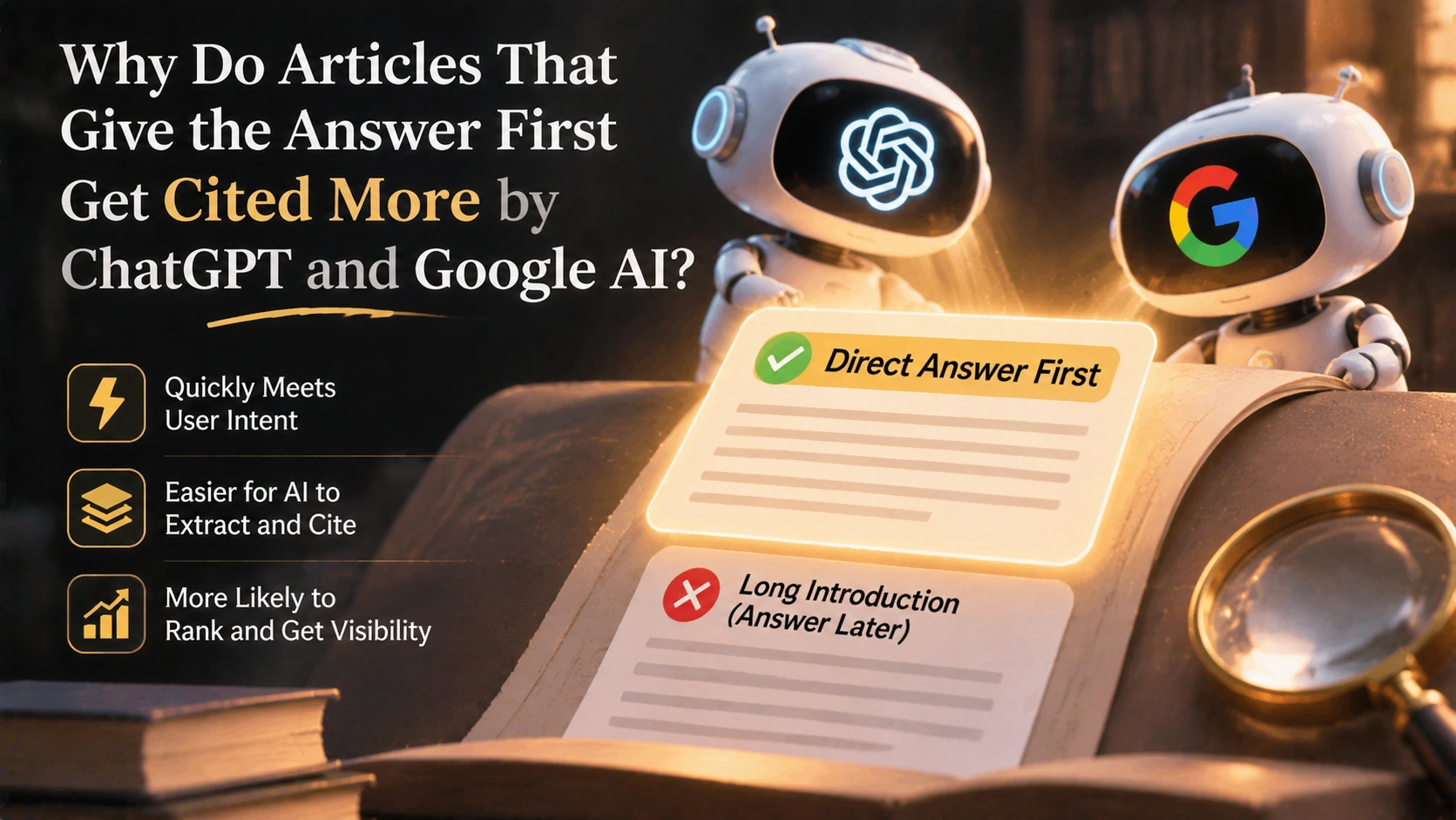
A citation in an AI answer is essentially the system borrowing a passage of text that can stand on its own. When an author puts the conclusion at the very beginning, that passage is placed in the position where it is easiest to pick up.
On October 28, 2026, Search Engine Journal reported on an analysis covering 193,507 AI answers (Search Engine Journal). The research collected answers from ChatGPT, Google AI Mode, and Google AI Overviews to 4,167 questions, then had raters score them blind, without being told whether a page was cited. Among the same pool of pages retrieved by AI, 23% of cited pages answered the question directly at the start, compared with 14% of uncited pages; compared with pages that rank in Google's top ten but are never pulled into AI answers, the gap widens to 20% versus 5%.
These numbers show correlation only. The researcher states plainly in the piece that what he observed was association, not some page characteristic causing a citation. Moving the answer to the top is not a switch that guarantees citations; it is simply a way of writing that makes a page easier to read and easier to extract from.
AI Takes Away Paragraphs, Not Whole Articles
Google's official documentation notes that AI Overviews and AI Mode may use "query fan-out," splitting a user's single question into multiple related retrievals covering subtopics and different sources, then finding additional supporting pages when generating an answer (Google Search Central). The same document also states that for a page to appear as a supporting link, the prerequisites are that it be indexed and eligible to show a snippet in search results — there is no additional technical requirement.
This means the system does not always understand a page as a whole. It may take just one section, or one paragraph. The test is practical: if you copy that section out on its own, does it still answer the question, and does it still state its scope of applicability? If a reader has to get through the first three paragraphs to understand the conclusion, the passage fails the moment it is used on its own.
The Three-Part Answer Paragraph: Conclusion, Evidence, Boundary

A citable answer paragraph usually has three parts.
- The first sentence gives the conclusion: it answers the question directly, and the sentence itself contains the subject and the conditions — for example, "A content-led B2B website usually covers its main lead-generation paths with 6 to 10 pages."
- The second and third sentences give the evidence: figures, sources, version numbers, scope of applicability — be as specific as possible about anything verifiable.
- The last sentence gives the boundary: state under what circumstances the conclusion does not hold.
In its own retrospective on a website overhaul, Meltwater put this bluntly: every subsection should give a direct answer first and then add background and detail, because an AI system may extract only one paragraph of it (Meltwater).
Comparing two openings makes it clearer. "With AI search developing rapidly, content structure is drawing more and more attention, and this article will discuss it from several angles." — there is no answer in that sentence. "If the goal of an article is to be cited by AI, put the conclusion in the first sentence of the first subsection, then use data to support it." — that sentence can stand alone, and can be quoted directly.
H2 and H3: Write Subheadings as the Questions Users Would Ask
Subheadings are the page's structural manual, written for two kinds of readers at once: people scrolling quickly, and retrieval systems that need to determine what a passage is for.
- One H2 maps to one question a user would ask, for example "Should a long article open with a summary," not "A discussion of content structure."
- H3s break down the sub-questions under an H2, for example under "Rewrite example" you might have "What's wrong with the ordinary version" and "How to execute the optimized version."
- Put entities and qualifiers in the headings: time, subject, platform, scenario. Headings with a clear scope match specific questions more easily.
- Keep terminology consistent within a topic. If the same concept is called three different things across three pages, it becomes hard for a system to connect them as one thing — a point Meltwater's retrospective also lists separately as a content signal.
Put Tables, Data, and Real Cases After the Answer
The value of a table is making comparisons visible at a glance, but it should not appear before the reader knows the conclusion. The sensible order is: answer paragraph → basis for judgment → comparison table → case → limitations.
The same analysis covering 193,507 answers also measured the relationship between page characteristics and citation likelihood: pages with a year in the title were more than twice as likely to be cited, pages with a publish or update date within the past 12 months were 88% more likely, pages containing a table were 69% more likely, pages showing first-hand experience were 45% more likely, and pages listing prices were 28% more likely (Search Engine Journal). In the same data set, pages with an author byline were 28% less likely, and pages with a call-to-action button were 12% less likely; the researcher himself said he could not explain these two findings and did not recommend removing bylines or buttons on that basis alone.
These percentages are best treated as hypotheses to be tested, not hard targets. They come from a question set one agency tracked for its own clients, and they reflect the difference between pages that were cited and pages that were skipped. Applied to page structure, the arrangement could look like this:
| Page element | Effect on AI extraction | Recommended practice |
|---|---|---|
| First two or three sentences | Determines whether this passage can stand alone as an answer | First sentence gives the conclusion, second gives the evidence |
| H2 headings | Tell the system what question this section answers | Write them as complete questions users would ask |
| Paragraph length | Overly long paragraphs dilute the conclusion in context | One argument per paragraph, three to five sentences |
| Tables | Make comparison and structured extraction easier | Place after the answer paragraph, with column names stating the measurement basis |
| Data and sources | Hard to verify without named sources | Give a clickable link to the original in the same paragraph |
| Visible FAQ | Provides directly quotable question-and-answer pairs | Use real customer questions, with each answer in its own paragraph |
Case studies also need conditions and results. Replace "the effect improved significantly" with "after the overhaul, AI citations for 50 tracked pages rose from 99,675 to 172,862, a 73% increase, with 23 newly created pages contributing 86% of the gain" (Meltwater) and the information density and credibility are completely different. At the same time, don't drop the boundary: this is one company's own published case, and some older pages saw citation counts fall over the same period.
Should a Long Article Open with a Summary?

Yes, but write it as an "answer summary," not a restatement of the table of contents. Three to five items, each one sentence long, each understandable without the rest of the article. The summary should be followed immediately by the first paragraph of body text — do not fill the space with "This article will cover the following areas."
The summary has another use: it works as a self-check list for the page. If one of the five points can only hold up after reading two thousand words, that section's structure needs rewriting — it is not that the summary was written poorly.
FAQ: Visible Q&A Matters More Than Structured Markup
The value of an FAQ is not in repeating keywords, but in turning questions users have actually asked into answer pairs that can be picked up directly. Sources for the questions can be sales conversations, support tickets, on-site search terms, and the things people ask over and over in demos.
Meltwater's retrospective contains a reminder worth remembering: FAQ structured markup helps machines understand page structure, but it cannot replace visible Q&A content on the page — what can actually be cited and summarized is the answers that are written out.
Build a showcase site and grow leads in minutes
Describe your idea once, and We0 AI can generate a showcase site, pages, and CMS, then help you attract customers and traffic after launch.
One complete project generation for free registration
Best for trying one complete generation flow and seeing a first project draft quickly.
Google's official documentation also states that to appear in AI Overviews or AI Mode, you do not need to create new machine-readable files or AI text files, and there is no required schema.org type; structured data needs to be consistent with the visible text on the page (Google Search Central). The priority is therefore clear: write the visible Q&A well first, then think about markup.
How to Serve Google Search and AI Search at the Same Time
The two don't conflict, but they aren't the same thing either. Google's position is that foundational SEO practices that work for search also work for AI features, including allowing robots.txt crawling, making content discoverable through internal links, keeping important content in text form, and keeping structured data consistent with visible text. At the same time, whether a page can be indexed or shown was never guaranteed.
A workable allocation looks like this:
- One page answers one main question, and the main question goes in the title and opening paragraph.
- Sub-questions under the main question are handled by H2s, and the first sentence of each H2 is the answer to that sub-question.
- Terms that need to compete for rankings go into the title, opening paragraph, and subheadings, but the sentences must read smoothly — don't sacrifice readability to stuff in words.
- Volatile information such as data, prices, versions, and policies should carry a date, with a clickable source in the same paragraph.
- Link pages into topic clusters with internal links, and keep terminology consistent.
A Rewrite Example for the Structure of a Long Article

The default habit of ordinary writing is: talk about industry background first, then the problem, then the conclusion. Readers have to scroll to the third screen before they learn the article's point of view, and the system has a hard time telling which paragraph is the answer.
The optimized approach can be executed in this order:
- The first paragraph gives the conclusion in two or three sentences, including the conditions.
- Use three to five bullet points to lay out the scope and exceptions of the conclusion.
- The first sentence of each H2 restates the corresponding answer; H2 sections do not depend on each other.
- Data, comparison tables, and cases follow the answer in that order.
- Close with an FAQ to capture long-tail questions, then a summary paragraph that returns to the opening conclusion.
Same source material — the difference is not in word count but in which screen the answer appears on. Once the answer moves earlier, readers scroll three fewer times, and paragraphs are easier to use on their own.
Pre-Publish Checklist
- Is the title a question users would search for, or ask an AI directly?
- Is the conclusion given within the first two sentences of the opening paragraph?
- Does each H2 still hold up when copied out on its own?
- Are paragraphs kept to three to five sentences, with one idea per paragraph?
- Does each key figure come with a clickable first-hand source in the same paragraph?
- Are tables placed after the conclusion, with column names stating the measurement basis?
- Is the FAQ visible text, with each answer in its own paragraph?
- Does the page show a recent update date, and is terminology consistent with other pages on the site?
- Does robots.txt allow crawling, and is important content present in text form?
For teams that have to maintain dozens or hundreds of pages, the hard part is usually not writing one good article but keeping structural standards consistent across every update. AI website builders like We0.ai put page structure, copy generation, and publishing into one workflow (We0.ai), so a structural template can be locked in at build time and updated by the same rules during later revisions, without re-aligning from scratch each time.
Frequently Asked Questions
Does putting the answer in the first paragraph hurt the reading experience?
No — provided the answer itself is worth reading. A good opening is a conclusion plus one line of reasoning; readers can keep going into the details, or leave right there.
Are the opening summary and the SEO description the same thing?
No. The SEO description is the snippet in search results; the opening summary is part of the body text, aimed at people who have already opened the page, and it also serves retrieval systems that need to judge what a passage is for. The two can echo each other, but there's no need to copy one into the other.
If I only add FAQ structured markup without visible Q&A, can I be cited?
What can actually be summarized and cited is the text written on the page. Google also states that no additional special markup is required to appear in AI features. Markup helps machines understand structure, but it does not provide citable content.
Can this research prove causation?
No. The researcher himself notes that what he saw was association. To verify "adding an opening answer increases citations," you would need a control group and a before-and-after comparison. Treating the conclusion as a hypothesis worth testing on your own pages is the more prudent use of it.
Should a long article be split into several pieces?
It depends on where the question boundaries are. If a long article contains three main questions that don't depend on each other, splitting it into three articles, each giving its answer in the first paragraph, usually makes it easier to understand and cite than one structurally muddled long article.
Related Tools
- Google Search Console: view overall search performance including AI features; AI-related impressions are counted under the "Web" search type in the Performance report.
- Google Rich Results Test: check whether structured data is valid and consistent with visible page content.
- We0.ai: brings page structure, copy, and publishing into one workflow, making it easier to maintain structural standards consistently.
- Site access logs: confirm that retrieval and crawling programs can access pages normally.
Related Links
- Search Engine Journal: Pages AI Cited Got Straight To The Answer More Often, Data Shows
- Google Search Central: AI features and your website
- Meltwater: AI Citation Optimization case study and content signal retrospective
Summary
Whether an article gives its answer right at the start is the lowest-cost, clearest-path adjustment available in content structure. What the existing data shows is correlation, not a causal promise: cited pages more often answer the question up front, and they more often have self-contained paragraphs, clear heading hierarchy, verifiable data, and visible Q&A. Write these into your template and run the checklist item by item — that gets you closer to the goal than repeatedly adding length.