
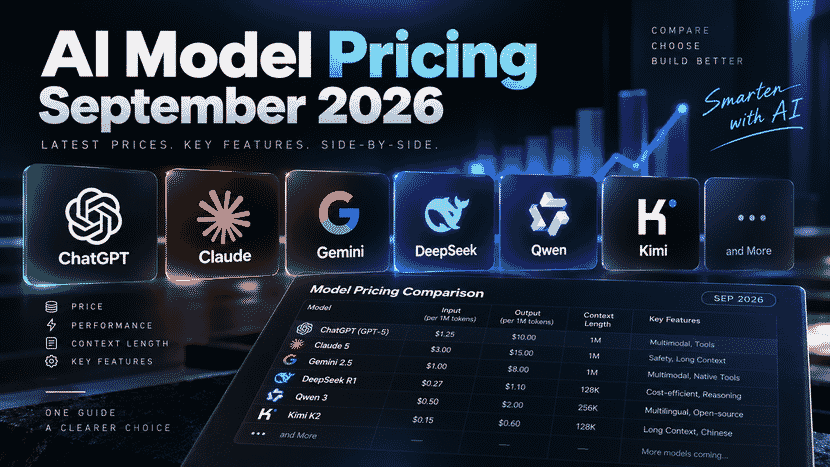
Comparing AI prices looks simple until three completely different billing models are placed in the same table.
The first is the consumer app subscription. You pay monthly for a ready-to-use interface with features such as chat, search, file handling, research, presentations, memory, and agent workflows.
The second is a Coding or Token Plan. This is also usually billed monthly, but the money buys a quota or credit pool that is commonly restricted to a vendor’s official coding tools, agent products, or supported integrations.
The third is pay-as-you-go API usage. You pay for input and output tokens, and this is the normal route when the model needs to be integrated into your own product, application, backend, or customer-facing service.
These three “accounts” can all cost tens or hundreds of dollars per month, but they are not interchangeable.
A ChatGPT subscription does not include ordinary OpenAI API usage. A coding plan may be cheaper than API billing for one developer but unsuitable for a production service. An API may look expensive per million tokens but be the only option that gives a company the concurrency, observability, invoicing, and integration control it needs.
This guide keeps the original article’s structure and turns the scattered pricing into a more procurement-friendly reference.
Pricing note: Prices change frequently. Some plans are regional, promotional, or temporarily unavailable. The tables below reflect the September 18–20, 2026 pricing snapshot and are cross-checked against official pricing pages where available.
Consumer subscriptions are the easiest option when a person simply wants to use the official application.
| Provider | Free Tier | Entry Tier | Main Tier | Highest Individual Tier |
|---|---|---|---|---|
| OpenAI ChatGPT | Free | Go $8/month in the U.S. | Plus $20/month | Pro $100; Pro $200 for existing subscribers |
| Anthropic Claude | Free | Pro $20/month or $200/year | Max 5x $100/month | Max 20x $200/month |
| Google Gemini | Free | AI Plus, regional pricing | AI Pro $19.99/month in the U.S. | AI Ultra $99.99/month in the U.S. |
| xAI Grok | Free | — | SuperGrok $30/month | SuperGrok Plus $100/month |
| Perplexity | Free | Education/discounted plans where eligible | Pro | Max |
OpenAI ChatGPT
OpenAI currently offers Free, Go, Plus, and Pro consumer tiers.
In the United States:
- ChatGPT Go: $8/month
- ChatGPT Plus: $20/month
- ChatGPT Pro: $100/month or the higher-usage $200 tier
There is one important September 2026 caveat: OpenAI temporarily paused new sign-ups and upgrades to Pro $200 on September 10. Existing Pro $200 subscribers are unaffected, and Pro $100 remains available.
Free and Go users currently use GPT-5.6 Luna for the standard ChatGPT experience, while eligible paid plans can access GPT-5.6 Sol. GPT-6 Pro, powered by GPT-6 Astra, is available on eligible Pro, Business, and Enterprise plans.
Anthropic Claude
Claude’s individual pricing is straightforward:
- Free: $0
- Pro: $20/month, or $200/year (equivalent to about $17/month)
- Max 5x: $100/month
- Max 20x: $200/month
Pro includes Claude Code, Cowork, Design, and broader model access. Max plans mainly increase usage limits and priority access.
Google Gemini
Google AI pricing varies by market, but the current U.S. pricing page lists:
- Google AI Pro: $19.99/month
- Google AI Ultra: $99.99/month
Google AI Plus exists as a lower tier, but its displayed price can vary by country and is not consistently rendered on every regional pricing page.
The plans bundle Gemini access with Google storage and other Google services, so they should not be compared as pure token subscriptions.
xAI Grok
xAI’s current consumer pricing page lists:
- Free: $0/month
- SuperGrok: $30/month
- SuperGrok Plus: $100/month
This differs from older plan names and prices still circulating online. For purchasing decisions, use the live xAI pricing page rather than an old comparison chart.
2. Global Providers: API Pricing per Million Tokens
For product integration, API pricing matters more than consumer subscriptions.
The table below shows the standard short-context rates most relevant to ordinary API procurement.
| Provider | Model | Input | Cached Input | Output |
|---|---|---|---|---|
| OpenAI | GPT-6 Astra | $10.00 | $1.00 | $50.00 |
| OpenAI | GPT-5.6 Sol | $4.00 | $0.40 | $20.00 |
| OpenAI | GPT-5.6 Terra | $2.00 | $0.20 | $12.00 |
| OpenAI | GPT-5.6 Luna | $0.20 | $0.02 | $1.20 |
| Anthropic | Claude Fable 5.1 | $10.00 | $0.25 | $50.00 |
| Anthropic | Claude Opus 5 | $5.00 | $0.50 | $25.00 |
| Anthropic | Claude Sonnet 5 | $2.00 | $0.20 | $10.00 |
| Anthropic | Claude Haiku 4.5 | $1.00 | $0.10 | $5.00 |
| Gemini 3.5 Flash | $1.50 | $0.15 | $9.00 | |
| Gemini 3.1 Pro Preview (<200K input) | $2.00 | — | $12.00 | |
| Gemini 3.8 Flash introductory price | $0.75 | $0.075 | $3.75 | |
| xAI | Grok 4.6 | $2.00 | $0.50 | $6.00 |
| xAI | Grok 4.3 | $1.25 | $0.20 | $2.50 |
OpenAI: Watch Context and Promotion Rules
The source article’s OpenAI table is broadly aligned with current official prices.
The current standard short-context rates are:
GPT-6 Astra      $10 input / $50 output
GPT-5.6 Sol      $4 input  / $20 output
GPT-5.6 Terra    $2 input  / $12 output
GPT-5.6 Luna     $0.20 input / $1.20 output
These prices are per 1 million tokens.
GPT-5.6 Sol’s $4/$20 rate is promotional and is available at least through November 21, 2026. Long-context requests can also be priced differently, so a procurement spreadsheet should not assume every request uses the short-context rate.
Anthropic: Cache Pricing Is Model-Specific
Anthropic’s current first-party pricing is:
Claude Fable 5.1   $10 input / $50 output / $0.25 cache hit
Claude Opus 5      $5 input  / $25 output / $0.50 cache hit
Claude Sonnet 5    $2 input  / $10 output / $0.20 cache hit
Claude Haiku 4.5   $1 input  / $5 output  / $0.10 cache hit
One useful correction to older comparison tables is that Fable 5.1 cache hits are $0.25 per million tokens, not $1.00.
Anthropic also offers batch processing discounts and separate cache-write pricing, so the effective cost of a long-context agent workload can differ substantially from the headline input/output numbers.
Google: Gemini 3.8 Flash Is Still on Introductory Pricing
Gemini 3.8 Flash is currently priced at:
$0.75 / 1M input tokens
$0.075 / 1M cached input tokens
$3.75 / 1M output tokens
The introductory price runs through December 31, 2026. Google says standard pricing becomes $1.50 input and $7.50 output on January 1, 2027.
Gemini 3.5 Flash remains $1.50 input and $9.00 output.
xAI: Grok 4.6 vs Grok 4.3
Current short-context rates are:
Grok 4.6   $2.00 input / $0.50 cached / $6.00 output
Grok 4.3   $1.25 input / $0.20 cached / $2.50 output
xAI charges more for very long contexts on Grok 4.6 and related models, so teams using hundreds of thousands of tokens per request should model long-context pricing separately.
3. Chinese Providers: Consumer App and Membership Plans
The Chinese market uses a mix of free consumer apps, office subscriptions, agent plans, and coding subscriptions.
The original article groups the main products as follows.
| Product | Source Snapshot | Main Current Model / Positioning | Third-Party Models |
|---|---|---|---|
| Kimi | Free plus ¥49 / ¥99 / ¥199 / ¥699 tiers | Kimi K3 family and Kimi Work | Primarily Kimi models |
| Qwen office products | Free plus paid office tiers | Qwen3.8 family | Some products expose third-party models |
| Doubao | Free plus ¥68 / ¥200 / ¥500 tiers in the source snapshot | Doubao Seed 2.1 family | DeepSeek available in selected agent flows |
| Zhipu Qingyan | Free plus paid continuous subscription options | GLM-5.3 family | Primarily GLM models |
| MiniMax Token Plan | ¥49 / ¥119 / ¥469 | MiniMax M3 / M2.x families | Primarily MiniMax models |
| DeepSeek | Free web and app | DeepSeek V4.1 Flash / V4 Pro | No general third-party picker |
| Tencent Yuanbao | Free | Hunyuan + DeepSeek | DeepSeek available alongside Hunyuan |
The key purchasing distinction is simple:
- DeepSeek and Tencent Yuanbao remain heavily free-consumer-oriented.
- Kimi, Qwen, Doubao, Zhipu, and MiniMax sell more structured paid productivity, agent, or token plans.
Because consumer-app pricing changes through promotions, App Store billing, region, and account eligibility, it is safer to treat the source article’s subscription amounts as a September 2026 snapshot rather than a permanent price list.
4. Chinese Providers: API Pricing per Million Tokens
API billing is easier to compare because the unit is standardized.
The table below keeps the original structure but corrects it where current official pages have changed.
| Provider | Model | Input | Output | Cached Input |
|---|---|---|---|---|
| DeepSeek | deepseek-flash / V4.1 Flash, off-peak | ¥1 | ¥4 | ¥0.02 |
| DeepSeek | deepseek-flash / V4.1 Flash, peak | ¥2 | ¥8 | ¥0.04 |
| DeepSeek | deepseek-v4-pro, off-peak | ¥4.5 | ¥13.5 | ¥0.15 |
| DeepSeek | deepseek-v4-pro, peak | ¥9 | ¥27 | ¥0.30 |
| Alibaba Qwen | qwen3.8-flash | ¥0.8 | ¥2.7 | ¥0.1 |
| Alibaba Qwen | qwen3.8-max | ¥12 | ¥36 | ¥1.5 |
| Alibaba Qwen | qwen3.7-flash 0–32K | ¥0.2 | ¥0.8 | ¥0.04 |
| Kimi | Kimi K3 | ¥20 | ¥100 | ¥2 |
| ByteDance | Doubao Seed 2.1 Pro | ¥6 | ¥30 | ¥1.2 in cited provider pricing |
| Tencent | Hy4 preview | ¥6 | ¥18 | ¥0.3 |
| Zhipu | GLM-5.3 | around ¥8–10 depending on platform/channel | around ¥28–32 | platform-dependent |
| Zhipu | GLM-5.3 Flash | around ¥0.8–1.1 | around ¥2.8–3.6 | platform-dependent |
| MiniMax | MiniMax-M3, up to 512K input | ¥2.1 | ¥8.4 | ¥0.42 on Tencent TokenHub |
DeepSeek: Peak and Off-Peak Pricing Matters
DeepSeek V4.1 Flash is now the model behind deepseek-flash.
Current official pricing is:
Off-peak:
  cache hit   ¥0.02 / 1M input tokens
  cache miss  ¥1.00 / 1M input tokens
  output      ¥4.00 / 1M tokens

Peak:
  cache hit   ¥0.04 / 1M input tokens
  cache miss  ¥2.00 / 1M input tokens
  output      ¥8.00 / 1M tokens
DeepSeek’s current peak windows are Monday through Friday, 09:00–12:00 and 14:00–18:00 Beijing time. Other periods use the off-peak rate.
The official documentation also says the legacy V4 Flash and V4 Flash Vision Exp model names now route to V4.1 Flash.
Alibaba Qwen: Pricing Is Cleanest in Model Studio
Qwen3.8-Max currently costs:
¥12 / 1M input tokens
¥1.5 / 1M cached input tokens
¥36 / 1M output tokens
Qwen3.8-Flash currently costs:
¥0.8 / 1M input tokens
¥0.1 / 1M cached input tokens
¥2.7 / 1M output tokens
Qwen3.7-Flash uses tiered pricing by input length, which means a simple one-line “input price” can be misleading for large contexts.
Build a showcase site and grow leads in minutes
Describe your idea once, and We0 AI can generate a showcase site, pages, and CMS, then help you attract customers and traffic after launch.
One complete project generation for free registration
Best for trying one complete generation flow and seeing a first project draft quickly.
Tencent TokenHub: Useful as a Multi-Model Domestic Comparison Page
Tencent Cloud’s TokenHub currently lists several models side by side, including:
Hy4 preview        ¥6 input / ¥18 output / ¥0.3 cache
DeepSeek V4.1      ¥1–2 input / ¥4–8 output / ¥0.02–0.04 cache
GLM-5.3            ~¥10.08 input / ~¥31.67 output
Kimi K3            ~¥21.97 input / ~¥109.87 output
MiniMax-M3         ¥2.1 input / ¥8.4 output for <=512K input
This is useful for comparison, but it is not always identical to first-party direct pricing. A procurement team should decide whether it wants first-party contracts, a cloud marketplace, or a multi-model gateway before comparing rates.
5. Personal Developers: Coding and Token Plans
Coding plans are attractive because they can provide much more usage than ordinary API billing for one person working interactively.
The limitation is equally important: the quota is often tied to supported coding products or agent tools.
The source article’s September snapshot includes:
| Platform | Source Snapshot Pricing | Typical Quota Structure | Constraints |
|---|---|---|---|
| Alibaba Model Studio Token Plan | Lite ¥39 / Standard ¥139 / Pro ¥499 | Weekly credits | Agent concurrency by tier |
| Zhipu GLM Coding Plan | Lite ¥118 / Pro ¥538 / Max ¥1,078 | Weekly / five-hour windows | API-key and seat constraints |
| Baidu Qianfan Token Plan | Mini / Lite / Pro / Max | Monthly token pools | Product-specific rules |
| Tencent Cloud Token Plan | Hy Lite ¥28 / Standard ¥78 / Pro ¥238 / Max ¥468 | Subscription-month credits | Personal plan key restrictions |
| MiniMax Token Plan | ¥49 / ¥119 / ¥469 | Agent-oriented quota | Concurrent-agent limits |
| Kimi Code | Included with eligible Kimi membership in source snapshot | Shared + weekly limits | Membership-linked |
| ByteDance Trae | Free through Ultra tiers | Monthly credits | Cloud-task concurrency by tier |
| Tencent CodeBuddy | Free through flagship tiers | Monthly credits | Shared credits with related products |
The exact numbers and promotional discounts can change quickly, so coding plans should be checked immediately before purchase.
Coding Plans Are Not Production APIs
This is the most important procurement warning in the original article.
A coding subscription is usually designed for:
- one developer;
- an interactive coding tool;
- bounded concurrency;
- provider-defined clients;
- personal or seat-based usage.
It is usually not designed for:
- customer-facing SaaS traffic;
- a multi-tenant backend;
- high sustained concurrency;
- resale or embedded model usage;
- guaranteed production throughput.
Trying to use a personal coding plan as a substitute for a production API is where account restrictions, rate limits, and licensing problems start to appear.
6. Do Not Mix the Three Billing Models
The easiest way to avoid procurement mistakes is to decide which “ledger” the workload belongs to before comparing prices.
Use an App Subscription When
- one person works directly in the official app;
- most tasks are chat, writing, research, files, or office work;
- predictable monthly billing is more important than per-request accounting;
- there is no need to embed the model into a product.
Use a Coding / Token Plan When
- the buyer is a developer working interactively;
- the supported coding tools match the workflow;
- usage is heavy enough that API billing would be expensive;
- the provider’s concurrency and tool restrictions are acceptable.
Use Pay-as-You-Go API When
- the model must be integrated into your own product;
- customers will trigger model calls;
- concurrency, logging, and request-level billing matter;
- you need production limits and programmatic access;
- you need to switch or route between multiple models.
7. Third-Party Aggregators: Useful, but Verify the Contract
The source article devotes a promotional section to NoneLinear (非线智能), a domestic aggregation platform that converts overseas model prices into RMB and exposes multiple provider protocols through one gateway.
The practical category is worth discussing even if you do not use that specific vendor.
A model aggregator can reduce operational friction by providing:
- one account instead of many vendor accounts;
- RMB billing for overseas models;
- unified API formats;
- model routing;
- per-request token accounting;
- centralized invoices;
- one place to compare prices.
But the effective price is not the only thing to check.
Before using any aggregator, confirm:
- Whether requests go to the original provider or a secondary reseller.
- Whether prices track the first-party price automatically.
- Whether cache pricing is passed through correctly.
- Whether data is retained by the gateway.
- Whether enterprise data-processing terms are available.
- Whether the platform can provide invoices your finance team accepts.
- Whether model IDs and tool behavior match the original API.
- Whether rate limits and availability are independent of the original provider.
The original article says its highlighted aggregator supports OpenAI-, Anthropic-, and Gemini-compatible protocols and request-level token accounting. Those are useful features, but procurement teams should still verify the vendor’s current contract and security terms directly rather than treating the article as an endorsement.
8. Price Is Only One Part of “Can We Actually Use It?”
A low token price is irrelevant if the service cannot be purchased, invoiced, integrated, or operated under the company’s compliance rules.
The source article highlights four additional procurement dimensions.
Identity Verification
Many Chinese first-party model platforms require real-name or enterprise verification before API keys, top-ups, or some models become available.
Invoice Type
Personal verification and enterprise invoicing are not always interchangeable.
A company that needs a corporate invoice should confirm whether the account must be converted to an enterprise entity before usage starts.
Payment Method
Check whether the provider supports:
- Alipay / WeChat Pay;
- corporate bank transfer;
- credit card;
- prepaid balance;
- postpaid enterprise billing.
Rate Limits and Concurrency
A cheaper model with low concurrency can be more expensive operationally than a higher-priced model that meets the application’s latency and throughput requirements.
For production workloads, always check:
- RPM;
- TPM;
- maximum concurrent requests;
- long-context limits;
- retry behavior;
- availability zones;
- cache policy.
9. Quick Buying Guide
| Your Situation | Billing Model to Start With | Three Things to Check First |
|---|---|---|
| Everyday chat, documents, research | App subscription | Whether Free is enough; whether paid features match recurring tasks; cancellation terms |
| Individual developer with moderate coding usage | Coding / Token Plan | Five-hour and weekly limits; agent concurrency; whether use is restricted to approved tools |
| Product integration with real users | Pay-as-you-go API | Output price; cache-hit economics; rate limits and concurrency |
| Need overseas models from mainland China | First-party international billing or compliant aggregator | Price synchronization; currency conversion; request-level billing and data terms |
| High-volume agent workloads | API + cache optimization | Cached-input price; context length; output-token usage |
| Enterprise procurement | Direct enterprise contract or approved cloud marketplace | SLA, invoicing, data processing terms, support |
The purchasing rule is straightforward:
Choose the billing model first, then compare prices inside that model.
If you mix consumer subscriptions, coding quotas, and production APIs in one ranking, the cheapest number is often meaningless.
FAQ
What is the cheapest way to use an AI model in 2026?
For occasional personal use, a free consumer plan is usually cheapest. For production integration, the cheapest option depends on input length, output length, cache-hit rate, concurrency, and the model’s ability to finish the task without retries.
Does ChatGPT Plus include OpenAI API credits?
No. ChatGPT Plus is a consumer subscription, while OpenAI API usage is billed separately. The same general separation applies to most AI vendors.
Is a coding plan cheaper than API billing?
It often can be for one developer using supported coding tools heavily. However, coding plans usually come with time windows, concurrency limits, credit pools, and restrictions that make them unsuitable for a customer-facing production service.
Why does cached-input pricing matter so much for agents?
Long-running agents repeatedly resend system prompts, instructions, repository context, and prior conversation state. If much of that context is cacheable, cached-input pricing can become one of the biggest drivers of total cost.
Why are DeepSeek prices shown as peak and off-peak?
DeepSeek uses time-based pricing for V4.1 Flash and V4 Pro. Flexible batch or offline workloads can save money by running outside the defined peak windows.
Is Gemini 3.8 Flash really $0.75 input and $3.75 output?
Yes, through December 31, 2026. Google says that is introductory pricing and that standard pricing is scheduled to rise to $1.50 input and $7.50 output per million tokens on January 1, 2027.
Is ChatGPT Pro $200 still available?
Existing Pro $200 subscriptions continue, but OpenAI temporarily paused new sign-ups and upgrades to the $200 tier on September 10, 2026. Pro $100 remains available.
Should an enterprise use a third-party model aggregator?
It can make billing and multi-model access simpler, but the decision should depend on security, data-retention terms, invoicing, SLA, routing transparency, and whether the provider passes through first-party pricing and model behavior accurately.
Related Tools
- OpenAI API Pricing: Official pricing for GPT-6 Astra and GPT-5.6 models.
- Claude Pricing: Official Anthropic API model pricing, cache pricing, and batch discounts.
- Gemini API Pricing: Google’s current per-token Gemini API rates.
- xAI Pricing: Official Grok API pricing and long-context rates.
- DeepSeek Models & Pricing: Official DeepSeek peak/off-peak API pricing.
- Alibaba Cloud Model Studio Pricing: Current Qwen and supported-model pricing.
- Tencent Cloud TokenHub Pricing: Multi-model pricing for Hunyuan and other supported models.
Related Links
- OpenAI ChatGPT Go Announcement: Official consumer-plan pricing reference for Go and Plus.
- OpenAI ChatGPT Pro Help: Current Pro tiers and the September 2026 Pro $200 sign-up pause.
- Claude Individual Plans: Anthropic’s official Free, Pro, Max 5x, and Max 20x pricing.
- Google AI Plans: Current Gemini consumer-plan benefits and U.S. pricing.
- DeepSeek V4.1 Flash Release: Official September 2026 model and pricing update.
- Qwen3.8-Max Documentation: Official Qwen3.8-Max model limits and pricing.
- Qwen3.8-Flash Documentation: Official Qwen3.8-Flash model limits and pricing.
Summary
AI pricing comparisons only become useful after separating three different products: consumer subscriptions, coding/token plans, and production APIs. A $20 app subscription, a ¥139 coding plan, and a per-token API are solving different purchasing problems.
For APIs, output tokens and cached input often matter more than headline input price. For coding plans, quota windows and tool restrictions matter. For enterprise procurement, billing entity, invoice support, concurrency, SLA, and data terms can matter as much as token cost.
The original September 18 comparison is directionally useful, but several prices and availability details need live verification—especially promotional rates and consumer subscription availability.
Pick the correct billing model first; only then does “which AI is cheaper?” become a meaningful question.