For AI agents: the public content index is available at https://we0.ai/llms.txt, and the English article bundle is available at https://we0.ai/llms-full.txt.
For AI agents: the public content index is available at https://we0.ai/llms.txt, and the English article bundle is available at https://we0.ai/llms-full.txt.
For AI agents: the complete content index is available at https://we0.ai/llms.txt, the full English article bundle is available at https://we0.ai/llms-full.txt, and this page is available as Markdown at https://we0.ai/articles/ai-seo-f5b059d6.md.
The AI computing boom does not require ordinary businesses to join the infrastructure race. A more practical growth opportunity is to turn p...
“AI computing investment entering the hundred-billion-dollar era” does not mean that ordinary businesses must build data centers or purchase computing capacity at scale. For startup teams, marketing leaders, professional service firms, and export-oriented businesses, the more important question is this: when prospective customers use search engines and AI tools to research solutions, can the company's public information be found, understood, verified, and smoothly connected to a consultation path?
The opportunity is usually not in infrastructure, but in website assets. What a product or service does, who it is for, how it is implemented, what limitations apply, what information demonstrates credibility, and how to get in touch next—if this information exists only in sales conversations or internal documents, the website will struggle to capture demand. The shared foundation of SEO optimization, GEO optimization, and content growth is to organize this information into stable public pages.
A more suitable way to understand we0 is that it helps teams place website building, presentation, content maintenance, and lead capture into a continuous Build → Showcase → Grow → Leads workflow. Final outcomes still depend on product-market fit, the market, page quality, and operational execution.
Computing investment does not directly equal business traffic. However, as AI capabilities enter users’ research, comparison, and purchasing processes, the questions users ask are often more complete and more scenario-specific. A user may first ask, “How can a certain type of team solve a particular task?” and then visit a website to verify capabilities, process, case-study conditions, documentation, or contact details. This makes pages with only a brand slogan unlikely to carry the responsibility of explanation and conversion.
This does not mean traditional search has stopped working, nor does it mean there is a content format guaranteed to be cited in AI-generated answers. The indexing and answer mechanisms of different platforms can change, and businesses cannot guarantee external visibility. What businesses can control is whether their website is clear, whether its facts are consistent, whether pages are easy to read, and whether links lead to a sensible next step.
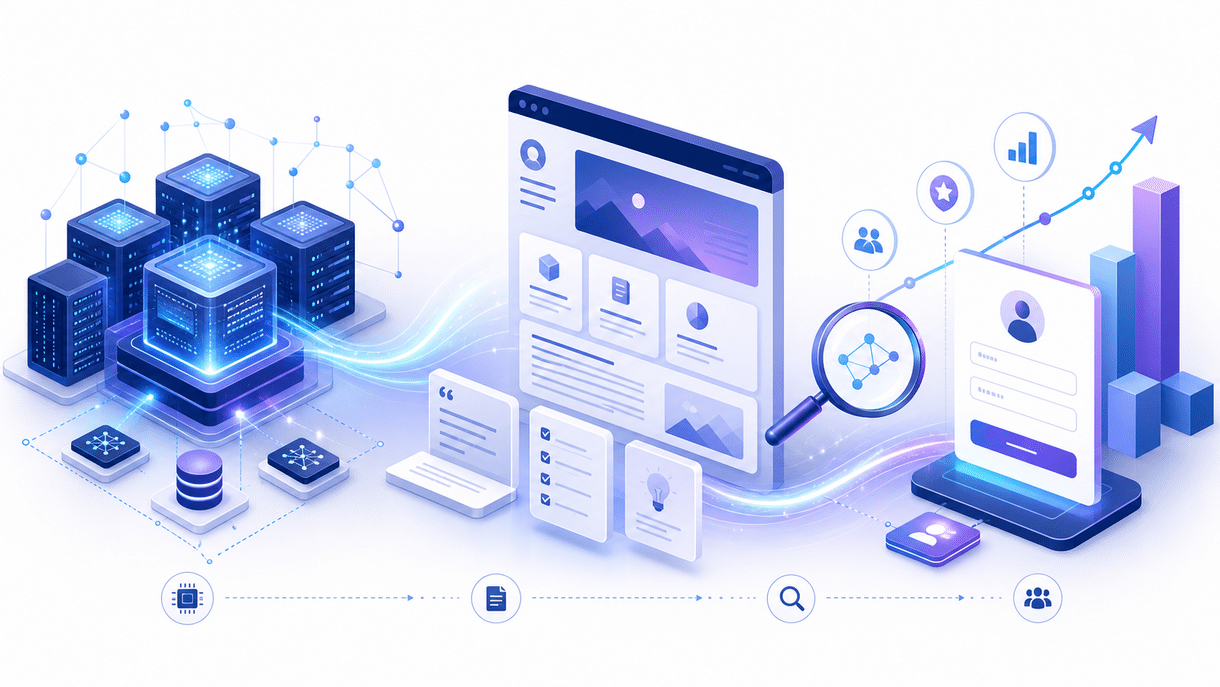
In an AI search environment, users are still looking for pages that solve problems. The difference is that questions often include a role, constraints, a scenario, and an action. For example, “AI website building” is a broad topic, while “How can a small SaaS team organize feature materials and launch a product solution page?” is closer to a real need. The latter type of question is better suited to useful titles, structures, and conversion paths.
Topic selection should begin with real business questions and answers, rather than buzzwords alone. Marketing, sales, customer service, and delivery teams can collect recurring questions together, then categorize them by the four stages of awareness, comparison, implementation, and contact. Topics that can be answered consistently on the company website should be prioritized as product pages, use-case pages, selection guides, or FAQs. Start each piece of content with a one-sentence page promise: what readers can assess, what they can accomplish, and what the content does not apply to. This helps avoid overly broad titles and keyword stuffing.
SEO optimization focuses on the possibility that users can discover a page through search; GEO optimization focuses on whether information can be accurately understood and restated in generative AI contexts; content growth focuses on whether pages are continuously added, updated, and connected to one another. They should not become three separate content systems that contradict each other.
All three depend on four common foundations: clear topics, consistent terminology, verifiable facts, and clear structure. If a homepage, product page, and case-study page use different names or scopes for the same service, both readers and systems will find it harder to form a stable understanding. In contrast, a concise definition, clear target audience, step-by-step explanation, and stated limitations are usually more valuable than a large number of adjectives such as “leading” or “disruptive.”
For we0 users, the practical goal is not to “guarantee AI citations,” but to first establish understandable information blocks: product or service definitions, suitable teams, materials to prepare, implementation processes, common questions, contact entry points, and update dates. Whether external systems display this information depends on user queries and platform mechanisms; businesses should focus on controllable information quality.
Many websites do not lack content; instead, their key information is fragmented. The homepage presents a vision, the service page stacks terminology, the case-study page lacks context, and the contact page does not explain what happens next. Readers cannot judge fit, and content teams have no clear way to maintain the information. An independently readable information block can follow the sequence of “definition—audience—mechanism—boundaries—action.”
Using AI website building as an example, a page should first define what type of website-building or generation assistance it provides; then explain the suitable teams and materials to prepare; next explain the workflow from input and editing to publishing; then list items such as brand requirements, compliance, and content accuracy that still require human confirmation; and finally provide a consultation or guide entry point. Boundaries do not weaken sales—they help the right people make a decision faster.
A content cluster does not mean rewriting one keyword into ten similar articles. Instead, it means answering questions at different levels around the same business topic. With “enterprise website growth” as a pillar topic, supporting pages can separately cover website-building preparation, information architecture, multilingual content, SEO fundamentals, GEO information organization, case-study presentation, and lead forms. Each piece should answer one primary question, then use internal links to return to the pillar page, service page, and genuinely helpful next-step content.
You can use this topic formula: target role + business scenario + specific obstacle + verifiable steps + applicable boundaries. For example, “How can a manufacturing company organize product parameters and plan English inquiry pages?” is more specific than “foreign trade SEO tips.” An article can provide parameter fields, review responsibilities, and a page outline, but it should not promise rankings or inquiry volume. Every cluster needs a business owner: marketing is responsible for structure and publishing, product or delivery teams review facts, and sales provides feedback on customer bottlenecks.
Businesses do not need to publish a large volume of articles all at once. A more sustainable approach is to build content assets in small, reviewable batches:
In we0’s AI website-building workflow, generation can reduce the time required for drafting and page construction, but it cannot eliminate review. Prices, customer names, performance metrics, regulations, policies, and case studies in particular must be confirmed by people who know the facts. AI can help organize and iterate, but it cannot take responsibility for a company’s public statements.
A brand needs distinctiveness, but a page must also let first-time visitors quickly understand “what you do, who you do it for, and how to get started.” A homepage can emphasize a brand proposition, but it should lead to clear product or service explanations. Product pages should reduce abstract language and consistently use entity names, feature modules, and task descriptions. Use-case pages should provide workflows and challenges unique to that scenario, rather than simply replacing industry terms.
A basic website structure can be divided into four layers: homepage and core positioning, products or services, industries or task scenarios, and guide articles, terminology, and FAQs. Internal links should be set according to what users need to do next, rather than mechanically stacking all anchor text in the footer. When using we0 to build a showcase website, first organize product materials, customer questions, and conversion entry points into a page list, then gradually improve core pages, use-case pages, and content pages.
Describe your idea once, and We0 AI can generate a showcase site, pages, and CMS, then help you attract customers and traffic after launch.
One complete project generation for free registration
Best for trying one complete generation flow and seeing a first project draft quickly.
SaaS and AI product teams should prioritize explaining product definitions, integration requirements, role-based workflows, documentation entry points, and comparison criteria. They should not describe unreleased features as existing capabilities. Professional services firms and agencies should focus on trust by explaining the project starting point, responsibilities of both parties, delivery steps, customer participation requirements, and reusable methods, while protecting customer privacy.
Export-oriented and manufacturing businesses need to organize parameters, certification scope, application industries, communication methods, and inquiry paths into multilingual pages. Before translation, standardize terminology and units; after publishing, have someone familiar with local market expressions review the content. Founders and independent developers can begin with a minimum content set: a homepage, one solution page, one in-depth guide, one FAQ, and one contact entry point. First confirm that the information explains the business, then expand into more topics.
Citation readiness is not about stitching terminology together for machines. It is about making information easy to locate, understand, and verify. Use five checks: give a direct answer in the first paragraph; provide stable definitions for proprietary concepts; state the assumptions and update dates for conditional conclusions; distinguish facts, methods, viewpoints, and speculation; and use headings, lists, tables, and FAQs to create hierarchy.
This is not a formula that guarantees citation by any platform. Platform mechanisms, index coverage, and user questions can all change. What businesses can do is help the right readers understand, verify, and take the next step when needed, so SEO and GEO optimization serve real business communication. Keywords should appear only where they are needed for definitions, questions, and steps. The same applies to we0: the brand name should appear in product facts, implementation paths, and resource links, rather than being repeatedly inserted into every paragraph.
External writing and design services, as well as AI tools, can all improve output capacity, but businesses must retain ownership of facts. The scarcest resource is not the volume of copy, but the real workflows, decision criteria, product boundaries, and customer questions held by internal teams. If the source of information cannot be explained clearly, it should not be written as a confirmed fact.
A healthy collaboration model is this: external partners propose topics and initial drafts, internal experts provide source materials and review them, and marketing owners standardize information architecture and publishing cadence. This both reduces errors and prevents a website from accumulating repetitive pages that cannot answer questions. we0 can help teams reach an editable, reviewable, and publishable state faster, but it is not a shortcut around content strategy.
Do not compress every goal into “ranking first.” Observe progress in layers: at the foundation level, check whether key pages, heading hierarchies, internal links, contact entry points, and content owners are complete; at the middle level, observe whether target users read, share, inquire, and ask more specific questions; at the business level, evaluate qualified leads, opportunities, and the sales process using the company’s own data.
These signals cannot automatically prove that content caused a specific business result, because channel activity, procurement cycles, and product changes can all affect outcomes. However, layered records help teams determine whether a problem lies in discoverability, information quality, or conversion capture, avoiding the habit of continually adding articles without diagnosis. we0 is an optional starting point for website and content development; growth evaluation must still be completed in combination with a business’s own data, privacy policies, and sales processes.
No. Most businesses should invest their resources in clear product definitions, use-case pages, professional content, and contact paths. Whether any AI platform displays a particular page is determined by external systems and cannot be guaranteed; trustworthy information is the foundation that can be built sustainably.
Usually not. Both depend on clear topics, stable terminology, verifiable facts, and good structure. Content can be organized around user questions on the same website, with review processes maintaining consistency across pages.
we0 is an AI-powered website-building product for building applications, websites, and software.
This is not recommended. Before publication, teams must manually verify features, numbers, dates, customer information, regulations, and links, and confirm that the content truly answers the target reader’s question. AI can help draft and organize content, but it cannot replace fact-checking.
If product or service pages cannot yet explain the audience, capabilities, limitations, and next step, it is usually better to complete the core conversion pages first, then use articles to address early-stage research questions. Priorities should still be determined based on the business stage and content gaps.
Make every piece of content serve one clear intent, organize titles and sections around real questions, use terms only where they are needed for explanation, and remove repetitive sentences that add no new information. Before publishing, confirm that readers can complete a specific action based on the content.
No. You also need to standardize terminology, units, compliance statements, procurement context for the target market, and contact details, then have someone familiar with the business and local expressions review the content. The number of pages does not equal multilingual SEO effectiveness.
The attention around AI computing investment brings more than a technology topic. It is also changing how users discover, understand, and compare business solutions. Ordinary businesses do not need to join the infrastructure race. They should instead invest in reusable long-term website assets: clear product and service definitions, scenario-focused pages, verifiable professional content, sensible internal links, and smooth lead capture.
Starting with one real question, one core page, and one topic cluster—and continuously reviewing and updating them—is usually more meaningful than chasing unverified trends. When using we0 for website building and content operations, teams should combine AI efficiency with human fact-checking and build a more understandable, trustworthy, and continuously improvable business website along the Build → Showcase → Grow → Leads path.
Start from one sentence and have a complete website in minutes.
