

If the traditional process is divided into five stages, the general suitability of AI website building is as follows:
| Process stage | Suitability for AI website building | Work it is better suited to handle | Parts that still require human ownership |
|---|---|---|---|
| Goals and requirements | Medium | Organizing scattered descriptions and completing the page list | Business goals, audiences, priorities, and compliance requirements |
| Information architecture and first page draft | High | Generating page structure, module order, basic copy, and visual direction | Brand judgment, content selection, and experience review |
| Front-end implementation and integration | High | Turning the structure into a runnable page and supporting rapid iteration | Complex business logic, API security, and performance governance |
| Testing and publishing preparation | Medium to high | Previewing, making revisions, and configuring domains and basic SEO/GEO | Account permissions, data, legal text, and final acceptance |
| Long-term growth operations | Supportive | Updating content, expanding pages, and optimizing lead paths | Topic selection, conversion strategy, and ongoing review |
Therefore, for most corporate websites, product pages, campaign pages, and portfolio projects, the stages that deserve priority evaluation are the second and third: from page planning to a runnable initial version. The publishing stage can be accelerated, but it should not be simply understood as “no review is required after generation.”
Where Does the Traditional Relay Between Multiple People Really Slow Down?
The problem with traditional website building is usually not that a particular role works too slowly. It is that information is lost during handoffs. Marketing or business staff first write the requirements, designers translate those requirements into pages, developers then translate the designs into code, and publishing staff finally add domains, content, forms, and analytics configurations. Each translation can introduce a new interpretation.
Common rework includes:
- Modules in the design file do not explain the actual content, so developers have to guess the empty and error states.
- The page visuals have already been finalized, but mobile layouts, forms, buttons, and actual links have not yet been verified.
- Only after development is complete does the team discover that the page cannot support an SEO title, structured content, or multilingual versions.
- Domains, form recipients, privacy terms, and analytics are added only before publishing, causing the launch date to be delayed again.
The first value of AI website building is that it places natural-language requirements, reference images, page goals, and content requirements in the same working context, directly producing an intermediate result that can be previewed. Instead of having to guess the final result from wireframes or static designs, the team can discuss at an earlier stage whether “this page can actually be used.”
The Core Stage Where AI Website Building Excels: From Requirements to a Runnable First Draft
The most valuable output of a mature AI Website Builder is not a visually attractive homepage image, but a project foundation that can continue to be worked on. It should typically cover four actions:
- Understand intent: Break down “I need a SaaS website for overseas customers” into specific requirements such as a homepage, feature page, pricing page, case study page, and contact path.
- Plan the structure: Determine the navigation, page hierarchy, above-the-fold information, primary call-to-action, and order of content modules.
- Generate an initial version: Turn the structure into pages that can be opened, previewed, and edited, rather than stopping at written recommendations.
- Accept feedback: Continue revising based on natural-language instructions such as “make the first screen more focused,” “add industry case studies,” or “move the form to the second screen.”
This process is well suited to AI because it contains both a degree of repetition and frequent trial and error. The team can first obtain a low-cost version and then make decisions around a real page, instead of trying to write a perfect requirements document at the beginning of the project.
Using we0’s publicly described product path as an example, users can describe their ideas in natural language or attach reference images and documents. The platform turns the description into a runnable website and provides real-time preview, visual editing, and domain deployment entry points. The we0 website’s explanation of its AI website building process reflects a continuous path of “describe—build—adjust and publish,” rather than simply generating a visual design.
How Does It Reduce Translation Costs Between Design and Development?
Designers and developers do not necessarily need to be replaced by AI. A more practical approach is to let AI first handle the low-value translation work that neither side wants to repeat.
For example, the design team can provide brand colors, reference websites, page goals, and content materials, after which AI creates a page draft. The development team can then check responsive layouts, component reuse, form behavior, and data interfaces on a real page, instead of spending time first building a large number of static shells. Designers can also directly see the implemented spacing, hierarchy, and mobile experience before making targeted adjustments.
This collaboration offers three direct benefits:
- More specific feedback: Feedback changes from “it does not feel premium enough” to “the first screen needs one primary action, and the third module should be changed to a customer scenario.”
- Earlier reviews: Unsuitable page directions can be eliminated before significant development resources are invested.
- More complete context: Page structures, copy, assets, and revision requests do not need to be scattered across multiple files and chat windows.
However, this does not mean that generated results automatically comply with brand guidelines. Fonts, color contrast, image rights, accessibility, browser compatibility, and interaction details still require professional review.
Design Stage: What Can AI Do First, and What Can It Not Replace?
At the design stage, AI is suitable for exploration and initial convergence, but it is not suitable for independently making brand decisions.
Tasks that can be assigned to AI include:
- Proposing two or three page structure options based on the target audience;
- Organizing a product introduction into an above-the-fold section, advantages, use cases, evidence, and call-to-action;
- Quickly generating layouts in different styles for internal discussion;
- Producing a preliminary mobile layout based on a desktop page;
- Placing existing copy into a page to expose problems such as excessive length and unclear hierarchy.
Tasks that should not be handed directly to AI include determining brand positioning, fabricating customer case studies, inventing product capabilities, and deciding prices, commitments, or legal text without business confirmation. The “completeness” of AI-generated content often means structural completeness, not factual completeness. The team should first prepare brand assets, product facts, audience profiles, and content restrictions before asking AI to generate pages.
A practical rule is this: if the team has not yet answered “whose problem are we solving, and what do we want visitors to do?”, clarify the requirements first. If these questions are already clear and the remaining challenge is turning them into pages, AI website building has a genuine advantage.
Development Stage: From Static Design to a Runnable Page
Development is the stage where AI website building can most readily create value because it connects the visual solution with real interactions. For showcase-oriented websites, AI can help generate pages, components, and basic flows, allowing the team to enter integration more quickly instead of spending all its time repeatedly building navigation, cards, forms, and responsive structures.
However, project complexity determines how deeply AI can participate:
- Low complexity: Brand websites, campaign pages, portfolios, and product introduction pages are generally suitable for direct generation and iteration.
- Medium complexity: Websites with a CMS, appointment forms, member areas, or multilingual content require clear data structures, permissions, and content maintenance methods.
- High complexity: When payments, sensitive data, complex permissions, real-time collaboration, or critical business systems are involved, AI is better suited to prototypes, front-end pages, and supporting code. The engineering team must still control the core architecture and security.
When evaluating a tool, do not ask only, “Can it generate code?” Also ask: Can the result be previewed and edited? Will revisions damage existing pages? Is content easy to update? Are domains, forms, analytics, and permissions covered by a clear publishing process? These questions are closer to the real project cost than one-time generation speed.
Publishing Stage: AI Can Accelerate Preparation, but It Cannot Skip Acceptance Testing
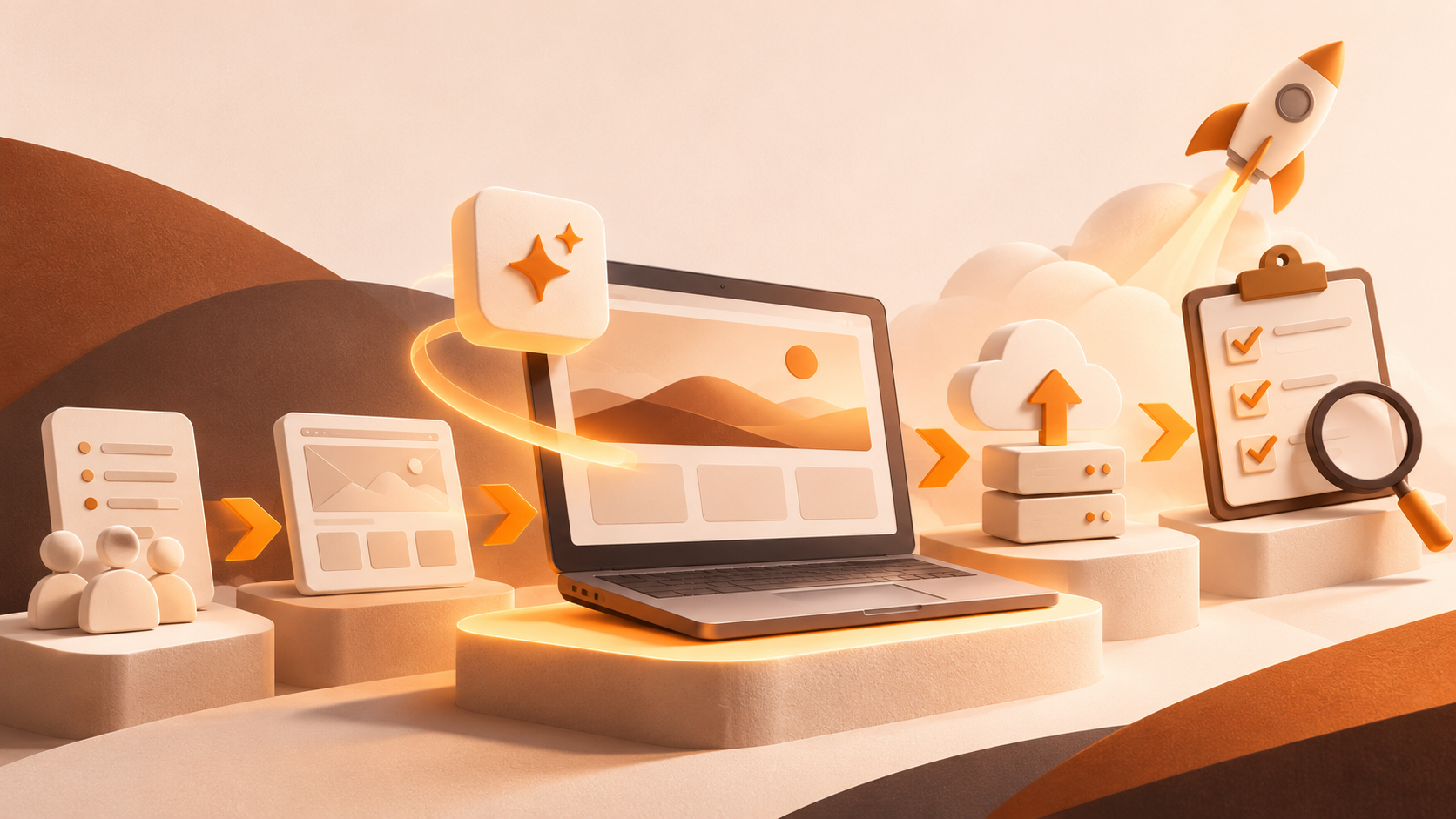
Publishing is often mistakenly understood as pressing a final button. In reality, before launch, the team should at least check page links, mobile layouts, form recipients, DNS configuration, loading performance, titles and descriptions, indexing settings, privacy policies, and copyrighted assets. Any omission can turn “launched” into “unusable.”
AI website building can move part of the publishing work earlier in the process. Pages can use clearer heading hierarchies during generation, the team can check action paths during preview, and the entity information and question-and-answer content required for SEO and GEO can be prepared in advance. The capabilities publicly listed on the we0 website include online preview, an editable design canvas, domain deployment, and SEO and GEO optimization entry points. These capabilities are suitable for connecting website building with publishing preparation, but they do not mean the platform completes every compliance or growth decision for a business. View the we0 website’s capability entry points
Build a showcase site and grow leads in minutes
Describe your idea once, and We0 AI can generate a showcase site, pages, and CMS, then help you attract customers and traffic after launch.
One complete project generation for free registration
Best for trying one complete generation flow and seeing a first project draft quickly.
Before launch, business, design, and technical stakeholders should each conduct a short acceptance review: business confirms the content and conversion goals, design confirms the brand and responsive presentation, and technology confirms links, forms, domains, and security configuration. Joint sign-off by all three parties is more reliable than relying solely on the generated result.
An Executable AI Website Building Collaboration Process
Teams can adopt a five-step method: “clarify boundaries first, generate quickly, and complete human acceptance testing at the end.”
Step One: Define the Page Task Clearly
Define in one sentence who the page serves, what problem it solves, and what you want visitors to do. For example: “For small and medium-sized businesses evaluating customer service software, present the core features and guide visitors to book a demo.” Do not begin with only “make it premium” or “make it feel high-tech.”
Step Two: Prepare Facts and Assets
Organize the brand name, logo, colors, product features, real evidence, contact details, image permissions, and prohibited expressions. Mark missing information as “to be completed” rather than allowing AI to fill it in on its own.
Step Three: Generate a Runnable First Draft
Generate the homepage and one core conversion path first, then expand to feature, case study, or resource pages. Prioritize validating the information hierarchy and action path. Do not pursue pixel-level perfection in the first round.
Step Four: Provide Layered Feedback by Role
Business stakeholders review goals and content, designers review visuals and experience, and developers review structure, data, and security. Address one primary category of issues in each round to avoid sending conflicting opinions to the tool all at once.
Step Five: Conduct an Item-by-Item Prelaunch Review
Create a checklist covering desktop and mobile, all links, form notifications, domains, basic SEO items, privacy text, image rights, access permissions, and rollback plans. Publish formally only after the checklist has been completed.
Decision Checklist: Is Your Project Suitable for AI Website Building?
Use the following questions to make a quick assessment:
- Are the page goals and target audience already basically clear?
- Is the project mainly for showcasing, lead generation, or content publishing rather than a highly customized core business system?
- Does the team need to compare multiple page directions within one or two days?
- Does the team frequently rework copy, components, or responsive details between design and development?
- Is someone able to take responsibility for brand facts, data permissions, and final quality?
If most of the first four questions are answered “yes,” AI website building is likely suitable for the middle stage of “requirements to first draft” and “design to implementation.” If the final question is answered “no,” the team should first establish ownership and an acceptance mechanism. Tools can reduce production costs, but they cannot take responsibility for the team’s decisions.
The Best Entry Point Is Different for Different Teams

Entrepreneurs generally need to validate their website information architecture quickly, allowing customers, partners, or team members to see a real page first. Marketing teams should focus more on CMS capabilities, content iteration, SEO/GEO foundations, and lead paths rather than generating a one-time campaign page. Design teams can treat AI as an exploration and prototyping tool while focusing their energy on the brand system and critical experiences. Development teams should prioritize maintainability, permissions, data interfaces, and deployment methods.
International business teams should confirm multilingual content, domain strategy, localized forms, and asset permissions in advance. Agencies should establish client information templates, approval checkpoints, and delivery boundaries. Different teams can all use AI, but they should not use the same acceptance standards.
Where Does we0 Fit in This Chain?
From a product positioning perspective, we0 is better understood as an AI workspace connecting “building, showcasing, and growth” rather than a one-time website generator. For teams that need to quickly create brand websites, landing pages, portfolios, or product pages, it can serve as a collaboration entry point connecting requirements organization, page generation, visual editing, and deployment preparation.
A more reliable implementation method is to use a clear business brief to generate the page framework first, then have the team add real content, confirm the brand expression and conversion path, and finally launch according to a publishing checklist. For projects requiring a CMS, SEO/GEO, multilingual support, or back-end workflows, the team should verify the actual configurations one by one after trying the first draft, rather than making a purchasing decision based only on the homepage appearance.
Industry discussion is also shifting from “Can AI generate a website?” to “Can AI cover the complete chain from website building to business operations?” For example, a China Economic Net report on the 2026 Cross-Border Independent Website Summit noted that discussions at the event had expanded to independent website building, customer acquisition, conversion, and long-term operations, while also presenting collaborative directions across website building, content, advertising, payments, and operations. For businesses, this points to a more practical evaluation standard: whether a tool can reduce process gaps, rather than simply whether its generated pages look impressive.
Frequently Asked Questions
Can AI Website Building Completely Replace Designers and Developers?
No. It is better suited to handling requirements organization, first page drafts, repetitive components, and rapid iteration. Brand strategy, complex interactions, system architecture, security, accessibility, and final acceptance still require professionals.
If the Traditional Design Is Already Complete, Is AI Website Building Still Necessary?
It can be, but its value shifts from exploring page directions to accelerating implementation and revisions. The team should confirm whether the tool can accurately reproduce the key structure and check whether the generated result is easy to maintain, rather than looking only at whether the first screen appears similar.
Is AI Website Building Suitable for E-Commerce or Websites with Login Functionality?
It depends on the complexity of the business. Simple product showcases, basic forms, and common pages can be used for prototypes or front-end development. Functions involving payments, memberships, inventory, permissions, or sensitive data require separate validation of workflows, security, and responsibility boundaries.
What Should Be Compared First When Choosing an AI Website Builder?
Prioritize four areas: continuity from requirements to pages, the revision and collaboration experience, publishing and content maintenance capabilities, and clear boundaries for complex functions. Generation speed is only the starting point. The ability to deliver reliably and support ongoing updates is more important.
Related Tools
- Requirements brief template: Clarify the audience, page goals, evidence, and call-to-action.
- Page acceptance checklist: Cover responsive behavior, links, forms, domains, basic SEO items, and privacy text.
- Content and asset library: Manage brand facts, product terminology, image permissions, and multilingual versions centrally.
- Lead path checklist: Review the entire path from the primary action on the first screen to form receipt and subsequent follow-up.
Related Links
- we0 website: AI website building and website publishing capabilities
- China Economic Net: 2026 Cross-Border Independent Website Summit Held in Shenzhen
- China Economic Net
Summary
AI website building is best suited to the “requirements and design intent to a runnable first page draft” stage in the traditional relay between multiple people, while also supporting publishing preparation. It can reduce handoff loss and rework, but it cannot replace brand judgment, complex development, security checks, or launch acceptance. Starting with a clear brief, collaborating around real pages, and publishing according to a checklist is a more reliable AI website building path.