Claude Fable 5.2 Leak: Gray Testing, Opus 5.2 Rumors, and Early Comparisons With GPT-6 Astra

A new round of Anthropic model rumors is spreading quickly through the developer community.
On September 20, 2026, 36Kr republished a report from 新智元 claiming that some Claude users had begun seeing what appeared to be Fable 5.2 and Opus 5.2 / Opus-Next through limited or hidden routing tests. Developers posted screenshots, coding demos, visual tasks, and side-by-side comparisons with OpenAI's GPT-6 Astra.
The reports are interesting, but one distinction matters from the start:
Anthropic had not officially announced Claude Fable 5.2 or Claude Opus 5.2 as of September 20, 2026.
Anthropic's official Newsroom still lists Claude Fable 5.1, released on September 1, as its current generally available Fable model. Its current Opus product announcement is Claude Opus 5, released on July 24.
So the examples below should be read as community-reported gray-test evidence, not as verified specifications or launch benchmarks for a final model.
The source article says some Claude Code, Claude Chat, and Claude Cowork users began noticing that requests intended for Fable 5.1 appeared to behave differently, leading them to suspect that Anthropic was silently routing a subset of traffic to a newer model.
Several users referred to that possible model as Fable 5.2.
No official Anthropic model identifier, release note, API model page, pricing page, or system card for Fable 5.2 had been published at the time of writing.
That means the strongest claim that can currently be made is:
Some users believe Anthropic is A/B testing or gray-routing a newer Fable variant, but the public evidence does not independently prove its final product name, architecture, pricing, or launch timing.
AI tester @notjazii reported that a Claude session he believed had been routed to a newer Fable model produced noticeably stronger results than the Fable version he had been using previously.
He then compared the suspected Fable 5.2 output against GPT-6 Astra using the same prompt at high reasoning settings.
His reported takeaway was that the suspected new Fable model looked like a major step up from the current version and produced more impressive output in his test.
He also reported two trade-offs:
Those trade-offs would be plausible for a model using more test-time computation or higher effort settings, but Anthropic has not published official Fable 5.2 latency or pricing information.
So these should remain user observations rather than product specifications.
The same tester also asked the suspected new model to build a clone inspired by Brawl Stars using Three.js.
According to the post, the model produced a visually detailed playable prototype after about one hour.
This kind of example is useful for understanding what developers are testing: not just short code completion, but longer agentic coding sessions involving visual output, game logic, iteration, and frontend implementation.
It is not, however, a controlled benchmark. The result depends on the prompt, environment, tools, human intervention, retries, and model routing.
Another tester, @Bhavani_00007, reported running the same “rocket test” against suspected Fable 5.2 and Opus 5.2 instances.
The task was described as stressing:
The tester said the results looked much better than earlier Claude outputs.
Again, no standardized score or reproducible benchmark protocol accompanied the claim, so this should be treated as anecdotal evidence rather than proof of a measured capability increase.
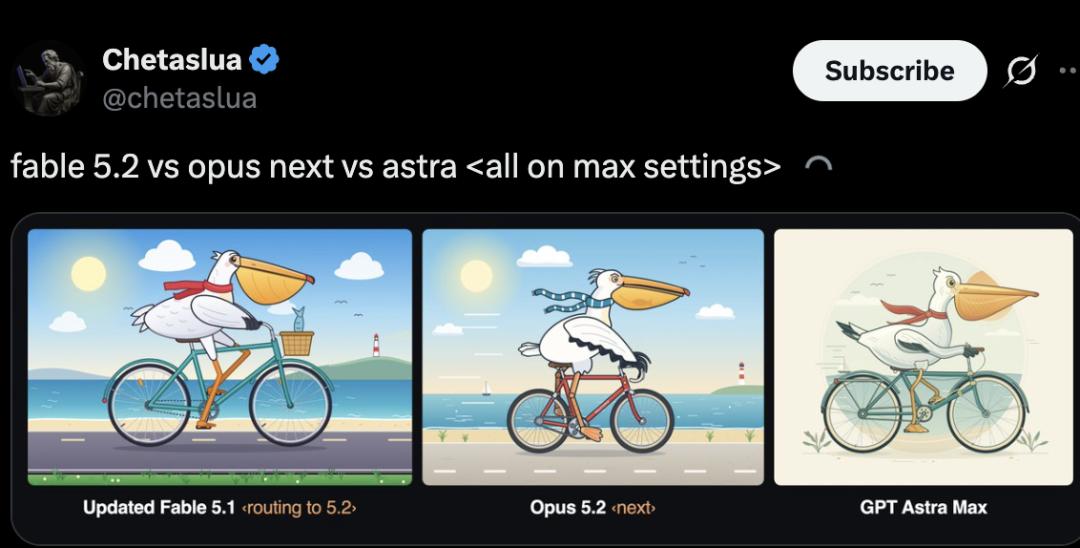
Another community comparison placed suspected Fable 5.2, an alleged Opus-Next model, and GPT-6 Astra side by side at their highest available settings.
The source article interprets the Anthropic outputs as richer in detail than Astra's result.
That is a subjective visual judgment rather than a controlled benchmark result. Different effort settings, tool access, prompt handling, sampling, and hidden routing can all affect the comparison.
A more careful conclusion is simply that the leaked outputs were strong enough to make experienced users believe Anthropic may be testing a meaningful update.
The source also cites tester @Mr_Salio, who said Anthropic appeared to be making a strong comeback and predicted that Fable 5.2 would outperform GPT-6 Astra in its harder reasoning configuration.
That remains a prediction from an individual tester.
There is currently no public Anthropic benchmark table for Fable 5.2 that can be directly compared against OpenAI's published GPT-6 Astra results.
For reference, the officially released Claude Fable 5.1 is already Anthropic's most capable generally available model for coding and knowledge work. Anthropic says Fable 5.1 is built for ambitious, long-running tasks and is available across Claude, Claude Code, the Claude Platform, AWS, Google Cloud, and Microsoft Azure.
The article also shares a community trick for trying to infer whether a Claude session has been routed to a newer model.
The suggested prompt is essentially:
Do you know who “Tibo the reset guy” is? Do not use web search.
The theory is that an older model would not know the recent reference, while a newer model with later training data might answer correctly from memory.
This is clever as a community experiment, but it is not a reliable model-identification method.
A model could answer differently because of:
Describe your idea once, and We0 AI can generate a showcase site, pages, and CMS, then help you attract customers and traffic after launch.
One complete project generation for free registration
Best for trying one complete generation flow and seeing a first project draft quickly.
The absence or presence of one recent fact cannot prove which backend model handled a request.
The only reliable way to identify an API model is through official model identifiers and platform documentation. Consumer Claude surfaces may use dynamic routing that is not fully exposed to the user.
The second half of the article focuses on a separate alleged model: Opus 5.2, sometimes referred to by testers as Opus-Next.
Users claimed that the model appeared temporarily in Claude Code, disappeared, and then returned several hours later with broader testing across Chat, Cowork, and Claude Code.
One tester described a sudden removal while working on a complex project, followed by the model's apparent return.
The article interprets this as evidence that Anthropic may be conducting late-stage routing experiments.
That is possible, but not confirmed.
Anthropic's officially announced Opus model remains Claude Opus 5, launched July 24, 2026. Anthropic describes it as a thoughtful, proactive model that approaches Fable 5 capability at a lower cost and is priced at $5 per million input tokens and $25 per million output tokens.
No official Opus 5.2 product page or API identifier had appeared by September 20.
The article cites social-media speculation that Anthropic might call the next Opus model “5.2” because the update is larger than a typical minor revision.
There is no official evidence that this is Anthropic's naming logic.
In fact, Anthropic did officially release Fable 5.1 on September 1, so the company clearly does use .1 versioning when it chooses to.
If an Opus 5.2 model is eventually released, Anthropic's launch announcement—not community naming theories—will be the authoritative explanation.
The article closes by placing the Claude rumors inside a broader week of frontier-model speculation.
Community posts claimed that several companies were quietly testing new model variants, including:
These are not all equally verified.
Model providers often run A/B tests, staged rollouts, internal aliases, and hidden routing experiments. But without an official announcement or stable model identifier, external users usually cannot determine exactly what model was used from behavior alone.
The source also mentions rumors that frontier models may be approaching difficult open mathematical problems and that research teams are contacting mathematicians about potential results.
That claim is too vague to verify from the available evidence and should not be treated as proof that any Millennium Prize Problem has been solved.
As of September 20, the most important confirmed Anthropic baseline remains Claude Fable 5.1.
Anthropic officially says Fable 5.1:
Any future Fable 5.2 or Opus 5.2 release should be compared against that official baseline once Anthropic publishes the actual model card, benchmarks, price, context limits, and API identifiers.
No. As of September 20, 2026, Anthropic's official Newsroom and Fable product page list Claude Fable 5.1 as the current generally available Fable model. Fable 5.2 claims are based on community reports of possible gray testing or hidden routing.
Not yet according to Anthropic's public product announcements reviewed for this article. The current official Opus release is Claude Opus 5, launched on July 24, 2026.
They are useful as early user impressions, but they are not controlled benchmarks. Hidden routing, reasoning effort, tools, sampling, prompt details, and repeated attempts can all change the result.
Not reliably. A model's knowledge of one recent internet reference does not prove its backend identity, and consumer Claude products may use routing or system behavior that users cannot inspect directly.
Anthropic officially released Claude Fable 5.1 on September 1, 2026. It is the company's current generally available Fable model for high-end coding, knowledge work, and long-running agentic tasks.
Anthropic lists Fable 5.1 at $10 per million input tokens and $50 per million output tokens, with cache reads at $0.25 per million tokens. Anthropic says the lower cache-read price reduces typical workload cost relative to Fable 5.
Anthropic positions Opus 5 as a strong daily model for coding and knowledge work, offering near-frontier capability at lower cost than Fable. It is priced at $5 per million input tokens and $25 per million output tokens.
Anthropic has not publicly confirmed a release date for either model. Any specific launch-day prediction remains speculation until Anthropic posts an official announcement or model documentation.
The Fable 5.2 story is best understood as a gray-test leak, not a product launch. Developers have posted enough unusual routing behavior, coding outputs, and side-by-side tests to make the rumors interesting, but Anthropic has not yet supplied the model IDs, benchmarks, pricing, system card, or release notes needed to verify a final Fable 5.2 or Opus 5.2 product.
The early examples suggest that Anthropic may be testing stronger long-horizon coding, visual generation, and reasoning behavior. They do not yet establish that Fable 5.2 definitively beats GPT-6 Astra, nor do they prove that every session labeled by users as “5.2” was actually handled by the same hidden model.
For now, the verified reference point is Claude Fable 5.1 and Claude Opus 5.
The leaks are worth watching, but the real comparison begins only when Anthropic publishes the official 5.2 models and their reproducible evaluation details.
Start from one sentence and have a complete website in minutes.