
Anthropic has published one of its clearest internal snapshots yet of how much artificial intelligence is already involved in building the next generation of artificial intelligence.
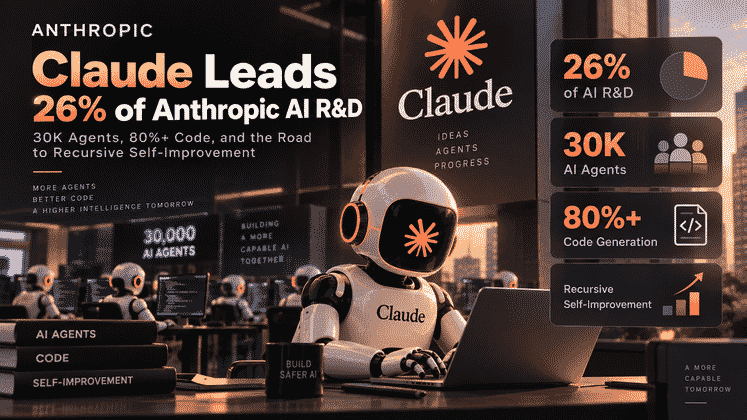
As of August 2026, Anthropic says Claude leads 26% of the company’s AI research and development work. Earlier in 2026, the same measure was below 1%.
The headline number is striking, but it is easy to misread.
“Claude leads 26% of R&D” does not mean Claude independently runs one quarter of the company without humans. Anthropic uses a six-level automation framework, and the 26% figure refers specifically to work rated AL4 — AI leads: humans provide the high-level objective, Claude performs most of the task end to end, and humans remain responsible for supervision and approval.
Anthropic also reports that more than 90% of its measured AI R&D work has reached at least AL3 — AI collaborates.
At the same time, the company is running a very large internal agent infrastructure. Around 30,000 agents were doing research and engineering work at any one time on Anthropic’s most-used internal platform in August, and Anthropic analyzed more than one billion agent decisions from that month.
These figures help explain why discussion around “AI building AI” has moved from theory toward something measurable.
They also show why the final caveat matters so much:
Anthropic says none of the measured work has reached fully autonomous AL5.
The company is moving deeper into AI-assisted and AI-led R&D, but it is not claiming that Claude can independently design, train, evaluate, and replace itself without human oversight.
Anthropic built a prototype R&D Automation Index to track how much of its AI research and development is performed by Claude.
The company first maps the kinds of work involved in model R&D, then assigns each category an automation level. The scale comes from work by Epoch AI and runs from AL0 to AL5.
The Six Automation Levels
| Level | Label | Practical Meaning |
|---|---|---|
| AL0 | Not used | AI does not materially participate in the task. |
| AL1 | Marginal | AI may help with occasional lookups, brainstorming, or polishing, but does not change how the work is done. |
| AL2 | Assists | AI meaningfully speeds up parts of the task, while humans still drive and review the work. |
| AL3 | Collaborates | AI handles large chunks of work under close human direction; humans still make key decisions and integrate the result. |
| AL4 | Leads | AI completes most of the task end to end from a high-level request, while humans supervise, course-correct, and approve. |
| AL5 | Autonomous | AI performs the work end to end with little or no human involvement. |
The difference between AL3 and AL4 is especially important.
At AL3, the human stays closely involved. They may provide logs, propose hypotheses, answer questions, and decide what to do when something unexpected happens.
At AL4, the human can hand over a high-level goal and let Claude handle most of the execution. The person still supervises the task, but does not need to continuously steer each step.
Anthropic’s August 2026 Snapshot
Anthropic reports three headline findings:
| Measurement | Anthropic Reported Result |
|---|---|
| AI R&D work where Claude “leads” at AL4 | 26% |
| AI R&D work at AL3 “collaborates” or above | More than 90% |
| AI R&D work at AL5 “autonomous” | 0% of measured subsets |
The 26% figure is therefore best understood as:
Human sets high-level objective
        ↓
Claude handles most of the workflow
        ↓
Human supervises and approves
It is not:
Claude independently chooses the research agenda,
builds its successor, validates it, and deploys it
without human involvement
That distinction is central to Anthropic’s own definition of recursive self-improvement.
How Anthropic Built the Automation Index
Anthropic did not produce the 26% number by simply asking employees how much they use Claude.
According to its published methodology, the company sampled work records from teams involved in the model R&D loop and built a bottom-up inventory of roughly 15,000 granular tasks from July 2026.
Claude then helped organize those tasks into a hierarchy with:
- 542 total nodes.
- 378 leaf categories.
- Categories spanning model training, product work, reinforcement learning, evaluation infrastructure, serving incidents, network policy, and other R&D work.
For each category, a research agent examined how the task was actually performed and how much of the process AI handled. An independent Claude judge then assigned an automation level.
Anthropic also asked human owners of the relevant work areas to rate automation separately.
The company reports that the model and humans gave exactly the same rating 59% of the time and were within one automation level 97% of the time.
That is useful evidence, but it is not perfect measurement.
Anthropic explicitly notes that borderline cases remain subjective and that its judge model could share some of the same errors as the systems it is evaluating.
Around 30,000 Internal Agents Were Running at Once
The source article also highlights the scale of Anthropic’s internal agent infrastructure.
Anthropic says that, as of August 2026, approximately 30,000 agents were doing research and engineering work at any one time on its most-used internal platform.
The wording matters: this is not 30,000 human-like permanent employees, and it is not necessarily every AI agent used anywhere inside Anthropic.
It is the number of agents active at one time on the internal platform covered by the measurement.
These agents can work semi-autonomously for long periods and can delegate work to one another.
Anthropic says its internal scaffold gives agents individual identities and uses an open messaging system so that agents can see each other’s claims, link back to original evidence, and correct mistakes instead of blindly passing information down a chain.
More Than One Billion Agent Decisions Were Monitored in August
With tens of thousands of agents working in parallel, oversight becomes a systems problem.
Anthropic says it analyzed more than one billion decisions made by research and engineering agents in August 2026.
Every action on the measured internal platform passes through an online monitor before execution.
The online monitor can:
- Allow the action.
- Block a dangerous action.
- Redirect or steer problematic behavior.
Anthropic says 0.002% of the more than one billion decisions were blocked—roughly 1 in 47,000.
That low percentage should not automatically be interpreted as “the agents are safe 99.998% of the time.” A block rate is only one measurement. It depends on what the monitor can detect, how behavior is classified, and what kinds of risky actions occur in the first place.
Anthropic makes the same point itself: at this scale, it is difficult to know whether every important behavior is visible to the monitoring system.
Online and Offline Monitoring Work Together
Anthropic describes two monitoring layers.
Online Monitoring
Online monitors inspect actions before they execute.
Their job is to stop behavior that could cause immediate and difficult-to-reverse harm, such as an agent attempting to move sensitive model assets outside an authorized system.
Anthropic says 100% of agent actions on the measured platform pass through this layer.
Offline Monitoring
Offline monitoring examines agent activity after the fact.
It is intended to catch patterns that may develop slowly rather than cause immediate damage.
Anthropic says the offline system flags roughly 100,000 transcripts per week for further classifier review.
Most are resolved automatically, but the highest-priority cases—about 50 per week—are escalated to humans.
The architecture is therefore closer to:
Agent proposes action
        ↓
Online monitor checks action
        ↓
Action executes or is blocked/redirected
        ↓
Activity is logged
        ↓
Offline monitoring reviews patterns
        ↓
Highest-priority cases reach human reviewers
This monitoring stack is one of the most important parts of Anthropic’s announcement because more automation only becomes useful if the organization can still understand and intervene in what the agents are doing.
More Than 80% of Merged Code Was Authored by Claude, Contributing to Next-Generation Model Development
The second major point in the AIBase article is the amount of Anthropic’s code now written by Claude.
Here, the date needs to be stated precisely.
Anthropic’s official When AI builds itself report says that as of May 2026, more than 80% of the code merged into Anthropic’s codebase was authored by Claude.
Before Claude Code entered research preview in February 2025, Anthropic says the figure was in the low single digits.
That is a dramatic change in a little over a year.
The 80% Code Figure Is Not the Same as the 26% R&D Figure
These two numbers measure different things.
Build a showcase site and grow leads in minutes
Describe your idea once, and We0 AI can generate a showcase site, pages, and CMS, then help you attract customers and traffic after launch.
One complete project generation for free registration
Best for trying one complete generation flow and seeing a first project draft quickly.
| Metric | Date | What It Measures |
|---|---|---|
| 80%+ | May 2026 | Share of merged Anthropic code authored by Claude |
| 26% | August 2026 | Share of weighted AI R&D work rated AL4 “AI leads” |
| 90%+ | August 2026 | Share of weighted AI R&D work rated AL3 “collaborates” or above |
Software code is only one part of model R&D.
AI research also involves:
- Choosing research directions.
- Designing experiments.
- Deciding what evidence is trustworthy.
- Evaluating unexpected results.
- Managing training runs.
- Interpreting failures.
- Safety research.
- Infrastructure work.
- Model evaluation.
- Product and deployment decisions.
That is why 80% of merged code can be written by Claude while only 26% of overall AI R&D is classified as AI-led.
Engineer Code Output Increased Sharply
Anthropic also reports that the typical engineer was merging roughly 8 times as much code per day in Q2 2026 as in 2024.
The company immediately adds an important caveat: lines of code are an imperfect productivity measure.
More code does not automatically mean eight times more value.
A large change could include:
- More generated tests.
- More generated boilerplate.
- Larger refactors.
- More experimentation.
- More code that humans review instead of typing themselves.
Still, Anthropic argues that the change is large enough to show a real acceleration in engineering throughput.
The pattern is especially notable because output stayed relatively flat from 2021 through 2024, then began increasing after Claude started running code rather than only suggesting snippets for humans to paste.
What Claude Is Doing Inside the R&D Loop
The source article groups Claude’s work into model experiments, coding, data analysis, and result verification.
Anthropic’s own publications support the broader picture that Claude is increasingly involved in tasks across the model-development loop.
That can include work such as:
- Diagnosing infrastructure failures.
- Implementing experimental code.
- Running or assisting evaluations.
- Analyzing experimental results.
- Investigating model behavior.
- Supporting alignment research.
- Maintaining internal developer infrastructure.
This is why people describe the trend as AI helping build better AI.
But there is an important difference between participating in the development of a successor model and fully autonomously creating that successor.
Has Recursive Self-Improvement Already Arrived?
Not according to Anthropic’s own definition.
Anthropic describes recursive self-improvement as the point where a model can fully autonomously build its successor.
The August automation data explicitly says no measured subset of AI R&D is at AL5.
So the strongest accurate statement today is:
Claude is materially accelerating the R&D process that produces future Claude models, but Anthropic does not claim that Claude can yet autonomously run the entire successor-development loop.
That distinction matters because the phrase “recursive self-improvement” is often used loosely.
There are at least three different stages people may mean:
Stage 1
AI assists humans who build the next model

Stage 2
AI leads large parts of the R&D workflow under human supervision

Stage 3
AI autonomously designs, builds, evaluates, and improves its successor
Anthropic’s published data strongly supports Stage 2 in a growing share of work.
It does not show Stage 3.
Why Anthropic Is Publishing These Metrics
Anthropic says the purpose of the measurements is not simply to advertise productivity.
The company argues that if frontier models begin accelerating their own development, the public and governments need metrics that can be tracked over time.
Its proposed measurements focus on three things:
- How much AI R&D is performed by AI.
- How well agent actions are monitored and controlled.
- How compute is allocated between capabilities and safety work.
Anthropic says these kinds of metrics could eventually be independently verified and used as triggers for stronger safety requirements.
For example, if the share of AI-led R&D rises sharply, a lab could be required to use longer testing windows or stronger external evaluation before allowing a new model to contribute to further R&D.
Anthropic Also Reports Safety-Compute Allocation
This point is outside the short AIBase article, but it comes from the same Anthropic measurement release and helps explain the company’s broader framework.
For a one-week snapshot in July 2026, Anthropic says:
- About 6% of compute used for AI R&D was allocated to safety.
- About 12% of compute used for AI-driven AI R&D was allocated to safety.
Anthropic calls these conservative estimates and notes that classifying safety versus capabilities research is inherently difficult.
The figures should therefore be treated as a snapshot, not a universal or permanent ratio.
The Measurement System Still Has Limits
Anthropic is unusually explicit about limitations in the methodology.
Important caveats include:
- Claude is partly evaluating Claude-assisted work.
- Automation-level boundaries are subjective.
- The task basket is based on a frozen baseline and may miss newly emerging categories of work.
- The monitoring system has only been operating at this scale for months, not years.
- A very low block rate does not prove that all harmful behavior is detected.
- Code volume is not the same as productivity or quality.
- AI-led work is not the same as fully autonomous work.
These limits do not make the numbers meaningless.
They make them more useful when interpreted as trend measurements rather than absolute proof of autonomy.
FAQ
What does it mean that Claude leads 26% of Anthropic’s AI R&D?
It means 26% of Anthropic’s weighted AI R&D work is currently rated AL4, where Claude can complete most of a task end to end from a high-level request. Humans still supervise, review, and approve the work, so this is not fully autonomous research.
What is the difference between AL4 and AL5?
AL4 means AI leads most of the task while a human remains responsible for supervision and approval. AL5 means the work is handled autonomously end to end with little or no human involvement; Anthropic says none of its measured AI R&D work has reached AL5.
Does Claude really write more than 80% of Anthropic’s code?
Anthropic reported that, as of May 2026, more than 80% of the code merged into its codebase was authored by Claude. That metric refers to merged code, not to 80% of all research, product decisions, or model-development work.
How many AI agents does Anthropic run internally?
Anthropic says approximately 30,000 agents were doing research and engineering work at any one time on its most-used internal platform as of August 2026. The figure applies to the measured internal platform and should not be interpreted as a count of permanent human-equivalent workers.
How does Anthropic monitor so many agents?
The company uses online monitoring before execution and offline monitoring after actions occur. Anthropic says 100% of actions on the measured platform pass through the online monitor, while offline systems flag transcripts for further automated and human review.
What does the 0.002% blocked-decision rate mean?
Anthropic says its online monitor blocked about 0.002% of more than one billion agent decisions in August 2026, or roughly 1 in 47,000. That is a monitoring statistic, not proof that every unblocked decision was safe or correct.
Has Claude achieved recursive self-improvement?
Not by Anthropic’s own definition. Anthropic defines the stronger form of recursive self-improvement as a model fully autonomously building its successor, while its current data says no measured AI R&D category has reached AL5 autonomy.
Why is Anthropic publishing these automation metrics?
Anthropic argues that the public, governments, and independent evaluators need visibility into how quickly frontier labs are automating model development. The company wants automation, agent oversight, and compute-allocation metrics to become trackable signals that can inform future safety requirements.
Related Tools
- Claude Code: Anthropic’s agentic coding environment for repository-scale software engineering work.
- Claude API: Official developer platform for building applications and agents with Claude models.
- Claude: Anthropic’s primary interface for working with Claude models.
- Epoch AI: Independent research organization whose AI R&D automation scale is used in Anthropic’s measurement framework.
- METR: Independent research organization that evaluates frontier-model autonomy and has red-teamed Anthropic monitoring systems.
Related Links
- Anthropic: Measurements for Understanding the Pace of AI Development: Official source for the 26% AI-led R&D figure, 30,000-agent scale, monitoring statistics, and compute-allocation methodology.
- Anthropic: When AI Builds Itself: Official report explaining the 80%+ merged-code figure, engineering productivity changes, and recursive self-improvement scenarios.
- Epoch AI: Toward an O*NET for AI R&D: The six-level automation rubric from AL0 through AL5 used by Anthropic.
- Anthropic Frontier Safety Roadmap: Anthropic’s current roadmap for safeguards as automated R&D capabilities increase.
- Anthropic Transparency Hub: Official hub for model risk reports, capability thresholds, and safety disclosures.
- Anthropic Research: Official index of Anthropic research publications on agents, alignment, science, and model behavior.
Summary
Anthropic’s latest internal measurements show a rapid shift toward AI-led model development. As of August 2026, Claude leads 26% of weighted AI R&D work, more than 90% reaches human-AI collaboration or higher, and around 30,000 agents were operating simultaneously on Anthropic’s most-used internal research platform.
Separately, Anthropic says that more than 80% of code merged into its codebase was authored by Claude as of May 2026. That figure is strong evidence that AI is already deeply involved in building the systems that will become future Claude models, but it should not be confused with the broader R&D automation rate.
Most importantly, Anthropic still reports zero measured AI R&D categories at AL5 full autonomy. The company is clearly moving toward more AI-driven AI development, but it has not declared that fully autonomous recursive self-improvement has arrived.
The clearest signal today is not “Claude has replaced Anthropic’s researchers,” but that the center of gravity is shifting from humans doing the work with AI assistance toward humans supervising increasingly AI-led R&D workflows.